Everything Was Green
By Marcio Parente
The quietest quarter-end close an engineer had ever worked was the one that should have been the loudest.
That is the scene Roberto Barbosa and I open the eighth chapter of Everything Is Green with. The firm is Asset Manager X, and I need to say plainly what it is: a composite, built for the book from several firms we have worked with. It matches no single institution, and every number attributed to it is the firm’s own illustrative number, not a market benchmark. We built it that way so we could tell the truth about a failure without telling anyone’s secrets.
The failure is worth telling, because nobody in it did anything wrong.
The quiet floor
By the fourth working day of a close, the reconciliations floor is supposed to be busy. Custodian statements arrive late from three time zones, exchange rates disagree in the fourth decimal place, and whatever the overnight triage cannot explain lands in a person’s queue. At the previous close, sixty-odd cash breaks had reached a human. This morning there were three.
The wall screen showed the quarter’s break count falling in a line so clean it might have been drawn with a ruler. A month earlier, the floor had applauded the lowest figure on record.
Elif, who owned the reconciliations agent, did the thing that matters in this story: she distrusted a good number. A break count falls because there is less to disagree about, or because fewer disagreements are being looked at, and a quarter-end has more to disagree about, not less. So she opened the list the squad skips on a good day, the breaks that had cleared automatically overnight as within tolerance, and sorted it by amount. At the top was a dollar cash account with a difference of more than thirty-eight thousand euros. It had cleared at 02:14 with no one looking, and the system said no one had needed to.
Four lines
The cause took her under a minute to find. Nine weeks earlier, the default tolerance for cash breaks had changed to a band about a hundred times wider.
The change record was tidy, because the platform wrote it. A new custodian’s feed was being onboarded. The custodian’s pack quoted its tolerance in basis points; the firm’s configuration held the same quantity in percent; the specification copied the figure across without converting it. Converted, the custodian’s figure was the firm’s existing default, and no change had been needed at all.
The agent did what the specification said. Its plan read update the cash tolerance to the specified value and named no scope, so it changed the default, which applied to most of the firm’s accounts. Four lines. Fourteen tests, generated with the change from the same specification, so they could only agree with it. Ten clean months of history on a quiet file. The routing gate scored it low on every input it read and approved it. In the owner field, where an engineer’s name would once have gone, it wrote auto-approved (routing gate).
Every control said yes
This is the part I want readers to sit with. No control was bypassed. The agent acted under its own identity, within its permissions, on a request raised through the proper workflow. The tests passed. The gate routed the change by a threshold a named executive had signed. The platform kept a complete record. Every step said yes, and each yes was correct on its own terms.
The failure lived in three things none of those steps could see.
Plausibility. The gate’s score was a reviewer’s instinct written as arithmetic: small changes are safer, passing tests are good, a clean history predicts a clean future. Those are sound instincts, and they are also exactly what a well-formed wrong change looks like. The gate was disarmed the way a tired reviewer is disarmed, only faster.
Where the tests came from. A score that counts passing tests without asking who wrote them is counting the agent’s agreement with itself. The second line had put that sentence in writing before the threshold moved.
What the change touched. The score measured consequence by counting callers, and a configuration file has one. But that line was not ordinary configuration. It decided which disagreements with the custodians anyone would ever see. The squad had tried to class the file as part of a control; an older policy rule said all matching-engine configuration was an operational parameter, and the squad’s row was parked for the next annual revision. The gate read the policy, not the squad’s spreadsheet.
The decision underneath
The line itself had been moved in late July, so that about half of all change passed without a reviewer, up from just over a quarter. The person who moved it had the authority to do so. She did it over a written objection from the second line, to relieve a review queue that had already cost the firm senior reviewers. A carve-out that would have kept critical systems out of automated approval had been built and tested, and was still queued for a later release.
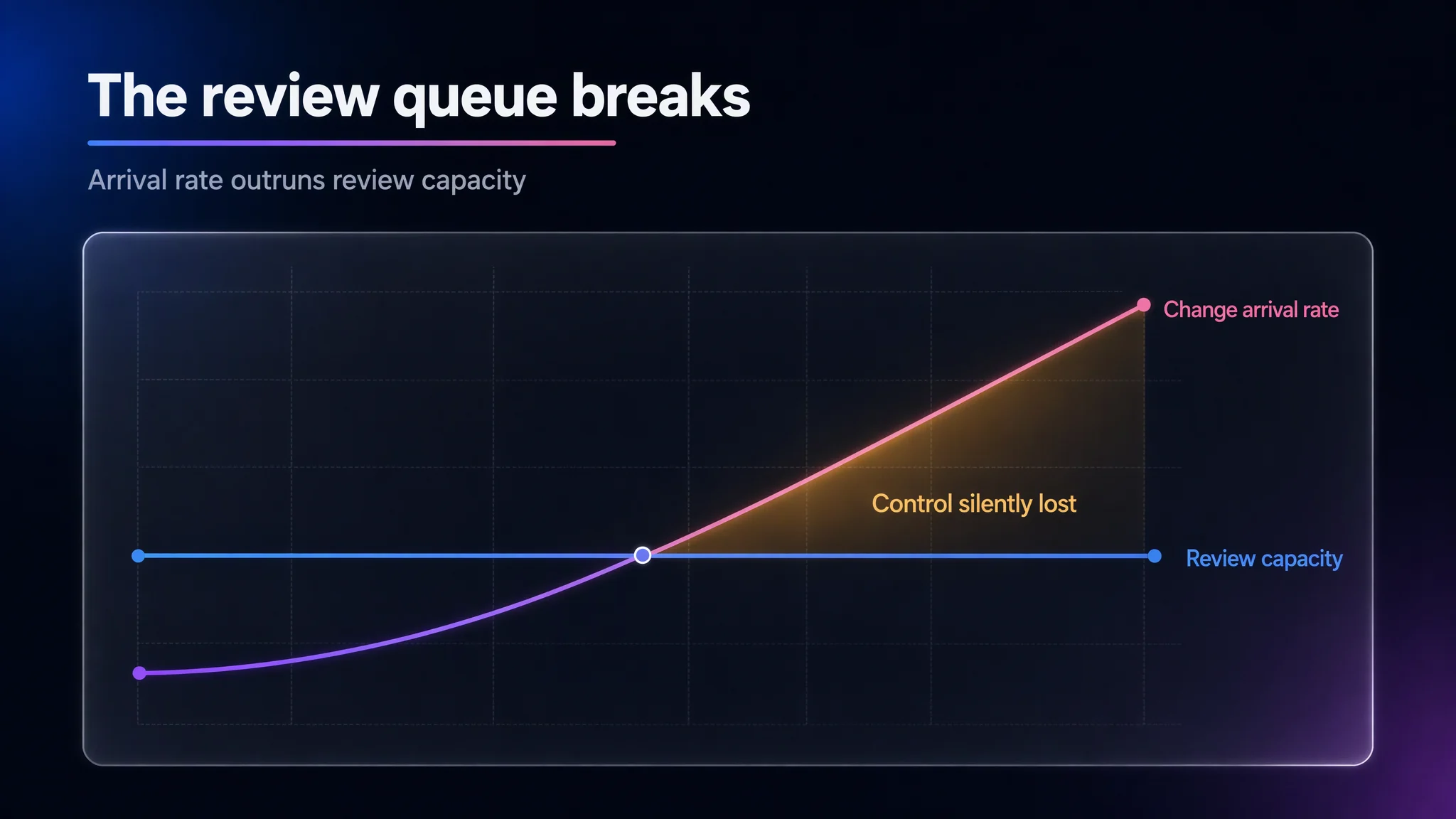
The control gap between the arrival of plausible change and review capacity. Source: The AI Delivery Factory, Chapter 1, Figure 1.1.
None of that is villainy. It is an ordinary sequence of reasonable decisions, each taken by a competent person under pressure, and that is why it is dangerous. The control change came before the control that should have bounded it.
What followed in the book is just as instructive, and I will only sketch it here. The instinct was a blanket freeze; we argue against it, because a freeze moves the whole volume back onto the people it overwhelmed in the first place. A two-week hold closed the only fast door, and an engineer had an agent write three urgent fixes in a personal workspace and copied them in under her own name. The fixes were correct. The finding was still a finding. And the owner field turned up again in a place nobody expected: a mailbox automation had been answering the depositary’s notices in the small hours, with a template that ended in Elif’s name.
What we would check this month
The book ends the chapter with checks that need no project, and they are the reason the chapter exists:
- Read the owner field on ten changes your gate approved last month without a person. If it names a mechanism, a service account or a mailbox, your accountability rule assumes something your workflow no longer does.
- Ask, of the same ten, who wrote the tests.
- List the single values that decide what people will see — tolerances, thresholds, limits, materiality levels, alerting rules — and check how your change policy classes them.
- Find out who last moved your threshold, on what evidence, and where that is recorded.
- Name, for each domain, the number that would move if the gate were letting the wrong things through, and treat a sharp, unexplained improvement as an alarm rather than a result.
Where this goes in the reference
The story belongs on the blog. The mechanisms belong in the reference, where they can be maintained and tested.
Change governance sets out the control-value list (every listed value goes to a reviewer, whatever its score, and the second line signs the list as complete), the blind spots a routing gate must read before anyone raises its line, why a shadow run cannot tell you what reviewers missed, and why moving the line is itself a change to a key control: the CIO runs the line, the CRO signs the band it moves within, and neither changes the other’s half alone.
Accountability takes the owner field seriously: who owns an agent’s change, what the books leave open when a workflow dispatches and a gate merges, and the monthly sample that tells you whether your owner fields name anyone at all.
Tomorrow morning your wall will probably be green. Some of those greens you can read. The rest mean only that no one has looked.