Evidence a Supervisor Can Query
By Marcio Parente
Sooner or later, a letter like this arrives:
Please describe the changes to the firm’s reconciliation controls that were approved without human review since 1 June. For each change, please state the approver, the test evidence relied on at approval, and the route by which the change was deployed to production.
That paragraph opens the ninth chapter of Everything Is Green, the book Roberto Barbosa and I are finishing. The letter goes to Asset Manager X, the book’s composite firm, built from several real ones and matching none. It is part of a thematic review: the supervisor is writing to every firm whose spring questionnaire said it would automate some approvals. It would have come whether or not anything had gone wrong. In this firm’s case, something had.
I want to use the chapter to make one argument. The hard part of answering a supervisor is rarely the question. It is the translation.
Three days of translation
A year before the letter, the platform lead works out what the answer would have cost. Approvals lived in the service-management tool. Test results lived in the pipeline system, kept for ninety days, so the earliest weeks of the window no longer existed there at all. Deployments lived in the cloud provider’s activity logs. What an agent did lived in the model platform’s logs, if anyone had switched them on. Who owned which agent lived in a register updated by hand. Configuration history lived in the repositories.
Three days, he estimates, for people who knew where everything was, most of it spent matching one system’s identifiers to another’s and arguing over which timestamp was true. And at the end, a reconstruction made after the question was asked, carrying the marks of the question.
That last sentence is the important one. Translation is a cost the supervisor never sees and the firm never books, but it is worse than a cost. Every hand that copies a record from one system into another could choose what to copy. Evidence assembled in response to a question is weaker evidence than evidence that existed before it.
What had changed
What had changed by the time the letter came was not a product purchase. Through the spring and summer, the platform had been writing everything it did into one evidence record: every agent action, every pipeline run, every approval, human or automated, every deployment and rollback. Each entry answered the same short list of questions in the same order — who initiated it, which agent executed it, under what envelope, what action, on what data, with which model, approved by whom, when, with what outcome — and each was written by the act it described, at the moment it happened, into storage that could not be altered afterwards.
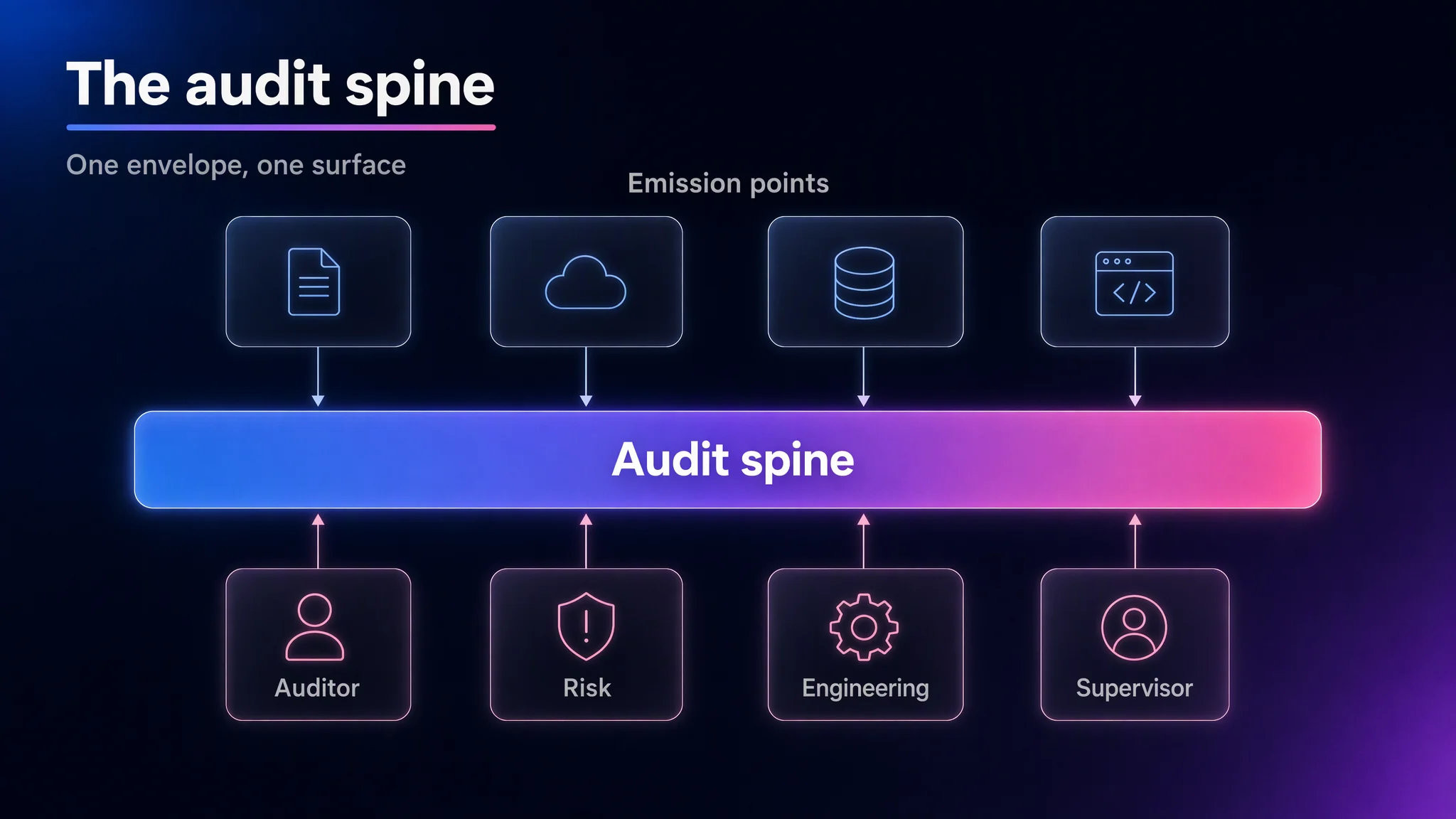
The audit spine: one envelope for every emission point, one surface for every reader. Source: The AI Delivery Factory, Chapter 9, Figure 9.2.
One design decision, which looked like tidiness at the time, turned out to carry the whole answer: an automated approval had to leave the same entry a human one did, with the score, its inputs and the line in force that day.
One query, typed twice
The scene I like best in the chapter is about who types.
The engineer who built the routing gate wanted to run the query. The second-line head said no: if the answer is going to a supervisor, the person whose control approved the changes does not get to be the only one who counted. So the platform lead wrote one query, and an analyst wrote her own from the question alone, at a different desk, without seeing his. They compared counts before anything else happened. The two counts matched, and each query had run in under a minute.
Then the work became human again, and that is the point. They filtered in the open, keeping every step so the supervisor could repeat it: who wrote the tests, which changes touched configuration, which of those changed a value that decided what a person would see. They read the residue by hand, with each record open beside it, which took minutes per change rather than a day, because the change, its tests, its approver and its route were already in front of them. And where one group of records had a blank field, a note entered months earlier declared the gap, with the date it opened and the date it closed.
A gap declared in advance is a departure somebody chose. A gap found afterwards is a finding.
The reading also found something no filter had been built to find, which is a reminder that the record makes reading cheap; it does not make reading unnecessary. Write down what you counted, not what you believe.
Why it pays twice
I call the evidence record the one investment that pays twice. It pays the first time as an operational asset: replay, incident reconstruction, a gate whose decisions can be audited. It pays the second time on the morning the letter comes, when the firm can answer from records instead of rebuilding them.
The regulatory hook is not exotic. Under DORA, the detailed change-management requirements expect changes to be recorded, tested, assessed and approved in a controlled manner, with the approving function independent of those requesting and implementing the change. Whether an approval that leaves no trace of what the approver checked satisfies that is a matter of audit and supervisory reading, and I would not want to be the firm that tests the question. The reference keeps the article-level detail, with dates and its authority labelled, in one place, so nobody has to restate it from memory.
Try the morning drill
You do not need a programme to find out where you stand. Write down the question a supervisor will one day send — every change to your most important control since a date four months back, who or what approved each, and on what basis. Hand it, without warning, to your platform lead and your head of technology risk, and time them.
If most of the time goes on finding things and matching identifiers, the gap is translation, and no amount of diligence closes it. Then put one machine-approved and one human-approved change side by side. If the automated entry is thinner, automation has bought speed by spending evidence.
Where this goes in the reference
Audit evidence is the working page: the nine record groups and the nine capture questions (two numberings the books use, which must not be mixed), the three capture points and the single correlation ID that joins them, immutable tiered storage, retention and legal hold, the procedure for answering a supervisor query with two independent counts, the quarterly replay rehearsal and the morning drill.
Regulatory map routes the obligations: change management, logging and the single-query test, incident clocks, the critical-or-important-function hinge. Every row carries its authority, so law, guidance, contract, standard and author synthesis are never merged.
Schemas and tools documents the Audit Evidence Schema and the change, decision and deployer-manifest files we now host under /aes/v0.1.0/. They are candidate versions, and the page says so: it lists the publication gaps still open and the reuse terms that are not yet confirmed, and it recommends vendoring and pinning the files rather than resolving them live.
The question the supervisor asks is never really about one change. It is whether you can find your own mistakes. A record that answers by query is how you show that you can.