
Route Regulatory Questions to Obligations and Evidence
A dated, article-level reference that routes AI design questions to the EU AI Act, DORA and its RTS, GDPR and sectoral rules, and turns each obligation into a control, an owner and evidence: change records under RTS 2024/1774 Art 17, the 4 h / 72 h / one-month incident clocks, the CIF hinge and its five artefacts, the three-count Register of Information reconciliation, Art 14(4) oversight controls, the Art 26(5) discharge, the FRIA gate, Art 49 and Art 50, SCHUFA-grade review and supplier controls.
- Version
- 0.2.0
- Owner
- DEIXEI
- Last reviewed
- Reading time
- 49 min
For Cto · Ai Architect · Risk And Assurance · Compliance · Internal Audit · Legal And Compliance · Procurement
Sources and details
- Section
- Govern and prove
- Source works
- Book 1 · Book 2 · Book 3 · Book 09 · Supporting Tools · Research Series · Whitepaper
- Source chapters
- 1, 2, 3, 4, 6, 7, 9, 10, 13, 14, 19, 20, 26
- Source appendices
- 01:A, 01:C, 04:F, 04:G, 04:I
- Tool specifications
- audit_evidence_schema@0.1.0
- Refresh trigger
- regulatory change
This page is the article-level half of the factory’s regulatory reference. It takes the design questions an AI architect meets when an agent or AI product goes into a regulated EU financial-services environment, routes each to the obligations that are likely to apply, and turns each obligation into a control, an accountable owner and the evidence a supervisor can ask for. Its companion, the regulatory calendar, holds every application date and pending item. Other reference pages link to these two pages instead of restating articles or dates.
It is a routing and control-design aid. It is not legal advice and not a compliance mapping. It does not decide whether a system is in scope, and a mapped cell does not show that an obligation is met. The legal position for a specific system belongs to the firm’s accountable legal and compliance owners, working from the official text and their supervisor’s expectations.
As of 14 November 2026. Article references marked as verified were re-read against the European Commission’s AI Act Service Desk consolidated text (as at 27 July 2026) or the Official Journal text on 15 November 2026. EUR-Lex refused automated retrieval, so everything not marked verified is as the source books cite it, and carries a [FACT-CHECK: …] marker where it matters.
Read every row by its authority
Every statement here carries the kind of authority behind it. Do not merge these labels when you build a control map, a risk register or a supervisory response.
| Label on this page | Book 1 label | Meaning | Examples |
|---|---|---|---|
| Law | [REQ] | Binding Union or national text: a regulation, a transposed directive, a delegated or implementing act | AI Act (Regulation (EU) 2024/1689) as amended by Regulation (EU) 2026/1744; DORA (Regulation (EU) 2022/2554) and its RTS/ITS; GDPR; sectoral law |
| Guidance | [EXP] | Supervisory publications or observed supervisory readings that shape expectations but are not rules | EBA AI Act factsheet (21 November 2025; the EBA calls it a mapping exercise, not guidance or a final supervisory position); EIOPA Opinion on AI governance and risk management (6 August 2025); FINMA Guidance 08/2024; “evidence produced as the path runs” (Book 2 Ch 13) |
| Contract | — | Obligations the firm accepted from a supplier | A model provider’s usage policy, DPA and sub-processor terms |
| Standard | [REC] | Voluntary standards used as the language of maturity | ISO/IEC 42001:2023, ISO/IEC 23894, NIST AI RMF 1.0, OWASP Top 10 for Agentic Applications, MITRE ATLAS |
| Author | [PREF] | A synthesis the source books propose | The unified control map, the five artefacts per agent, the six-step sectoral diagnostic, “one playbook, separate cover sheets” |
| Advice | — | This page’s engineering recommendation | Evidence fields, sequencing, ownership defaults |
The EBA factsheet date and the EIOPA Opinion’s date and reference (EIOPA-BoS-25-360) were confirmed against the issuing authorities’ sites on 15 November 2026. [FACT-CHECK: the EBA’s publication is titled on its own PDF “AI Act implications for the EU banking sector”; Book 1 cites it as “AI Act: implications for the EU banking and payments sector”. Confirm the canonical title before citing it externally.]
Composite firms. Bank A, Insurer I, Asset Manager X and Bank D are composites written for the books. Their artefact names (AGT-CRED-001, CreditAssist) and timings illustrate a mechanism. They are not benchmarks or real institutions.
Check the calendar before you plan
Dates are on the regulatory calendar, not here. It lists the AI Act stages as amended by the AI Omnibus, the DORA RTS/ITS, CTPP designations, ESA guidance, national laws and harmonised standards, each with status, as-of date and official source. Three planning rules from the sources still apply on this page:
- Plan to the substance, replan to the date. The AI Omnibus moved high-risk dates. It did not remove or weaken Articles 9–15. Book 3 App I recommends building to the original baseline so the firm reaches the deferred dates with 12–18 months of operating evidence. Advice: keep that posture for any agent that supports a regulated decision.
- Never plan to a proposal. Do not replan or communicate externally against an amendment until it is published and in force.
- Durations live here, dates live there. Incident clocks such as 4 hours or 15 days are legal durations and stay on this page. When they start and which text sets them are given with each clock below.
Route the design question
Use the table to open the conversation with the right owner. The rows link to the control-level sections below. Article numbers are as consolidated unless marked.
| Design question | Obligations to check | Owner of the answer | Evidence to produce | Detail |
|---|---|---|---|---|
| Is this use case prohibited or high-risk? | AI Act Art 5; Art 6 with Annex III (credit scoring of natural persons, point 5(b), with a fraud-detection exception; life and health insurance risk and pricing, point 5(c); employment, point 4); Art 6(3) derogation, never available where the system profiles natural persons | Second line and legal, not engineering | Signed classification rationale, re-reviewed on material change and when Commission guidance changes | Role allocation |
| Who is provider and who is deployer? | AI Act Art 3(3), (4), (11); Art 25(1); Art 53(1)(b) for GPAI documentation; Art 2(1)(c) for third-country firms | Legal, with the product owner | Role declaration per system; GPAI downstream documentation on file | Role allocation |
| Does the agent support a critical or important function? | DORA Art 3(22) definition; Arts 28–30; Art 28(8) exit | ICT risk function and the business owner of the function | The five artefacts per agent; Register of Information row | CIF hinge |
| Where must a human be able to intervene? | AI Act Art 14(4); Art 26(2); GDPR Art 22 and the SCHUFA judgment | Product owner, with second-line challenge | Approved envelope; Art 14(4) control map; meaningful-review evidence | Oversight and Art 22 |
| Is a fundamental-rights assessment required? | AI Act Art 27 (deployers of Annex III 5(b) and 5(c), before first use) | DPO, consulting Model Risk and Legal | Completed FRIA; MSA notification; registry fria_reference | FRIA gate |
| What must be logged, and for how long? | AI Act Arts 12, 19, 26(6) (with the financial-institution route); DORA logging under RTS 2024/1774 Art 12 | Platform owner and evidence owner | Record-level traces answerable in one query; approved retention policy | Logging |
| How is a change to the agent approved? | DORA Art 9(4)(e) and RTS 2024/1774 Art 17; AI Act Arts 9 and 17 (provider side) | Change authority, independent of the requester | Change records emitted by the path, showing what the approver checked | Change management |
| What happens when it fails? | DORA Arts 17–19 with RTS 2024/1772, RTS 2025/301, ITS 2025/302; AI Act Art 73; GDPR Art 33; sectoral and fund-side rules | Classification by legal and compliance; response by operations | Classification record; notifications on time; tested playbook | Incidents |
| Which model, tool or connector supplier is involved? | DORA Arts 28–30, RTS 2024/1773, RTS 2025/532, ITS 2024/2956; CTPP regime (Arts 31–44); AI Act Art 25; GDPR Art 28 | Third-party risk owner | RoI row reconciled three ways; concentration view; costed exit plan | Register and suppliers |
| What identity and authority does the agent hold? | DORA Arts 5–16 and RTS 2024/1774; AI Act Art 15 | Identity and platform owners | Per-agent identity record, sponsor, expiry, revocation evidence. See identity and secrets | — |
| How is adversarial behaviour tested? | AI Act Art 15; DORA Arts 24–27 and RTS 2025/1190 (TLPT) | Security testing owner | TLPT scope naming agent scenarios; red-team results | TLPT |
| How are training and grounding data governed? | AI Act Art 10; GDPR lawful basis (Art 6) and DPIA (Art 35) | Data owner and DPO | Lineage; bias and representativeness checks; lawful-basis register | Data classes and lanes |
| Does it interact with people or generate content? | AI Act Art 50(1), (2), (4), (5) | Product owner, with legal | Disclosure text, marking tests, go-live record | Art 50 |
| Must the firm explain a decision to a person? | GDPR Arts 12(3), 15, 13(2)(f); AI Act Art 86 | DPO | Subject-access and explanation cases with deliverables | Subject requests |
| Who supervises this? | AI Act Art 70; sectoral supervisors; ECB SSM for significant credit institutions | Compliance (supervisory relations) | Supervisor engagement map per use case | Diagnostic |
What remains with sectoral law. For financial services the AI Act complements sectoral law; it does not replace it. Book 1 Ch 7 says internal-ratings-based capital models stay in the CRR internal-model regime, and that fraud detection, most anti-money-laundering monitoring and trading models fall outside Annex III. The fraud-detection exception in point 5(b) is in the text. [FACT-CHECK: confirm the AML and trading-model exclusions against Annex III and the applicable sectoral rule before relying on them for scoping.]
Allocate AI Act roles before anything else
Roles decide which half of the AI Act applies. Research Paper 9 §7.5 sets out the allocation, as of November 2026.
| Situation | AI Act role | Consequence | Source |
|---|---|---|---|
| The firm buys and uses a system | Deployer (Art 3(4)) | Art 26 duties if high-risk; Art 27 FRIA for 5(b)/5(c); Art 50(3)–(4) where relevant | Law |
| The firm builds a system for its own use | Provider. “Putting into service” includes supply for own use (Art 3(11)) | If high-risk: Arts 9–17, conformity assessment, Art 49(1) registration. If not high-risk: mainly Art 50 | Law, read by Research Paper 9 |
| The firm points a general-purpose assistant at credit decisions, puts its name on a high-risk system, or substantially modifies one | Treated as provider of a high-risk system (Art 25(1)) | The full provider stack lands on the firm | Law |
| The firm integrates a vendor’s general-purpose model | Downstream provider | Obtain the model provider’s Art 53(1)(b) documentation and keep it with the system file | Law |
| A Swiss or UK firm whose system output is used in the EU | In scope (Art 2(1)(c)) | Do not assume it is outside | Law |
Three rules follow. First, Articles 9–15 bind high-risk systems only (Art 8(1)). Adopting them as a design standard for every agent is sensible but is a choice; record it as one. Second, classification is per use case. The same data class and lane can serve a high-risk and a minimal-risk use. Third, the Art 6(3) derogation (narrow procedural or preparatory task) never applies where the system profiles natural persons (Research Paper 2 §4.1). A field-extraction pipeline on mortgage applications is a different regulatory object from the same pipeline on supplier invoices.
GDPR roles run in parallel. Controller, processor and sub-processor are a separate pair of determinations. Research Paper 9 §7.3–7.4 gives the design consequences: the purpose is a field in the AI inventory entry; sub-processor changes trigger review; a client’s data never fine-tunes a shared model or fills shared memory.
Build Article 14 oversight as controls
Article 14 makes human oversight a system-design requirement for high-risk systems. The consolidated Art 14(4) lists five capabilities the natural persons assigned to oversight must have (verified 15 November 2026). Book 1 Ch 4 §6.3 maps four of them, (a)–(d), to controls for a composite credit-scoring agent. The book omits (e), which the consolidated text contains (stop or interrupt); the page adds it.
| Art 14(4) point | What the overseer must be able to do (paraphrased) | Control (Book 1 Ch 4 §6.3, composite; (e) is Advice) | Evidence field (Advice) | Acceptance check (Advice) |
|---|---|---|---|---|
| (a) | Understand capacities and limitations; monitor operation; detect anomalies and unexpected performance | Model card and explainability tooling; monitoring on every call | Model card version; monitoring rule ID | Overseer can state, unprompted, two known failure regions of the system |
| (b) | Stay aware of automation bias, especially where the system recommends | Mandatory recorded rationale for every accepted recommendation in the high-stakes range; recording forces conscious cognition | review_rationale per accepted recommendation | Sample of accepted recommendations: none with an empty or templated rationale |
| (c) | Interpret output correctly with the tools available | Structured score with contributing factors; low-confidence flag that forces a human re-decision | confidence_band; forced_redecision=true | Low-confidence cases never auto-complete |
| (d) | Decide not to use the system, or disregard, override or reverse an output | Two kill switches: the officer’s referral to a senior, and Model Risk’s authority to take the agent offline | Override and referral records; offline authority named in the envelope | Both switches tested in the last quarter |
| (e) | Intervene or interrupt, e.g. with a stop procedure that halts in a safe state | Suspension path of the agent platform (see incident response) | Suspension rehearsal record | Stop reaches a safe state without data loss in rehearsal |
Article 26(2) adds that the deployer assigns oversight to people with the necessary competence, training and authority (verified). Name them in the envelope, not in a policy.
The envelope is the oversight design. Book 1 Ch 2 §5.3 and Ch 6 §6 treat the bounded-agency envelope (mandate, means, memory, monitoring) as the Art 14 artefact: the mandate carries the human-override clause, means the kill switch and session-revoke primitives, memory the logs, and monitoring the escalation path. Ch 2 §5.2 maps mandate and means to OWASP Least Agency and memory and monitoring to Strong Observability. Book 1 Ch 4 §6.3 names OWASP ASI09 (human-agent trust exploitation) as the threat they mitigate, which is why the interface avoids anthropomorphic framing. (Author.) See bounded agent.
Platform features are primitives, not compliance. Book 1 Ch 7 §5.1 lists per-agent identity and policy features on Azure, AWS and Google as building blocks for Art 14. None implements it on its own; the design is the firm’s.
Discharge Article 26 through existing governance, and know what is not discharged
Article 26(5) lets a deployer that is a financial institution subject to internal-governance rules under Union financial-services law meet the monitoring duty by complying with those rules. Article 26(6) lets it keep logs as part of the documentation that financial-services law already requires (both verified 15 November 2026). Book 3 App I §2.1 and Ch 14 §5.1 read the EBA factsheet as confirming this route.
Artefact: the Art 26 crosswalk (one page, owned by Legal and Compliance). Rows: each Art 26 paragraph. Columns: the existing rule that discharges it (CRD internal-governance provisions and the EBA Internal Governance Guidelines for banks; Solvency II Art 41 for insurers; MiFID II Art 16 for investment firms, as Book 3 cites them), the control, the evidence, the owner. Map, do not duplicate.
What the crosswalk does not discharge. The deemed-compliance route covers monitoring and log keeping only. It does not cover:
- assigning competent oversight (26(2));
- input-data relevance where the deployer controls input (26(4));
- suspending use and informing the provider and market surveillance authority where a risk appears, and immediately informing the provider first on a serious incident (26(5), first subparagraph);
- informing natural persons subject to Annex III decisions (26(11)) and workers (26(7));
- the FRIA (Art 27), which is a separate article.
Book 3 App I reads the discharge as reducing the firm’s AI Act footprint “substantially”. Advice: keep the crosswalk honest by listing the paragraphs it does not cover; a crosswalk that claims all of Article 26 is a finding waiting to happen.
Gate first use on the FRIA
Article 27 requires a fundamental-rights impact assessment before first use by deployers of Annex III point 5(b) and 5(c) systems, among others (verified).
| Element | Requirement or practice | Authority |
|---|---|---|
| Who | Deployers of Annex III 5(b) (creditworthiness, credit score) and 5(c) (life and health insurance risk and pricing) | Law |
| When | Prior to deploying; applies to first use; update when an element becomes outdated (27(2)) | Law |
| Content | (a) processes and intended purpose; (b) period and frequency of use; (c) affected persons and groups; (d) specific risks of harm, using the provider’s Art 13 information; (e) human-oversight measures per the instructions for use; (f) measures if risks materialise, including governance and complaints | Law |
| Notify | The market surveillance authority, using the Commission’s questionnaire template (27(3), (5)) | Law |
| Reuse | Cross-refer an existing GDPR Art 35 DPIA where it covers the same ground (27(4)); reuse earlier FRIAs for similar cases (27(2)) | Law |
| Owner | DPO, with Head of Model Risk and Legal consulted; DPO countersignature | Author (Book 3 App I §2.2) |
| Gate | The envelope’s mandate carries a fria_reference field; registry onboarding refuses a 5(b)/5(c) use case with an empty field | Author (Book 3 App D) |
Acceptance: every Tier 3 use case in Annex III 5(b)/5(c) has a FRIA dated before its first production call, and the MSA notification record exists. The FRIA does not replace the DPIA or the Art 26 crosswalk; each is its own row.
Register only where the AI Act says so
Article 49 registration falls mainly on providers (verified, consolidated text):
- 49(1): before placing on the market or putting into service an Annex III high-risk system (other than point 2), the provider or its authorised representative registers itself and the system in the EU database (Art 71).
- 49(2): a provider that concludes under Art 6(3) that its Annex III-listed system is not high-risk must still register it. [FACT-CHECK: the Service Desk consolidated text shows 49(2) unamended by the AI Omnibus; confirm on EUR-Lex.]
- 49(3): deployer registration applies only to public authorities, Union bodies and those acting for them.
Consequence. A private financial institution has no deployer-side registration duty (Book 2 Ch 20 note). It registers only as the provider of its own in-house high-risk systems, which is why the role allocation comes first.
Source difference. Book 3 App I §2.2 has the deployer verify, at the Agent Control Board, that a bought high-risk system is registered. The text makes non-use of an unregistered system mandatory only for public-authority deployers (Art 26(8)). Advice: keep the verification step as prudent practice for bought high-risk systems, labelled as such, and do not describe it as a legal duty.
One inventory format. Generate the Art 49 entry, the Annex IV technical documentation, the DORA Art 8 asset inventory and the FINMA 08/2024 use-case inventory from the same registry record (Book 1 Ch 6 §5, Book 2 Ch 20). See model governance.
Disclose on client channels under Article 50
Article 50 applies to every AI system in its scope, not only high-risk ones (verified, consolidated text):
| Paragraph | Duty | Who | Control |
|---|---|---|---|
| 50(1) | People interacting directly with the system are told it is AI, unless obvious to a reasonably well-informed, observant person | Provider | Disclosure line in the first turn of every client channel |
| 50(2) | Synthetic audio, image, video or text marked machine-readably and detectable as AI-generated; assistive editing excepted | Provider | Provenance metadata (C2PA-style) on generated media; marking test per generation surface |
| 50(3) | Emotion recognition and biometric categorisation: inform exposed persons | Deployer | Normally refused at the prohibited-use list |
| 50(4) | Deepfakes disclosed; AI-generated text published to inform the public disclosed unless human-reviewed under editorial responsibility | Deployer | Editorial-review record for published text |
| 50(5) | Information given clearly, at the latest at first interaction or exposure, meeting accessibility rules | Both | Disclosure placement test in the release checklist |
Client channels (Book 2 Ch 26 §4, §8). A client-facing agent channel is an AI system interacting with natural persons from the first client who uses it. Where the client’s own agent calls the firm’s endpoint, the natural person is on the client’s surface; the firm’s duties to disclose, keep records and protect the consumer do not disappear. Advice: write the disclosure obligation into the channel’s terms for client-owned agents, log the disclosure the endpoint returned, and treat “the channel went live without legal sign-off and a disclosure line” as a stop condition. No go-live without disclosure. Application dates, including the transitional period for 50(2), are on the calendar.
Source conflict on Article 50, resolved. Book 1 Ch 6 (§4.4, §7), Book 1 App C and the Whitepaper (Part II §1 and its glossary entry) describe the Omnibus as accelerating Art 50 watermarking to 2 December 2026. That is wrong. The fact-checked Book 1 Ch 7, Book 2 Ch 26, Research Papers 1 and 9 and the Commission’s AI Act Service Desk timeline agree: Art 50 applies from the general application date, and only providers of 50(2) systems already on the market before that date get a transitional period. This page and the calendar follow the verified reading. The earlier [FACT-CHECK] on the 50(2) transitional period is closed (Service Desk timeline, accessed 15 November 2026). The manuscripts carry a source-fix.
GDPR Article 22 and meaningful review
GDPR Art 22 gives a person the right not to be subject to a decision based solely on automated processing with legal or similarly significant effects. The CJEU’s SCHUFA judgment (C-634/21, 7 December 2023, as Book 3 cites it) sets the bar: where the human step is a rubber stamp, the decision is still solely automated. [FACT-CHECK: confirm the case reference and date against the CJEU’s curia site before external citation.]
The meaningfulness standard (Book 3 App I §6, Ch 14 §5.4). The supervisor’s question is what the human does in practice, not what the policy says. The sources name three design elements to document and validate: the interface, the latency budget and the override authority. This page adds a fourth evidence type (Advice):
- Interface documentation (source). The reviewer sees the inputs, the contributing factors and the confidence band, not only the recommendation.
- Latency (source: a documented latency budget; the distribution test is Advice). Time between presentation and decision, per case. A distribution clustered at a few seconds on complex cases is evidence of rubber-stamping.
- Override authority (source). The reviewer can change the outcome without escalation, and the record shows who did.
- Override and rationale records (Advice). A non-trivial disagreement rate and recorded reasons (the Art 14(4)(b) control above serves both regimes).
Acceptance (Advice): sample 20 Tier 3 decisions per quarter; each must show all four. Where the review is meaningful, the firm stands on Art 22(2)(a) (contract) or 22(2)(c) (explicit consent) only after legal confirms the ground; where it is not, Art 22 attaches however the process is described.
Jurisdictional differences. The UK replaced UK GDPR Art 22 with provisions inserted by the Data (Use and Access) Act 2025, so the texts differ (Research Paper 2 §4.1). The Swiss revFADP Art 21 is built as a duty to inform and a right to human review on request, not a right not to be subject (Research Paper 9 §7.3). A human decision point satisfies the design intent of all three. Confirm each with counsel.
Answer subject-access and explanation requests
GDPR Art 15 gives access; Art 13(2)(f) requires meaningful information about automated decision-making; AI Act Art 86 gives a right to an explanation for certain decisions taken on the basis of Annex III high-risk systems. GDPR Art 12(3) sets the response time at one month from receipt, extendable by two further months where necessary. [FACT-CHECK: confirm the scope of Art 86 and the date from which it bites for Annex III systems under the amended Art 113.]
The Supporting Tools SAR engine spec (docs/api/engine_sar.md, Draft 1) gives a workable shape (Author):
- Request classes:
subject_access | right_to_explanation | erasure, withverification_method,verifier_upnanddue_at. - States:
intake_complete → scoping → collection → redaction → review → delivered → closed, orrefusedwith arefusal_classofidentity_unverified | scope_excessive | manifestly_unfounded | hold_conflict. Each transition emits an audit record (kind=sar.*). - Deliverable: every record naming the subject, every decision about them with its rationale, policy version and the envelope in force at the time; third-party identifiers and confidential investigation references redacted.
- SLO: the spec gives a hard turnaround of “30 days per GDPR Art. 12(3)”. The legal limit is one month (extendable); Advice: set the SLA to the shorter of the two in calendar terms. The spec’s typical pilot SLO is ≤ 5 days.
Retention versus erasure. GDPR Art 17(3)(b) excludes erasure where processing is necessary to comply with a legal obligation, which is the ground for keeping DORA and sectoral evidence after an erasure request. The DPO decides per record class; a held record is not erased, and the subject is told why. The procedure is on audit evidence.
Hold the management body accountable (DORA Article 5)
DORA Art 5 places responsibility for the ICT risk-management framework on the management body, which defines, approves, oversees and is responsible for it. Book 3 Ch 3 §4 and App I §3 read this as reaching the AI components and as not delegable to the head of platform or to the CIO alone.
| Element | Requirement or practice | Authority |
|---|---|---|
| Accountable | A named management-body member signs the ICT risk-management framework that includes the AI programme | Law (Art 5), as read by Book 3 |
| Countersign | The CRO as second-line owner (Book 3’s composite: CFO signs, Group CRO countersigns) | Author |
| Integration | One management-body resolution covering ICT and AI risk appetite, not two | Author (Book 1 Ch 6 §5) |
| Signatures the supervisor reads | The framework; the model-provider contract; each major-incident notification; the TLPT scope that includes agents | Author (Book 3 App I §10) |
| Evidence | Board minutes; signed risk-appetite paragraphs; signature and board-pack reference on the framework | Author |
| Acceptance | Ask “who is the management-body member who signed for this?” The answer is a name, with a document, within a day | Advice |
Role assignments and RACI are on accountability, which links here for the article text.
The framework applies to agents. DORA Art 6(1) requires a sound, comprehensive and well-documented ICT risk-management framework. Book 1 Ch 6 §4.1 reads RTS 2024/1774 as setting the policies that framework must contain and lists AI extensions to six of them: asset management (the agent registry), identity and access (per-agent identity), network security (private endpoints), logging (AI-system granularity), data and system security (the agent-readable data dictionary) and programmes and security testing (the evaluation suite). [FACT-CHECK: Book 1 counts “20 policies” and numbers them 1–20; confirm the RTS’s actual structure before citing the count or the numbers.] The simplified framework under DORA Art 16 shrinks the stack proportionately; Book 1 Ch 6 §7 insists it does not reduce the per-agent artefacts.
Repeatability makes the firm supervisable (Book 2 Ch 3). A supervisor examines a process by sampling it. Only a repeatable delivery motion produces evidence where a sample can stand for the whole; bespoke deliveries with bespoke evidence prove nothing at agent volume. That is the engineering reason the factory standardises paths, and the regulatory reason Art 6 bites on it. (Author reading.)
Evidence change management as the path runs
DORA Art 9(4)(e) requires ICT change-management procedures; Commission Delegated Regulation (EU) 2024/1774 Art 17(1) lists what they must contain. The elements below were checked against a reproduction of the Official Journal text and agree with Book 2 Ch 13 and the Book 09 Introduction. [FACT-CHECK: confirm point lettering against the EUR-Lex text; the reproduction numbers the elements 1–8.]
| Art 17(1) | Element (paraphrased) | Emitted by the path as it runs (Advice) | Approval-record field (Advice) |
|---|---|---|---|
| (a) | Verify ICT security requirements are met | Policy and security-scan results attached to the change | security_checks[] with result and version |
| (b) | Independence between functions that approve and those that request and implement | Gate refuses approval by the author, the requesting team’s identity or the agent that drafted the change | approver_id, requester_id, implementer_id (all different) |
| (c) | Roles ensure changes are specified, planned, transitioned, tested and finalised under control, with quality assurance | Spec reference, test run, staged rollout and health check recorded per stage | spec_ref, test_run_id, rollout_stage[] |
| (d) | Purpose, scope, timeline and expected outcomes documented and communicated | Change manifest generated from the pull request and spec | purpose, scope, planned_window, expected_outcome |
| (e) | Fall-back procedures and responsibilities, including aborting or recovering from failed changes | Rollback plan named and tested before promotion; reversal record if used | fallback_ref, rollback_tested_at, reversal_record_id |
| (f) | Procedures, protocols and tools for emergency changes with adequate safeguards | Emergency lane with its own gate | change_class=emergency |
| (g) | Emergency changes documented, re-evaluated, assessed and approved after the fact, workarounds and patches included | Post-implementation review task opened automatically | retro_approval_id, retro_approved_at |
| (h) | Potential impact on existing ICT security measures identified, and whether new measures are needed | Impact assessment field required for changes touching controls | security_impact, new_measures_required |
Record what the approver checked, not that they approved. Book 09 Ch 1’s composite finding: forty screenshots showed a name, a tick and a time, and could not show what any approver examined. A screenshot shows that a change was approved; it cannot show that it was assessed. Make the approval record carry what was checked: the artefacts opened, the tests consulted, the risk class and the reviewer’s rationale. Acceptance (Advice): sample twenty changes from last month and, for each, answer “who checked it and what did they check?” from records, not memory.
Evidence produced, not assembled (Guidance). Book 2 Ch 13 reports the supervisory reading, as of mid-2026, that a change ticket written after the event does not show a change was documented and reversible; the supervisor wants the manifest, health check and reversal record timestamped in sequence by the path. That is an observed expectation, not a quoted rule. The path design is on change governance and release engineering.
Thresholds and control values are controls. Book 09 Ch 8: a tolerance file is a leaf on a dependency graph and a control in the firm. List the tolerances, thresholds, limits and alert rules, and route every change to them to a reviewer however small the diff.
Log at record level and pass the single-query test
AI Act Art 12 (automatic logging, high-risk), Art 19 (provider log keeping), Art 26(6) (deployer retention, at least six months unless other law says otherwise, with the financial-institution route; verified) and DORA’s logging policy under RTS 2024/1774 Art 12 are each operationalised at the record level (Book 2 Ch 9 §2). [FACT-CHECK: confirm that RTS 2024/1774 Art 12 is the logging article.] Meeting each obligation in each system’s native logs can still fail the supervisor’s test.
The single-query test (Book 2 Ch 9, Book 3 Ch 11). The composite supervisor asks for every change to a named agent family in six weeks, with approver, test evidence consulted and deployment route, in an ingestible format. If the answer needs four systems joined by hand, the firm has no audit spine. Join pipeline, gateway and agent-action records on session_id and change_id in one queryable surface. Retention is the longer of the AI Act floor and sectoral rules; Book 1’s composite keeps credit-decision traces 36 months for consumer-credit and national rules. See audit evidence.
Classify incidents and run the clocks
Clocks and who starts them
| Regime | Trigger | Clock | Starts | Verified |
|---|---|---|---|---|
| DORA Art 19 with RTS 2025/301 Art 5(1)(a) | Major ICT-related incident | Initial notification as early as possible, within 4 hours of classification as major and no later than 24 hours after becoming aware | Classification as major; awareness caps it | Yes, OJ text |
| RTS 2025/301 Art 5(2) | Classified major more than 24 h after awareness | Initial notification within 4 hours of that classification | Late classification | Yes |
| RTS 2025/301 Art 5(1)(b) | After the initial notification | Intermediate report within 72 hours of submitting the initial notification, even if nothing changed; updated report without undue delay and when regular activities are recovered | Submission of the initial notification | Yes |
| RTS 2025/301 Art 5(1)(c) | After the (latest updated) intermediate report | Final report no later than one month | Intermediate report | Yes |
| RTS 2025/301 Art 5(3)–(4) | Deadline cannot be met; deadline on a weekend or bank holiday | Inform the authority before the deadline with reasons; weekend/holiday deadlines may move to noon of the next working day [FACT-CHECK: confirm the holiday rule’s scope by entity type] | — | Partly |
| AI Act Art 73(2) | Serious incident, high-risk system (provider reports) | Immediately on a causal link; no later than 15 days after awareness | Provider or deployer awareness | Yes |
| AI Act Art 73(3) | Widespread infringement, or serious incident under Art 3(49)(b) (critical infrastructure) | Immediately, no later than 2 days | Awareness | Yes |
| AI Act Art 73(4) | Death of a person | Immediately, no later than 10 days | Awareness | Yes |
| AI Act Art 26(5) | Deployer identifies a serious incident | Immediately inform the provider first, then importer or distributor and the MSA | Identification | Yes |
| GDPR Art 33(1) | Personal-data breach likely to result in a risk | Without undue delay, where feasible within 72 hours | Awareness | As cited by Research Paper 9 |
| Swiss revFADP Art 24 | Breach likely to cause high risk | As quickly as possible | Awareness | As cited by Research Paper 9 |
Lex specialis. For entities in DORA scope, DORA’s incident reporting takes the place of the equivalent NIS2 obligation (Book 1 Ch 6 §4.2, citing DORA Art 1(2)). [FACT-CHECK: confirm the article pinpoint.] Art 73(9). Where an Annex III provider is already subject to equivalent Union reporting obligations, its Art 73 notifications are limited to fundamental-rights infringements under Art 3(49)(c) (verified). Whether DORA counts as equivalent for a given system is a question for legal; do not assume it.
Build to the stricter clock. A firm under GDPR and revFADP builds one incident process to the stricter clock and lets legal decide which notifications are due (Research Paper 9 §7.3).
Is it major? The RTS 2024/1772 test
Commission Delegated Regulation (EU) 2024/1772 sets the classification criteria: clients, financial counterparts and transactions affected; reputational impact; duration and service downtime; geographical spread; data losses; criticality of services affected; economic impact (Book 1 Ch 6 §4.2 lists these seven). Under its Art 8(1), an incident is major if it affected critical services and either meets the data-loss threshold referred to in Art 9(5)(b) or meets two or more of the other thresholds. Art 8(2) treats recurring incidents with the same apparent root cause, occurring at least twice in six months, as one major incident if together they meet the test, assessed monthly. (Checked against a reproduction of the OJ text and Book 09 Ch 8. [FACT-CHECK: confirm on EUR-Lex.])
Fund-side and sectoral rules come first where they apply. Book 09 Ch 9’s composite asset manager handled an investor-report misstatement through the funds’ own rules on correcting reports and valuation errors, which put the fund board and depositary in the loop before any supervisor of its technology, and only then ran the DORA criteria. Map the sectoral path into the playbook ahead of the DORA test.
The classification record
Book 3 App F §5 gives a one-page record filed at classification. Fields, extended here (Advice in italics):
| Field | Content |
|---|---|
classification | not major / provisionally major / major, with time |
criteria_matched | each RTS 2024/1772 criterion with the evidence for it, and whether the Art 9(5)(b) data-loss threshold is met |
rationale | why the Art 8(1) test is or is not met |
names | the roles with their RACI position: Legal and Compliance accountable; platform owner, CISO and SOC responsible; Model Risk, business owner, wrangler and DPO consulted; executive sponsor consulted before any supervisor-facing message |
next_decision | final classification time; notification gate |
aware_at, classified_at | the two timestamps that start the DORA clocks |
parallel_regimes | AI Act Art 73 test result; GDPR Art 33 test result; sectoral or fund-side path |
signatory | who signs each notification (Book 3’s composite: the executive sponsor, the CFO) |
Who classifies. Legal and Compliance, not engineering (Book 3 App I §3, Decision 21). Engineering supplies the facts fast and accurately. Incident classification is never deferred for business reasons; Book 3 Ch 17 has the machine draft and the human decide. The response procedure is on incident response.
How fast. Book 1 Ch 4 §6.1’s composite runs the classification matrix in under fifteen minutes; its walkthrough closes in ninety minutes from alert, with root cause in eight days. Acceptance: the matrix has been run on a rehearsal incident in under fifteen minutes in the last twelve months, and every CIF-supporting agent has a SOC rule mapped to RTS 2024/1772, tested in the last twelve months (Book 1 Ch 6 §7).
One detection path, separate cover sheets. One SOC rule and one playbook; a DORA cover sheet to the competent authority, an Art 73 cover sheet to the MSA where it applies, and a GDPR cover sheet to the data-protection authority. Each is tested. (Author, Book 1 Ch 6 §5.)
Source differences on incidents
| Topic | Source says | This page follows |
|---|---|---|
| DORA clock start | Book 1 Ch 4 §6.1: the 4-hour clock would start when the first flag arrived | RTS 2025/301 Art 5: from classification as major, capped at 24 h from awareness |
| 72-hour clock start | Book 3 App F §5: begins at classification | RTS 2025/301 Art 5(1)(b): from submission of the initial notification |
| Number of criteria | Book 1 Ch 6: seven; Book 3 App I lists eight (splits clients and transactions) and says two must hit; App F walks “four criteria” | RTS 2024/1772 Art 8(1) test as stated above |
| Art 73 timescales | Book 1 Ch 6: 2-day maximum under “Art 73(7)”; Book 3 App I: “immediate” under 73(7) | Art 73(2)–(4): 15 days / 2 days / 10 days. Art 73(7) concerns onward notification by the MSA |
Treat the CIF flag as the hinge
DORA’s critical or important function (Art 3(22)) decides more than half of the DORA load on an AI programme (Book 3 App I §3). An agent supporting a CIF carries the full Art 30 contractual set, an Art 28(8) exit strategy and a Register of Information entry against the CIF flag. Book 3 App I reads a non-CIF arrangement as carrying only the high-level Art 28(4)-type content. [FACT-CHECK: confirm which Art 30 provisions apply to all ICT arrangements and which only to CIF-supporting ones (Art 30(2) versus 30(3)).]
Keep the CIF flag separate from the risk tier. The CIF assessment runs at intake (Book 3 RACI Decision 17), by the second line, on a parallel track to tiering, and is revisited on material change. Most Tier 3 use cases are CIFs; most Tier 2 use cases are not; the tier never decides CIF status. In the registry they are two fields: risk_tier and cif_flag with cif_id. Tiering is on risk tiers.
Five artefacts per agent (Author, Book 1 Ch 6 §2–3). For every agent touching a CIF:
| # | Artefact | Owner | Evidence |
|---|---|---|---|
| 1 | Register of Information entry, cross-referenced to the agent and CIF | Procurement / third-party risk | RoI row |
| 2 | Incident-classification rule mapped to RTS 2024/1772, tested | SOC with Legal and Compliance | Rule ID; last test date |
| 3 | TLPT scope item with agent scenarios | CISO | Scope document |
| 4 | Third-party register row with a costed exit strategy | Third-party risk | Exit plan approved by the management body |
| 5 | Where the use case is in Annex III: the AI Act sectoral position paper | Second line, signed by first-line owner and third line | Position paper, reviewed annually |
Agent-to-CIF reconciliation (Book 1 Ch 6 §7). Pull the agent registry and the CIF inventory. For every agent that touches a CIF, confirm the five artefacts exist. Raise a 30-day remediation for every gap. Smaller firms run the same check on a spreadsheet and a single CIF tab; the five artefacts do not change. Acceptance: zero CIF-touching agents with a missing artefact older than 30 days.
Internal critical capabilities (Book 2 Ch 13; Research Paper 8 §3.7). The Art 28 register covers third-party arrangements; an internal shared service is not one, and nothing in the Level 1 text puts it on the register (Law, as Book 2 reads it). The supervisory logic of the register, though, extends to the internal capabilities CIFs depend on (Guidance, an observed reading as of August 2026). Book 2’s practice is a concentration entry per CIF-supporting shared capability, held to the register’s analytical standard, without the exit strategy where exit is meaningless (Author). Keep the three labels apart: conflating them either gold-plates the register or turns an obligation into a preference.
Reconcile the Register of Information in three counts
The Register of Information (DORA Art 28(3); templates under ITS 2024/2956) is, by force of law, the firm’s AI vendor inventory: every contracted AI service is an ICT third-party arrangement (Book 1 Ch 6 §4.3). Book 1 places each AI arrangement in template B_05.02. [FACT-CHECK: confirm against ITS 2024/2956 which template carries the arrangement and service rows; Book 1 says B_05.02.] Book 3 App I gives an annual submission to the competent authority. [FACT-CHECK: the submission window is set by the competent authority each year; confirm on the calendar.]
Row content (Book 1 Ch 6 §6, composite). Provider legal entity; ICT service (for example a model service on a named cloud); geographical scope; contractual instrument; cross-references to the CIF ID, the agent ID, the envelope ID and the audit-rights clause; CTPP flag where the provider is designated.
The three counts must agree (Book 1 Ch 6 §7).
- Rows in the RoI where the ICT service is an AI service (model APIs on each cloud, the model provider’s API, fine-tuned vendor models, SaaS agent products).
- AI arrangements in the third-party-risk register.
- Deployments in the agent registry and model catalogue.
A mismatch is a finding: an AI service in use without a register row, or a row with no live deployment. Acceptance (Advice): the three counts reconcile monthly, with every difference explained. Admin-enabled routes (below) are the usual source of the gap.
The MCP catalogue is not the register. A connector catalogue or agent registry governs runtime use; the RoI records contractual ICT arrangements. Feed one from the other; do not treat either as the other. See MCP and connector broker.
Control the supplier surface
DORA posture for a non-CTPP model provider
The ESAs published the first list of designated critical ICT third-party providers on 18 November 2025 (verified, ESMA). Per Book 3 Ch 3 §4 and App I §3, it named nineteen providers including AWS, Microsoft and Google Cloud, and neither Anthropic nor OpenAI. [FACT-CHECK: confirm the list PDF and whether any later designation round has named Anthropic; check the calendar.]
| Designated CTPP (for example the hyperscaler route) | Non-designated provider (Anthropic as of the sources’ dates) | |
|---|---|---|
| Contract | Art 28 arrangement; Art 30 clauses for CIFs | Same |
| Register | RoI row with CTPP flag | RoI row |
| Diligence | Can lean on lead-overseer outputs and standardised provisions | All the firm’s own: DPF status, SOC 2 Type II, ISO/IEC 42001 scope, GPAI Code of Practice adherence, sub-processor changes, evaluation evidence |
| Exit | Art 28(8) exit strategy | Same, and no oversight outputs to rely on |
| Trigger | — | Re-version the mapping on any designation change (Book 3 App I §11) |
Designation shifts the diligence load; it never removes the firm’s own Art 28 duties. Per-route effects are on deployment routes.
Admin toggles that open AI sub-processors
Book 3 Ch 2 and Ch 4 record that, from 24 September 2025, Claude models became reachable inside Microsoft 365 Copilot through a toggle in the Microsoft 365 admin centre, hosted outside Microsoft-managed environments under Anthropic’s terms, and that Anthropic was listed as a Microsoft sub-processor for select Copilot experiences from 7 January 2026, outside the EU Data Boundary (as of August 2026). [FACT-CHECK: current status of the Copilot route, its hosting and its Data Boundary position against Microsoft and Anthropic documentation.] The failure mode is general: a tenant administrator can open a third-country AI sub-processor without procurement, a landing-zone change or a register row.
Controls (Advice, from Book 3 Ch 4).
- Bind every AI-model enablement toggle (Microsoft 365, Copilot Studio, every SaaS admin console) to the same change process as a model deployment.
- Give each admin-enabled route its own RoI row, owner and DPA record; Book 3’s composite holds two rows for two surfaces.
- Name one owner who reads both the landing-zone and the productivity-tenant configuration each quarter.
- Acceptance: ask “who can turn on an AI sub-processor here without raising a change?” If the answer takes more than ten seconds, the gap is open.
The provider’s usage policy is a contract boundary
Book 3 Ch 1, 2 and 14 §5.2 report that Anthropic’s Usage Policy (updated 15 September 2025) names creditworthiness, loan approvals, investment advice and insurance underwriting as high-risk uses requiring a human in the loop and disclosure of AI involvement to the affected person. [FACT-CHECK: confirm the current Usage Policy text, categories and date against anthropic.com/legal/aup.] By signing, the firm agrees to those constraints: an autonomous creditworthiness use on that provider breaches the contract before any regulator looks.
Mapping (Book 3 Ch 14 §5). Those categories sit in Tier 3; Tier 3’s human-approval and disclosure controls implement what the policy asks. The policy is the floor; the tier raises it. The policy’s universal prohibitions are restated on the firm’s prohibited-use list because enforcement is the firm’s own. Keep the usage policy as a Contract row in the control map, separate from AI Act and GDPR rows that may demand the same control.
Other supplier rows
| Obligation | Control | Evidence | Owner |
|---|---|---|---|
| GPAI provider duties (AI Act Arts 51–55) and Code of Practice | Verify adherence at contract and at each Code update | Signed-adherence record listing the model in scope | Procurement |
| GDPR Art 28 processor terms | DPA verification workflow | DPA version in force | Procurement with DPO |
| Transfers (EU–US DPF; SCCs Module 2 with TIA) | Certification check; fallback plan | DPF status record; TIA | DPO |
| Subcontracting (RTS 2025/532) | Track material subcontractors and changes | Sub-processor register | Procurement |
| Exit (DORA Art 28(8)) | Costed, management-body-approved exit; annual rehearsal | Exit plan; rehearsal close-out | Third-party risk; see vendor concentration and exit |
Concentration and the five-primitive spine
Book 1 Ch 6 §8 describes a register complete per contract and blind in total. Recovery: a concentration view refreshed monthly, aggregating exposure by CTPP across all CIFs and agents, so the management body sees it when the ESAs issue a recommendation. For each CTPP dependency the exit strategy must be current, costed and approved at management-body level (Book 1 Ch 6 §7).
Book 1 Ch 10 §7 adds the contract spine: score the platform against five primitives (per-agent identity, registry, runtime policy, identity-aware gateway, evaluations), give each primitive an owner and a maturity score, and check whether the contract names each primitive at interface level. Book 1’s owner defaults for a large firm: head of identity (identity), head of platform engineering (registry), head of AI security (runtime policy), head of API platform (gateway), head of model governance (evaluations); a small firm gives all five to one platform lead. Gaps go to procurement; unclean exit equivalence goes to the CRO and the DORA Art 28 owner. If it does not, exit equivalence cannot be enforced. The test: can the team describe what an agent does without vendor product names? Book 1 Ch 10 §8 also names an owner for the macroprudential dialogue on AI concentration, typically in regulatory affairs with CIO and CRO input. Measurement and rehearsal live on vendor concentration and exit.
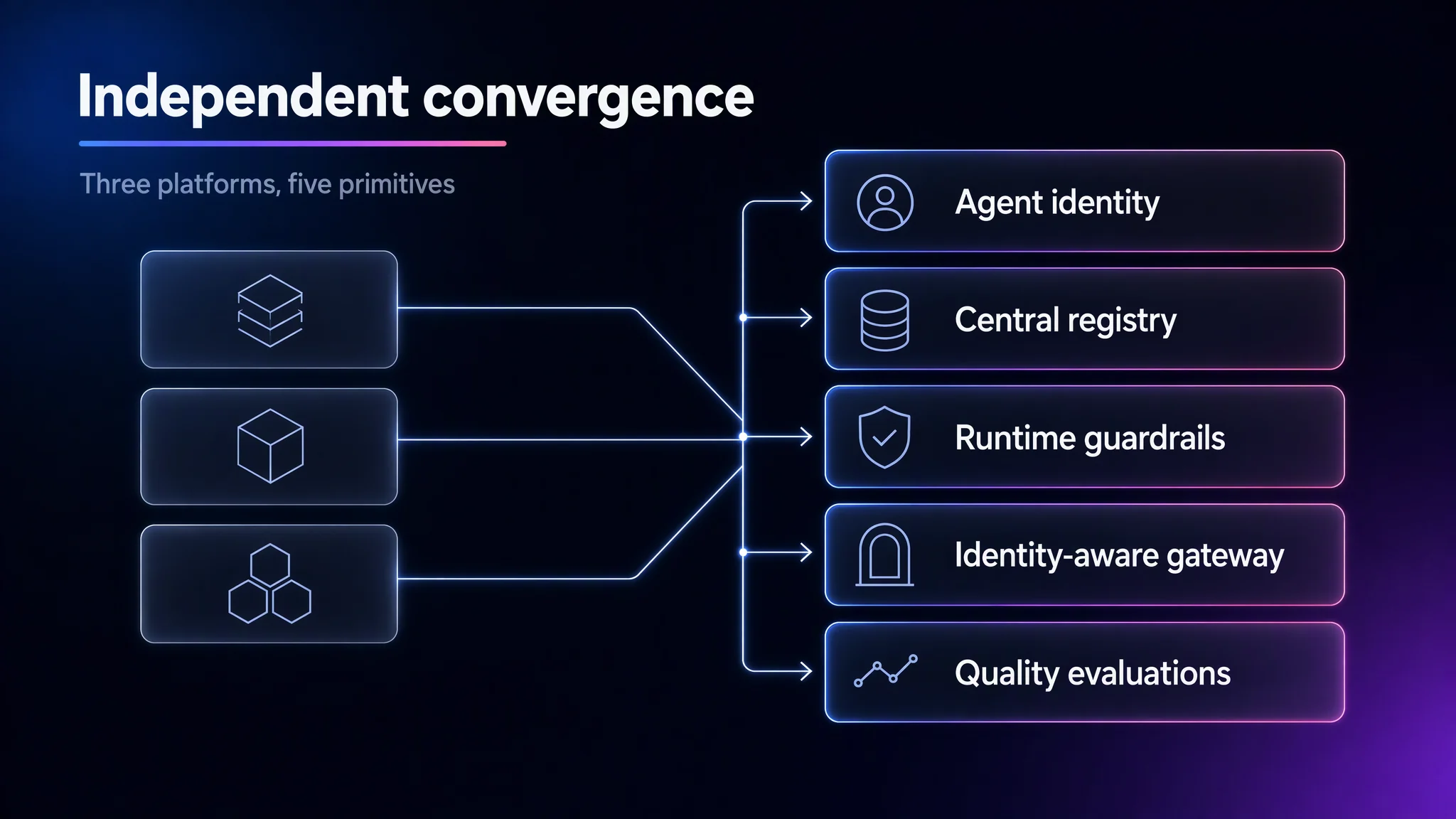
Three platforms, five primitives: agent identity, central registry, runtime guardrails, identity-aware gateway and quality evaluations. Source: Whitepaper, Building Organisations for the Age of AI.
Put agents in TLPT scope
DORA Arts 24–27 set the testing regime; Art 26 and RTS 2025/1190 set threat-led penetration testing for in-scope entities. As the sources cite them: at least every three years; internal testers allowed under safeguards, with every third TLPT using external testers; the TIBER-EU methodology. [FACT-CHECK: confirm cadence, tester rotation and entity scope against RTS 2025/1190.] Dates are on the calendar.
- Scope (Author reading). Where agents execute parts of a CIF they are testable assets. Book 1 Ch 6 §4.3 and §8 argue that a TLPT excluding the agent fleet because it is “AI” is non-compliant; that is the author’s reading, not a supervisory finding.
- Scenarios. Book 1’s composite adds four: prompt injection through free-text fields; tool misuse calling a write API outside the mandate; identity confusion to elevate runtime identity; memory poisoning of the retrieval index.
- Feed (Book 3 Ch 19). OWASP ASI01–ASI10 and MITRE ATLAS feed the scenario library; red-team findings feed the next TLPT scope.
- Acceptance: the TLPT scope document has at least one agent-specific scenario per CIF-supporting agent family, and the wrangler community attended scope-setting.
Continuous testing is on evaluation and resilience.
Read the sectoral layer as reuse, not a second programme
What the EBA and EIOPA say (Guidance)
The EBA mapped AI Act high-risk requirements against banking and payments law and classed each as fully aligned, partially aligned, complementary or not present in sectoral law. Its headline: no significant contradictions; the AI Act complements sectoral law; supervisory cooperation is needed; no immediate need for new or revised EBA Guidelines (Book 1 Ch 6 §4.5; findings consistent with the EBA factsheet).
Net-new for a bank (Book 1 Ch 6–7 reading of the EBA map). Art 12 logging at AI-system granularity; Art 13 instructions in prescribed form; Art 14 as a system-design requirement; Art 15 adversarial robustness; the Art 17 QMS in AI-specific form; conformity assessment, CE marking and Art 49 registration (Arts 43, 47, 49). Fully or largely aligned: much of Arts 9, 10 and 11 for credit scoring.
Reuse ratio (Author estimate). Book 1 Ch 7 §6 estimates the credit-scoring evidence stack at 60–70% reuse of CRR/CRD/DORA evidence and 30–40% net-new. It is a planning figure from the author’s reading, not an EBA number.
EIOPA (Guidance). EIOPA’s Opinion of 6 August 2025 explains how existing insurance rules apply to AI and does not create new requirements. Book 1 lists seven principles (fairness and ethics; data governance; documentation and record-keeping; transparency; human oversight; accuracy and robustness; cybersecurity) and four assessment dimensions per use case: data sensitivity, customer exposure (especially vulnerable groups), business-continuity impact and financial materiality. [FACT-CHECK: confirm the seven principles and four dimensions against the Opinion text.] ESMA had no equivalent mapping as of the sources; its 30 May 2024 statement on AI in retail investment services holds MiFID II Arts 16, 24 and 25 regardless of AI (Book 3 App I §4).
Sectoral obligations that bind regardless of AI
As Book 3 App I §8 maps them (Law, as cited; confirm each against the text):
| Obligation | AI-specific control | Evidence | Owner |
|---|---|---|---|
| MiFID II Art 17 and RTS 6 (algorithmic trading) | Extend the annual RTS 6 self-assessment to AI/ML components; kill switches tested | Self-assessment; kill-switch test | Legal and Compliance |
| MiFID II Arts 24–25 (best interest, suitability) | Suitability controls apply to AI-assisted advice; disclosure to retail clients | Suitability assessment per client | Legal and Compliance |
| CRR3 / CRD VI internal models; ECB Guide to Internal Models (revised July 2025) | Model-risk management, traceability, independent validation, drift monitoring for ML in internal models | Validation reports | Head of Model Risk |
| Solvency II Art 41 (governance); Arts 112–127 (internal models) | Governance framework covers AI components; independent validation | Governance pack; validation | Legal and Compliance (insurer); Model Risk |
| IDD Art 25 (product oversight and governance) | POG covers chatbots, AI quoting, customer correspondence | POG records | Legal and Compliance |
| PRIIPs Regulation | AI-generated KIDs allowed; accuracy stays with the manufacturer; human review | KID review record | Legal and Compliance |
| SR 11-7 and PRA SS1/23 (by analogy) | MRM templates for classification, validation, monitoring | MRM policy | Head of Model Risk |
Switzerland
| Instrument | What it asks (as the sources read it) | Factory control |
|---|---|---|
| FINMA Guidance 08/2024 (18 December 2024) | Inventory of AI use cases with risk classification; central accountability; data quality; testing and validation; explainability fit for purpose; documentation; third-party management; staff training. A supervisory lens, not a separate rulebook | The use-case registry is the inventory in operational form |
| FINMA Circular 2023/1 (operational risks and resilience) | Critical-data concept; AI processing of critical data triggers enhanced protection | Critical-data flag in data classes |
| FINMA Circular 2018/3 (outsourcing) | For significant functions: inventory naming provider and subcontractors (margin no. 14); concentration and orderly transfer (17, 18.1); audit and inspection rights for firm, auditor and FINMA (26); for outsourcing abroad, enforceable rights and information accessible in Switzerland (30, 31); the firm stays accountable (23) | Lane approval checks margin no. 31; outsourcing register row |
| SBA Cloud Guidelines, 3rd edition (4 November 2025) | Industry self-regulation aligned with FINMA, incorporating critical data | Cloud-arrangement controls |
| revFADP Art 21 / Art 22 / Art 24 | Automated-decision information and review on request; DPIA; breach notification “as quickly as possible” | Human decision point; DPIA template; stricter-clock incident process |
| revFADP Art 9(1) | A processor may be used only if no statutory or contractual confidentiality duty prohibits it | Can decide the lane for client-identifying data before any other analysis |
Sources: Book 3 App I §5–6; Research Paper 9 §7.3 and §9 (FINMA 2018/3 margin numbers read against the circular as amended 4 November 2020). Retention: FINMA does not set one; apply the longest of sectoral, DORA, contractual and data-protection needs.
Run the sectoral diagnostic once per use case
Book 1 Ch 7 proposes six steps (Author). The output is an AI Act sectoral position paper, one to three pages per use case, owned by the second line, signed by the first-line product owner and the third line, reviewed annually or on material change.
- Classify under the AI Act: prohibited, high-risk, transparency-only or minimal, with a written rationale. Revisit when the Commission’s Art 6 guidelines change (status on the calendar).
- Identify the sectoral law already governing the decision (for credit: CRR, CRD, the Consumer Credit Directive, EBA loan-origination guidelines, GDPR Art 22; for insurance: Solvency II, IDD, EIOPA Opinion).
- Compare each in-scope article (typically 9, 10, 12, 13, 14, 15, 17 and 26) with existing evidence: fully aligned, partially aligned, complementary or net-new. A planning aid, not a supervisory finding.
- Map supervisors. Home-state NCA first; conduct authority; home-state market surveillance authority; the EU body (EBA, EIOPA, ESMA, AI Office); the DPA; host-state authorities. Book 1 counts 12–18 entries per use case for a 50,000-person group and 3–5 for a 1,000-person specialist. Book 1 Ch 7 reads the Omnibus competence clarification (AI Office competent for systems built on a GPAI model by the same provider, except for financial institutions and three other areas) as keeping national competent authorities in the lead for finance [FACT-CHECK: confirm against the adopted Omnibus text]. The map is an engagement artefact: who calls whom, who sees the first letter, who drafts the reply.
- Locate national overlays and keep a one-page national-overlay tracker per Member State of operation: authorities designated, sectoral decrees, criminal-law overlays, procurement signals, framework law versus implementing act. Italy’s Law 132/2025 is the reference case; its corrected dates and pending decrees are on the calendar.
- Build the evidence stack. Reuse where aligned; build new evidence only for net-new items; cross-reference so audit sees the connection.
Feed the result into the unified control map. Each obligation stays its own row with one accountable owner.
Fold, do not duplicate
Book 1 Ch 6 §8 and Ch 7 §8 describe the most expensive mistake: a parallel AI Act programme. Signals: a second-line function with “AI” in its name that does not report into model risk or ICT risk; an AI Act readiness pack with no DORA cross-references; a duplicate “AI logs” architecture; a readiness pack whose only external counterparty is the AI Office. Recovery (Author): fold Arts 9–15 into the model-risk framework; fold Art 12, Art 73 and the cybersecurity side of Art 15 into the ICT-risk framework (Ch 6; Ch 7 §8 names Arts 12 and 19 instead of 73, so take both); keep a thin AI-Act-only layer for conformity assessment, CE marking and registration.
The integration map in one view
Book 1 Ch 6 §5 composes DORA and the AI Act once. Six rows are discharged by a single control when both regimes are read together; five are AI-Act-only. (Author.)
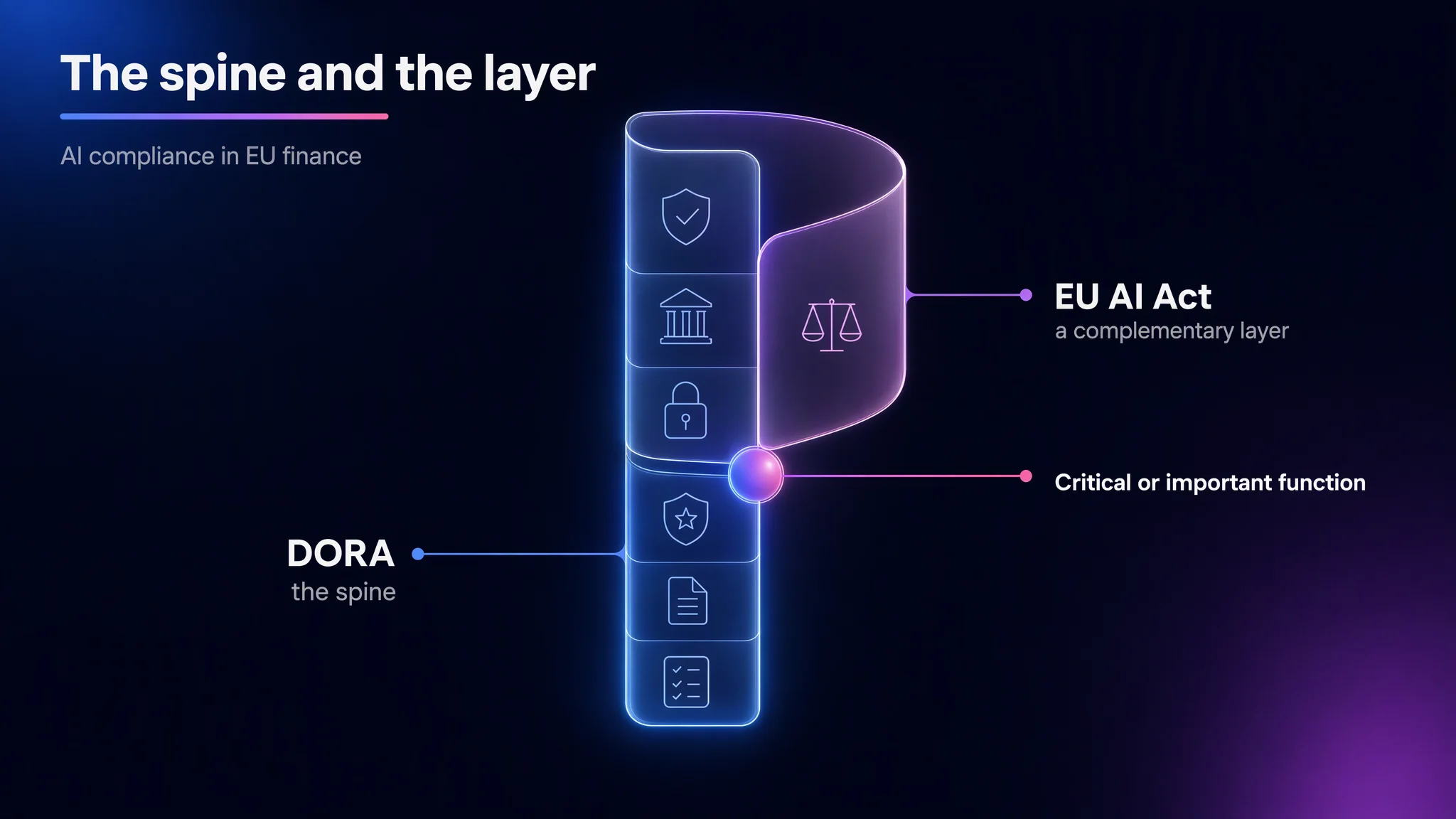
DORA is the spine; the AI Act is a complementary layer on top of it, hinged on the critical or important function. Source: Building Organizations for the Age of AI (Book 1).
| Single control discharges both | AI-Act-only (no DORA counterpart) |
|---|---|
| Management-body resolution (DORA Art 5 / AI Act Art 17 leadership) | Transparency to deployers (Art 13) |
| ICT framework with AI extensions (Art 6 + RTS / Art 17 QMS) | Art 50 transparency and marking |
| One agent registry (Art 8 / Art 11 + Annex IV) | Conformity assessment and registration (Arts 43, 47, 49) |
| One lifecycle risk process (Arts 5–14 / Art 9) | Annex IV technical documentation in prescribed form |
| One logging stack (RTS logging / Art 12 + 26(6)) | Deployer pack under Art 26 |
| One incident playbook with cover sheets (Arts 17–19 / Arts 72–73) | — |
Evidence and acceptance checks
Before an agent that supports a regulated decision enters production, the firm should be able to show (Advice):
- a role declaration and signed classification rationale; for Annex III 5(b)/5(c), a FRIA dated before first use and its MSA notification;
- for a CIF-touching agent, the five artefacts, with the RoI row reconciled in the three counts;
- an Art 14(4) control map with tested override, referral and stop paths, and SCHUFA-grade review evidence for Tier 3 decisions;
- an Art 26 crosswalk that lists what it does not discharge;
- change records that show what each approver checked, emitted by the path;
- record-level traces that answer the single query, retained for the approved period;
- a classification record template, a SOC rule tested in the last 12 months, and notification cover sheets for DORA, Art 73 and GDPR;
- an Art 50 disclosure test passed before go-live on any client channel;
- RoI rows for admin-enabled AI routes, and the provider usage policy mapped to tiers;
- a supervisor engagement map, a dated sectoral position paper and a national-overlay tracker;
- for every row: one accountable owner, a named control and an evidence artefact. Book 3 App I’s rule: a gap in any of the three means the obligation is not yet satisfied and goes on the open-issues register.
A green dashboard or a vendor attestation does not satisfy these checks.
Failure modes
- Treating a crosswalk as proof. A mapped cell shows where to look. Keep owner and evidence on every row.
- Claiming all of Article 26 through the discharge clause. It covers monitoring and logs, not oversight assignment, suspension duties, information to persons or the FRIA.
- Starting the DORA clock at the wrong moment. Running the 72-hour clock from classification, or the 4-hour clock from detection, produces wrong deadlines in both directions.
- Engineering classifying incidents. Classification belongs to Legal and Compliance.
- Screenshots as change evidence. They show approval, not assessment.
- CIF folded into the tier. The heavier third-party surface then attaches to the wrong use cases.
- An admin toggle opens a route. A new AI sub-processor with no change, no RoI row and no owner.
- Planning to a proposal or to an uncorrected manuscript. Book 1 Ch 6, App C and the Whitepaper carry a superseded Art 50 date framing.
- Stale national detail. Re-check national designations and decrees against the gazette before each supervisory submission.
- Copying a provider-specific mapping. Book 3 App I maps one provider’s programme at one composite bank. Its structure is reusable; its provider facts are dated.
Provenance and refresh
Verified on 15 November 2026 against official sources: AI Act Arts 14(4), 26, 27, 49, 50, 73 and 113 (Commission AI Act Service Desk consolidated text as at 27 July 2026, and its timeline); RTS 2025/301 Art 5 (Official Journal text, OJ L 20.2.2025); DORA application date (EIOPA); CTPP list publication date (ESMA); EIOPA Opinion date and reference (EIOPA). Checked against an unofficial reproduction of the OJ text: RTS 2024/1774 Art 17(1) and RTS 2024/1772 Art 8. As cited by the sources, not re-verified: everything else, with [FACT-CHECK] where it matters. EUR-Lex refused automated retrieval.
Closed in this revision: the Art 50(2) transitional period; the new Art 5 prohibition’s application day; the Omnibus amending act’s number and entry into force (both moved to the calendar); the Art 73 timescale conflict; the DORA clock rules; the EBA and EIOPA dates.
Known source inconsistencies still for the author’s source-fix:
| Topic | Inconsistency | This page |
|---|---|---|
| Art 50 framing | Book 1 Ch 6 and App C, and the Whitepaper, say “accelerated” | Follows verified text |
| Art 73 timescales and paragraph | Book 1 Ch 6 and Book 3 App I | Follows Art 73(2)–(4) |
| DORA clock start | Book 1 Ch 4 §6.1; Book 3 App F §5 | Follows RTS 2025/301 Art 5 |
| Incident-criteria count | Book 1 Ch 6 (seven); Book 3 App I (eight); App F (four) | Follows RTS 2024/1772 Art 8 |
| CTPP article range | Book 1 Ch 4 / App A versus Ch 6 | Uses Arts 31–44 |
| Art 49 deployer verification | Book 3 App I §2.2 versus Art 26(8) | Practice, not duty |
| Italian Law 132/2025 dates | Book 1 App C versus Ch 6–7 and the Gazzetta | Calendar gives the verified dates |
Refresh this page when an article it cites is amended, when the ESAs designate or de-designate a provider, when an ESA, ECB or national authority publishes AI-relevant guidance, or when a source book is corrected. Run the calendar’s change-trigger procedure first; it tells you which rows here move. Review at least quarterly while the high-risk deferral is in transition, and re-date the “as of” line at every revision.
This page remains a draft. It needs independent legal review and EUR-Lex verification of every article reference before it can move to review status.
Source material
- Book 1 (Building Organizations for the Age of AI), Chapter 2, The Bounded Agency Thesis (§5.2–5.3 envelope mapped to OWASP and Article 14)
- Book 1 (Building Organizations for the Age of AI), Chapter 4, The Unified Control Map (§6.1 incident walkthrough; §6.3 human oversight under Article 14)
- Book 1 (Building Organizations for the Age of AI), Chapter 6, DORA, the EU AI Act, and the Sectoral Layer (as of 15 May 2026; §2 five artefacts; §4.1–4.6; §5 integration map; §6 worked example; §7 Monday morning; §8 anti-patterns)
- Book 1 (Building Organizations for the Age of AI), Chapter 7, The EU AI Act, Sectoral Guidance, and the National Layer (Draft 4, as of 30 May 2026, after fact-check; §4–§8)
- Book 1 (Building Organizations for the Age of AI), Chapter 10, The Convergent Platform Pattern (§7 five-primitive scoring; §8 macroprudential owner)
- Book 1 (Building Organizations for the Age of AI), Appendix A, The Unified Control Map: Quick Reference
- Book 1 (Building Organizations for the Age of AI), Appendix C, The Stop-the-Press Calendar (as of 10 May 2026)
- Book 2 (The AI Delivery Factory), Chapter 3, Why Craft Alone No Longer Scales (§2, §4.5 repeatability and DORA Article 6)
- Book 2 (The AI Delivery Factory), Chapter 9, The Audit Spine (§2 record-level logging; the single-query test)
- Book 2 (The AI Delivery Factory), Chapter 13, Release Engineering and Change Resilience (the regulatory floor: DORA change resilience; internal critical capabilities)
- Book 2 (The AI Delivery Factory), Chapter 20, Agent-Driven Departments (§4.4 Article 49 registration note)
- Book 2 (The AI Delivery Factory), Chapter 26, The Agent Channel (§4, §8 Article 50 for client-facing channels)
- Book 3 (Deploying Claude Safely), Chapter 1, The Day Claude Went into Production (Usage Policy as a contract surface)
- Book 3 (Deploying Claude Safely), Chapter 2, Why Claude Becomes the Default (Microsoft 365 Copilot arrival vector)
- Book 3 (Deploying Claude Safely), Chapter 3, The Control Plane Is Yours (§4 DORA Article 28 and Article 5)
- Book 3 (Deploying Claude Safely), Chapter 4, The Deployment Decision (admin-toggle route; anti-pattern 'letting an admin toggle open a route')
- Book 3 (Deploying Claude Safely), Chapter 14, Risk Tiers and the Use-Case Taxonomy (§5.1–5.4 tiers mapped to regulation)
- Book 3 (Deploying Claude Safely), Chapter 19, Red Team and Continuous Control Testing (§6, §8 agent scenarios in TLPT)
- Book 3 (Deploying Claude Safely), Appendix F, RACI Matrix for the Claude Operating Model (§5 Decision 21, incident classification)
- Book 3 (Deploying Claude Safely), Appendix G, Risk-Tier Control Matrix (§4)
- Book 3 (Deploying Claude Safely), Appendix I, Regulatory Mapping (as of 14 May 2026; §2–§11)
- Book 09 (Everything Is Green), Introduction and Chapter 1, The Day the Review Queue Broke (screenshots are not evidence; RTS 2024/1774 Art 17)
- Book 09 (Everything Is Green), Chapters 8–9, The Number That Was Too Good and One Query (fund-side rules before the DORA test)
- Supporting Tools, docs/api/engine_sar.md, SAR / right-to-explanation engine API
- Research Paper 2, Ten Solution Archetypes for Regulated Finance (§4.1 where regulation bites)
- Research Paper 8, Reusability and the Compounding Factory (§3.7 concentration of compounding assets)
- Research Paper 9, Data Classes, Processing Lanes and Controller/Processor Roles for AI (§7.3–7.5, §9)
- Whitepaper, Building Organisations for the Age of AI (Part II §1, Article 50 framing; superseded on this point)
- European Commission, AI Act Service Desk: timeline and consolidated articles 14, 26, 27, 49, 50, 73, 113 (consolidated as at 27 July 2026), accessed 15 November 2026
- European Commission, AI Act policy page (digital-strategy.ec.europa.eu), last updated 19 October 2026, accessed 15 November 2026
- Commission Delegated Regulation (EU) 2025/301, Article 5 (OJ L, 20.2.2025), read from the Official Journal text, 15 November 2026
- EIOPA, Digital Operational Resilience Act page; ESMA press release of 18 November 2025 on CTPP designation; EIOPA Opinion on AI governance and risk management (6 August 2025)
Related guidance
-
 Regulatory Calendar for AI in EU Financial ServicesThe stop-the-press calendar rebuilt as a dated register: AI Act stages after the AI Omnibus, DORA and its RTS/ITS, CTPP designations, ESA and supervisor guidance, national laws such as Italy's Law 132/2025 with corrected dates, and harmonised standards, each with status, as-of date, official source and the reference pages it moves, plus the change-trigger procedure for when an item moves.
- Build a Unified Control MapJoin the firm's AI and technology controls in one traceable operating view: rows are operating concerns, columns are frameworks read at their own altitude, every cell points to live evidence, and existing ITIL, COBIT and CIS artefacts are extended to agents with a five-question test instead of a parallel AI governance track.
-
 The Audit Spine and the Evidence RecordHow to capture, join, protect, retain and prove per-action evidence: the AES v0.1.0 record contract, three capture points and one correlation ID, tiered immutable storage, retention and legal hold, replay rehearsal, the route-approval evidence gate, and the Claude-specific ways evidence goes missing.
- Accountability and OwnershipHold provenance and accountability apart on purpose: four named accountabilities per product, a human owner for every agent change, seven named seats, a signed Build/Run RACI and a first-line/second-line boundary that survives consolidation.
- Vendor Concentration and ExitMeasure concentration on three axes against 70% and 85% discussion triggers, keep a tested successor for every material model usage, record eight contract-cleavage points per route, prove evidence portability with a 15-item checklist, and rehearse exit on one material use case every year with a filed close-out report.
-
 Model Governance: Usage Registry and Upgrade LifecycleGovern models at the grain regulators ask about: a catalogue for what exists, an 18-field usage registry for what is used, risk classified per usage, a registry the policy decision point reads by usage_id, pinned model IDs, and a four-phase upgrade lifecycle from Day −14 to Day +90 with numeric rollback thresholds.
-
 Classify Use Cases into Risk TiersThe T0–T4 use-case taxonomy as a working decision reference: the prohibited-use gate, four intake questions, data and action boundaries per tier, the twelve-area control matrix, retention and payload rules, runtime enforcement, approval gates, regulatory routing and re-tiering.
- Choose the Shape of an AI ProductA least-agency decision sequence for choosing a product design: agency classes and their trade-offs, the eight questions, evidence for every step up, the consequence matrix that caps action scope, the cut-set review for agents, the other selection dimensions, and the design record.
-
 Change Governance for Agent-Enabled DeliveryRoute agent-speed change by risk without losing the approver: control values that always reach a person, a routing gate that reads the right signals, autonomy earned per change family, a Virtual CAB that prepares a complete dossier, and three bodies with defined escalation.
- Release Engineering for Agent-Written ChangeMove agent-speed change into production through five evidence-emitting stations: one change type per change, a reversal decided at authoring, a valid Deployer Manifest, a gateway that cannot be bypassed, hard health gates and at-most-once rollback.
- Respond to Agent IncidentsSort an agent failure into one of four incident shapes, suspend it in three verified layers, keep humans on every classification and disclosure decision, route one playbook to every authority that needs a cover sheet, and close each incident with a named control change.
- Evaluate, Assure and Test Agent ResilienceDefine a versioned evaluation contract, test the trajectory and the execution boundaries, run three assurance layers into one quarterly pack, map the OWASP Agentic Top 10 to controls that demonstrably fire, bring agents into threat-led penetration testing with a five-section scope, keep a continuous cadence between formal tests, land every finding as a live control-plane artefact, and engineer recovery down to a minimal AI service level on models you host.
-
 Operate the Agent LifecycleInventory, register, sign, zone, review, suspend, recover and retire agents through a six-stage lifecycle with named human ownership, zone-specific authority and evidence at every transition.
-
 Choose and Contract Claude Deployment RoutesDecide, per use-case class, which route carries Claude into production (Anthropic API, Claude Platform on AWS, Bedrock, Google Cloud, Microsoft Foundry, plus the Microsoft 365 Copilot surface); record who operates, bills and processes; size the diligence to the processor; check residency, zero data retention and HIPAA per feature; sign a contracting matrix row; and run Agent SDK or hosted agents with the controls the product does not supply. Provider-specific and dated.
- Data Classes, Processing Lanes and TokenisationClassify every model request by its data, route it only to a processing lane the class permits, keep derived artefacts inside their source class, and treat retention, roles and tokenisation as recorded, testable decisions.
-
 Govern MCP Connectors Through a BrokerAdmit, tier, pin and enforce every MCP server through one registry and two enforcement points, keep tokens audience-bound, govern A2A delegation through its own registry and gateway, and expose client-facing agent channels only through the same policy layer.
-
 Identity, Secrets and Configuration for Agent WorkloadsGive every actor one owned identity, size its authority for the worst case, separate runtime from deployment, federate instead of holding keys, refuse impersonation and silent fallback, govern configuration by class, and audit the estate until flagged identities decline.
-
 The Enterprise Agent Control PlaneThe firm-owned services that make every agent action identifiable, decidable, approvable and reconstructable: the ownership boundary, six planes and their contracts, the Policy Decision API with its latency budget, the persistence schema, the build sequence and the tests that show it works.
- Bounded-Agent PatternA class 3 agent lets a model choose the next step, but only inside a registered, validated and enforced envelope of Mandate, Means, Memory and Monitoring.