Choose the Shape of an AI Product
A least-agency decision sequence for choosing a product design: agency classes and their trade-offs, the eight questions, evidence for every step up, the consequence matrix that caps action scope, the cut-set review for agents, the other selection dimensions, and the design record.
- Version
- 0.2.0
- Owner
- DEIXEI
- Last reviewed
- Reading time
- 23 min
For Cto · Ai Architect · Product Leader · Platform Engineer · Risk And Assurance · Internal Audit
Sources and details
- Section
- Design
- Source works
- Book 2 · Book 1 · Research Series
- Source chapters
- 1, 22
- Source appendices
- 02:C
- Refresh trigger
- source change
Use this guide at product intake or architecture review, after a candidate has a bet card admitted through the discovery portfolio. Every request arrives as somebody’s picture; it should leave as a governed choice among named shapes. The outputs are:
- An agency class, chosen by the least-agency rule, with every lower class rejected for a written reason.
- A ceiling on action scope, set per decision by the consequence matrix, independent of the class.
- For class 3 and 4 designs, a cut-set answer showing no single control failure lets the agent act outside its mandate.
- The classification line and a ten-field design record (an ADR) committed before the first branch.
Status of the model. The agency classes, decision sequence, escalation criteria, trade-off matrix, consequence matrix and design record are the author’s design proposal (Book 2 Ch 22; Research Papers 1 and 2), written for EU, UK and Swiss banks, insurers and asset managers. The underlying principle, that complexity should rise only when needed, is consensus guidance from Anthropic, Microsoft and Google Cloud as cited in those sources. Asset Manager X is the books’ composite institution. Where Book 2 and the Research Series differ, this page says which it follows.
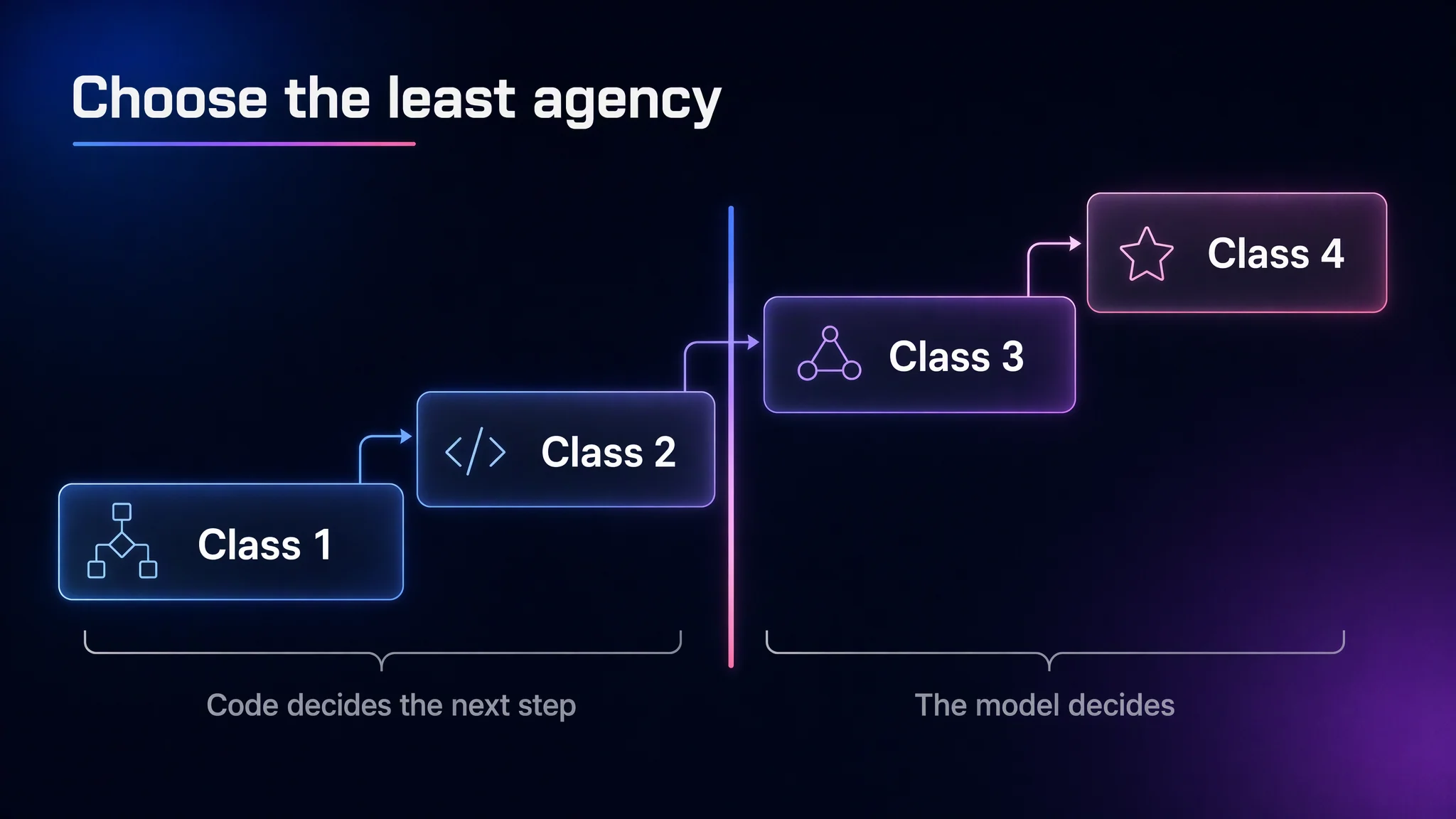
At a glance: choose the lowest agency class that meets the need, and climb only on evidence. The detailed diagram is under Keep two scales separate. Source: The AI Delivery Factory, Chapter 22, Figure 22.2.
Keep two scales separate
An agency class is a design-time property: who decides the next step. It is fixed when the design is chosen. Action scope (in Book 2’s terms, the rung on the autonomy ladder) is a run-time permission: what the design may do in production — read-only, draft for a human to send, act with approval, act autonomously within a defined envelope. It is earned on evidence. The two are independent: a class 3 design can operate at the advisory rung, and Research Paper 2’s research crew is class 4 and read-only (§2.2). The vocabulary mapping across books is on the bounded-agent pattern.
| Agency class | Shape | Who decides the next step? |
|---|---|---|
| 0 — single call | One model call, without enterprise facts | Code |
| 1 — grounded answer | Retrieval plus one model call | Code |
| 2 — workflow | A fixed sequence that may include model calls | Code |
| 3 — bounded agent | One agent in a loop inside a bounded-agency envelope | The model, within its envelope |
| 4 — multi-agent | Several agents with separate owners and identities | Models and code |
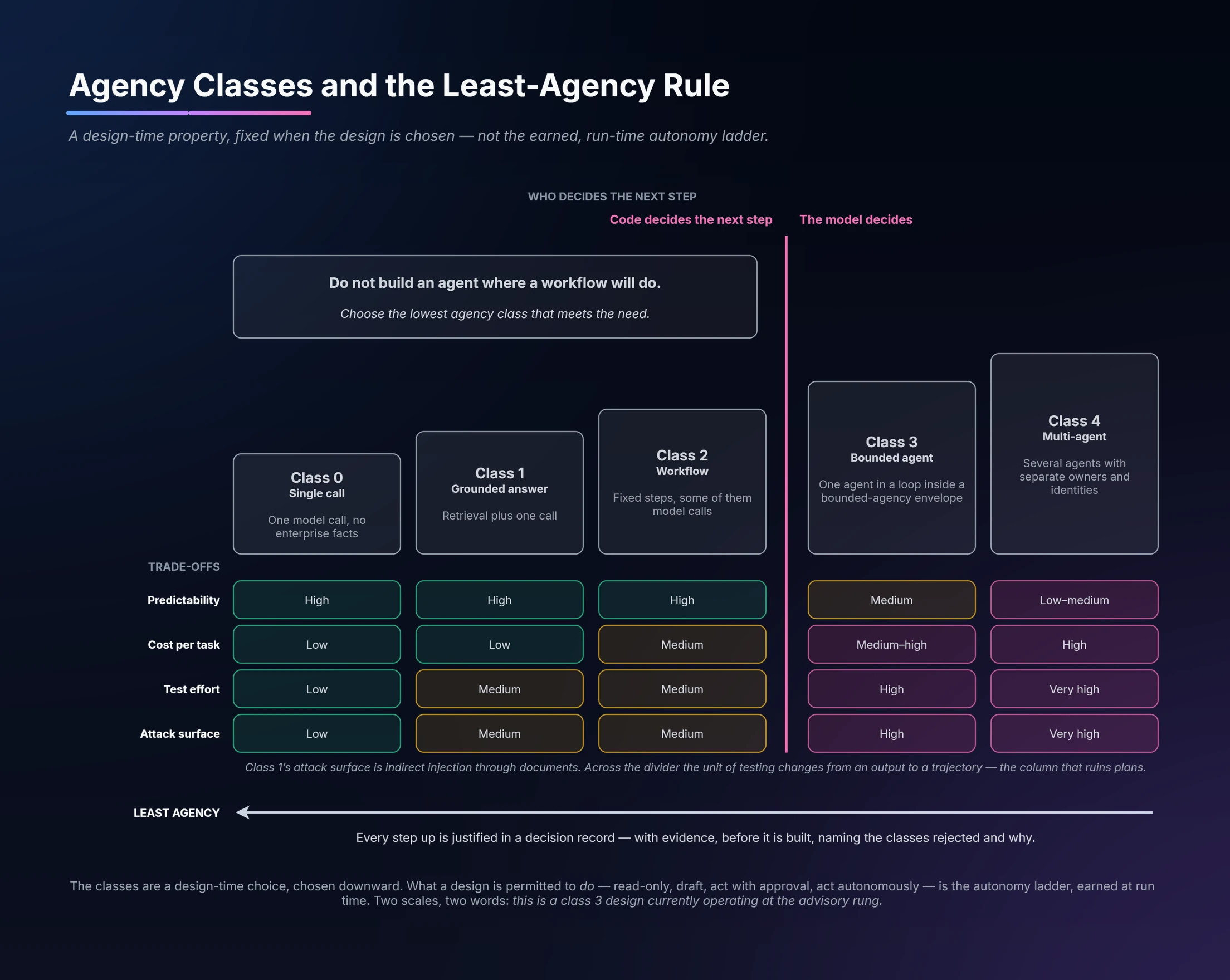
Agency class is a design-time choice; the autonomy ladder is earned at run time. Source: The AI Delivery Factory, Chapter 22, Figure 22.2.
The control-flow test. The only conceptual boundary is between classes 2 and 3: in a workflow code selects the next step; in an agent the model does. Hold that line whatever a vendor diagram calls the pattern. A sequential or parallel flow whose order is fixed in code is a workflow, however many model calls or “agents” sit inside it (Book 2 Ch 22 §4.4).
Class 4 is defined by ownership. Research Paper 2 (§2.2) and Research Paper 1 (§7.3) add a nuance this page follows: a design is class 4 when it contains several agents with separate owners, identities, security boundaries or release cycles. If code fixes their sequence, it keeps most of a workflow’s predictability and test effort, but it still carries class 4’s identity controls — agent registry, authorisation between agents, a kill switch per agent — because those follow the identities, not the control flow.
Know what each class costs before committing
Research Paper 1 (§7.3) gives the qualitative trade-offs, with the control additions each class brings. The ratings are the author’s assessment.
| Class | Predictability | Latency | Cost per task | Test effort | Attack surface | Typical additions to the control bundle |
|---|---|---|---|---|---|---|
| 0 Single call | High | Low | Low | Low | Low | Gateway, output filters |
| 1 Grounded answer | High | Low–medium | Low | Medium | Medium (indirect injection through documents) | Permission-aware retrieval, citation checks |
| 2 Workflow | High | Medium | Medium | Medium | Medium | Step validation, human checkpoints where needed |
| 3 Bounded agent | Medium | Medium–high | Medium–high | High | High | Tool policy, agent identity, budgets, trajectory evaluation |
| 4 Multi-agent | Low–medium | High | High | Very high | Very high | Agent registry, authorisation between agents, replay testing, kill switch |
Read the test-effort column twice. Between class 2 and class 3 the unit under test changes from an output to a trajectory. A firm that has only evaluated outputs cannot yet say whether an agent did the right thing for the right reason; budget trajectory evaluation (evaluation and resilience) before approving the first class 3 design.
Ask the eight questions in order
The default at every step is the least agentic, least bespoke option that meets the need. Questions 1 to 5 produce the agency class; 6 to 8 produce reuse, controls and hosting. For an ordinary request the sequence takes about forty minutes and should be run live with the sponsor in the room; its output is a draft design record with the alternatives still visible (Book 2 Ch 22 §5.1).
| # | Question | Outcome |
|---|---|---|
| 1 | Is AI needed at all? Would rules, a query or conventional analytics do? | If yes, build conventional software and stop. This question ends more requests than the other seven together |
| 2 | Prediction or generation? | Predicting a number or class from structured data (default probability, fraud score, lapse rate) is classical machine learning with its own model-risk regime; continue only for generation |
| 3 | Does it need enterprise facts? | No enterprise facts and one call suffices → class 0. Enterprise facts needed, or more than one step → question 4 |
| 4 | Are the steps known in advance? | One step over retrieved facts → class 1. Several known steps → class 2. Not known → question 5 |
| 5 | Is it one coherent responsibility? | One responsibility, one owner, one tool set → class 3. Several responsibilities needing separate owners, identities, security boundaries or release cycles → class 4 |
| 6 | Which catalogue assets cover each anatomy tier? | Go tier by tier through the application anatomy; every covered tier is one you do not design, test or separately control |
| 7 | Which policy pack applies? | Inherited by scope from risk tier, data class, agency class and action scope (see the note below) |
| 8 | Which hosting route and model class do data class and cost allow? | Vendor API, private tenancy or controlled infrastructure; model class from the firm’s own evaluations |
Multi-step work on user-supplied content (source difference). Book 2 Ch 22 §5.1 sends every “no enterprise facts” answer to class 0. Research Paper 1 (§7.1) repairs this: a task with no enterprise facts but several steps — draft, check against a style rule, reformat — continues to question 4 and lands at class 2, and one whose steps cannot be known continues to question 5. Without the repair, a workflow or agent over user-supplied content has no path through the sequence. This page follows Research Paper 1.
Question 7 (source difference). Book 2 keys the policy pack on risk tier, agency class and data class; Research Paper 1 keys the control bundle on risk tier, action scope and data class. This page treats them as layers: the agency class brings the structural controls in the trade-off table’s last column, the action scope brings the per-rung controls (approval points, reversibility), and the risk tier and data class select the package around both. Pre-approve a policy pack for every recurring combination with the second line, so question 7 is inheritance rather than negotiation.
Question 8. Book 2 calls the three options hosting routes; Research Papers 1 and 9 call them processing lanes. They are the same three choices. Lane definitions and the per-deployment assignment rule are on data classes and lanes. A hosting route is not a delivery lane: the delivery lane decides who builds the thing, the route decides where it runs.
When the request is an existing procedure
Book 1 (Ch 1 §4.5) describes an approach for institutions formalising procedures for the first time (its example is Gulf banks with less legacy process debt): map each operational SOP directly into a decision model rather than a document, with five elements — task, inputs, decision criteria, output, and the explicit point where a human stays in the loop. Book 1’s reading is that wherever the criteria are deterministic and the data governed, an AI agent can act, and wherever judgement, exception or regulatory accountability is required, the human point is marked before any code is written. Book 1’s precondition: internal staff, not an integrator, own and maintain the decision models.
This page’s recommendation is to feed the decision model into questions 1, 4 and the consequence check rather than straight into an agent: deterministic criteria over governed data are usually a rules or workflow candidate under the least-agency rule (class 3 only where the steps cannot be fixed), and the marked human point is where the consequence matrix is applied. Book 1 frames the method for Gulf institutions; applying it to any firm formalising a procedure is the page’s extension.
Choose between neighbouring archetypes
Most real decisions are between two adjacent shapes. Research Paper 2 (§6.2) gives the rule: take the simpler one unless a stated condition holds — for example, a grounded assistant rather than a research crew unless questions routinely need planning across many sources and a synthesised report; a document pipeline rather than a bounded agent unless documents vary so much the steps cannot be fixed. When the room cannot agree, ship the simpler shape and let its evaluation results show whether the harder one was needed. The archetype cards are in Research Paper 2 and the recipe families on the recipe catalogue.
Bring evidence for every step up
Choose the lowest agency class that meets the need. A step up is allowed, but the design record must carry the evidence (Book 2 Ch 22 §5.2; Research Paper 1 §7.2).
| Step up | Escalate only if | Evidence the design record must carry |
|---|---|---|
| 0 → 1 | Answers depend on internal or current facts | Examples where the base model gets it wrong |
| 1 → 2 | The task needs several distinct steps, tools or validations | The step list, and the failure modes of the single call |
| 2 → 3 | The next step cannot be predicted from the input; the paths are too many to code | Path analysis showing combinatorial branching; the cut-set answer |
| 3 → 4 | One agent’s tool set or instructions become self-conflicting, or domains need separate ownership, security boundaries or release cycles | Evaluation results showing single-agent degradation; the cut-set answer |
| Prompting → fine-tuning | Prompting and retrieval have plateaued on a stable task, or cost and latency demand a smaller model | The evaluation curve, a data-governance plan, a re-tuning plan |
| Read-only → acting | The business case needs execution, and reversibility or approval is designed in | Action inventory, reversibility analysis, approval points, named wrangler |
What is not evidence for 3 → 4: that the process has four steps, that four teams are involved, or that a vendor diagram has four circles. Several agents are justified by ownership boundaries and demonstrated single-agent degradation, not by the shape of the org chart.
Source difference. The cut-set answer in rows 2 → 3 and 3 → 4 is Book 2’s addition; Research Paper 1’s table does not include it. This page follows Book 2.
Defer with a trigger, never “no”. Every deferral of a higher class names the trigger that reopens it, for example “class 3 deferred; revisit when the evaluation harness holds a quarter of graded peer-comparison outputs” (Book 2 Ch 22 §6). Read the deferrals as a portfolio: if nothing has ever crossed the 2 → 3 line, the criteria are being deployed as a veto, not applied.
Cap action scope by consequence
Agency class describes mechanics. It does not say whether the firm should let the system act. That is set per decision, on two axes: how much harm a wrong decision causes, and how complex the decision is. The principle — human involvement follows consequence, not use-case category — is taken by both sources from McKinsey’s 2026 public-sector work; the matrix below is Research Paper 1’s proposal for applying it (§7.6). Sign-off by category (“all HR use cases need sign-off, operations do not”) is over- and under-inclusive from its first day.
| Consequence of a wrong decision ↓ / Decision complexity → | Low | Medium | High |
|---|---|---|---|
| Low | AI runs it | AI runs it; a human reviews samples | AI proposes; a human has the final say |
| Medium | AI recommends; a human approves | AI recommends; a human approves | A human decides; AI assists |
| High | A human decides; AI assists | A human decides; AI assists | A human decides; AI assists |
Default for regulated firms. Both sources place in the high-consequence row, by default, every decision that has a legal or similarly significant effect on a person, a client or the firm’s regulatory standing: a credit decision, a claims denial, a suitability assessment, a regulatory filing. The legal basis and article references for human intervention are on the regulatory map.
How the cap is applied.
- List the decisions the product takes or contributes to, not the use case as a whole. One product often contains decisions in different cells.
- Place each decision in a cell and record the reason in the design record (field 7, residual risks).
- Translate the cell into a ceiling on action scope. This page’s mapping (a synthesis, not a source table):
| Matrix cell | Highest action scope | Oversight mode (Research Paper 1 §7.4) |
|---|---|---|
| AI runs it | Act autonomously within the envelope | After the fact |
| AI runs it; a human reviews samples | Act autonomously within the envelope | After the fact, sampled |
| AI proposes / recommends; a human has the final say / approves | Act with approval | In the loop |
| A human decides; AI assists | Read-only or draft (advisory) | In the loop; the human owns the decision |
- The consequence ceiling is the maximum; the escalation criteria above decide whether the design may approach it, and the autonomy ladder decides when the rung is earned. A high-consequence decision caps action scope whatever the agency class.
- Apply the stricter of the consequence ceiling and the use-case tier’s
autonomy_ceilingfrom risk tiers (where, for example, T2 and T3 denyexecute_autonomously). The matrix works per decision; the tier works per use case. Neither loosens the other.
Source difference. Book 2 (Ch 22 §5.3) states the two axes and says the result caps “the rung”; it does not print the matrix. Research Paper 1 prints the matrix and says it caps “action scope”. With the ladder-to-scope mapping, these are the same cap. This page uses the Research Paper 1 matrix.
Run the cut-set review for class 3 and 4
For every class 3 or class 4 design, the design record must answer one question: is any single control failure sufficient for the top event — the agent acts outside its mandate? The idea is borrowed from fault-tree analysis: a minimal cut set is the smallest combination of failures that produces the top event, and a cut set of one is a single point of failure. No probabilities, no gate arithmetic, no new artefact (Book 2 Ch 22 §5.2).
Method (about ten minutes if the design record is honest).
- Write the top event concretely for this agent: what “outside its mandate” means (an issuer it may not touch, a write it may not make, a recipient it may not reach).
- List every control between the agent and that event.
- Tag each control with its part of the bounded-agency envelope and its control-plane location:
| Control type | Envelope part | Control plane (product side) |
|---|---|---|
| Instruction or system-prompt rule | Mandate | Policy |
| Tool broker refusal, scoped identity, data entitlement | Means | Identity and policy |
| Retained trajectories that reconstruct what was asked | Memory | Evidence |
| Checkpoint, alert, sampled review | Monitoring | Observability and evidence |
Book 2 names the plane for the instruction (policy), the broker refusal (identity and policy) and the checkpoint (observability and evidence); placing retained trajectories on the evidence plane is this page’s reading.
- Test each control alone and in pairs. Ask: if only this fails, does the top event occur? Then: which pairs suffice?
- Record the result. Any single-event cut set is a finding, not a note. Separately record controls that remove detection but not prevention.
- Fix with a control that fails differently, not a better-worded instruction.
Independence heuristic. No top event should be reachable by the failure of controls drawn from one part of the envelope. Controls that share a plane and a tier are rarely as independent as their designers believe. A guardrail on the same tier as the instruction it protects is the same event.
Composite worked answer (Book 2 Ch 22 §5.2, Asset Manager X’s deferred peer-comparison agent). Top event: the agent pulls filings for, or writes about, an issuer outside its mandate. Candidates: (a) the guardrail is bypassed by text inside a retrieved filing; (b) its service identity was over-granted; (c) the human checkpoint on each quarter’s first table is skipped.
| Failure | Sufficient alone? | Why |
|---|---|---|
| (a) Guardrail bypass | No | Provided the tool broker enforces the mandate’s issuer list regardless of what the model asks |
| (b) Over-grant | No | Nothing induces the agent to ask |
| (c) Skipped checkpoint | No | It removes detection, not prevention; record as a separate finding |
| (a) + (b) | Yes | The model is talked into the request and nothing downstream refuses it |
The answer that fails is the most common: the only thing between the agent and an out-of-mandate action is an instruction in its prompt. The fix is an independent control: the connector broker refuses the call because the issuer list is an authorisation property of its configuration, not a sentence the model can be argued out of.
Owner. The pattern arbiter (part of the factory architect’s job, Book 2 Ch 24) runs it in the same review that reads the classification line. No new forum or role.
Regulatory framing. Book 2 treats a single-event cut set in a product’s control architecture as the same class of finding as DORA’s duty to identify material single points of failure in ICT systems. The book labels this its own extension of that duty, not a separate obligation; for a product supporting a critical or important function, it is the reading to have on file. Article references are on the regulatory map.
Week three exercise (Ch 22 §7). Take the class 3 agent you are least worried about, write its top event, list the controls and ask whether any one failing alone is enough. A yes is the second control to build this quarter.
Settle the other selection dimensions
Agency class is one choice among several. Research Paper 1 (§7.4) lists the rest and what to choose by.
| Dimension | Options | Choose by |
|---|---|---|
| Model class | Frontier · mid-tier · small or open-weight · specialised | Task difficulty shown by the firm’s own evaluations, latency budget, cost, hosting constraint. Published rankings date within months |
| Processing lane (hosting route) | Vendor API · private cloud tenancy · controlled infrastructure | Data class, outsourcing rules, exit strategy (data classes and lanes) |
| Knowledge pattern | Context stuffing · RAG · advanced RAG · graph grounding · semantic layer · agentic RAG | Shape of the data (text, tables, relations), variety of queries, freshness |
| Interaction mode | Chat · embedded · batch · event-driven · agent-to-agent | Where the user or process already works |
| Human oversight | In the loop (approves each action) · on the loop (monitors, intervenes) · after the fact (reviews samples) | Action scope, reversibility, risk tier, and the consequence matrix above |
| Build or buy | Packaged assistant · built on the platform · custom | Differentiation, data access, control needs, vendor concentration (vendor concentration and exit) |
| Framework | Direct SDK · workflow engine · agent framework | Team skills and portability. A framework must not hide prompts and responses |
Pattern families. Each capability is built from one of eight families (Book 2 Ch 22 §4.2; Appendix C): model interaction, knowledge and grounding, model adaptation, workflow, agent, multi-agent, integration and interoperability, and trust, governance and operations. Record the named pattern per anatomy tier in the design record. Integration and interoperability is both an anatomy tier (where a component lives) and a family (how it is built); the classification line keeps the two positions as separate fields.
Record the decision
The classification line
Six values, carried in the repository manifest, the catalogue entry and the product BOM: anatomy tier / pattern family / agency class / risk tier / data class / reuse generation. Search, policy-as-code, the catalogue and the pattern arbiter all read it. Value definitions, reuse generations and the no-automatic-promotion rule are on BOM and recipes.
The design record (ten fields)
An ADR in a repository agents can reach, marked superseded rather than edited when it changes (Book 2 Ch 22 §5.5; Research Paper 1 §7.5).
| # | Field | What it holds |
|---|---|---|
| 1 | Problem and business owner | The problem in the originator’s words (from bet card field 1); the named sponsor |
| 2 | Classification line | The six values |
| 3 | Chosen agency class, and every lower class rejected with the reason | The least-agency rule made auditable; deferrals carry triggers |
| 4 | Patterns used per anatomy tier | Named patterns from the catalogue |
| 5 | Catalogue assets reused; new assets proposed for contribution | Output of question 6 |
| 6 | Model class and hosting route | With the data-class reason |
| 7 | Policy pack and residual risks | Including the consequence cell per decision and, for class 3/4, the cut-set answer and any findings |
| 8 | Evaluation plan and acceptance thresholds | Output or trajectory evaluation as the class requires; golden records where they exist |
| 9 | Named accountable human for the operational scope | The wrangler |
| 10 | Exit or fallback strategy | What happens when the model, vendor or pattern fails |
Field 3 is the one that changes behaviour: a record stating only the chosen class is a receipt; one stating the rejected classes and why is a decision. Because the record sits where agents read, an agent that meets an unresolved design question can propose the missing record instead of filling the gap with a plausible default; the human decides.
Sequencing rule. No branch until the record exists. If writing it takes more than an hour, the fields are wrong. A record first committed after the first substantial pull request is retrospective justification.
Reading vendor reference architectures
Published material falls into five families that answer different questions (Book 2 Ch 22 §4.4; Research Paper 1 §3): hyperscalers describe lifecycle and quality, practitioners composition, academics forces and trade-offs, standards bodies interfaces, regulators obligations. Take each family’s strength; none alone is enough.
Five substance tests. Keep an element only if it passes at least three: (1) it states a principle that survives a change of vendor; (2) it names trade-offs or failure modes, not only benefits; (3) it maps to a component or control someone can build or audit; (4) any numbers come with a method; (5) it is consistent with independent sources. Brand names, unqualified impact percentages and product lists fail.
Vendor positions (as of September–November 2026, per Book 2 Ch 22 §4.4 and Appendix C C.12). [FACT-CHECK: pattern names and classifications in the current Microsoft Learn, AWS Well-Architected Generative AI Lens and Google Cloud agentic design pattern pages; all are revised without version numbers.]
| Source | Contribution | How this factory reads it |
|---|---|---|
| Anthropic, Building effective agents | Workflows (predefined code paths) versus agents (model-directed); five workflow patterns; “simplest solution possible” | Draws the line where this page does |
| Microsoft Learn, AI agent orchestration patterns | Sequential, concurrent, group-chat, hand-off and magentic orchestration; use the lowest complexity that reliably meets requirements | Orchestration guidance, not a portfolio model: says how to wire four agents, not whether to have four |
| AWS Well-Architected Generative AI Lens | Quality pillars across lifecycle phases | A good per-workload review instrument; little on portfolio reuse |
| Google Cloud, choose a design pattern for agentic AI | Requirements-to-pattern selection; lists sequential, parallel and loop among multi-agent patterns | Under the control-flow test, code-ordered sequential, parallel and loop flows are workflows. Mislabelling decides which control bundle attaches and whether trajectory evaluation and an agent identity are needed |
Translate imported material at the door into the factory’s vocabulary: six anatomy tiers and one plane, five classes, eight families. Hold the mapping centrally.
Failure modes and recovery
| Failure mode (Book 2 Ch 22 §8; the last row from §5.3) | How to recognise it | Recovery |
|---|---|---|
| The taxonomy becomes a filing cabinet | Ask which system fails when a classification line is wrong. If none, nothing reads it | Wire the line into consequences: policy pack attaches from it, catalogue counts reuse from it, unregistered combinations get no credentials |
| Agency creep by demonstration | Drift signature: the line says class 2 while traces show the model choosing tool order. Escalations happened one commit at a time | Make the class a run-time assertion: compare declared class with observed control flow in traces, and open a finding on mismatch rather than waiting for audit |
| Design record written afterwards | Record committed after the first substantial pull request; rejected alternatives nobody seriously considered | No branch until the record exists |
| Least agency as a permanent veto | Records that say no and stop, with no deferral triggers; nothing ever crosses 2 → 3 | Require a trigger on every deferral; review deferrals as a portfolio |
| The single control | Cut-set review run backwards yields one entry, or all entries on one tier and plane | Add a control that fails differently (broker refusal, unreachable data, workflow-held approval) |
| Importing someone else’s stack whole | Two people use “layer 3” for different things for ten minutes without noticing | Hold the mapping centrally and translate at the door; keep the anatomy and the portfolio apart (application anatomy) |
| Consequence by category | Sign-off rules written per department or use-case type | Re-classify per decision on the matrix |
Translocation. The shape is not permanent. When trajectory traces show the same tool sequence in the large majority of runs over a sustained period, codify the hot path as a workflow, replay-test for equivalence and narrow the agent to the residue; legacy systems can delegate exceptions upward to an agent in draft or approval mode. Procedure on the bounded-agent pattern.
Acceptance checks
- Every AI product in production or build has a classification line; at least one system reads it with consequences (policy, catalogue or credentials).
- Every design record has field 3 filled with rejected lower classes and reasons; every deferral has a trigger.
- Every step up carries the evidence in the escalation table; no 3 → 4 escalation rests on step count, team count or a vendor diagram.
- Each decision the product takes is placed on the consequence matrix, and the configured action scope does not exceed the stricter of the matrix ceiling and the risk tier’s
autonomy_ceiling. - Every class 3 or 4 design record contains a cut-set answer naming the top event, the controls with their envelope part and plane, and no single-event cut set (or an open finding with an owner and date).
- Declared agency class is checked against trace evidence; a mismatch opens a finding.
- Design records are committed before the first branch.
- The share of requests whose control bundle attached without a meeting is measured (Book 2’s best single indicator that the taxonomy is working).
Scale to the firm
| Firm (Book 2 Ch 22 §7) | Approach |
|---|---|
| About 1,000 people | No pattern arbiter. The technology-strategy owner holds the taxonomy for about ninety minutes a fortnight. Adopt the eight family names and five classes; let specific patterns accumulate. Still write the classification lines down |
| About 3,000 people | Appoint the pattern arbiter explicitly within the factory architect’s job: no design record, no build. Pre-approve a policy pack per recurring class-and-data-class combination |
| About 50,000 people | Centralise the vocabulary (five classes, eight families, one control-flow test), the escalation criteria and the design-record schema; let divisions hold their own pattern catalogues underneath |
The research-assistant example applies the full sequence to a composite request: seven agents on a vendor slide became a class 2 routing workflow in front of a class 1 grounded assistant, with class 3 deferred on a trigger and class 4 rejected on the 3 → 4 rule.
Source material
- Book 2 (The AI Delivery Factory), Chapter 22, The Shape of an AI Product (§2, §4.2–§4.6, §5.1–§5.5, §6–§8)
- Book 2 (The AI Delivery Factory), Appendix C, The Pattern Catalogue (C.10 Trust, governance and operations; C.12 Cross-reference: the practitioner guides)
- Book 1 (Building Organizations for the Age of AI), Chapter 1, The Adoption Gap (§4.5, the GCC leapfrog: formalising SOPs into decision models)
- Research Paper 1, A Taxonomy for a Reuse-Driven AI Factory (§3 sidebar five tests; §7.1–§7.6 decision framework)
- Research Paper 2, Ten Solution Archetypes for Regulated Finance (§2.2 agency class and action scope; §6.1 find the agency class; §6.2 choose between neighbours)
Related guidance
-
 Run a Discovery-Paced PortfolioHow to decide which problems become products when construction is cheap: the selection rule and its evidence, the nine-field bet card, the kill clause, a retirement recipe run before promotion, and the promotion boundary, with owners, failure modes and acceptance checks.
- Classify Use Cases into Risk TiersThe T0–T4 use-case taxonomy as a working decision reference: the prohibited-use gate, four intake questions, data and action boundaries per tier, the twelve-area control matrix, retention and payload rules, runtime enforcement, approval gates, regulatory routing and re-tiering.
- Build a Living Product Bill of Material and RecipeDescribe what an AI product contains and how the firm builds it in one versioned specification shared by pipelines, agents and assurance teams, including the classification line, readiness grades and reuse generations.
-
 The Anatomy of an AI ApplicationA six-tier view of what one AI product is made of, crossed by a trust and operations plane that attaches controls to every tier; what the factory already supplies per tier, how the anatomy maps to the six-layer product portfolio, and how to run an anatomy review.
- The AI Delivery Factory: Operating ModelThe factory's six connected parts, the control gap it closes, the handover curve that governs what agents may take over, and how to start one without rebuilding your tooling.
-
 Workflow PatternUse a workflow when code can determine the next step, even when some steps call a model: the eight workflow patterns with their forces and factory notes, why class 2 is the default, how code-orchestrated multi-agent flows stay workflows, how to codify a stable agent path down or delegate exceptions up, and a composite service-desk triage example read across frameworks and cloud pillars.
- Bounded-Agent PatternA class 3 agent lets a model choose the next step, but only inside a registered, validated and enforced envelope of Mandate, Means, Memory and Monitoring.
- The Ten AI Product Recipe FamiliesThe ten recipe families and their design cards (flow, action scope, data classes, controls, evidence, evaluation, anti-patterns), how to fit a request and choose between neighbours, the pattern catalogue beneath them, the human duties each recipe must staff, who governs the catalogue, and the pipeline checks that catch family drift, families of one and orphans.
-
 Data Classes, Processing Lanes and TokenisationClassify every model request by its data, route it only to a processing lane the class permits, keep derived artefacts inside their source class, and treat retention, roles and tokenisation as recorded, testable decisions.
-
 Govern MCP Connectors Through a BrokerAdmit, tier, pin and enforce every MCP server through one registry and two enforcement points, keep tokens audience-bound, govern A2A delegation through its own registry and gateway, and expose client-facing agent channels only through the same policy layer.
-
 Worked Example: Research AssistantA composite Asset Manager X request is split into a grounded assistant and a deterministic routing workflow instead of a multi-agent research crew, then written down twice: as the ten-field design record and as a filled bounded-agency envelope, with two contrasting envelopes and their alert thresholds.
- Route Regulatory Questions to Obligations and EvidenceA dated, article-level reference that routes AI design questions to the EU AI Act, DORA and its RTS, GDPR and sectoral rules, and turns each obligation into a control, an owner and evidence: change records under RTS 2024/1774 Art 17, the 4 h / 72 h / one-month incident clocks, the CIF hinge and its five artefacts, the three-count Register of Information reconciliation, Art 14(4) oversight controls, the Art 26(5) discharge, the FRIA gate, Art 49 and Art 50, SCHUFA-grade review and supplier controls.