Readiness Diagnostic
Four self-assessment instruments at four altitudes: the six-question CIO self-diagnostic (can the firm govern agents at all?), the ten-pillar control-plane scorecard (0–60), station readiness (lowest of four, 0–3), and ten evidence-scored statements (0–20, pilot/building/running). How to score on records, how to read the results together without averaging them, and which page to start from for each weak answer.
- Version
- 0.1.0
- Owner
- DEIXEI
- Last reviewed
- Reading time
- 19 min
For Cio · Cto · Cro · Ai Architect · Platform Engineer · Risk And Assurance · Internal Audit
Sources and details
- Section
- Adopt and fund
- Source works
- Whitepaper · Book 1 · Book 09
- Source chapters
- 1, 5
- Refresh trigger
- source change
Use this page before funding anything. It collects the corpus’s self-assessment instruments in one place, says which question each one answers, and shows how to read the results without turning them into a single maturity number. Each instrument gives a score, and also a list of named gaps, each linked to the page that closes it.
Reading the labels. All four instruments are author models. The questions, bands, anchors and reported scores were written by the book authors from advisory work. None is an industry standard, a supervisory expectation or a benchmark. Book 09 says so explicitly of its ten statements and bands. The reported mean score (about 1.4 of 6) and best score (4 of 6) on the six-question diagnostic are the authors’ anecdotes from their own conversations, not survey data. Recommendation marks this page’s own synthesis: the reading rules across instruments, the evidence column, the start-here mapping and the record template.
Which instrument answers which question
| Instrument | Question it answers | Altitude | Scale | Time | Run by | Source |
|---|---|---|---|---|---|---|
| Six-question CIO self-diagnostic | Can the firm govern an agent in production at all? | Estate operating layer | 6 yes/no | Minutes | The CIO, personally | Whitepaper Part I §3; Book 1 Ch 1 §5 |
| Ten-pillar control-plane scorecard | Which parts of the cloud control plane are owned, enforced and observable? | Platform | 10 × 3 × 0–2 = 0–60 | Hours | Head of cloud, pillar owners | Book 1 Ch 5 §7 |
| Station readiness | Can agents work on the systems the last hard change crossed? | Delivery path | Lowest of four, 0–3 | An afternoon | Platform lead with the teams | Book 09 Closing (method detail on agent readiness) |
| Ten evidence-scored statements | Can the firm let agents carry consequential work? | Factory | 10 × 0–2 = 0–20 | An afternoon | CIO with second line and internal audit | Book 09 Closing |
The whitepaper’s diagnostic and Book 1’s Adoption Gap Diagnostic are the same six-question instrument. The whitepaper cites Book 1 Ch 1 for it. This page presents it once and notes where the two wordings differ.
Three scoring rules for every instrument
From Book 09 Closing, applied here to all four instruments (recommendation):
- Numbers come from records, not memory. Where no record exists, write unknown and the name of whoever should know. The blank is a result, and often the most useful one.
- Do not average anything. Not across instruments, not across stations, not across pillars into a board number.
- Do the reading yourself. Someone may pull the data, but the person accountable reads it.
Where an instrument needs activity data, take ninety days. Book 09 says a month is noise and a year hides the bend. Split activity figures between the teams that use coding assistants most and least.
The six-question CIO self-diagnostic
Answer each question yes, no, or credibly “in progress”. “Credible” means a funded, owned piece of work with a date, not an intention (recommendation).
| # | Theme | Question (paraphrased) | “No” looks like | ”Yes” looks like | Evidence to put on the table (recommendation) | Start here |
|---|---|---|---|---|---|---|
| 1 | Inventory | Can you produce, within one hour, a complete inventory of every AI agent in the estate, including agents embedded in SaaS tools? | A committee spreadsheet, updated monthly, suspected incomplete | A live registry queried from the platform, reconciled with deployment, runtime and identity records | The registry query and its run time; the agent count from runtime logs beside the registry count | Agent lifecycle |
| 2 | Boundary | For each agent, can you state in one sentence what it may do, with which tools, over which data? | ”It does claims triage”: use case, not boundary | A bounded-agency record with mandate, means, memory and monitoring all populated | Three randomly drawn agents with their envelopes | Bounded agent |
| 3 | Accountability | If an agent acts wrongly today, can you name the accountable human within fifteen minutes? | A committee or “the business sponsor”: a body, not a person | A named, individually accountable wrangler | The wrangler field for the same three agents, and a timed lookup | Accountability |
| 4 | Enforcement | Can the platform refuse a policy-violating agent action at runtime and evidence the refusal? | Policy in a long document; refusals appear as audit findings months later | Policy-as-code at the API layer, deny events in the evidence pipeline | A recent deny event and its evidence record | Enterprise control plane |
| 5 | Evidence | Could you hand a regulator, this week, a structured timeline of any agent action in the last ninety days, including its reasoning at each step? | Logs exist; reasoning is not captured; reconstruction takes engineering effort | Evidence records populated automatically and queryable | One timeline produced by query, with the time taken | Audit evidence |
| 6 | Integration | Has a named person, this year, connected the firm’s service-management, governance, security, resilience, AI and agentic-security obligations into one artefact? | Each obligation owned by a different function; integration is an annual workshop | A unified control map, owned and under change control | The control map, its owner and its last change record | Control map |
Scoring warn-only policy. Score question 4 “no” if policy-as-code warns but does not deny. Book 1 says that middle ground does not survive a serious incident review.
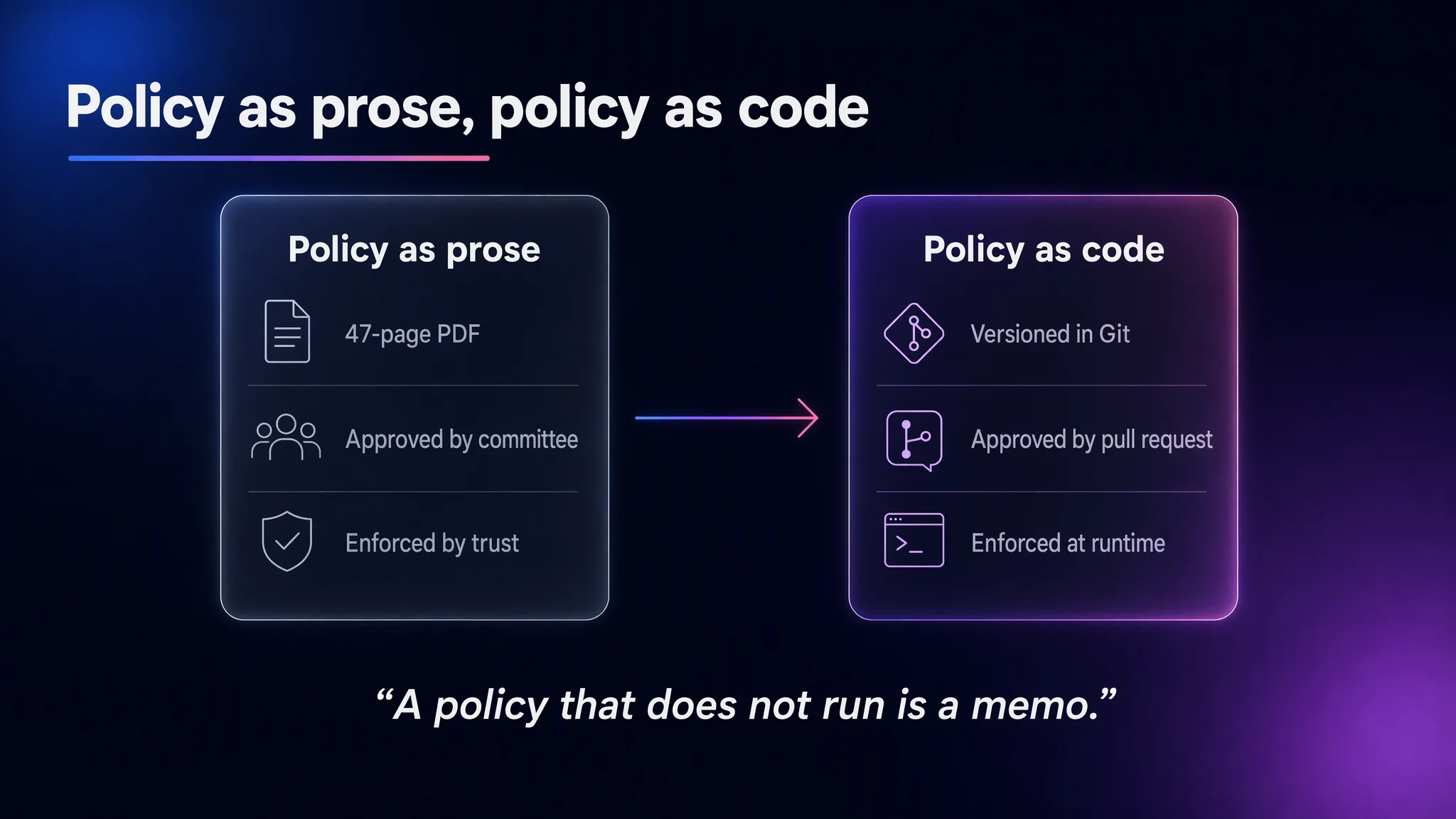
A policy that warns but cannot refuse is still prose. Source: Building Organizations for the Age of AI (Book 1).
Bands (author’s bands, Book 1 Ch 1 §5.1; whitepaper Part I §3):
| Result | Reading | The sources’ label |
|---|---|---|
| ”No” to four or more | Agents on the roadmap, no operating layer to govern them | ”The 99 per cent" |
| "No” to two or three | Shipping agents without a control plane: exposed | ”The 11 per cent without a control plane" |
| "Yes” or credible “in progress” on at least five | The position from which scaling, to several hundred production agents in the whitepaper’s framing, is safe | ”The 11 per cent with one” |
The labels borrow from the 99/11/95 adoption-signal composite: roughly 99% of large organisations with agents on the roadmap, 11% with agents in production under named owners, and a very high incident signal among early shippers. Book 1 Ch 1 §4.3 calls this a directional composite of three separately sourced signals, not one measured population. Do not quote it as a statistic. This page uses the plain readings in the middle column for that reason.
Reported scores (anecdote). Book 1 reports a mean of about 1.4 out of six across the CIOs the authors ran it with, and a best credible score of 4. The whitepaper puts the highest defensible score across European regulated firms in mid-2026 at four. Both say a CIO who scores six has not looked closely. Treat a six as a prompt to re-check the evidence column.
Closure order (Book 1 Ch 1 §5.3). Close them in this order: inventory (1), then wranglers (3), bounded-agency records (2), the unified control map (6), policy-as-code (4), and audit evidence (5). The first three can start within weeks; the last three are programmes. Starting with 4 and 5 because they feel like progress fails: without 1–3 the platform has no operating layer to act on.
Wording differences. Question 6 in Book 1 names the frameworks (ITIL, COBIT, CIS, DORA, the AI Act, OWASP Agentic). The whitepaper names the domains (service management, governance, security, resilience, AI). The test is the same: one owned artefact, not one per function. The whitepaper frames the instrument explicitly as a CIO instrument, not a board instrument.
What to do with the result (Book 1 Ch 1 §7).
- This week: score it yourself; do not delegate. Date it, and send it to the CRO and the head of internal audit with one paragraph of context, so the baseline exists outside your own head.
- Within a month: commission the agent inventory, about six weeks of work. Cover explicit agents (built or procured), embedded agents (agentic features inside SaaS already in use) and experimental agents (proofs of concept that never went through change control). Book 1 expects the experimental category to be the largest.
- Within a quarter: name a wrangler for every agent. Book 1’s guide for a large firm is no more than five to seven agents per wrangler.
- At the board: replace the use-case slide with the score, in the form “we have x agents in production, our diagnostic score is y/6, and we commit to z by year end.”
- Smaller firms run the same diagnostic. Book 1 argues their exposure is sharper because they have fewer redundant controls. Their first-count agent inventory is typically five to twenty agents.
The ten-pillar control-plane scorecard
Score each of the ten cloud capability pillars (identity, network, security, compute, data, integration, observability, governance, automation, AI platform control) on three dimensions at 0, 1 or 2. Each pillar scores 0–6; the total is out of 60 (Book 1 Ch 5 §7). Book 1 reports that no organisation scores above 50 on a first pass. The pillar definitions and per-cloud components are on cloud and hosting.
| Dimension | 0 | 1 | 2 |
|---|---|---|---|
| Ownership clarity | No accountable owner | Owner named, mandate unclear | Accountable owner with a mandate |
| Policy coverage | Controls on paper only | Some controls enforced as code | Controls enforced and evaluated as code |
| Observability | Not observable | Partly observable | Evidence answers the pillar’s auditor question |
The level descriptions are this site’s anchors, shared with agent readiness. Book 1 defines the three dimensions and the 0–2 scale, but not the wording of each level.
Use the auditor’s question as the observability test. A pillar scores 2 on observability only if its evidence answers the question Book 1 Ch 5 §5 assigns to it (Book 1’s board slide sets ten minutes; using it as the scoring test is this page’s recommendation):
| Pillar | Auditor’s question (Book 1 Ch 5 §5) |
|---|---|
| Identity | Show every identity that touched system X this week, including agents. |
| Network | Demonstrate that no agent in development can reach production data. |
| Security | How quickly can you detect prompt injection? |
| Compute | What runs your critical or important functions? |
| Data | Where is sensitive data, and who can read it? |
| Integration | Which APIs and MCP servers are exposed, and who calls them? |
| Observability | Show the audit trail for action Y. |
| Governance | Who approved this exception? |
| Automation | Was this deployed through an approved pipeline? |
| AI platform control | What can this agent actually do? |
The 90-day plan (Book 1 Ch 5 §7). Pick the two lowest pillars. Book 1 expects them to be AI platform control (because it is new), plus integration (MCP servers not yet under control) or observability (the evidence schema not yet adopted). A realistic 90-day target moves one pillar from 2 to 5. A plan to move all ten by one point is, in the source’s word, theatre. Run a weekly 40-minute forum until the pillars stabilise: chaired by the wrangler lead, with one representative from each framework team and one from each pillar under work. In parallel, extend one practice per framework altitude: change enablement, managed data and asset inventory are Book 1’s starting points.
Owner floor. A large firm runs ten capability groups with one accountable director each. A firm of about 1,000 people combines them under at least five owners, two pillars each on average. Book 1 warns that one owner for all ten creates a single point of failure for the whole control plane.
Pre-flight check (Book 1 Ch 5 §8). Before scoring, check that the frameworks and the cloud organisation are operationally real. One test: ask three randomly chosen practice owners for their practice’s KPI last quarter. If two cannot answer, the framework is shelf-ware, and pillar scores built on it will mislead.
Station readiness (pointer)
The third instrument scores the three to five systems the firm’s last hard change had to cross. Each station gets 0–3 on four questions: can an agent learn what it is, catch a wrong change cheaply, undo it cheaply, and see the outcome? The station’s score is the lowest of the four, and the change’s score is its lowest station. At 0–1 an agent assists and a human reads every step. At 2, bounded repetitive work can be handed over with outcomes checked. At 3, a station is a candidate for standard changes without a reviewer, inside machine-enforced limits. The anchors, the record and the funding rule (low score against high dependence first) are on agent readiness. Book 09 Closing says never add the station score to the ten-statement total.
Ten evidence-scored statements
Book 09 Closing’s factory readiness score. Score each statement 0 (no), 1 (partly), or 2 (yes, with evidence). A 2 means you can put your hand on a record: a signed document, a register, a query result. Something you believe but cannot show scores 1. A plan scores 0.
| # | Statement | What earns a 2 (paraphrased from Book 09) | Evidence to pull (recommendation) | Start here |
|---|---|---|---|---|
| 1 | Every agent has a named owner | A register entry for every agent the platform’s logs show running, each naming a person, not a team; register count equals log count | Registry export and runtime agent count, same day | Accountability |
| 2 | Agents have their own identities | Agents never act under the identity of whoever started them; the access review treats agents as a separate principal class alongside people and workloads | Last access review, showing agents as a principal class | Identity and secrets |
| 3 | There is one evidence record | One query answers the twenty-change sample: who or what acted, under what limits, with which model, approved by whom (person or machine), with what outcome, each recorded at the moment of the act | The query and its output for last month’s sample | Audit evidence |
| 4 | The routing gate sees where tests came from and what a change touches | The auto-approval score takes two inputs: who wrote the tests, and how many components depend on what changed. Control values sit on a list, and any change to one goes to a reviewer. Where nothing is auto-approved, score the rules that assign reviewers on those two inputs | Gate configuration; the signed control-values list | Change governance |
| 5 | The CRO has signed a control budget | A signed band on how fast change may arrive relative to the capacity to stand behind it, with a measure, a threshold and consequences that follow without a meeting | The signed band and the last automatic consequence it triggered | Control budget |
| 6 | Usage is measured for every shipped product | A list of everything shipped in the past year, each with last month’s users or calling systems, read from the product itself | Product list with usage source per row | Factory measurement |
| 7 | Every agent loop has a stop condition | Each agent has a count, cost, time or repetition limit that stops it with no human in the loop, and the limit has been tested at least once | Per-agent stop condition and test date | Running the factory |
| 8 | Reversal is decided before release | Change records carry the named way back before deployment; the last rehearsal of a way back has a date | Sample change records; rehearsal log | Release engineering |
| 9 | The seven owners are named | Seven names in one place, with anyone holding more than one seat declared | The seat list | Seven names |
| 10 | The threshold for building is set | A signed document with numbers: how many products, on how many genuinely shared patterns, over what horizon, one of them shared data with a stated promise about meaning and freshness. “Below the line, we buy.” | The signed threshold and last count | Build, configure or consume |
Bands (Book 09 Closing):
| Total | Band | Meaning | Next action |
|---|---|---|---|
| 0–7 | Pilot | Whatever the dashboards say, the agents are experiments | Keep them away from consequential change; start at line 1 of the ninety days |
| 8–14 | Building | The usual result a year into a programme | The zeros show which of the ninety-day lines were skipped |
| 15–20 | Running | Re-score next quarter | A running factory can slip back into building without anyone deciding it should |
Read statements 4 and 5 together. Book 09 calls them the pair that fails late: full marks on the other eight still allow a gate to pass a change whose own tests were built to confirm it, at an arrival rate no one has signed off. A firm scoring 2 on statement 5 but 0 or 1 on statement 4 has a signed band over a gate that cannot see what matters (recommendation).
Inputs the statements assume. Statement 3 needs the twenty-change sample: twenty changes from last month, drawn at random by someone outside the teams, with approver, what was checked, test origin, minutes to approval, and whether a control value was touched. Book 09 adds the morning drill: timing an unannounced supervisor-style question. Both are defined on audit evidence. Run them first (recommendation): statement 3 cannot honestly score 2 without them.
Reading the results together
The instruments sit at different altitudes and fail in different ways. Read them as a stack, top down, and act on the lowest layer that is failing (recommendation):
| Pattern | What it means | Act first on |
|---|---|---|
| Six-question: “no” to four or more | No operating layer; every other score is premature | Inventory, wranglers, bounded-agency records, in that order |
| Six-question passes, pillar scorecard has two pillars at 0–2 of 6 | The control plane has holes where agents will cross | The 90-day plan on the two lowest pillars |
| Pillars healthy, lowest station 0–1 | The platform is ready but the systems agents must change are not | Readiness money worst-first, weighted by dependence (agent readiness) |
| Ten statements in Pilot | The factory cannot yet carry consequential work, whatever the platform scores | The implementation roadmap from line 1 |
| Ten statements in Building, zeros on 1, 2 or 9 | Ownership and identity gaps | Accountability, identity and secrets |
| Ten statements in Building, zeros on 3, 4 or 5 | Evidence and gate gaps: the late-failing pair | Audit evidence, change governance, control budget |
| Statement 10 at 0 and a platform hire planned | Spending ahead of the portfolio rule | Write and sign the threshold before the hire (build, configure or consume) |
| High self-scores with empty evidence columns | Belief, not evidence | Re-score with the evidence column; every unsupported 2 becomes a 1 |
Never send a composite upwards. Report each instrument’s score with its gaps named. Book 09 tells the reader not to send either score upwards as an average. Book 1 tells the CIO to put the six-question score, with the agent count and a commitment, on the board slide.
Size calibration (Book 09 Closing; Book 1 Ch 5 §7). In a firm of a few hundred people, the sheet takes an hour. The seven seats are shared among three or four people and declared. One combination must be refused: a single person who builds the controls on the agents and also tests whether they work. In such a firm the threshold will usually say buy. A firm of a few thousand, with technology under one head, gets the organisational work nearly free. It should borrow the operating model, size the controls to its own risk, and run the threshold hardest, because it is the most likely to fail it.
Diagnostic record
Keep each run as a dated record, so the next run is a comparison and not a fresh debate. This template is a recommendation; the sources prescribe no format.
| Field | Content |
|---|---|
run_date | Date scored |
scored_by | The accountable person who did the reading |
instrument | six-question, pillar scorecard, station, ten statements |
item | Question, pillar-dimension, station or statement number |
score | As the instrument defines it, or unknown |
evidence_ref | Pointer to the record, query or signed document; empty means the score is at most 1 (or “no”) |
unknown_owner | For unknown items, the named person who should know |
gap_action | The page or ninety-day line that closes it, with an owner |
rescore_due | Next run (quarterly for the ten statements; after each 90-day plan for the pillars) |
Send the six-question result to the CRO and the head of internal audit on the day it is scored, as Book 1 advises.
Failure modes
| Failure | Recognise it | Recover |
|---|---|---|
| Scoring from belief | 2s with nothing in the evidence column | Apply Book 09’s rule: believed but unshown scores 1; a plan scores 0 |
| One maturity number | A board slide with a single blended percentage | Report each instrument separately with named gaps |
| Delegated diagnostic | The six questions answered by a team, not the CIO | The CIO re-scores personally |
| Starting with the platform | Funding policy-as-code and evidence pipelines before inventory and owners | Follow the closure order: 1, 3, 2, then 6, 4, 5 |
| Ten pillars at once | A 90-day plan moving every pillar by one point | Two lowest pillars only |
| A six out of six | A perfect score on the first run | Re-check against the evidence column; the sources treat six as not yet looked |
| Quoting 99/11/95 as a statistic | The composite presented as a survey result | Label it directional, or drop it |
| No re-score | The last run is older than two quarters | Book the quarterly re-score of the ten statements |
Acceptance checks
- The six-question diagnostic was scored by the CIO personally, dated, with an evidence reference per “yes”, and sent to the CRO and head of internal audit.
- The pillar scorecard shows thirty cells (ten pillars × three dimensions); each observability 2 answers its auditor’s question from evidence.
- The 90-day plan names the two lowest pillars, a target score for each, and the forum’s chair.
- The station scores for the last hard change are recorded on the station assessment record, and are not added to any other total.
- The ten statements are scored with an evidence reference for every 2. The twenty-change sample and morning drill were run before statement 3 was scored.
- Statements 4 and 5 are reported side by side.
- Every
unknownnames a person. - Each gap is mapped to a page or ninety-day line with an owner, and a re-score date is set.
Source status
- One instrument, two sources. The whitepaper’s six questions summarise Book 1 Ch 1 §5 and cite it. The bands match. The reported scores differ in framing: Book 1 gives a mean of about 1.4 and a best of 4, the whitepaper a highest defensible score of four in mid-2026. Both are anecdote.
- The pillar scorecard. Book 1 Ch 5 §7.1 describes a per-pillar 0–6 scale, and §7.2 a 0/1/2 score per dimension totalling 60. These are consistent: three dimensions × 0–2 per pillar. The level wording is this site’s own.
- The ten statements, bands and seven seats are, in Book 09’s own words, new to that edition and the authors’ own: a starting point, not a standard.
- Not covered here. The sectoral regulatory diagnostic is on the regulatory map, and the station method on agent readiness. These are different instruments.
Source material
- Whitepaper (Building Organisations for the Age of AI), Part I §3, The diagnostic that locates the firm
- Book 1 (Building Organizations for the Age of AI), Chapter 1, The Adoption Gap (§4.3 the 99/11/95 composite; §5.1–5.3 the Adoption Gap Diagnostic; §7 Monday morning and board conversation)
- Book 1 (Building Organizations for the Age of AI), Chapter 5, The Framework Backbone and the Cloud Control Plane (§4.2 ten pillars; §5 pillar table and auditor's questions; §7 pillar scorecard and 90-day plan; §8 pre-flight check)
- Book 09 (Everything Is Green), Closing, An Afternoon with a Pencil (three rules; station score; ten statements and bands; seven owners; at your size)
Related guidance
-
 The Implementation RoadmapSequence the factory as a dependency graph, not a calendar: the closure order for the governance gap, a written portfolio threshold, six overlapping phases over eighteen months with entry conditions, exit evidence, 'not yet' lists and pass/soft-fail/hard-fail gate questions, tranche funding released on exit evidence, a programme RACI, size, maturity and sector calibration with four signed trade-offs, and the first week, thirty days and ninety days in dependency order.
- Build, Configure or ConsumeThe layered sourcing decision: a signed portfolio threshold (8 products, 24 months, 3 shared patterns including shared data) decides whether building is available at all; Research Paper 7's four gates decide each capability; Book 2's five weighted dimensions score the contested cases. Covers the annual estate sort, the audit-log export clause for rented workflows, the model-sourcing breakeven test and register, and who owns what is built.
- Control BudgetAn author proposal for a CRO-signed limit on how fast change may arrive relative to the firm's capacity to understand it: the CIO runs the line, the CRO signs the band, only changes with a full record count, two weeks outside the band queues intake automatically, quarter-end widening is signed in advance, and someone outside the squad reviews what the budget held back.
-
 Assess Agent Readiness Across the EstateCheck the estate's control foundations, grade the stations a change must cross on evidence, route work by the weakest station, fund readiness worst-first with a stated split, and make bought products machine-operable at renewal.
- Design the Cloud Production Line and Hosting BoundariesClassify, segment, constrain and observe every workspace at the plane where actions execute, choose hosting routes per request, and keep vendor maturity, contracts and exit equivalence dated and explicit.
-
 The AI Delivery Factory: Operating ModelThe factory's six connected parts, the control gap it closes, the handover curve that governs what agents may take over, and how to start one without rebuilding your tooling.
- The Enterprise Agent Control PlaneThe firm-owned services that make every agent action identifiable, decidable, approvable and reconstructable: the ownership boundary, six planes and their contracts, the Policy Decision API with its latency budget, the persistence schema, the build sequence and the tests that show it works.
-
 Accountability and OwnershipHold provenance and accountability apart on purpose: four named accountabilities per product, a human owner for every agent change, seven named seats, a signed Build/Run RACI and a first-line/second-line boundary that survives consolidation.
-
 The Audit Spine and the Evidence RecordHow to capture, join, protect, retain and prove per-action evidence: the AES v0.1.0 record contract, three capture points and one correlation ID, tiered immutable storage, retention and legal hold, replay rehearsal, the route-approval evidence gate, and the Claude-specific ways evidence goes missing.
- Build a Unified Control MapJoin the firm's AI and technology controls in one traceable operating view: rows are operating concerns, columns are frameworks read at their own altitude, every cell points to live evidence, and existing ITIL, COBIT and CIS artefacts are extended to agents with a five-question test instead of a parallel AI governance track.
-
 Bounded-Agent PatternA class 3 agent lets a model choose the next step, but only inside a registered, validated and enforced envelope of Mandate, Means, Memory and Monitoring.
-
 Identity, Secrets and Configuration for Agent WorkloadsGive every actor one owned identity, size its authority for the worst case, separate runtime from deployment, federate instead of holding keys, refuse impersonation and silent fallback, govern configuration by class, and audit the estate until flagged identities decline.
-
 Design and Operate the Model GatewayBuild the model gateway as the governed edge for every model call: per-client identity, per-request highest-class routing, tokenisation, pinned models, a conformant wire contract, a correlated evidence record, a tested concentration answer, and day-two cost, latency and reliability operations across two estates and three meters.
-
 Change Governance for Agent-Enabled DeliveryRoute agent-speed change by risk without losing the approver: control values that always reach a person, a routing gate that reads the right signals, autonomy earned per change family, a Virtual CAB that prepares a complete dossier, and three bodies with defined escalation.
- Operate the Agent LifecycleInventory, register, sign, zone, review, suspend, recover and retire agents through a six-stage lifecycle with named human ownership, zone-specific authority and evidence at every transition.
- Measure the FactoryRead usage first, then the seven-dimension scorecard; emit a served-request event that separates human from agent callers; label every reported number by evidence tier; watch the two leading numbers of a control gap; treat an unexplained sharp improvement as an alarm; and never turn a participation metric into a target.
- Run the AI Delivery FactoryOperate demand, capacity, the two worker classes, exceptions and evidence as one service: read two leading numbers, keep a handover backlog, gate construction on three conditions, run queues and alerts at agent volume, and count unused products as cost.