Build, Configure or Consume
The layered sourcing decision: a signed portfolio threshold (8 products, 24 months, 3 shared patterns including shared data) decides whether building is available at all; Research Paper 7's four gates decide each capability; Book 2's five weighted dimensions score the contested cases. Covers the annual estate sort, the audit-log export clause for rented workflows, the model-sourcing breakeven test and register, and who owns what is built.
- Version
- 0.1.0
- Owner
- DEIXEI
- Last reviewed
- Reading time
- 42 min
For Cio · Cto · Cfo · Cro · Ai Architect · Platform Engineer · Procurement · Vendor Management · Risk And Assurance · Internal Audit
Sources and details
- Section
- Adopt and fund
- Source works
- Research Series · Book 2 · Book 09 · Book 3 · Book 1
- Source chapters
- 2, 3, 13, 15, 17, 19, 21, 24, 25, 27
- Refresh trigger
- quarterly
Agents have made code cheap to write. They have not made software cheap to own. This page is the decision guide for what a regulated firm should build on its own factory, configure on a platform, or consume from a provider. It applies to applications, to platform capabilities, and to the one input every factory buys, model capability.
Reading the labels. Source claim means a book or paper states it. Author model means a framework the sources propose: the four gates, the 8/24/3 threshold, the five dimensions, the breakeven test, the seven minimum terms. None of these is an industry standard or a supervisory expectation. Recommendation marks this page’s own synthesis, including how the three instruments are layered (owner decision D4). Asset Manager X (AMX) and Bank D are composite firms written for the books. Their figures (a renewal at €372,000 a year, 240 seats, seven candidates) are illustrative, not benchmarks. Vendor facts carry a date and the source that gave it. They are marked [FACT-CHECK] where they are current product claims not yet re-verified against vendor documentation. DORA’s exit-strategy, contractual and register provisions are cited at article level only on the regulatory map, and their dates on the regulatory calendar.
Decisions this page supports
| Decision | Who decides | Section |
|---|---|---|
| May we build at all, or is every build question still “buy”? | CIO, CFO and CRO sign; platform team counts; second line checks | Precondition: is the factory real? and The portfolio threshold |
| Which of our bought applications are candidates to flip? | CIO with procurement, annually | Sort the estate every year |
| For one capability: consume, configure or build? | Architects, recorded once in the catalogue | The four gates |
| A contested case: how do we score it? | Product team, with finance | Gate 4 |
| What must a renewal of a rented workflow contain? | Vendor management, second-line technology risk | Renting a workflow rents the record of your controls |
| Which model route and class serves this workload, and is self-hosting justified? | AI platform owner, data protection, finance | Model sourcing |
| Who owns a built or agent-created application for its life? | Head of the factory, named before the build | Ownership after the decision |
| How is the factory itself funded and justified? | CFO, audit committee | Funding the factory |
Three instruments, one decision
The corpus gives three sourcing instruments. They use different criteria. The coverage audit flagged the difference, and this page does not blend them. It layers them, each at the altitude where it applies (recommendation, per owner decision D4):
| Layer | Instrument | Source | Question it answers | When it runs |
|---|---|---|---|---|
| 1. Portfolio rule | Written threshold: at least 8 products over 24 months on at least 3 genuinely shared patterns, one of them shared data | Book 09 Ch 3 and Closing; Book 2 Ch 27 §4.2 | Does the firm have the portfolio that makes building pay? Below the line, every build verdict becomes “buy, better”. | Once, before the first platform hire; recounted at each relevant renewal and at least annually |
| 2. Decision flow | Four gates in order: differentiation, agent-operability, ceilings and exit, honest return | Research Paper 7 §9 | For one capability: consume, keep at arm’s length, configure, or build as code? | Once per capability, recorded in the catalogue and re-decided on a date |
| 3. Scoring | Five dimensions (data gravity, integration surface, regulatory posture, total cost of ownership, exit cost), the last two weighted double | Book 2 Ch 25 §5, §7 | How does a contested candidate fall, and is “neither purely” the answer? | Inside Gate 4, and in the annual sort |
Where they differ, and what this page follows.
- What stays bought. Paper 7 §7 consumes a capability that is commodity, evidence-bearing and “alive” (identity, payments, electronic signature, document retention, collaboration). Book 2 Ch 25 §5 and Book 09 Ch 3 keep bought anything whose value is a network, proprietary data, a regulated utility, a deep domain engine, or R&D shared across many customers. The tests overlap but are not the same. This page applies both at Gate 1: a candidate that meets either is consumed.
- Model sourcing. Book 2 Ch 17 calls its ordered model questions “the four sourcing gates”. Paper 7 §10.4 calls the same sequence “four questions”. These are not the capability gates above. This page says capability gates for §9 and model-sourcing questions for §10.4, to avoid the collision.
- Who signs the threshold. Book 2 Ch 27 §7 takes it “to the CFO and CRO before the board”. Book 09 Closing line 9 names the CIO, CFO and CRO. This page follows Book 09: three signatures.
Precondition: is the factory real?
Book 2 Ch 25 §7 puts one gate in front of every build question. If the following are not running (on a roadmap does not count), the answer to every build question is still buy:
| Component | Running means (this page’s gloss) | Reference page |
|---|---|---|
| Standard application foundation | A new application inherits identity, logging, secrets, deployment path and evidence without anyone assembling them | Application foundation |
| Recipes | Assembly and release go through a governed, versioned path | BOM and recipes |
| Automation factory | A governed workspace can be provisioned without hand assembly | Factory model |
| Evidence by construction | Built applications emit to the firm’s own evidence record in its one format | Audit evidence |
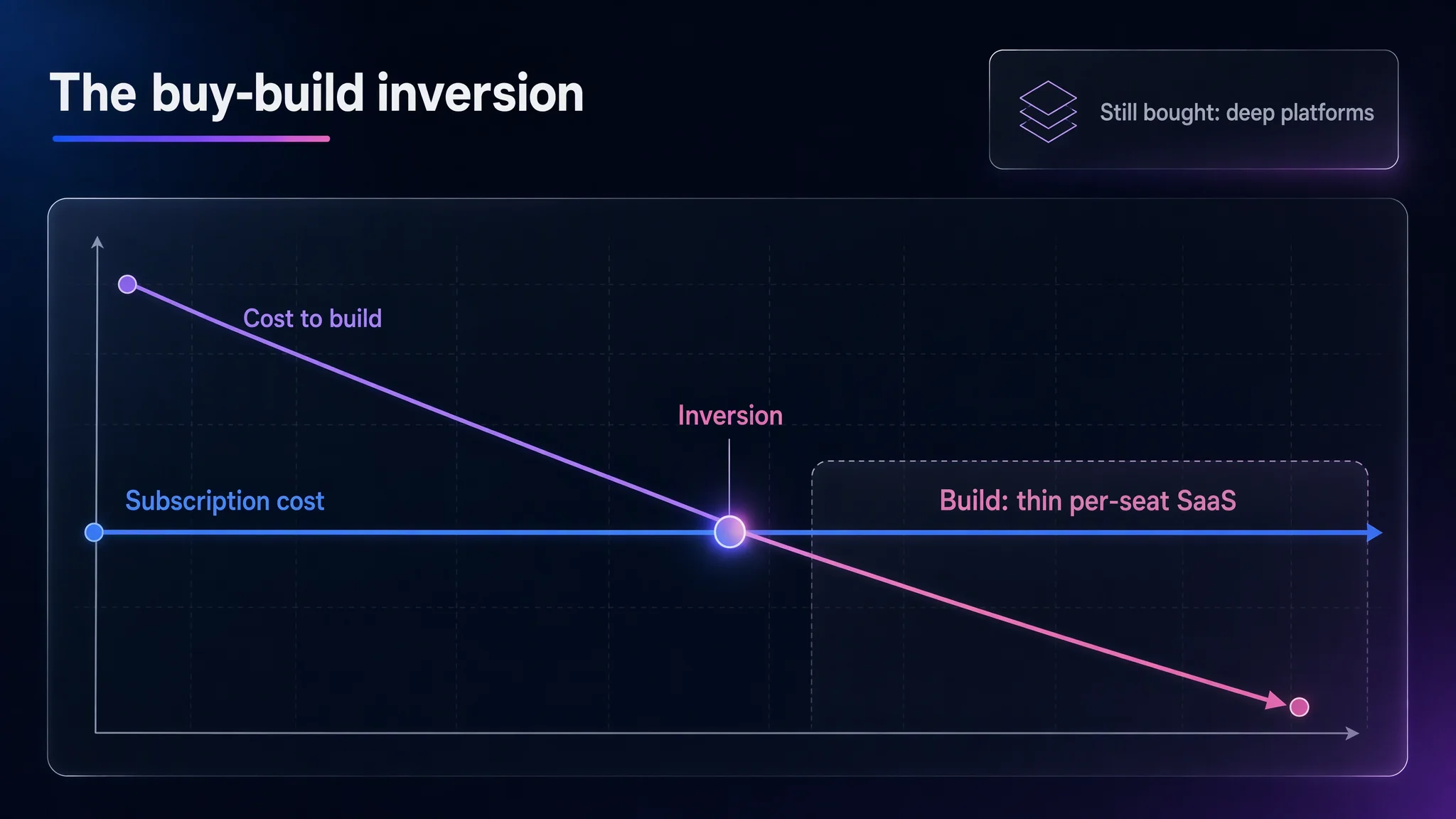
Why (source claim, Book 2 Ch 25 §2–§4; Book 09 Ch 3). Code was never most of the cost. The plumbing was: roles, four-eyes approval, secrets, logging, a pipeline, an audit log internal audit accepts. Each item also needed a handoff between teams. With a factory, that plumbing is inherited, and only the thin layer of business logic remains to build. Without one, the firm rebuilds all of it for a single product and owns every patch and audit question afterwards. Book 2 calls that outcome the bespoke-software graveyard of the 1990s.
Source: The AI Delivery Factory, Chapter 25, Figure 25.1.
Second precondition: never a factory for one product. Reuse is the engine, and reuse needs a portfolio (Book 2 Ch 25 §4, §8). Research Paper 8 (§3.6) states the mechanism: compounding works only where the products’ bills of materials overlap. A factory that serves a single product is therefore a poor investment. If the roadmap names one product and no second, either load real portfolio demand into the factory or buy the product and shelve the factory until the demand exists.
The portfolio threshold, signed before the first platform hire
The rule (author model, Book 09 Ch 3; Book 2 Ch 27 §4.2). Write the threshold as a one-page document with numbers in it, and have it signed before the first platform hire. The default starting values are:
| Clause | Default | Calibrate? |
|---|---|---|
| Products | At least 8 products the firm will build | Yes, to the estate |
| Horizon | Over the next 24 months | Yes |
| Shared patterns | Drawing on at least 3 patterns they genuinely share | Yes |
| Data clause | At least one of those patterns is shared data: a data contract with a written promise about what it means and how fresh it is, and its quality declared (Book 2: “declared quality SLOs”) | No. The sources say not to calibrate this clause away. |
| Below the line | ”Below that line, we buy.” | Must be stated |
The “genuinely shared” test (Book 2 Ch 27 §4.2; Book 09 Ch 3 note). Shared infrastructure does not count. Running on one container platform shares nothing that compounds. Instantiating one recipe and reading one governed data set does. Count the overlap from the bills of materials the firm already holds (see BOM and recipes). If the overlap cannot be counted, the firm lacks the instruments to run the gate, and the source treats that as the first finding.
Why the data clause is fixed. The two authors disagree on the order of work, and the clause turns the disagreement into a measurement. Marcio Parente’s position is factory first: governed data contracts are factory artefacts, built on the same line, and a data platform built ahead of the factory inherits the old sprawl in tables. Roberto’s counter-position is that reuse compounds through data, not code, so applications built before governed data exists cannot use each other’s data. Book 2 Ch 25 rules factory first and keeps Roberto’s caution as the named discipline inside that ruling. Book 09 Ch 3 leaves the order unsettled. Both treat the data clause as the test: if the first products come to share governed data without a data programme ahead of them, factory first was right.
Who counts, and how
| Step | Owner (recommendation, following the Book 09 composite) | Acceptance |
|---|---|---|
| List candidate products for the horizon | Product leads, platform lead, second line (each adds its own, e.g. a breach register kept in a spreadsheet) | Every candidate named, with its source |
| Count shared patterns | The platform or measurement team, not the people who want to build | Counted from each product’s own records and BOMs, not from owners’ promises |
| Check the count | Second-line risk | Second-line sign-off on the count sheet |
| Sign the threshold | CIO, CFO, CRO | Three signatures, dated, before the first platform hire |
| Record the cost of waiting | CIO | The cost of each shorter or bridging term (see below) written under the rule |
Composite example (Book 09 Ch 3, Ch 13). AMX listed seven candidates: the exception tool, an attestation tracker, a complaints log, two approval workflows, a control-breach register and the product teams’ own plans. It found two genuinely shared patterns (an approval chain and attached-document handling) and no shared data. That is below the line, so the firm renewed. At the next renewal the count was six products, two patterns, no shared data. The CIO renewed again and added a dated condition to the threshold: a named shared data set, under one stated promise with declared quality, read by at least two of the six products by a fixed date. If the condition was not met, the next renewal would be for three years and the board would be told why. Copy the form (recommendation): a threshold that fails gains a dated condition, not an exception.
Below the line is a result, not a failure. Book 2 Ch 27 §7 says a CIO who counts four products and one shared pattern, and buys, has done the most valuable thing in the chapter. Book 2 Ch 27 §4.2 adds a second view, from Marcio Parente’s layered-model paper: below a certain scale, buy several of the lower layers, retaining in-house only what regulation effectively requires (identity, observability, evaluation). Small firms are the most likely to fail the threshold, and Book 2 Ch 27 tells them to run it hardest. Book 09 Closing gives a firm of a few hundred people, with perhaps seventy engineers, a usual outcome of “buy”. The first ninety days then turn to renewal terms and identity rather than building. Bank D (composite, a platform team of forty people) builds “almost nothing”: only where reuse is near-certain and lock-in genuinely hurts. It buys portably, for exit, otherwise (Book 2 Ch 25 §7).
The threshold is statement 10 of the factory readiness score. Its place in the first ninety days is on the implementation roadmap.
Sort the estate every year: the renewal book
The first move is an inventory, not a build (Book 2 Ch 25 §7). List every application the firm pays for per seat. Sort each into three lists:
| List | What belongs here | What to do |
|---|---|---|
| Stays bought | Value lies in something the firm cannot manufacture (the five moats below), or Gate 1 consumes it | Buy better: machine-operability scorecard, minimum terms, exit-ready contracts. This list is also the firm’s negotiating position. |
| Flips | Thin SaaS: rented per seat, its substance records, forms and a workflow, its only moat the old cost of building | A build candidate only above the threshold. Book 09’s composite marks every line in this column “only above the line”. |
| Contested | Parts pull each way | Score on the five dimensions; often split the product (build the thin differentiated layer, keep the deep engine bought, joined by a contract) |
Run it on purpose, once a year, not when a vendor triples a quote (Book 2 Ch 25 §7; Book 09 Ch 3 note). Hold it on the same annual cadence as the factory’s continue/shrink/expand review, and read it beside the deprecation ledger. The ledger reprices both sides of keeping a legacy technology. The cost of keeping it now includes the agent capacity it forecloses, which agent-lane telemetry can estimate per technology. The cost of retiring it fell, because migration is the best-evidenced agent win. Treat these as source claims from Book 2 Ch 25 §4; the readiness caveat is on agent readiness. Add the model contracts to the same book: one line per minimum term per data-receiving route, marked signed or missing (Book 2 Ch 25 §7).
Composite (Book 09 Ch 3 note). AMX’s procurement list had never been put in one place. It held more than sixty subscriptions, a dozen renewing within the year, and three bought twice by different departments. Do the de-duplication first; it is free money.
Rank build candidates by reuse, then by moat depth. In a large firm, sequence builds behind the reuse they generate: build a shared approval engine before a one-off dashboard (Book 2 Ch 25 §7). For new products, Book 2 Ch 21 §5 adds two rules. Rule 1 ranks candidates by moat depth: how much of the firm’s own proprietary data and process they draw on, not how loudly they were requested. An application running on data every competitor has is a commodity to buy. Rule 2 sizes each bet to a learning horizon: the question it answers and the date it answers by, not a scope. The bet card that carries both is defined in Book 2 Ch 21.
Decide each capability through four gates
Research Paper 7 (§9.1) proposes four gates, taken in order. A candidate stops at the first gate that decides it. The paper labels the framework a proposal that has not been tested in a controlled comparison (§11).
| Gate | Question | If it decides | Outcome |
|---|---|---|---|
| 1. Differentiation | Commodity, evidence-bearing and alive? Or a five-moat product? | Yes | Consume as a foundation; agents use it through its interfaces and never re-implement it |
| 2. Agent-operability | Machine-operable surface, line-comparable artefacts, source-control integration, keepable change record? | No | Keep at arm’s length; it does not become a shared part of the factory |
| 3. Ceilings and exit | Documented limits clear of projected load, and a realistic exit for a CIF-supporting component? | No | Build as code (this page’s layering: only above the threshold; below it, buy a better-fitting product) |
| 4. Honest return | Full cost on both sides, measured outcomes only | Either way | Configure the platform or build as code |
Gate 1: differentiation
The three never-build properties (Paper 7 §7, argument). Consume a capability that holds all three:
- it is a commodity that confers no differentiation;
- it is load-bearing for security or compliance evidence that auditors expect from an established third party;
- it is alive: regulation, protocols or the attack surface keep changing, and a provider already funds the work of keeping up.
Paper 7 names identity, payments, e-signature, document retention and core collaboration as meeting all three. The paper reports finding no regulated institution that has published a never-build policy. The list is reasoning, not precedent.
The five moats (Book 2 Ch 25 §5; Book 09 Ch 3 note). A product also stays bought when its value is a network everyone else is on (a payment scheme, a counterparty network); proprietary data the firm cannot assemble (market data, a benchmark, a rating); a regulatory utility only an authorised operator may run (clearing and settlement, trade repositories, e-invoicing rails); a deep domain engine whose moat is decades of specialist work and validation history (a risk-analytics library, an actuarial engine); or R&D economies of scale a vendor’s customer base still beats. Cheap construction touches none of the five.
Decide at a finer grain than the product. Most solutions contain both commodity and differentiating parts (Paper 7 §7). In authentication, the protocol flows, multi-factor mechanics, session handling and token rotation are commodity. The authorisation model, user model and tenancy rules are the firm’s own. Buy the first and own the second. Paper 7 treats agent identity as unsettled ground and so a reason to consume it from a provider that tracks the changes.
Workflow is the important exception. Approval logic fails the commodity test, because an approval flow encodes the firm’s control model. In a regulated firm, that is differentiation. The catalogue answer is: buy or configure the engine, and own the control model as versioned, testable code that an agent can read (Paper 7 §7, §9.2). Book 09 Ch 3 shows why. Three analysts at AMX gave three different rules for when a break could be written off without a second approver, and the vendor’s settings allowed all three. Before such a tool can be rebuilt, someone has to write down what it is.
Gate 2: agent-operability
The candidate platform must expose four things (Paper 7 §9.1). Book 2 Ch 25 §5 states a close equivalent as its RFP criterion: an API surface, diffable and versionable artefacts, structured output with stable exit codes, and evidence emission.
| Check | Passes when |
|---|---|
| Machine-operable surface | An API covers everything the GUI can do |
| Comparable artefacts | Configuration is text the firm can diff, review and roll back, not state trapped in a designer |
| Source-control integration | Artefacts live in, or round-trip to, the firm’s repositories |
| Keepable change record | Each change leaves structured output, stable exit codes and evidence the firm’s evidence store can consume |
A GUI-only platform is not impossible for agents. Paper 7 §4.2 reports the “agents cannot drive GUIs” claim as dead, and finds no independent measurement either way. Such a platform fails Gate 2 because its work cannot be repeated or audited at factory pace. It may still be used at arm’s length. Partial passes are real: a platform with programmable interfaces and exportable definitions passes, and a hosting feature whose artefacts sit outside the platform’s own source control passes with a noted gap. Book 2 Ch 25 §5 and the Book 09 Ch 3 note both weight machine operability as heavily as security posture. The renewal scorecard and the M&A due-diligence checklist built on the four readiness properties are on agent readiness. Book 2 Ch 25 §5 adds one discipline: scoring a target “ready” routes what the agent lane can touch, but does not score it safe. The risk tier still authorises autonomy.
Gate 3: ceilings and exit
Load margin. Documented throttle, payload and nesting limits should sit comfortably clear of projected load. Paper 7 uses ten times projected load as a working heuristic and says the firm should set its own.
The rebuild trigger (Paper 7 §6.1). A platform ceiling rarely announces itself as a reason to rebuild. It shows up as a workaround: parent and child workflows, extra connections, hand-partitioned loops. Each workaround brings code-like complexity into the configured artefact and keeps the platform’s constraints. The rule: the second structural workaround is the rebuild trigger. Once a configured workflow needs a second such workaround (for throughput, payload or nesting), make the rebuild decision on the record at that point. Paper 7 calls the threshold of two a judgement with no calibration data. Record each structural workaround against the catalogue entry so the count is a query, not a memory (recommendation).
Documented ceilings, as of November 2026 per Research Paper 7 §4.3 and §6.1 [FACT-CHECK: limits change with plan and revision; re-read each vendor's limits page before relying on a figure]:
| Platform | Documented limits cited by Paper 7 | Documented remedy |
|---|---|---|
| Azure Logic Apps (Consumption) | 500 actions per workflow, nesting depth 8; 100,000 action executions per rolling 5 minutes (300,000 in a preview high-throughput mode); 100 MB message, with some connectors lower; Service Bus connector up to 6,000 calls per minute. Standard (single-tenant) has no per-interval execution limit. | Parent and child workflows; multiple connections; manual partitioning with take() and skip(); nested workflows |
| AWS Step Functions (standard) | 25,000 execution-history events; 256 KiB task input or output | New execution; child workflows; pass a pointer to object storage |
| Google Cloud Workflows | 128 KB definition; 512 KB memory for all variables in one execution | (not stated) |
| Google Application Integration | 100 tasks per integration | Split across integrations |
Exit for CIF-supporting components (Paper 7 §6.3). A workflow configured into a proprietary platform that supports a critical or important function brings that platform into the firm’s exit planning. The plan must answer three questions: what would replace it, how long the transition takes, and whether the configured logic can be extracted in usable form. The same capability built as code on commodity compute exits more simply. Paper 7 reads DORA’s exit-strategy and contractual exit-and-transition provisions as a weight on the build side for such components, not a verdict, and leaves the weight to legal and risk. The articles and their status are on the regulatory map. The exit rehearsal is on vendor concentration and exit.
Gate 4: honest return on both sides
Only now compare configuring with building, and only with the full cost on each side (Paper 7 §9.1):
| Side | Cost lines that must appear |
|---|---|
| Build as code | Tokens. Human review capacity, sized for a first-attempt failure rate of roughly two in five on realistic tasks (Paper 7 §3.2: the top SWE-Bench Pro public entry resolved 61.5% on 10 November 2026, a figure the paper says will date). A delivery-stability penalty (§3.4). A maintenance liability: more duplication, less consolidation (§3.3). The run-it-forever obligation: maintenance, patching and security for the application’s life (Book 2 Ch 25 §8). |
| Configure | Licences. Estate governance: someone must inventory, rationalise and retire what the platform makes easy to create (§6.2). Ceiling-workaround risk and cost (§6.1). Exit cost (§6.3). |
| Both | Measured outcomes only. Know which category the work is in: migration and rewrite have documented large wins; new capabilities do not (§5.1). |
Admissible evidence (Paper 7 §3.1, §5.2).
- A self-reported productivity gain is not admissible in a return model (Paper 7’s reading, as of November 2026). In METR’s trial, developers believed AI tools made them about 20% faster when they had measured 19% slower, a gap of about forty points. METR now marks that result out of date, and its 2026 follow-up gives an unreliable signal. The current effect on experienced developers is unmeasured, and any business case that states it as a number is stating an estimate.
- A licence or usage count is an input, not an outcome. Ask for measured delivery outcomes with a stated baseline, and date every figure.
- Migration wins are bounded by category. The Stanford Digital Economy Lab study (April 2026) reports an insurer’s rewrite quoted at 5,000 hours with seven people and delivered in 600 hours with three. The study is self-reported, selected for success and compared against estimates. It is evidence for rewrites, where the old system is the specification, not for new capabilities.
The worksheet for contested cases (Book 2 Ch 25 §7, Table 25.1). Score each candidate buy or build on each dimension, one line per dimension:
| Dimension | Pulls toward buy | Pulls toward build | Weight |
|---|---|---|---|
| Data gravity | Data lives in the vendor’s world | Data already lives in the firm’s estate | 1 |
| Integration surface | Few, stable integration points | Many integrations into systems the firm owns | 1 |
| Regulatory posture | A regulated utility or shared rail | Evidence and control the firm must own anyway | 1 |
| Total cost of ownership | Genuine R&D amortised across many customers | Per-seat cost recurring on undifferentiated logic; include the run-it-forever tail | 2 |
| Exit cost | Portable, low lock-in, real substitutes | High lock-in on a capability core to the workflow | 2 |
Under the scores, put three numbers: (a) the renewal cost over the contract term; (b) the honest build-plus-run cost over the same term; (c) how much of the rest of the roadmap would reuse what the build creates. If the dimensions say “build” but no other product would reuse it, look again. The direct saving alone rarely justifies taking on the run-it-forever obligation. Book 2 says firms score TCO and exit cost too generously in the vendor’s favour, which is why they carry double weight. Keep the worksheet where the whole product team can see it, so the loudest voice does not decide a portfolio question by anecdote.
Composite example: three applications, three answers (Book 2 Ch 25 §6).
| Application | Verdict | Why |
|---|---|---|
| Market-data platform | Buy the data; build the thin analytics layer on top | Proprietary data, regulated feed, data gravity with the vendor |
| Reconciliation exception workflow | Build, and reuse the approval chain (Book 2 assumes a firm above the line) | Data, integrations and evidence all internal; per-seat bill on undifferentiated logic; three-year lock-in. The larger return is the next product calling the approval chain. |
| Client portal | Split | Experience and orchestration built on the firm’s own data; identity federation, consent and accessibility kept bought underneath, joined by a contract |
Book 09 replays the reconciliation case and reaches the opposite result. The firm was below its own threshold, so it renewed. Book 2’s verdict assumes a firm above the line. Book 09 shows what the same tool gets in a firm that is not.
The low-code platform as a governance host
The choice between building and configuring is dissolving (Paper 7 §4). Low-code platforms are becoming hosts for code that agents write. The useful question becomes: which governance layer will host the code the agents write? The candidates are the platform’s inherited identity, data-loss-prevention and connector controls, or a landing zone the firm assembles itself.
As of November 2026, per Research Paper 7 §4.1 and §4.3 [FACT-CHECK: verify current Power Apps code-apps limitations, connector count and licensing, and App Studio regions, against Microsoft and AWS documentation]:
- Microsoft Power Apps code apps (announced generally available on 5 February 2026): React or Vue web applications published to the platform. They inherit Entra authentication and authorisation, connectors (more than 1,500 per the September 2026 documentation), and managed-platform policies (sharing limits, Conditional Access, DLP). Documented limitations: no support for the platform’s Git integration, and compiled assets served from a public endpoint without IP restriction. End users need a premium licence or pay-as-you-go. Under Gate 2 this is a pass with a noted gap.
- AWS and Google Cloud. Step Functions, Workflows and Application Integration are text-defined from the start, which helps review and regeneration. Paper 7 found no equivalent of publishing professional code into a low-code platform that inherits its policies. On these clouds the governance host for agent-written code is the landing zone itself (see landing zone). AWS App Studio was documented in two regions, US West (Oregon) and Europe (Ireland).
Record the decision once: the capability catalogue. The factory’s case does not need agents to win every comparison. It needs the comparison made once, by architects, with evidence, and then reused (Paper 7 §9.2). Keep three things:
- A foundations layer of consumed capabilities (identity, document management, collaboration, payments, electronic signature). Specify in advance how agents are to access each one.
- A capability catalogue of pre-decided answers. Paper 7’s defaults: workflow and approval use an engine configured on the firm’s platform, with the control model owned as versioned code. Forms and user interfaces are agent-written code on a governance host. Integrations use governed connectors first, and custom code past documented ceilings.
- A scorecard per entry: agent-operability, documented ceilings, exit cost, structural-workaround count (recommendation), and a re-decide date. Paper 7 suggests reviewing every three to six months, prototyping before deciding anything close to a boundary, and avoiding multi-year commitments on capabilities whose economics are still moving.
Renting a workflow rents the record of your controls
A firm that rents a workflow tool also rents the record that its controls operated: who approved which write-off, when, and on what grounds. That record sits in the vendor’s database, in the vendor’s format. A supervisor puts the question “show that your controls worked” to the firm, not to the vendor (Book 09 Ch 3). In the composite, nobody at the firm knew what it could take away at exit, because it had never meant to leave.
Clause requirements for any rented tool that holds control evidence (recommendation, built from the Book 09 Ch 3 negotiation; legal owns the wording):
| Requirement | Specification | Why |
|---|---|---|
| Scope | The full audit log, including the approval reason, not only actor and time | In the composite, the first export in the contracted format omitted the reason for each write-off approval. A second negotiation put it back. |
| Frequency and destination | Monthly, into the firm’s own storage | An export “on request” is an exit-time scramble |
| Format | Fixed in the contract (annex the field list), not “the format of the day” | Readable without the vendor’s tools |
| Price | Inside the subscription, not billed at a daily rate | The vendor’s first offer was a paid export on request |
| Exit assistance | Help with a complete final export and transition | Same purpose as the exit-and-deletion term for model routes |
| Embedded AI features | Out of the price until the vendor answers where data goes, how long it is kept, and whether it trains or improves a model | Book 09’s composite removed the assistant feature on these grounds. The same questions are three of the seven minimum terms. |
Verify every export (the running cost nobody priced, Book 09 Ch 3). Each month, a named person in the owning product team lands the export, reconciles its record counts against the tool’s own counts, checks that required fields are present, and keeps the archive readable. Map the exported records into the firm’s evidence record or index them beside it, so a supervisor’s query does not depend on the vendor (recommendation). Put the reconciliation result on the renewal book line.
Buy time with short terms, and price it. Below the threshold, prefer one-year terms where possible, with the log exported (Book 09 Ch 3 and Ch 3 note). In the composite, the one-year option cost about €50,000 a year more than the three-year price. The vendor also offered a three-year term with an 18-month break, for a fee that was most of the difference. A short term is an option on the next count, and the option has a price. Write the price and who funded it under the threshold, as the composite CIO did. Notice dates for the short term go on the renewal calendar the day it is signed.
What stays bought, and how to buy it better
Most of an estate stays bought, even above the threshold. A working factory makes the firm a better buyer of the five-moat products, not their builder (Book 2 Ch 25 §5; Book 09 Ch 3 note). Buying better means:
- Machine-operability scoring at every renewal (agent readiness). The composite AMX asked its position-keeping vendor which screens had an interface behind them. About a third had none, and the answer became the next renewal’s scorecard.
- Building the thin layer on top. Buy the data feed; generate the analytics and reporting layer against its API. Book 2 Ch 25 §4 predicts this unbundling (dated 2026 and labelled a prediction): data, network and regulated-rail providers keep their moat; UI-and-workflow layers get built in-house; and the integration contract, increasingly an MCP surface, becomes the product.
- A test for vendor AI roadmaps (Book 09 Ch 3 note): does the roadmap deepen something the firm cannot build, or decorate the part it now can?
- Leverage. The stays-bought list is a negotiating position. A buyer with a credible internal alternative pays a different price, and account teams can tell.
- Platform-layer buys. Book 2 Ch 25 §4 predicts consolidation at the platform layer (hyperscalers, data providers, regulated utilities), where the buy case gets stronger because every built application runs on more platform. Compare providers on identity, policy and data gravity, not on agent demos. Dated positions, as of August 2026 per Book 2 Ch 25 §4 and Book 09 Ch 3 note: AWS’s AgentCore identity-and-policy story was in several respects ahead of the field in early 2026; Google’s agent platform is strongest where data already sits in BigQuery; AWS Marketplace and Google Cloud Marketplace let bought SaaS transact against an existing cloud commitment.
[FACT-CHECK: current product names, GA status and marketplace terms]Detail per cloud is on cloud and hosting.
One default agent fabric. Book 3 Ch 2 applies the same calculus one layer up: the firm buys the model and builds the control plane around it. An institution needs exactly one approved general-purpose agent path, a small number of specialised exceptions, and the discipline to retire everything else. The default only reduces shadow agents if it is useful, integrated, fast (no slower than the unapproved alternative) and well supported. Choose it for the integration surface, the identity story, the evidence path and the exit route; benchmark scores are a tiebreaker, because they move every quarter. “Default” does not mean single-vendor lock-in: routing, evaluation evidence, suspension authority and exit plans stay with the firm. It does not mean every use case: prohibited uses stay out. And it does not mean no other models. Specialised models are allowed with named owners, a separate path, separate evidence and sub-processor records, and an annual review against the default. Composite, dated as of June 2026 per Book 3 Ch 2: AMX settled on two approved paths. Claude hosted in Microsoft Foundry served general internal assistance. The direct Anthropic API behind Azure API Management served workflows that needed Anthropic-native features (Citations, Files, the Compliance API). Fourteen tools went to two paths and one narrow exception in nine months. [FACT-CHECK: Foundry processor role and data-zone availability; the corpus disagrees on the processor, see vendor concentration and exit] Route mechanics are on deployment routes.
Model sourcing: two axes, four questions, one test
Model capability is the one input every factory consumes, so Gate 1 is already answered: consume it. What remains is how: rented hosted, rented with dedicated capacity, or run on infrastructure the firm controls (Paper 7 §10; Book 2 Ch 17, Ch 25 §5).
Separate the two questions. Economics asks how cheaply and elastically the firm can buy the capability. Control asks how much the firm must own the boundary, availability and continuity. Expensive mistakes come from arguing one on the other’s ground. “Self-host to save money” is a control decision argued as economics, and the sources call it usually false. “Everything is sensitive, so nothing leaves” is an economics decision argued as control, usually over-cautious and costly.
The four model-sourcing questions, in order (Paper 7 §10.4; Book 2 Ch 17 “four sourcing gates”). The first two are control questions and override the rest. The first question that triggers decides.
| # | Question | If yes |
|---|---|---|
| 1 | Sensitivity. May this data lawfully and safely be processed outside the firm’s defined boundary? | If no: an in-boundary deployment (private tenancy or controlled infrastructure); cost is secondary |
| 2 | Continuity. Would loss, throttling or sharp repricing of the primary provider be unacceptable for this workload? | Mandatory second provider or in-boundary fallback behind the routing layer |
| 3 | Difficulty. Does the task need the most capable model, or does a smaller one pass the firm’s quality test? | Hard: the most capable hosted model. Routine: the cheapest tier that passes |
| 4 | Volume and steadiness. Is volume high, steady and predictable? | Only then may self-hosting be considered on cost, and only if the breakeven test clears |
Routing matrix (Paper 7 §10.4):
| Routine task | Hard task | |
|---|---|---|
| Data may leave the boundary | Cheapest hosted tier that passes, with caching and batch pricing; self-host only if the breakeven test clears (economics) | Most capable hosted model (economics) |
| Data may not leave | In-boundary deployment sized to the volume (control) | In-boundary deployment of the most capable model the boundary permits, accepting a capability gap or higher price (control) |
Add a fallback in any cell for a continuity-critical workload. Self-hosting in the top row must name the control it buys. If it cannot, the firm is paying a control premium for an economics problem. Paper 7 offers the opinion that the slice of data that truly cannot leave is usually smaller than first assumed. It cites the Stanford study’s finding that sovereignty was handled through contracts and data minimisation, not model architecture.
The breakeven test at real utilisation. Before approving self-hosting on cost, require five numbers (Paper 7 §10.5; Book 2 Ch 17):
- Fully loaded hourly cost of the serving capacity: hardware or instance, power, and a share of the people who operate it (Book 2: including ops and MLOps headcount).
- Sustained tokens per second the chosen model achieves on that capacity.
- Expected utilisation, the proportion of hours the capacity is busy. Proposals overstate this figure more than any other.
- Effective cost per token = hourly cost ÷ (throughput × utilisation × 3,600).
- The hosted per-token price for comparable capability, net of caching and batch discounts.
Unless (4) sits clearly under (5) at a realistic utilisation, leaving room for the capability gap and the extra operating work, the cost case fails. Argue it on control instead, or drop it. Worked illustration (this page’s arithmetic, invented numbers): €12 an hour, 1,500 tokens per second, 25% utilisation gives 12 ÷ (1,500 × 0.25 × 3,600) ≈ €0.0000089 per token, or about €8.9 per million tokens. At 80% utilisation the same box gives about €2.8 per million. Utilisation, not the hardware price, decides the case. Dated context, per Paper 7 §10.2 [FACT-CHECK: current provider price lists]: one provider’s published list charged a tenth of the base input price for cache reads and gave 50% off for batch processing. Microsoft documents provisioned deployments as billed hourly regardless of tokens consumed, and better suited to predictable traffic than to low or variable volume.
What to standardise. The provider and any self-hosted model are disposable within quarters. The lasting asset is the provider-agnostic router that classifies each request by these questions and dispatches it, with failover for continuity-critical classes (Paper 7 §10.6; Book 2 Ch 25 §5). Keep a modest self-hosted floor warm, not at scale. It serves the sensitive slice, doubles as the resilience fallback for the minimal AI service level, and is a negotiating position: a firm with a credible exit pays a different price. The router, its routing by highest data class, and its spend controls are on model gateway. Data-receiving routes do not open until the seven minimum terms are signed (data classes and lanes). Choose the model class on the factory’s own evaluations and golden records, not on a report’s shortlist (Book 2 Ch 25 §5, §8).
Two review speeds. Prices, model versions, measured quality and utilisation move monthly; review them quarterly on a calendar. Data classifications, contract terms and regulatory constraints move rarely; review them on an event: a new rule, a changed contract term, a provider changing its data-use terms, an outage (Paper 7 §10.6; Book 2 Ch 25 §5).
The model-sourcing decision register
One row per workload class (Book 2 Ch 24 §7; field names below are this page’s, since the source gives the content but not names):
| Field | Content |
|---|---|
workload_class | The class of work routed together |
decision | Route and model class currently chosen (vendor API, private tenancy, controlled infrastructure; frontier, mid-tier, small) |
deciding_question | Which of the four model-sourcing questions decided it |
facts | The facts it rests on: data class, continuity criticality, evaluation result, volume and utilisation, price |
fallback | Required fallback, if continuity-critical (recommendation; not in Book 2’s row) |
owner | A named person |
last_validated | Date |
Run reviews as exception analysis, not re-litigation. Open only the rows where an underlying fact has moved enough to flip the outcome: a price, a model deprecation, a new regulation, a measured utilisation. Bump the date on the rest. Version the register on every review; never overwrite in place. “Why did we route this data there in March?” must have a dated answer. Keep it compact: Book 2 treats the full instrument as tooling, not something for the floor’s wall. Model lifecycle and pinning are on model governance.
Ownership after the decision
Name the lifetime owner before the build starts. A built application has no vendor to sue and no roadmap the firm did not fund. Every feature is one the firm pays for and every incident one it owns (Book 2 Ch 25 §8). Name the product team and the wrangler who own it for its life before the build starts. “Better only if somebody owns it the day after it ships” is the composite platform lead’s condition in Book 09 Ch 3.
Four governance regimes (Book 1 Ch 15 §4.4).
| Regime | Fails through | Governance home |
|---|---|---|
| Bought | Vendor concentration, contract obsolescence, weak exit; embedded AI features outside the original contract scope; AI-feature lock-in | Third-party risk, vendor concentration and exit |
| Built | Technical debt, ownership fade, security drift | The factory’s SDLC, agent-speed SDLC |
| No-code and low-code | Proliferation, shadow IT, ungoverned data movement; Book 1 rates it the highest-risk of the three classic regimes, as of May 2026 | Platform estate governance, registration in the SDLC |
| Agent-created | Assets the SDLC never sees | Every agent-created digital asset inherits its wrangler’s accountability and the governance perimeter of the originating agent |
For example, a flow generated by an agent belongs to that agent’s wrangler, and it must be registered like any other production application. Book 1 expects supervisors to start asking about this under DORA’s ICT-risk provisions. That is a dated prediction, not a requirement.
A built capability is a chosen concentration. Building moves a dependency off the third-party register and onto the firm’s own list of things that can fail (Book 09 Ch 3; Book 2 Ch 25 §2). Built capabilities that the portfolio leans on (the approval engine, the document service, the evidence schema) deserve the concentration and resilience scrutiny the firm gives its vendors. The register treatment of internal capabilities, including the intra-group edge case, is on the regulatory map. Both books frame it as supervisory expectation, not a registration obligation, pending legal review.
Funding the factory: the cost case and the tranches
The threshold says whether to build. The cost case says what consolidating delivery is worth (Book 2 Ch 19). The tranches say how the money is released (Book 2 Ch 27 §4.4).
Count the fragmentation tax first. One agent deployment crosses five domains (cloud, identity, network, security engineering, AI), often under three or four leaders. Count it this way (this page’s counting steps, built from Book 2 Ch 19 §4.1–§4.4 and the §6 composite):
- List the crossings one deployment makes, and the team that owns each.
- For each, record queue wait, the time to reach the front of the queue, not service time. The source’s illustrative range is 3–5 working days per crossing, and 15–25 days in transit per agent.
- Count requeues where one team hands back to another. They multiply the wait rather than add to it.
- Multiply by initiatives per year at the loaded cost of the waiting teams.
- Add the three hidden costs: incident economics (several managers on a bridge before anyone may act), exam duplication (one evidence pack per team, stitched together before the exam), and knowledge loss on turnover (bought again once per silo).
The tax scales with the number of agents, not people, so the cheapest moment to consolidate is earlier than the pain suggests. Present it as an emergent cost between well-run teams, never as a failure of the people in them. The cycle-time figures (about six months fragmented against six to eight weeks consolidated) are engagement-derived illustrations, not benchmarks.
The cost-case pattern (Book 2 Ch 19 §5).
| Move | Content | Discipline |
|---|---|---|
| 1. Current-state surface | The addressable surface only: staff, tooling, vendors, incidents, exams, handoff tax | Not the IT budget. An inflated surface loses the CFO on contact. |
| 2. Proposed-state surface | The same six lines after consolidation | Staff savings through attrition and specialisation, not day-one redundancy |
| 3. Transition investment | Organisation change, tool consolidation, control-plane build, training, backfill | On the first slide |
| 4. Payback | Year-one net, steady-state run-rate saving, the month the firm is ahead | Plain time |
| Rule 5 | Difficulty costs as line items: morale support, retention envelope, transition backfill, drag on in-flight programmes (the §6 composite adds pay-band protection) | Not caveats in an appendix. Separately, invite an independent finance review in month one and refresh the model quarterly (§8). |
| Rule 6 | Counter-incentives at signing: the CRO-signed control budget that throttles intake, and the supervisor named as a customer in the factory charter | A case that funds throughput alone funds the erosion of control |
Build the model with finance as a partner, and walk the CRO through it privately, on paper, before the meeting. The AMX figures (€34.5m surface, €25.2m proposed, €2m investment, sub-year payback) are illustrative only. The consolidation itself is on agent-driven departments.
Evidence dividend and capability sequence (Book 2 Ch 19 §4.5, §7; Ch 27 §4.4). Every artefact that makes the estate ready for agents is also a regulatory artefact: structured logs, machine-readable policy, bills of materials, deterministic builds. One investment earns two returns. Take a capability sequence to the board, never a named paradigm. Each capability carries its own payback line and its own consequence if cut (Book 2 Ch 19 §7; Ch 27 §4.4). The case must survive a board that has never heard the book’s vocabulary, because named paradigms get cancelled whole when sponsors rotate. A practical test (recommendation): strike every coined term from the funding paper; if the argument collapses, it was a brand.
Release money against evidence (author model, Book 2 Ch 27 §4.4):
- Three tranches across the eighteen months, each released when a phase shows its exit evidence, on the audit committee’s calendar rather than on a fixed date. Missing a criterion changes the phase’s scope, not the tranche’s date. Example exit evidence: a signed portfolio threshold; a product created end to end from a recipe; a product that inherited identity, logging, policy and evidence; a lighthouse with adoption numbers, not deployment numbers.
- Showback through both horizons from one reconciled ledger. Treat chargeback as a later, separate go/no-go, because chargeback that does not move budget is theatre.
- Unit cost: cost per governed AI product in production. That is fully loaded build cost plus allocated platform run cost, divided by the products running in production with a complete bounded-agency envelope and full evidence coverage. “Governed” belongs to the unit’s definition.
- Per-pod token and inference budgets enforced at the gateway: alerts at 50%, 75% and 90% of quota, refusal at 100% (model gateway).
- The claimed five-to-ten-times fall in marginal cost per subsequent product is a practitioner estimate: it may frame the argument but must not enter the business-case arithmetic.
Factory-level measures, including the shipped-unused balance, are on factory measurement.
Ownership
| Artefact or decision | Accountable | Consulted | Cadence |
|---|---|---|---|
| Portfolio threshold | CIO (author), with CFO and CRO signing | Product leads, platform lead | Before first platform hire; recount at each relevant renewal and at least annually |
| Threshold count | Platform or measurement team | Second line checks | Each recount |
| Renewal book (three lists) | CIO with head of procurement or vendor management | Platform lead, second-line technology risk | Annually, plus each renewal |
| Capability catalogue and gate decisions | Factory architect | Security, risk, platform lead | Each entry re-decided every 3–6 months |
| Audit-log export clause and monthly reconciliation | Vendor management (clause); owning product team (reconciliation) | Second-line technology risk, internal audit | Clause at each renewal; reconciliation monthly |
| Model-sourcing decision register | AI platform owner; a named owner per row | DPO, legal, finance | Quarterly (economics); on event (control) |
| Lifetime owner of each built or agent-created application | Head of the factory names the product team and wrangler | Operational owner | Before the build starts |
| Cost case and tranche releases | CFO and head of the factory | CRO, audit committee | Per phase exit |
Role labels follow the books’ composites. Map them to the firm’s own seats on accountability.
Failure modes and recovery
| Failure | Recognise it | Recover |
|---|---|---|
| Building without the factory | The build case says “an agent can just write it” and never mentions foundation, recipe or wrangler | Reinstate the precondition: no build leaves the queue until the factory it needs is running |
| A factory for one product | The roadmap names one product and no second | Load real portfolio demand, or buy the product and shelve the factory |
| The gate nobody wrote | Nobody can state the threshold from memory; the “shared patterns” are infrastructure; products cannot reuse each other’s data | Run the count from the BOMs now, at whatever month; if the answer is buy, buying late beats building wrong |
| Counting by the builders | The people who want to build produce the count | Independent count from records; second-line check |
| Under-pricing the run-it-forever tail | A build case with a delivery cost and no multi-year run cost | Price the tail explicitly; the factory lowers it but does not remove it |
| Build-by-reflex | The buy side is argued away, not scored | Hold the five moats and Gate 1; the factory makes the firm a better buyer of them |
| Self-reported gains in the ROI | ”Developers say they are 30% faster” in the return line | Strike it; use measured outcomes with a baseline, dated |
| Workaround creep | A configured workflow on its third parent-child refactor | Second structural workaround triggers an explicit rebuild decision |
| Rented record, unread | Export clause signed but nobody reconciles it; fields missing at exit | Monthly reconciliation with a named owner; fix missing fields at the next negotiation call, not at exit |
| Model from someone else’s shortlist | The selection record cites a publication, not an evaluation run | Re-run on the factory’s own evaluations; restrict the route to public data until terms are signed |
| Self-host to save money | A self-hosting proposal with no utilisation figure | Demand the five numbers; fund on control or not at all |
| Register re-litigated | Every quarterly review reopens every row | Exception analysis only; version and date |
| Agent-created assets unowned | Flows or apps in production with no wrangler on record | Register them; the originating agent’s wrangler owns them |
Acceptance checks
- A signed, dated threshold exists with numbers for products, horizon and shared patterns, a shared-data clause, and the words “below the line, we buy”. It carries CIO, CFO and CRO signatures that pre-date the first platform hire.
- The last count was produced from records by a team that does not stand to build, checked by the second line, with the count sheet filed.
- All four precondition components can be shown running, each with an artefact (not a roadmap line).
- The renewal book holds every per-seat subscription in one of three lists, dated within the last twelve months, with duplicates removed.
- Every capability-catalogue entry records the deciding gate, its scorecard and a re-decide date no more than six months out.
- Each configured workflow on the catalogue shows its structural-workaround count.
- Each Gate 4 comparison shows both cost columns in full and no self-reported productivity figure.
- Every rented tool that holds control evidence has a monthly, fixed-format, full-log export clause, and reconciliation records for the last three months.
- Every self-hosting approval carries the five breakeven numbers and names the control it buys if it is not cost-positive.
- The model-sourcing register has one row per workload class, each with owner and last-validated date, and earlier versions are retrievable.
- Every built and agent-created application in production names a lifetime owning team and wrangler.
- Tranche releases reference exit evidence, not dates.
Source status and differences
- Three instruments, layered here. Research Paper 7’s four gates, Book 2’s five dimensions and Book 09’s 8/24/3 threshold are separate author models with different criteria. The layering (threshold, then gates, then scoring) and the “either test consumes at Gate 1” rule are this page’s synthesis, per owner decision D4. They are not stated by any single source.
- Book 2 versus Book 09 on the exception tool. Book 2 Ch 25 builds it; Book 09 Ch 3 and Ch 13 renew it twice because the firm is below its threshold. The difference is the firm’s position against the line, not a disagreement about the method.
- Gate naming. Book 2 Ch 17’s “four sourcing gates” are model-sourcing questions, not Paper 7 §9’s capability gates.
- Unverified judgements. The ten-times load margin, the two-workaround trigger, the 8/24/3 defaults, the seven minimum terms and the 50/75/90/100 budget alerts are the authors’ judgements, without published calibration.
- Regulation. DORA exit, contractual and register statements are summarised here only as design weights. Their legal basis and status belong on the regulatory map, and both books carry open legal-review notes on the internal-capability analogue.
- Refresh. Quarterly, because the vendor figures (platform limits, prices, product names) and the evidence figures (benchmark scores, METR, DORA research programme) all date. Paper 7 §8 shows five of its seven rejected claims failed through staleness within about a year.
Source material
- Research Paper 7, Build, Configure or Consume: Sourcing Decisions When Agents Make Code Cheap (§3 cost of agent-written code; §4.1 and §4.3 platforms as governance hosts; §5 where code-first wins; §6 platform ceilings, rebuild trigger, DORA exit; §7 what never to build; §9 four gates and the catalogue; §10 model sourcing)
- Research Paper 8, Reusability and the Compounding Factory (§3.6 network effects between production lines; factory first)
- Book 2 (The AI Delivery Factory), Chapter 25, Buy versus Build in the Factory Era (§3–§5 inversion, five buy reasons, Table 25.1 dimensions, RFP and due-diligence artefacts, model input and hosting routes; §6 worked example; §7 renewal book, worksheet, size scoping; §8 anti-patterns)
- Book 2 (The AI Delivery Factory), Chapter 27, The Eighteen-Month Roadmap (§4.2 written portfolio threshold; §4.4 tranches, showback, unit cost, gateway budgets; §7 day one; §8 'the gate nobody wrote')
- Book 2 (The AI Delivery Factory), Chapter 17, Measuring the Factory (model economics, the two axes and the four sourcing gates)
- Book 2 (The AI Delivery Factory), Chapter 24, Running the Factory (§7 model-sourcing decision register; one-product warning)
- Book 2 (The AI Delivery Factory), Chapter 21, Product Development at Agent Speed (§5 Rules 1–2, moat depth and learning horizon)
- Book 2 (The AI Delivery Factory), Chapter 19, The Motivations, Benefits and Difficulties (§4 fragmentation tax, evidence dividend; §5 cost-case pattern; §7 capability sequence)
- Book 09 (Everything Is Green), Chapter 3, The Quote Turned Face Down (record of your controls; the threshold; one-year term and export clause; estate-sort note)
- Book 09 (Everything Is Green), Chapter 13, The Inspection (the threshold recount and dated condition)
- Book 09 (Everything Is Green), Closing, An Afternoon with a Pencil (statement 10; ninety-day line 9; size bands)
- Book 3 (Deploying Claude Safely), Chapter 2, Why Claude Becomes the Default (default agent fabric; what default does not mean)
- Book 1 (Building Organizations for the Age of AI), Chapter 15, SDLC in the Age of AI (§4.4 four governance regimes, agent-created applications)
Related guidance
-
 Readiness DiagnosticFour self-assessment instruments at four altitudes: the six-question CIO self-diagnostic (can the firm govern agents at all?), the ten-pillar control-plane scorecard (0–60), station readiness (lowest of four, 0–3), and ten evidence-scored statements (0–20, pilot/building/running). How to score on records, how to read the results together without averaging them, and which page to start from for each weak answer.
- The Implementation RoadmapSequence the factory as a dependency graph, not a calendar: the closure order for the governance gap, a written portfolio threshold, six overlapping phases over eighteen months with entry conditions, exit evidence, 'not yet' lists and pass/soft-fail/hard-fail gate questions, tranche funding released on exit evidence, a programme RACI, size, maturity and sector calibration with four signed trade-offs, and the first week, thirty days and ninety days in dependency order.
- Control BudgetAn author proposal for a CRO-signed limit on how fast change may arrive relative to the firm's capacity to understand it: the CIO runs the line, the CRO signs the band, only changes with a full record count, two weeks outside the band queues intake automatically, quarter-end widening is signed in advance, and someone outside the squad reviews what the budget held back.
- The Factory CharterThe one ratified document the factory's organisation, business case and operating model hang off: mission, mandate and decision rights, operating principles and ordered values, each value with an owner, policy, metric and veto. Covers the clauses to adopt, who drafts, co-writes, signs and ratifies them, how they compile into running systems, and how drift and decoration are caught.
-
 The AI Delivery Factory: Operating ModelThe factory's six connected parts, the control gap it closes, the handover curve that governs what agents may take over, and how to start one without rebuilding your tooling.
-
 Assess Agent Readiness Across the EstateCheck the estate's control foundations, grade the stations a change must cross on evidence, route work by the weakest station, fund readiness worst-first with a stated split, and make bought products machine-operable at renewal.
- Build the Standard Application FoundationRun the shared identity, telemetry, deployment, data and AI capabilities as a funded product that humans and agents both start from, with a contract, evidence-computed trust, a cheap promotion boundary and reuse measured by consumption.
-
 Design and Operate the Model GatewayBuild the model gateway as the governed edge for every model call: per-client identity, per-request highest-class routing, tokenisation, pinned models, a conformant wire contract, a correlated evidence record, a tested concentration answer, and day-two cost, latency and reliability operations across two estates and three meters.
- Data Classes, Processing Lanes and TokenisationClassify every model request by its data, route it only to a processing lane the class permits, keep derived artefacts inside their source class, and treat retention, roles and tokenisation as recorded, testable decisions.
- Choose and Contract Claude Deployment RoutesDecide, per use-case class, which route carries Claude into production (Anthropic API, Claude Platform on AWS, Bedrock, Google Cloud, Microsoft Foundry, plus the Microsoft 365 Copilot surface); record who operates, bills and processes; size the diligence to the processor; check residency, zero data retention and HIPAA per feature; sign a contracting matrix row; and run Agent SDK or hosted agents with the controls the product does not supply. Provider-specific and dated.
- Design the Cloud Production Line and Hosting BoundariesClassify, segment, constrain and observe every workspace at the plane where actions execute, choose hosting routes per request, and keep vendor maturity, contracts and exit equivalence dated and explicit.
-
 Build a Living Product Bill of Material and RecipeDescribe what an AI product contains and how the firm builds it in one versioned specification shared by pipelines, agents and assurance teams, including the classification line, readiness grades and reuse generations.
-
 Vendor Concentration and ExitMeasure concentration on three axes against 70% and 85% discussion triggers, keep a tested successor for every material model usage, record eight contract-cleavage points per route, prove evidence portability with a 15-item checklist, and rehearse exit on one material use case every year with a filed close-out report.
-
 Route Regulatory Questions to Obligations and EvidenceA dated, article-level reference that routes AI design questions to the EU AI Act, DORA and its RTS, GDPR and sectoral rules, and turns each obligation into a control, an owner and evidence: change records under RTS 2024/1774 Art 17, the 4 h / 72 h / one-month incident clocks, the CIF hinge and its five artefacts, the three-count Register of Information reconciliation, Art 14(4) oversight controls, the Art 26(5) discharge, the FRIA gate, Art 49 and Art 50, SCHUFA-grade review and supplier controls.
-
 The Audit Spine and the Evidence RecordHow to capture, join, protect, retain and prove per-action evidence: the AES v0.1.0 record contract, three capture points and one correlation ID, tiered immutable storage, retention and legal hold, replay rehearsal, the route-approval evidence gate, and the Claude-specific ways evidence goes missing.
- Accountability and OwnershipHold provenance and accountability apart on purpose: four named accountabilities per product, a human owner for every agent change, seven named seats, a signed Build/Run RACI and a first-line/second-line boundary that survives consolidation.
- Model Governance: Usage Registry and Upgrade LifecycleGovern models at the grain regulators ask about: a catalogue for what exists, an 18-field usage registry for what is used, risk classified per usage, a registry the policy decision point reads by usage_id, pinned model IDs, and a four-phase upgrade lifecycle from Day −14 to Day +90 with numeric rollback thresholds.
- Measure the FactoryRead usage first, then the seven-dimension scorecard; emit a served-request event that separates human from agent callers; label every reported number by evidence tier; watch the two leading numbers of a control gap; treat an unexplained sharp improvement as an alarm; and never turn a participation metric into a target.
- Agent-Driven DepartmentsWhat an Agent-Driven Department is and how to test for one, the six-system stack it runs and the order to build it, the measured agent share, and the consolidation boundary: what moves into the department, what stays with the CISO, CRO, DPO and the business, and the order in which to move it.
-
 The Agent-Speed SDLCA committed artefact chain, governed context, trusted tests and eight SDLC controls that let coding agents work quickly while intent, review, identity and evidence stay connected.