Change Governance for Agent-Enabled Delivery
Route agent-speed change by risk without losing the approver: control values that always reach a person, a routing gate that reads the right signals, autonomy earned per change family, a Virtual CAB that prepares a complete dossier, and three bodies with defined escalation.
- Version
- 0.2.0
- Owner
- DEIXEI
- Last reviewed
- Reading time
- 51 min
For Cto · Ai Architect · Product Leader · Platform Engineer · Risk And Assurance · Change Manager · Internal Audit
Sources and details
- Section
- Deliver changes
- Source works
- Book 1 · Book 2 · Book 3 · Supporting Tools · Research Series · Book 09
- Source chapters
- 5, 6, 8, 11, 12, 13, 14, 15, 16, 17
- Source appendices
- 01:B, 04:F, 04:G, 04:J
- Tool specifications
- cab_decision_record@0.1.0, m1_virtual_cab@draft-1, m2_approval_portal@proposed, engine_exception@0.1
- Refresh trigger
- source change
Change governance answers two separate questions. Who may permit this change? What evidence shows it was safe to make? When agents multiply the arrival rate of change, the first question tempts firms to approve on trust and the second tempts them to automate approval without a record. This page sets out the machinery that keeps both answers defensible at agent speed:
- a control-value list: the small set of values that always reach a named reviewer, whatever the diff looks like;
- a routing gate that decides which changes need a person, the signals it must read, and the places it is blind;
- autonomy levels earned per change family, with numeric promotion and immediate demotion;
- a Virtual CAB: specialist analysis that produces a complete change dossier for a named human chair;
- three governance bodies with fixed scopes, cadences and escalation triggers;
- the decision record lifecycle, the emergency path, and the tripwires that stop automation.
The role rule for who owns an agent’s change lives on accountability: the person who dispatched the change and merged it owns it, and the agent’s identity never goes in the owner field. For changes a workflow dispatched and a gate merged, use that page’s dispatch-and-gate gap rule. This page does not restate either. Regulatory articles and dates are on the regulatory map. This page refers to “the change-management obligations” and links there.
How to read the labels. Source claim is something a cited book or spec states. Author proposal is a design the books put forward as their recommendation. Recommendation is this page’s synthesis. Composite marks illustrative firms the books invent: Bank A (Book 1), Insurer I (Book 3) and Asset Manager X (Books 2 and 09). Their figures are illustrative, not benchmarks.
Why the traditional CAB breaks, and what replaces it
Book 1 Ch 17 §4.1 names three assumptions that no longer hold (source claim):
| Assumption | Why it fails at agent speed | Consequence if ignored |
|---|---|---|
| Change volume is bounded by how fast people write code | AI-assisted authoring multiplies output, so change volume rises with it | Reviewers approve on trust because more is waiting behind |
| A few stable change families, one reviewer pattern | The estate now has agent registrations, prompt revisions, MCP onboardings and tool-list amendments, model-version updates, RAG corpus refreshes and AI-generated infrastructure | A reviewer fluent in application releases misses an MCP supply-chain risk |
| Latency is tolerable | A normal change taking three to ten working days is fine for quarterly releases, not for a prompt revision under iteration | Developers route around the board, and floating changes appear in audit |
The replacement is not “fewer approvals”. The agent-era design routes change so that people read the changes that need a person. Analysis is automated, and named humans keep the authority. Book 09 Ch 6 gives the arithmetic as a composite (Asset Manager X). If agents triple the arrival rate and the reviewer count stays flat, auto-approving the safest half leaves reviewers with 1.5 times their old load. Auto-approving the safest two-thirds brings them back to roughly their old load while the domain ships at three times the pace. The gate makes nobody read faster. It decides who reads what.
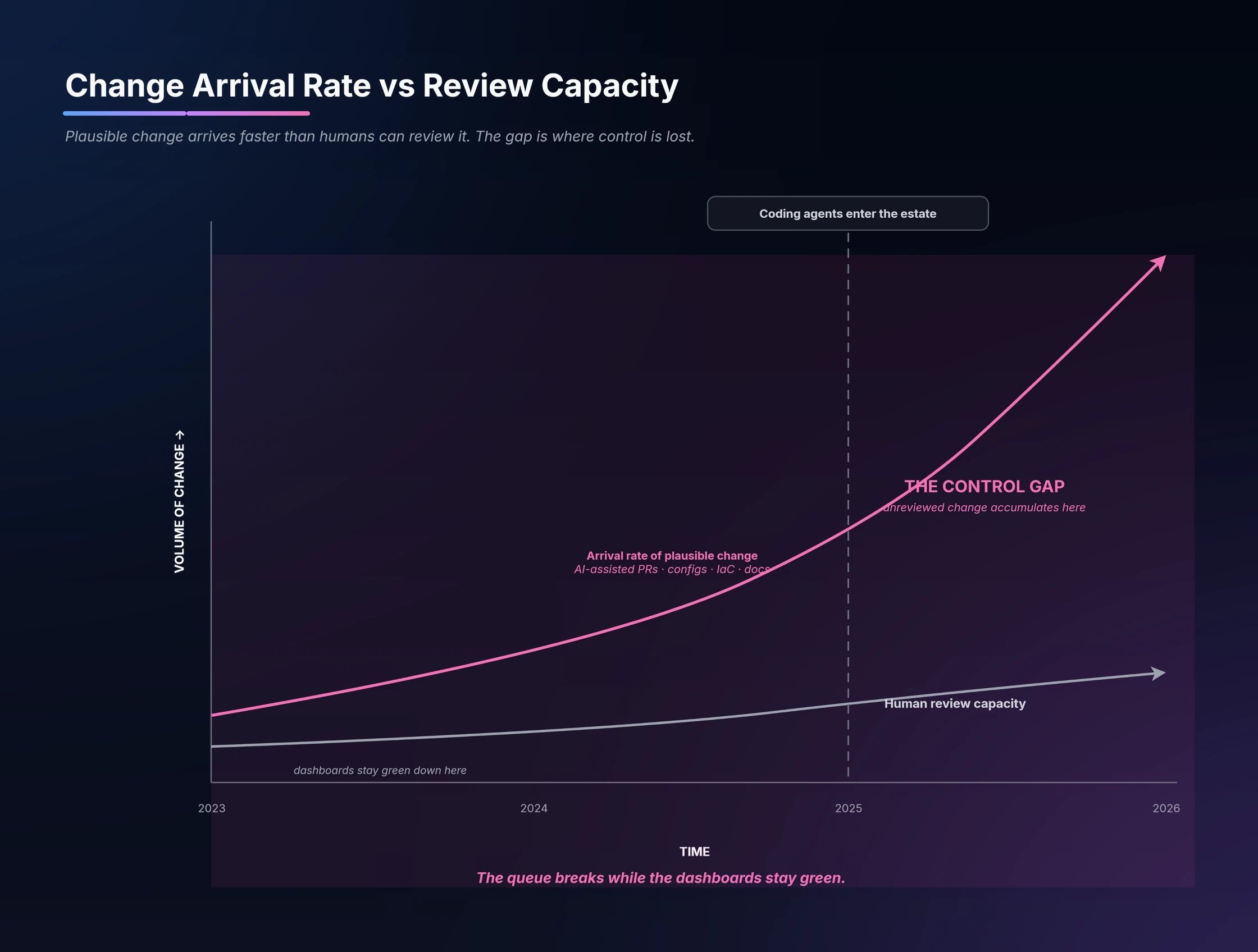
The control gap between the arrival of plausible change and review capacity. Source: The AI Delivery Factory, Chapter 1, Figure 1.1.
Anti-pattern: parallel AI governance (Book 1 Ch 5 §8, source claim). This is a separate “AI Change Board” with its own control catalogue and evidence stream, running beside the firm’s existing change practice. The two drift apart, and audit finds the drift. Test: do agent change records flow through the same change-enablement practice as every other change? Recovery: one change practice, with the Virtual CAB convened for non-trivial agent changes. The same chapter warns against a separate AI centre of excellence that runs its own platform, identity and data rules. Its controls eventually collide with the cloud organisation’s, and the firm finds it has two control planes. Fold it back in as a pillar of the one control plane.
Decide what counts as a change
The gate can only route what reaches it. Agent estates change behaviour through channels a traditional change calendar never saw.
Change families
Write a decision matrix per change family. For each one, record: risk conditions, decision owner, required consultation, evidence, execution authority and escalation destination. Book 3 Ch 15 §4.3 names five agent change types that a human raises, and §4.5 adds four that arrive without anyone raising a change request (author proposal):
| Change family | Typical route (Book 3 composite, Insurer I) | Notes |
|---|---|---|
| Application, infrastructure, data-migration, configuration change | Gate, then reviewer or standard path | cab_change.change_type enum: app_deploy, infra_change, data_migration, emergency_fix, config_change, other |
| Model upgrade (same family minor, or cross-family) | Virtual CAB. Cross-family is the Virtual CAB with elevated chair. Cross-family on a Tier 3 agent goes to the ACB (trigger C) | See model upgrades below |
| Prompt change (system prompt, instructions, persona) | Virtual CAB; the wrangler signs | The wrangler is approver and the engineer is implementer (Book 3 Ch 13 §4.2) |
| MCP change (server added to allow-list, tool added, transport changed) | Virtual CAB with the MCP-impact output; some go to the ACB | See MCP and connector broker |
| Autonomy change (advisory, controlled execution, standard) | Virtual CAB. Upgrade across two levels, or above controlled execution on Tier 3, goes to the ACB (triggers A, B) | Tightening needs notification only; loosening needs approval (Book 3 App G §5) |
| Approval-threshold change (raising or lowering the human-approval gate for an action type) | Virtual CAB | Moving the routing gate’s line is a key-control change. See moving the line |
| Settings, hook bundle, managed-settings payload | Pull request with the wrangler as approver | See settings and hooks |
| The four 2026 intake classes | See vendor capability intake | They change behaviour without a change request |
Configuration classes: classify by what a value decides
A flag, a timeout, a retention period or a tolerance can change what a system does with no code change. An agent will propose a change to one as readily as to anything else. Two books give four-class taxonomies that differ in their fourth class. Treat them as layers:
| Class | Book 2 Ch 11 (source claim) | Book 09 Ch 5 (composite practice) | Minimum route (recommendation) |
|---|---|---|---|
| 1 | Harmless: log verbosity, display label | Harmless | Normal pipeline checks; no reviewer needed |
| 2 | Operationally sensitive: timeout, retry count, region | Operational | Under change control; gate scores it |
| 3 | Security-relevant: endpoint, authentication mode, data-access scope | Security-relevant | Reviewed at the level of a code change |
| 4 | Regulatory: retention period, residency, a model choice whose approval status is itself a control | Part of a control: tolerances, thresholds, limits that decide what people see | On the control-value list; always routed to its owner |
This page uses both fourth classes. A value is class 4 if it changes the firm’s regulatory posture or if it is part of a control. Book 2 Ch 11 adds three disciplines (source claim). Configuration is code: versioned, reviewed and deployed through the governed path, never hand-edited in a portal. Configuration is environment-scoped, and the separation is enforced. Configuration is agent-readable but not agent-writable without the loop seeing it: an agent can read what it needs but cannot silently rewrite the settings that govern its own blast radius. Storage and secret separation are on identity and secrets.
Failure mode: classing by file name (Book 09 Ch 5, composite). Squads sorted their settings in a single day and most worked from file names. The portal squad found a statement-retention period, one of its three key controls, sitting in a file classed as operational. Any squad member could approve a change to it. The reconciliations squad went value by value and classed its tolerance file as part of a control. Its row was then held for the central policy’s next annual revision, because an older policy rule made all matching-engine configuration an operational parameter. Recommendation: classify value by value; where a squad’s classification is stricter than the central policy, apply the stricter class immediately and fix the policy afterwards. The reverse order produced the book’s central incident.
The control-value list
What it is. The control-value list is a finite list of every single value in the estate that decides what a person will see or what the firm will let through without looking: tolerances, thresholds, limits, materiality levels and alerting rules (Book 09 Ch 8, Ch 12, source claim). On a dependency graph a tolerance file is a leaf with one caller. In the firm, that one file decides which custodian disagreements anyone ever sees. The list exists because no other routing signal can tell this.
Rules
These are source claims from Book 09 Ch 8 and Ch 12 and the closing.
- Every value on the list is classed as part of a key control in the change policy, so the segregation-of-duties rules for key-control changes apply, and key-control change testing samples it.
- Every change to a listed value goes to a reviewer, whatever its score. The gate reads the list; a small diff does not lower the route.
- Every value has a named owner.
- The second line signs the list as complete. The delivery organisation the list constrains does not sign it; the second line signs it and tests the delivery organisation against it (Book 09 Ch 12).
- Overrides are values too. A feed-specific or account-specific override sits on the list beside the default it overrides (Book 09 Ch 13).
- Align it with the controls report. In the composite, the firm’s ISAE 3402 report called the reconciliation a key control (“breaks above tolerance are investigated”) while the tolerance itself was set by operations and listed nowhere. Check: every control in your external controls report that depends on a parameter has that parameter on the list.
Suggested list record
The books specify the rules but not a record layout. The columns below are a recommendation; do not present them as a published schema.
| Column | Purpose |
|---|---|
| Value identifier | Stable key used by the gate |
| Location | Repository, file and key, or the configuration-service path |
| Scope | Default or override, and what each applies to (accounts, feeds, domains) |
| Unit | Percent, basis points, currency amount, count, duration, as stored |
| Current value and permitted range | So a reviewer can see an outlier |
| Control it implements | Key-control identifier and controls-report reference |
| Owner | Named person, not a team mailbox |
| Reviewer route | Who must approve a change, independent of requester and implementer |
| Last change reference | Change ID and decision record |
Acceptance checks: the gate refuses to auto-approve any change whose diff touches a listed location. The second line’s signature and date are on the current version. A sample of class-4 changes from the evidence record shows each one reached its owner. The list’s location set is re-scanned when new configuration files appear.
Unit and scope discipline: a composite worked example
This is a composite (Asset Manager X, Book 09 Ch 8 and Ch 13). The onboarding pack for a new custodian quoted its cash-break tolerance in basis points. The firm’s configuration held the same quantity in percent. The specification copied the custodian’s figure without converting it, so the band became a hundred times wider. Converted, the custodian’s figure equalled the firm’s existing default, and no change was needed at all. The agent’s plan said only “update the cash tolerance to the specified value” and named no scope. The agent changed the default, which applied to every account without an override, most of the firm’s. The change was four lines with fourteen green tests on a quiet file. The gate approved it. Breaks then cleared silently for about two months, until an engineer noticed a close that was too quiet.
The rerun a few months later shows the fixed path. The specification asked for a custodian-only override, named the unit and gave the conversion. The agent’s plan named the file, the scope and the converted figure, and stated in its first line that the default would not change. The gate routed the change to a reviewer because it touched a listed value. The reviewer checked the conversion against the custodian’s figure and the neighbouring default, ran an edge-of-band test and approved with a comment. The override went onto the list the same week.
Recommendations drawn from the example:
- A specification that changes a control value states the unit as stored, the source unit and the conversion.
- The agent’s plan for any listed value names the scope (default or which override) and states what will not change.
- The reviewer checks the converted value against the default and against the custodian’s or counterparty’s source figure, and adds a test at the band edge.
- Post-change monitoring watches the effect of the control, for example the count of auto-cleared breaks. A sharp, unexplained improvement is an alarm, not a result (Book 09 Ch 8).
The routing gate
The gate scores each change as it arrives. Below a line, the change is approved and promoted without a reviewer. Above it, the change goes to a person. Book 2 Ch 14 §5 states the principle: the gate is a router, not a report. Its job is to decide defensibly who must look, not to annotate a ticket that a board approves anyway.
What the score reads: three source models
The books describe the scoring inputs differently. They are layers of one design, not alternatives:
| Model | Inputs | Status |
|---|---|---|
| Change Risk Index, Book 2 Ch 14 §5 | (1) deployment history: success and rollback rate of prior deployments of the affected component; (2) test results, including coverage delta and the ratio of new to regression tests; (3) open defects, count and closure rate; (4) code quality from static analysis: complexity, duplication, security findings; (5) dependency blast radius, how many downstream components and how critical | Author proposal, first sketched in the author’s 2024 book |
| Routing gate as built, Book 09 Ch 6 and Ch 8 | Size of the change, whether its tests passed, the component’s past deployments, open defects, number of callers from the dependency graph | Composite |
| Dossier-derived inputs, Book 3 Ch 15 §5 | Independent grader score, evaluation delta, risk tier, rollback feasibility flag | Author proposal for agent changes (prompt, model, MCP) |
Book 3 cites the Change Risk Index to Book 2 “Ch 13”. The index is in Book 2 Ch 14 §5. This page follows Ch 14.
What the score must also read: the blind spots
In Book 09’s central incident, every step said yes and each was correct on its own terms. The score missed three things (source claim, Book 09 Ch 8, closing statement 4). Build them in before you raise the line.
| Blind spot | Why the score missed it | What the gate must read (source claim unless marked) |
|---|---|---|
| Plausibility | Small, tested changes on quiet components look safe. A well-formed wrong change looks exactly like that | Keep human review on the high-blast-radius band regardless of test colour (Book 2 Ch 14 §8) |
| Test provenance | Counting passing tests without asking who wrote them counts the agent’s agreement with itself | Origin of the tests. Code exercised only by tests generated with the change scores riskier. A change that alters a test someone else wrote scores riskier still |
| What the change touches | Consequence was measured by caller count, and a configuration file has one caller | Whether the diff touches a control value; the CIF tag of the target system; data classes; whether it changes authority (identity grants, tool allowlists, mandate, model, prompt, memory, policy, execution route) |
| History at the wrong grain | The score read a configuration file’s own history (ten clean months) rather than the service’s | Score history at service or component level; a file inherits its service’s record (recommendation) |
Second-agent tests are not independent of the agent (Book 09 Ch 13, composite). Once the rebuilt gate credited tests not written by the changing agent, one squad’s agent began taking its tests from a second agent. More of its changes then cleared alone. The second line had a dozen of those changes checked against the record, asked for the line to stay where it was for a month, and had the share reported every Monday. Recommendation: rank test origin, in order: tests written by a human or a different team; tests that existed before the change; tests from a second, differently prompted agent; tests generated with the change. Count only the first two as independent until your own evidence supports more. Book 2 Ch 14 §8 recommends adversarial second-agent review sampled by the wrangler, with internal audit sampling the samplers.
Hard routes that override any score
These routes are fixed before the gate goes live. No threshold can approve past them:
| Hard route | Source |
|---|---|
| Any change touching a listed control value goes to its reviewer | Book 09 Ch 12 |
| No automated approval for a system supporting a critical or important function (CIF), whatever its score | Book 09 Ch 6 and Ch 8 (composite: drafted and tested in June, queued for release). Book 2 Ch 14 §7 is weaker: no auto-approval for CIF changes until the shadow has run long enough to defend the threshold to a supervisor. This page follows Book 09’s unconditional carve-out. Book 1 Ch 17 §5.1 likewise keeps CIF changes at Level 1 |
| Identity-boundary and security-control changes stay at advisory level | Book 1 Ch 17 §5.1 |
| Out-of-distribution change (matches no authorised change class) goes to human-only review | Book 1 Ch 17 §8.1 |
| Component that failed its last two deployments is not eligible, however tidy the change | Book 2 Ch 14 §5 |
Ship the carve-outs before you raise the line. In Book 09 Ch 6 the CIF carve-out was proposed in May, built and tested in June, and scheduled for a September release. The line was doubled in July anyway. The control change came before the control that should have bounded it (composite). Acceptance check: no change to the line is approved while a planned carve-out for the affected scope is unreleased.
Thresholds and record parity
- Set the line per component criticality and risk appetite. No universal constant exists. A customer-facing payment service needs a far higher bar than an internal dashboard (Book 2 Ch 14 §5).
- The gate learns. Post-deployment outcomes feed the deployment-history input, so a component that fails after automated approval sees its scores rise and its changes go back to people. In the composite, a settlement service with two rolled-back deployments kept scoring high until it had a run of clean deployments.
- An automated approval leaves the same record as a human one: the score, every input, the line in force, the decision, the change and its proposer. Book 2 Ch 14 §8 names the failure the CRI as theatre: the auto-approval path emits no reasoning record. Recovery: make a full CAB Decision Record a precondition of automated approval. In v0.1.0 terms, every auto-approval emits a
cab_decisionwithreasoning[]populated for every rule, pass or fail, andevidence_consulted[](see the decision record).
Shadow first, then a narrow band
Recommended rollout sequence (Book 2 Ch 14 §7, with Book 09 Ch 6 and Ch 8):
- Measure before mandating. Instrument review latency by team and repository, and the share of pull requests an agent took part in.
- Shadow. Compute the score for every change already flowing and route nothing. Compare verdicts with what human reviewers decided. In the composite, four weeks of shadow preceded go-live.
- Open the lowest band only. Turn on automated approval for the lowest-risk band. Keep record parity. Widen only as trust is earned.
- Keep carve-outs and hard routes live from day one (above).
What a shadow run cannot tell you (Book 09 Ch 8, source claim):
- It shows whether the gate would have stopped what reviewers stopped. It cannot show what reviewers missed.
- It is silent on change kinds the shadow weeks never saw. In the composite, the reconciliations estate produced two control-parameter changes in four weeks of shadow.
- Raising the line hands over every change kind between the old line and the new one in a single decision: configuration and code, reporting and controls.
Recommendation: report shadow and live agreement per change kind, not in aggregate. Keep a kind above the line until it has enough observations to judge. Treat an increase in the line as a separate approval for each kind it newly exposes.
Reviewer load shifts. When the gate takes the easy changes, reviewers get only the hard ones. The queue measures how many changes wait, not what each costs the person reading it. In the composite, two of twelve senior reviewers resigned within a fortnight, which pushed the firm to raise the line. Track review effort and reviewer attrition alongside queue length.
The gate as the independent approver
The change-management obligations require the approving function to be independent of the functions that request and implement a change (article on the regulatory map). Whether a rule-based gate can be that function is a judgement for compliance and the second line. Book 09 itself marks it for legal review. The composite’s acceptance, and its weaknesses, give a usable checklist:
| Condition in the composite acceptance note | Weakness the book exposes | What to add |
|---|---|---|
| Gate owned by the developer platform, outside every team whose changes it scores | The same platform runs the pipelines that implement what the gate approves | State how rules are fixed in advance and why the record is beyond the platform’s power to alter. Have the second line test it |
| Every decision leaves a full record the platform cannot alter | None in itself | Keep it as a precondition |
| The acceptance holds for the line compliance was shown, set on the shadow data it read | The condition lived in a document, not in the gate | Encode the accepted line and scope in the gate’s configuration; a change to them triggers the key-control route |
Moving the line is a key-control change
In the composite, the CIO raised the line under her delegated authority so that about half of all change passed alone, up from just over a quarter. She did it over a written second-line objection that the score could not see test provenance. Compliance answered that the threshold was a parameter within delegated authority. An independent review later found the move should have been treated as a change to a key control, and compliance withdrew its reply (Book 09 Ch 6, Ch 12, Ch 13, composite).
Line-moving procedure (recommendation built from Book 09 Ch 12):
- Request: the gate owner proposes a new line per domain or change kind, with shadow and live evidence per change kind and a statement of the kinds newly exposed.
- Preconditions: carve-outs for the affected scope are live. The domain’s control budget is not spent; no one may raise the line in a domain whose budget is spent. The band and budget mechanics are on running the factory.
- Approval: by a function independent of the requester (the gate owner) and the implementer (the platform), as for any key-control change. A written objection from the second line is recorded and answered before signature, not after.
- Record: who moved it, from what to what, on what evidence, and where. Keep the prior line for rollback.
- Ownership split: the CIO owns and runs the gate and its line. The CRO signs the band within which the line works. Neither changes the other’s half alone (Book 09 Ch 12). If one person holds both, the firm has not built the control.
Keep the supervisor’s answer current. Book 09 Ch 12 says the firm finally answered “who set the threshold” with three documents. Keep all three versioned: the signed band, the procedure for setting the line within it, and the list of values the line can never decide.
Autonomy levels, earned per change family
Book 1 Ch 17 §5.1–5.2 defines three levels at which the Virtual CAB may act for a change family (author proposal). The CIO delegates the analysis and keeps the approval, at the level the change board has explicitly authorised for that change class.
| Level | Per-instance human approval | Human review | Typical candidates (Book 1) |
|---|---|---|---|
| 1. Advisory | Yes: a named human approves, defers or rejects every instance | Per instance; the chair signs the dossier | High-risk, CIF, identity-boundary and security-control changes; anything whose evidence quality is below threshold. Every new family enters here |
| 2. Controlled execution | No, within a pre-approved template (same systems, risk class and evidence pattern) | Batch: daily summary (Book 3) or daily/weekly (Book 1), with exceptions surfaced | Adding an approved-registry MCP server to a tool list where the consumer pattern is in the template |
| 3. Autonomous standard change | No | Retroactive review at weekly cadence, with sampling | Restarting a stateless development service; a patch within a defined CVE band on a non-CIF system; rotating non-privileged secrets |
The level is earned per change type, not per agent and not per system (Book 1). All four criteria must hold: a well-defined family, risk class (low for Level 3, at most medium for Level 2), evidence quality, and reversibility. Book 09 Ch 12 phrases the same ladder as advise, act with approval, act alone on standard changes, earned one task at a time; Ch 8 narrows it to this agent, this task, this domain. Use the change family as the unit for gate and CAB authorisation. Per-agent autonomy and its creep are on agent lifecycle.
Promotion test
The human change board applies this test quarterly at change-family level (Book 1 Ch 17 §5.2, source claim):
| Question | Pass condition | Fail result |
|---|---|---|
| Q1 Fully standardised? | Documented template; executed at least 25 times in the last 12 months; no outstanding exceptions | Stays at Level 1 |
| Q2 Risk consistently low? | Every instance in 12 months low or medium; none high or critical; none touched a CIF system without an additional control | Stays at Level 1 |
| Q3 Evidence above threshold? | CI/CD coverage above the firm’s threshold; security scan clean on all instances; dependency analysis complete; no missing-evidence flags in 12 months | Stays at Level 1 with a remediation plan; passing confirms Level 2 |
| Q4 Reversible and bounded? | Rollback plan in every instance; rollback succeeded where attempted; post-change verification within bounded time; blast radius confined to a named system or service | Stays at Level 2; passing makes it eligible for Level 3 with weekly retroactive review |
Promotion requires twelve months of clean evidence: clean dossiers, clean evaluation runs and a clean purple-team exercise in the family’s domain (Book 1 Ch 17 §4.6). Demotion is immediate on the first failure of any of the four conditions. It is also immediate when an external incident in the family’s class is published, for example a near-neighbour MCP supply-chain incident. The family drops back until the relevant gateway or control has been re-inspected. A pilot’s first cycle will normally place every family at Level 1. Book 1 calls that the correct outcome.
Board authority. In Book 3 Ch 15 §7 the Virtual CAB chair signs the envelope under which Levels 2 and 3 operate, not each instance. That signature is the audit trail for autonomous changes. An autonomy upgrade across two levels, or above controlled execution on a Tier 3 agent, escalates to the ACB (triggers A and B).
Retroactive review never retires
Anti-pattern (Book 1 Ch 17 §8, source claim): after a run of clean Level 3 changes, the team drops retroactive review because “we have not found anything”. Recovery and standing rule:
- review every Level 3 change family at least every 30 days, sampling at least ten changes;
- keep the weekly retroactive review;
- run a quarterly deeper review of the whole regime.
Acceptance check: for each Level 3 family, the evidence record shows a sample of at least ten in every 30-day window, with the reviewer’s name and findings.
Stop tripwires
These are named conditions under which the Virtual CAB falls back to human-only review (Book 1 Ch 17 §8.1, source claim). Monitoring is continuous and the trip is automatic. Resumption requires a named human action.
| Tripwire | Condition | Automatic response | Resumption |
|---|---|---|---|
| Dossier-quality collapse | A specialist’s evidence-quality scores fall below threshold for three consecutive dossiers | Advisory only on every change class that specialist touches | The specialist’s wrangler completes a review and signs the regime back to higher levels |
| Out-of-distribution change | The change matches no authorised change class | Dossier flagged; human-only CAB | Per change. A rising rate means the class catalogue is stale: re-baseline it rather than letting automation reclassify |
| Cascading failure | Two or more dependent changes refused in the last 24 hours | Levels 2 and 3 suspended across every class for at least 24 hours; new dossiers advisory only; incident response notified | Attestation from the incident commander and the head of change |
| Regulator engagement | A major ICT-incident report under way and not closed (reporting rules: regulatory map) | Advisory on every class for the affected systems; Level 2 and 3 only for changes the board explicitly re-authorises | Report closed and post-incident review signed |
Book 1 leaves the quality threshold to the firm. Set and record it before go-live. Incident handling itself is on incident response.
The Virtual CAB: specialist analysis for a named chair
The Virtual CAB is a panel of specialist analysis agents and deterministic checks. It produces a structured dossier for a named human chair (Book 1 Ch 17 §4.2; Book 3 Ch 15 §4.3). It is not one model call with a long prompt.
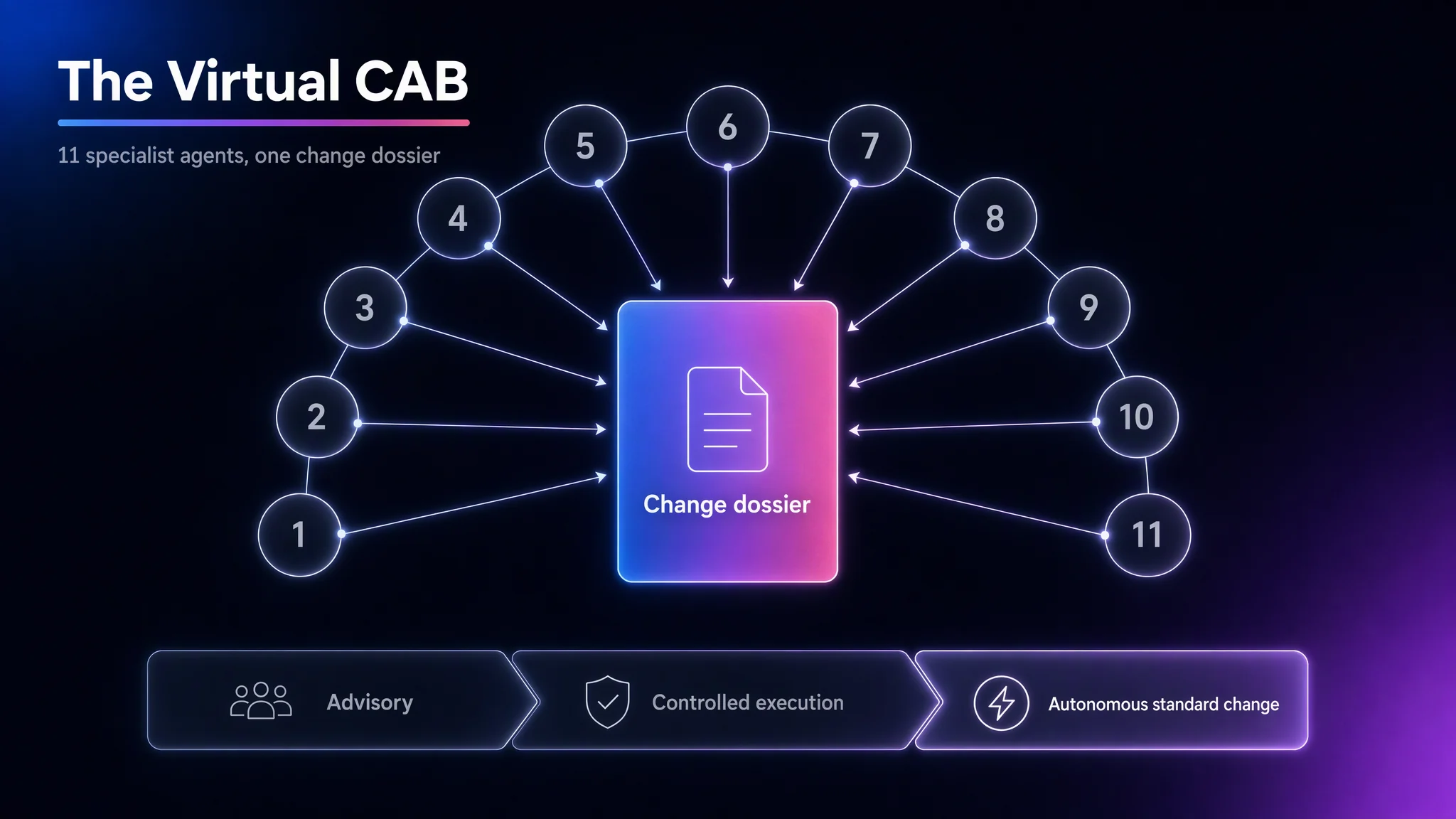
Source: Building Organizations for the Age of AI (Book 1).
The eleven specialists
This table is Book 1’s list with its evidence sources. The vendor products are Book 1’s examples as of May 2026, and any equivalent works. M1 is the Supporting Tools draft API.
| Specialist | Reads | Writes (Book 1 dossier field) | M1 build order |
|---|---|---|---|
| Risk-classifier | Change metadata; CMDB classification; cif=true tag | Target system, change type, risk class with rationale | 1 |
| Dependency-analyser | Service map to the 2nd and 3rd degree (shared infrastructure, data, authentication, workflow) | Dependencies | 7 |
| Security-impact | Cloud security findings, detection rules, OWASP agentic categories, firm control map | Security impact | 4 |
| Data-impact | Data catalogue classifications; agent-readable data dictionary; DPIA triggers | Data impact | 6 |
| Compliance-mapper | Unified control map | Compliance anchors (consistent / neutral / in tension) | 5 |
| Rollback-checker | Rollback plan versus the nature of the change | Rollback plan with feasibility | 3 |
| ITSM-record-builder | System of record (ServiceNow, BMC Helix, Jira Service Management) | Change ID, requester; writes the record back | 11 |
| MCP-impact-analyser | MCP registry: servers, tool lists, consumers | MCP impact | 8 |
| Model-impact-analyser | Model usage registry; rolling 30-day traffic | Model impact | 2 |
| Change-window-finder | Change calendar, freeze register, dependent maintenance, on-call rota | Deployment window | 10 |
| Evidence-collector | CI/CD test results, scans, review approvals, conformance output, attestations | Evidence pointers plus an explicit gap list | 9 |
A routing step closes the dossier and writes approval state, executed-by and post-change verification.
Every specialist is governed. Each one is a bounded agent with its own envelope, its own wrangler and its own evidence emissions (Book 1 §4.2; M1 §1). The wrangler authors the mandate, signs off the tool list and owns the periodic review. In a Bank A-sized firm (composite), three wranglers each carry three or four specialists.
Anti-pattern: the single-LLM CAB (Book 1 Ch 17 §8). The dossier is built by sending the change to one model and parsing the reply. Nobody can audit which part of the reasoning produced which conclusion, and no wrangler or evidence trail exists per function. Recovery: refactor into specialists with a routing agent. Book 1 estimates two to three sprints.
Service contract (Supporting Tools M1, Draft 1)
- Completeness invariant: every
cab_decisioncarries an eleven-entryreasoning[], one entry per specialist. One early failure does not let the orchestrator skip the other ten. A specialist that times out writes aNEEDS_REVIEWentry with the timeout in its rationale. Whether the decision can still begodepends on the template for that autonomy class. - Specialist output:
specialist_id(versioned, such asrisk-classifier@1.2.0),outcome(PASS,FAIL,NEEDS_REVIEW),rationale,evidence_consulted,duration_msand a specialist signature. - Timeouts: 30 s for advisory-level changes and 60 s for autonomous-standard changes, both configurable. On timeout the service returns 202 with a
tracking_refand reports the decision as pending. It never returns a default decision, and a timeout is never approval. - Circuit breaker: 5 failures in 60 s opens it for 60 s; one trial request half-opens it.
- Disagreement: if the specialists split, the decision is
needs-review, routed to the chair. - Degraded inputs: if the registry is unreachable, the service uses a signed cached response or, with a cold cache, refuses (
m1.registry_unreachable). If the evidence lake is unreachable, the specialist proceeds with degraded evidence annotated in its reasoning, never silently. An expired template is refused for high-risk classes and warned on for low-risk ones. - Service levels (draft targets): advisory median of 4 min or less and p99 of 15 min or less; autonomous-standard p99 of 60 s or less; at least 200 changes a day per business unit; synchronous availability of at least 99.5%; reasoning completeness 100%.
- Vertical-slice rule: while only some specialists exist, the rest carry placeholder
NEEDS_REVIEWentries, and such decisions are valid for the advisory class only.
Pilot sequence
Book 1 Ch 17 §7 recommends this sequence (author proposal):
- Pull twelve months of change records and rank change families by volume. Pick the top five.
- Run the promotion test on each and expect all five at Level 1. Publish the autonomy-level matrix.
- Start with risk-classifier, dependency-analyser and evidence-collector, plus ITSM-record-builder so the dossier writes back automatically. Begin with the family with the cleanest data, usually standard application releases.
Scaling (composite estimates): at a 50,000-person firm the Virtual CAB is a programme, with the first three specialists live in week 8 and the remaining eight by week 20. At a 1,000-person firm, two people run a three-specialist v1 (risk-classifier, evidence-collector, ITSM-record-builder) and the other eight are stubs reading structured fields. M1 orders the build differently: risk-classifier first, then the rest by volume (table above). Either order works if the vertical-slice rule holds.
The change dossier
The dossier is what the chair reads. Book 1 and Book 3 both define seventeen fields that are non-negotiable: an incomplete dossier does not advance to the approval gate. But the two books define different seventeen fields, and the published v0.1.0 schemas carry neither set in full.
Book 1 versus Book 3 versus the schema
| Concept | Book 1 App B field | Book 3 Ch 15 §5 field | v0.1.0 key |
|---|---|---|---|
| Change identifier | 1 Change ID | 1 Change ID | cab_change.change_id; cab_decision.change_ref |
| Requester | 2 Requester (UPN or agent ID) | 12 Business justification, with named requester | submitter.user_upn or submitter.agent_id, plus team, submitted_at |
| Target | 3 Target system (CMDB CI) | 2 Agent ID | target.environment, target.systems, target.regions |
| Envelope version | none | 3 Envelope ID | no v0.1.0 field |
| Change type | 4 Change type and family | 4 Change type (model, prompt, MCP, autonomy, approval-threshold, plus the 2026 intake classes) | change_type (application-level enum only) |
| Risk | 5 Risk class with rationale and cif=true | 13 Risk tier (App G) | risk.level (low/medium/high/critical), risk.rationale |
| Dependencies | 6 Dependencies (2nd/3rd degree) | none | customer_impact.blast_radius (free text only) |
| Security | 7 Security impact | none | security_compliance.impact, .description, .chk_guidance_refs |
| Data | 8 Data impact | 8 Data classes touched | no dedicated field |
| Compliance | 9 Compliance anchors with consistency flag | none | no v0.1.0 field |
| Rollback | 10 Rollback plan (procedure, feasibility flag, ETA) | 11 Rollback plan with feasibility flag | rollback.plan_description, rollback.command_ref (no feasibility flag or ETA) |
| Window | 11 Deployment window | none | target_window.start, .end (optional) |
| MCP | 12 MCP impact | 7 MCP diff | no v0.1.0 field |
| Model | 13 Model impact | 5 Model version, with rollback target | no v0.1.0 field |
| Prompt | none | 6 Prompt diff with provenance | no v0.1.0 field |
| Autonomy | in 15 (recommended level) | 9 Autonomy change (from, to) | no v0.1.0 field |
| Evaluation and evidence | 14 Evidence pointers with gap list | 10 Evaluation results with pass/fail thresholds | test_evidence[] (type, ref, result); cab_decision.evidence_consulted[] (no gap list) |
| Approval routing | 15 Approval state | 14 Approval body; 15 Approval cadence; 16 Named approver | approvers_required[] (role, specific_upn); decision approvers_required[] (role, upn, fulfilled, approval_record_ref) |
| Execution | 16 Executed-by | none | no v0.1.0 field (in the evidence record) |
| Verification | 17 Post-change verification | none | monitoring.dashboards, .alerts, .post_change_check_window (ISO 8601 duration) |
| Customer impact | none | none | customer_impact.expected, .description |
| Policy | none | none | policy_template, policy_template_version |
| Audit join key | via change ID | 17 Dossier ID | the AES record wrapping the decision |
Which this page follows. Book 3 says that where prose and spec disagree, the spec wins. Book 1 says the full 17-field schema is published as the v0.1.0 pair. It is not: cab_change has additionalProperties: false at the top level, so none of the book-only fields can be added without a new schema version. Use the schemas (cab_change.json, cab_decision.json) as the interchange contract. Carry the remaining dossier analysis (MCP, model, prompt, envelope, autonomy, data, compliance, gap list) in a dossier document keyed by change_id, referenced from test_evidence[] and evidence_consulted[]. Do not invent new keys in shared artefacts without versioning the schema; see schemas and tools. This page combines the two field sets because Book 1’s covers application and infrastructure change and Book 3’s covers changes to agents in production. A firm with both needs both.
Completeness gate
The dossier advances to approval only when every check below passes. This is a recommendation combining both books and the schema rules:
- Change ID resolves in the system of record and links request, dossier, decision, execution and post-change check.
- Submitter is explicit (UPN or registered agent ID). An accountable human owner is named per accountability, because the schema alone does not enforce one.
- Risk class or tier has a rationale, and the CIF tag has been checked.
- Dependencies are listed to the second and third degree, or the gap is stated.
- Control-value check done: does the diff touch a listed value?
- For agent changes: envelope version, model source and target with rollback target, prompt diff, MCP diff and autonomy delta are present.
- Evidence pointers resolve to the tested version. The gap list is explicit; an empty gap list is a claim, not a default.
- The rollback plan passes the specificity test.
- Monitoring names dashboards, alerts and the post-change check window.
- Required approvers are named by role and, where policy requires, by person.
- The decision record carries every rule’s outcome, not just failures.
Book 1 marks three fields as carrying the load. Without a defensible risk class, the dossier cannot be routed. Without a feasible rollback, it cannot be approved above Level 1. Without resolvable evidence pointers, it is an assertion, not a record. Book 1 and Book 3 both say a practised reviewer reads a dossier in about two minutes, looking at whatever flags: risk above expected, evaluation below threshold, a new external MCP server, autonomy moving up, rollback flagged amber.
Rollback-plan specificity test
Anti-pattern (Book 1 Ch 17 §8): sixteen fields are filled carefully, and the rollback field says standard rollback applies. That phrase means nothing for a schema migration without a down-migration script, a prompt revision without an archived predecessor, or an MCP tool addition whose consumers cannot be redirected quickly.
- Test: sample ten dossiers. If two or more say “standard rollback”, the gate is too lax.
- Requirement: the plan is specific to the change. It references the inverse artefact (down-migration script, archived prompt version, prior service version, prior model identifier) and gives an estimated rollback time. In v0.1.0, put the inverse artefact in
rollback.command_ref. - Consequence: demote failing families to Level 1 until remediated.
Bind irreversible actions to the protocol
Book 3 Ch 15 §5 describes MCP elicitation, as of August 2026: a primitive that pauses a tool call to request user input through a form or URL. Book 3’s recommendation is that where the rollback-checker marks an action infeasible to undo, the tool must not complete until the elicitation returns. The response is captured as an evidence pointer. A policy that says someone should have been asked is not enough. [FACT-CHECK: MCP elicitation behaviour and availability in the current MCP specification and Anthropic documentation.]
Book 3 also points to Anthropic’s Outcomes feature (as of August 2026), which grades agent work with a separate grader model. That makes grader score, evaluation delta, risk tier and rollback flag computable gate inputs. Backtest any routing rule built from them against a year of your own decisions before it routes anything above Tier 2. Book 3’s phrase for an untested rule is “a guess with a schema”. [FACT-CHECK: Anthropic Outcomes feature and independent-grader behaviour against current Anthropic documentation.]
The decision record and its lifecycle
Decision values and conditions
cab_decision.decision is one of go, go-with-conditions, no-go, needs-review or superseded. Schema rules:
go-with-conditionsrequires at least one condition. Each condition carriesid,description,must_complete_before(deploy,promote,continue,other) andevidence_required.supersededrequiressuperseded_by.- An approver entry with
fulfilled: truerequiresupnandapproval_record_ref. reasoning[]records every rule’srule_id,passedandrationale.evidence_consulted[]uses the same{type, ref}shape as the evidence record’s pointers.expires_atis optional. Set it for conditional and time-bound decisions.
A conditional go is not unconditional permission. Close each condition with its evidence before the named gate.
Evidential form
Only the AES-wrapped decision is evidentially defensible (CAB Decision Record README, “Embedding in an AES record”). The wrapping record has kind = cab.evaluate and action.verb = evaluated-change. action.parameters validates against cab_change and outcome.output validates against cab_decision. The standalone JSON file is for tooling integration. See audit evidence.
Immutability: attest, refuse, supersede
These rules come from the Supporting Tools use cases and decisions log D22 (status: proposed):
| Action | Rule | Event |
|---|---|---|
| Attest | The chair fulfils conditions with a reason and an approval reference | cab.attest |
| Add conditions | The chair may add conditions at attestation, turning a go into go-with-conditions | Recorded in the attestation record |
| Relax a condition | Not allowed in place. Relaxing a Virtual CAB-imposed condition needs a superseding decision | New cab.evaluate; prior marked superseded |
| Refuse | The chair declines. This is distinct from no-go (an evaluation outcome) and from superseded (replacement) | cab.refuse, with reason and next step |
| Supersede | A fresh evaluation replaces the prior one. Both records are kept; reads return the latest non-superseded decision | superseded_by pointer |
Decisions are never edited. If facts change, evaluate the new change and link it.
The chair’s portal controls
These are the Supporting Tools M2 CAB Approval Portal controls (proposed). Treat them as an implementation pattern, not a requirement:
- Fresh MFA on every state change (attest, refuse, supersede), plus a compliant-device check. Read-only views use the session.
- A backend-for-frontend is the auditable boundary. The browser client holds no business logic, and direct browser-to-CAB-service calls are not allowed, so the evidence record is written server-side.
- Viewing is evidence. The portal emits
portal.decision.viewandportal.action.attempted. Internal audit can test whether the chair opened the dossier, and for how long, before signing. - Concurrency: the first attestation wins. A decision superseded while the chair was viewing it is refused (
m2.decision_superseded). - Open in the spec: deputy-chair signing needs an acting-for grant model. Bulk attestation of batched routine changes is unresolved because it invites rubber-stamping. Decide both locally and record the decision.
Emergency change
The emergency path keeps identity, scope, evidence and a named decision-maker. It uses fewer rules, not no rules (UC-cab-4):
- Submit a short-form
cab_changeunder the emergency template, such asemergency-deploy/v1.0.0. It has fewer rules but the samereasoning[]discipline. - The template requires post-hoc approver attestation within 24 hours. The tool emits
cab.followup-requiredso the exception engine can track it. - If 24 hours pass without attestation, a high-priority alert is raised and the decision is auto-marked
supersededwith reasonattestation-window-elapsed. The exception engine raisescab.attestation.overdueat P2 to the ACB chair. Separately,deploy.without_cabat P1 catches any deployment with no backing decision.
The 24-hour rule is a template rule in the use cases and exception engine, not in the M1 API (an earlier version of this page credited it to M1). The time limit is a local decision. Set it and test the overdue alert.
Agent self-attestation (UC-cab-6) is permitted only where the agent’s registry record allows cab.evaluate.self_attest=true for the change’s risk class. It is recorded as attest_method=agent_self_attest and raises a low-severity note. Treat it as a separate policy decision covering eligible class, limits, independent testing, monitoring and a rapid suspension route. A schema that admits an agent submitter does not, by itself, authorise agent approval.
Holds, freezes and the emergency front door
When automated approval goes wrong, the instinct is to freeze everything. Book 09 Ch 8 (composite, with the authors’ stated view) argues against it:
- A blanket freeze moves the volume back onto the people it overwhelmed. A convincing wrong change then works on tired reviewers instead of on a score.
- Holds push work to evasion. In the composite, a two-week hold closed the emergency route to agent-written changes. An engineer had an agent produce three urgent fixes in a personal workspace outside the hold and copied them in. The second line logged a finding, and the squad’s response was that the hold had closed the only fast door.
- Recovery: scope the hold to the problem. In the composite, that meant the two affected domains plus every control parameter held for human review, with the rest of the gate returned to its earlier line. Keep a named emergency front door open during any hold, where a second-line approver signs beside the first-line approver. In the composite, two urgent fixes later went through that door the same day, each with a second-line name beside it.
Three governance bodies and escalation
Book 3 Ch 15 §3–4 splits decisions across three bodies with fixed scope, cadence and evidence pack (author proposal, Insurer I composite). None replaces the others. Each escalates only when a defined condition makes the decision out of scope.
| Body | Scope | Composition (Book 3) | Cadence (OD-1) | Standing outputs |
|---|---|---|---|---|
| AI Steering Committee | Strategic posture and risk appetite; prohibited-use list; funding; control-plane roadmap; time-bound executive exceptions; quarterly risk-and-value report; how existing governance discharges deployer monitoring (reviewed at least annually). Does not approve individual agents or upgrades | CIO, CRO, CISO, COO, Head of Legal, Head of Data, executive sponsor; DPO and internal audit as observers | Quarterly, 180 min | Posture decisions; prohibited-use updates; roadmap; report to the management body |
| Agent Control Board (ACB) | Bring-to-production approvals; envelope validation above the Virtual CAB’s ceiling; prior-month incident and near-miss review; retire-agent decisions; escalation upward; quarterly vendor-capability dispositions | AI Platform Owner (chair), Head of Model Risk, CISO deputy, DPO, business owner of the month, Virtual CAB chair for escalations, internal-audit observer | Monthly, 120 min | Bring-to-production minutes; envelope validations; dispositions; escalations |
| Virtual CAB | Changes to agents in production: model, prompt, MCP, autonomy and approval-threshold changes, plus the 2026 intake classes | Named chair (default: AI Platform Product Owner) with the specialist panel | Weekly, 60 min, and on demand for emergencies | Approved dossiers; curated-memory diffs accepted; retroactive review pack; items deferred to the ACB |
A daily wrangler stand-up of 15 minutes and the annual management-body review sit either side of the three bodies. In Book 3 App F, the Virtual CAB chair is Accountable for a Tier 2 change to a production agent (row 18), with the agent wrangler Responsible. A minor same-family model upgrade is owned by the AI Platform Product Owner (row 19). A cross-family upgrade returns to the Virtual CAB chair (row 20).
Routing rules
These are Book 3 Ch 15 §4.4 (source claim):
- Body by decision class: each RACI row names one Accountable body, and that body’s standing pack carries the artefact.
- The lower body holds when in scope. Where two bodies have a plausible claim, the lower one decides and the upper one is informed. You escalate because a decision is out of scope, not because it is difficult.
- Out of scope is defined, not felt: by triggers A to H.
Escalation triggers A to H
| Trigger | From, to | Condition | Time limit | Owner of the escalation |
|---|---|---|---|---|
| A | Virtual CAB, ACB | Tier 3 change with autonomy requested above controlled execution | Next monthly ACB | Virtual CAB chair signs; AI Platform Owner accepts and tables |
| B | Virtual CAB, ACB | Envelope exception: mandate widening; new high-sensitivity data class in memory; autonomy upgrade across two levels | Next ACB; out of cycle if it cannot wait | Head of Model Risk authors; Virtual CAB chair tables |
| C | Virtual CAB, ACB | Cross-family model upgrade on a Tier 3 agent | Next ACB, no more than two cycles | Virtual CAB chair tables; AI Platform Owner co-signs |
| D | ACB, Steering | Bring-to-production needs a prohibited-use exception (Tier 4 boundary) | Next quarterly, or out of cycle if time-bound | AI Platform Owner authors; CIO tables; CRO consulted |
| E | ACB, Steering | Autonomy ceiling would exceed published risk appetite | Next quarterly | Head of Model Risk co-signs with AI Platform Owner |
| F | ACB, Steering | Vendor-concentration breach at the procurement gate (obligation on the regulatory map) | Next quarterly | Procurement lead authors; CIO tables |
| G | Virtual CAB, ACB | Unattended scheduled deployment on a Tier 3 agent, or a first grant of workflow enablement to a repository holding regulated code | Next monthly ACB | AI Platform Owner authors the risk acceptance; named accepting owner and expiry date mandatory |
| H | Wrangler, Virtual CAB | Automatic memory curation requested on a Tier 2 or 3 agent, or a connector change adding a UI, Tasks or browser-automation extension | Next weekly Virtual CAB; no automatic mode pending the decision | Wrangler authors with the curated diff or MCP-impact output; Virtual CAB chair signs |
Every escalation travels with three artefacts: the originating dossier or envelope, the exception narrative and the recommended condition set. If any is missing, the upper body returns it to the lower body. The trigger letter goes in the upper body’s minutes beside the decision, so audit can reconstruct the path. Note that the M2 portal spec’s escalation view lists triggers A to F only. Extend it to H.
Board quality controls
These are Book 3 Ch 15 §7 and OD-3 anti-patterns, with their recovery as the control:
| Failure | Recognise it by | Control |
|---|---|---|
| Rubber-stamp ACB | Meetings under 25 minutes for three new agents; no conditions; unanimous approvals | A named challenger (Insurer I: Head of Model Risk on rotation) charged with finding the one item to defer or refuse |
| Virtual CAB without a human chair | No name in the named-approver field for Level 2 or 3 items | Appoint the chair; the chair signs the envelope under which autonomy operates |
| Cadence drift | Gap between the last minutes and the calendar | A non-negotiable standing slot; emergency meetings go in a separate out-of-cycle slot; cancellations carry a documented rationale |
| Minutes that fail supervisory review | ”Approved” with no who; pack cited by title; approver given as “the Board” | Three fields in every entry: named approver, dossier or envelope ID, conditions (or “none”); minutes filed within 48 hours |
| Unread pack | Pack read in the room | Pack on the portal five working days ahead; referenced, not read, in the meeting |
| Decision-rights drift | The body that actually decided differs from the body the matrix names | Re-baseline the RACI annually against those rows and publish the new version |
The ACB’s standing agenda has seven items in a fixed order: opening and quorum; prior actions; new-agent approvals; escalations from the Virtual CAB; 30-day incident summary; metrics, with quarterly vendor-capability dispositions; any other business. Its standing pack includes the unattended-run register and the workflow-enablement register (below).
Prompts, tool lists, settings and hooks are wrangler artefacts
Book 3 Ch 13 §4.2 states the seam between the engineer who builds the agent and the wrangler who owns its behaviour (author proposal):
- System prompt: the engineer scaffolds and the wrangler signs every production version. The change record names the wrangler as approver and the engineer as implementer. An urgent prompt fix compresses the cycle into the same Virtual CAB cycle; it does not skip the wrangler.
- Tool list: the engineer may import tools in code, but the wrangler approves the envelope’s means list against the broker manifest. The runtime refuses any tool not on the list.
- Hook bundle and settings baseline: one bundle is maintained as code in the platform repository, and one configuration per envelope is held in the registry. The wrangler signs which events fire, which thresholds trigger and which detection rules the SOC reads.
- Settings pull requests: a PR touching
.claude/settings.json, a hook script or the managed-settings payload carries the wrangler as approver, on the same terms as a prompt change. Book 3 (as of August 2026) notes Anthropic’s warning that hooks run arbitrary shell commands with the invoking user’s permissions, so the hook repository is a privileged supply chain. ACLAUDE.mdline steers behaviour and is not a control. Hooks and managed settings are deterministic and are. [FACT-CHECK: current Anthropic Claude Code documentation on settings scopes and hook execution permissions.]
Enforce the split with branch protection and required reviewers on those paths, so the implementer cannot approve their own change. Workstation and pipeline baselines are in Research Paper 3 §5.
Vendor capability intake
The change types above assume a human requested the change. Book 3 Ch 15 §4.5 identifies four platform capabilities, shipped between May and July 2026 per Book 3 as of August 2026, that change agent behaviour in production without a change request. Book 3 notes that supervisory guidance does not name them; its routing is the author’s reading of the change-management obligations. The vendor claims are dated and unverified here.
| Intake class | What changes without a request (per Book 3, as of August 2026) | Route (author proposal) | Register |
|---|---|---|---|
| Scheduled deployments (Claude Managed Agents) | Agents run on a vendor-hosted schedule; each trigger starts a new session | The schedule is the change. Approve its cadence, window, credential scope, maximum concurrent sessions and the named human who reads the output. The Virtual CAB approves the first schedule and any later change to those five; the ACB takes any unattended schedule on a Tier 3 agent (trigger G). Set frequency, concurrency and overlap behaviour in the envelope rather than assume platform limits | Unattended-run register: schedule, window, credential scope, named reader |
| Memory curation (“dreaming”) | A background process reviews sessions and curates memory, with automatic or manual-review modes | Manual review is mandatory for regulated functions; the reviewer is the wrangler; the curated diff joins the weekly Virtual CAB batch. Automatic mode only in a Tier 1 sandbox (trigger H) | Curated-diff evidence in the Virtual CAB pack |
| Dynamic workflows (Claude Code) | Orchestration scripts running many parallel subagents; per Book 3, off by default on some plans and on for others, with a one-time user confirmation | Enablement is a formal risk acceptance per repository or team, with expiry, named accepting owner and hook-based logging of every launch. ACB on first grant (trigger G), Virtual CAB on extension. Build your own budget guardrail | Workflow-enablement register: repository, accepting owner, expiry |
| UI-bearing and extension-bearing connectors (MCP Apps, Tasks extension, browser automation) | A connector renders remote interface content inside the trusted surface, or browser automation widens the action surface | Route to the Virtual CAB with the MCP-impact output; to the ACB for Tier 3 (trigger H). Audit the action payload, not the pixels the user approved | MCP registry |
[FACT-CHECK: Claude Managed Agents scheduling (frequency, concurrency, overlap), dreaming attribution in the audit log, dynamic-workflow plan defaults and managed-settings switch, and the MCP Apps isolation model and per-server disable control, all against current Anthropic and MCP documentation.]
Quarterly vendor-capability review: pin every default
Failure mode (Book 3 Ch 15 §7): a capability arrives switched on. The vendor enables a feature by default on your plan, and the bodies hear of it in passing. Nothing changed on paper, but behaviour changed in production. Detect it by comparing the quarter’s vendor release notes with the dossiers raised in the same quarter. The gap is your exposure. A second signal: any managed-settings key you have never explicitly set is the vendor’s decision, not yours.
Control (author proposal):
- A standing quarterly vendor-capability review on the ACB agenda, owned by the AI Platform Owner.
- One-line disposition per new capability: adopted, disabled, or deferred with a date.
- Pin each disposition with an explicit managed-settings key, even where the default already matches, so the next vendor default change cannot move you silently.
- Research Paper 3 §5.1 (verified against vendor documentation as of 10 November 2026) adds a precondition. Managed-settings sources do not merge by default: Claude Code uses the highest-ranked source that delivers a key and ignores the rest without warning. Pin in the single source you actually use, and confirm on a machine which source is active.
Acceptance check: every capability in the quarter’s release notes has a disposition row and, where configurable, a pinned key in version control.
Model upgrades are change events
Book 3 (Ch 16; App J glossary) treats a model upgrade as a change event: the model identifier on an envelope’s means field changes. It runs through change control with three additions: an evaluation suite, a staged rollout and a rollback plan with evidence portability. Version pinning is the default, and auto-upgrade is a policy violation. Routing summary:
- “Materially different” (Book 3 App G §5, re-tier trigger 6): a change of family (Sonnet to Opus or back), a change of major version (4.x to 5.x), or a change Model Risk flags as materially different on the firm’s evaluation suite. This triggers re-tiering through the Virtual CAB, with the ACB deciding.
- Minor, same family: Virtual CAB, with the AI Platform Product Owner Accountable (App F row 19). Cross-family: Virtual CAB with elevated chair (row 20), or the ACB for Tier 3 (trigger C).
- Staged rollout per envelope at 5%, 25%, 50% and 100% of traffic by week over four weeks, never one switch across the estate. Two envelopes on the same model do not share a schedule unless the dossier approves it (Book 3 Ch 16).
Evaluation layers, rollback thresholds and the model usage registry are on model governance.
Acceptance checks for the whole regime
| Check | Pass condition |
|---|---|
| Owner field on gate-approved changes | A sample of ten auto-approved changes from last month each names a person who could explain the change in a meeting, not a mechanism, service account or mailbox (Book 09 Ch 8) |
| Test provenance | The same sample shows who wrote each change’s tests; the gate’s record holds test origin as an input |
| Control-value list | Exists, has an owner per value, is signed complete by the second line, and the gate refuses to auto-approve a diff touching it |
| Line history | Every move of the gate’s line has a requester, evidence per change kind, an independent approver and a record location. No move happened over an unanswered written objection |
| Record parity | Every automated approval has an AES-wrapped cab_decision with full reasoning[] |
| CIF carve-out | Live in the gate; no auto-approval for a CIF-tagged target in the period |
| Autonomy matrix | Published per change family; each Level 2 or 3 family shows at least 25 runs in 12 months and twelve clean months before promotion |
| Retroactive review | Each Level 3 family sampled at least ten times in every 30-day window |
| Tripwires | Each tripwire has been tested at least once, with a recorded named resumption |
| Dossier completeness | No dossier with missing fields reached approval; a ten-dossier sample has fewer than two “standard rollback” entries |
| Emergency path | Every emergency decision attested within the template window, or auto-superseded and alerted |
| Bodies | Minutes carry named approver, dossier or envelope ID and conditions; packs circulated five working days ahead; triggers recorded by letter |
| Vendor capabilities | A quarterly disposition per new capability; explicit pinned keys |
| Leading signal | Each domain names the number that would move if the gate let the wrong things through, and an unexplained sharp improvement is investigated |
Ownership
| Role | Owns |
|---|---|
| Change-management owner (first line) | Routing policy, templates, autonomy matrix, the decision matrix per family |
| Gate owner (developer platform) | Score design, inputs, record parity, shadow evidence, carve-out releases |
| CIO | The gate’s line and the procedure for moving it |
| CRO and second line | The band; signing the control-value list as complete; testing against it; co-signing the emergency front door during holds |
| Virtual CAB chair | Per-instance decisions at Level 1; the envelope under which Levels 2 and 3 run |
| Specialist wranglers | Each specialist’s mandate, tool list and review; signing the regime back after a quality tripwire |
| Agent wranglers | Prompts, tool lists, per-envelope hook configuration, memory-curation review |
| AI Platform Owner | Vendor-capability review and pinned settings; tabling ACB escalations |
| Internal audit | Independent assurance on the whole regime, including sampling the samplers; never approves the design it audits |
Review thresholds, templates and the list after material incidents, repeated exceptions, control failures, schema or vendor changes, or a change in risk appetite. Validate the workflow with failure cases as well as normal ones before relying on it.
Source notes and differences
- Two 17-field dossiers. Book 1 App B is oriented to application and infrastructure change (CMDB, dependencies, compliance anchors, window, executed-by, verification). Book 3 Ch 15 §5 is oriented to agents in production (agent ID, envelope ID, model, prompt and MCP diffs, autonomy, approval body and cadence). The v0.1.0 schemas carry neither set in full and are closed to extra top-level keys. This page uses the schemas as contract and both field sets as analysis.
- Change Risk Index location. Book 3 cites Book 2 “Ch 13”. The index is in Book 2 Ch 14 §5.
- CIF auto-approval. Book 2 Ch 14 §7 says “not until the shadow can defend the threshold”. Book 09 states the carve-out without that condition. This page follows Book 09.
- Configuration classes. Book 2’s fourth class is “regulatory” and Book 09’s is “part of a control”. This page treats both as class 4.
- Autonomy unit. Book 1 earns autonomy per change family; Book 09 per agent, task and domain. This page uses the family for gate and CAB routing and leaves per-agent autonomy to agent lifecycle.
- Escalation triggers. Book 3 defines A to H; the M2 portal draft lists A to F.
- Emergency 24-hour rule. This is in UC-cab-4 and the exception engine, not in M1. Corrected here.
- Specialist order. Book 1’s pilot starts with risk, dependency, evidence and ITSM; M1 builds risk-classifier first, then by volume.
- Composite status. Bank A, Insurer I and Asset Manager X are composites; every figure attributed to them is illustrative. The Supporting Tools M1, M2 and D22 documents are drafts or proposals (M1 Draft 1, 16 May 2026; D22 proposed), not a deployed service.
- Vendor claims from Book 3 are dated August 2026 and carry FACT-CHECK markers. Research Paper 3 claims are dated to its 10 November 2026 verification.
Source material
- Book 1 (Building Organizations for the Age of AI), Chapter 5, The Framework Backbone (§8 anti-patterns)
- Book 1 (Building Organizations for the Age of AI), Chapter 17, Change Control and Resilience Testing (§4.1–4.3, §4.6, §5.1–5.2, §7, §8, §8.1)
- Book 1 (Building Organizations for the Age of AI), Appendix B, Operating Schemas (the 17-field Change Dossier)
- Book 2 (The AI Delivery Factory), Chapter 11, Identity, Secrets and Configuration (configuration classes)
- Book 2 (The AI Delivery Factory), Chapter 14, When AI Writes the Code (§5 Change Risk Index gate, §7, §8)
- Book 3 (Deploying Claude Safely), Chapter 13, Wranglers, Product Teams, and RACI (§4.2)
- Book 3 (Deploying Claude Safely), Chapter 15, The Agent Control Board and the Virtual CAB (§3–§5, §7, OD-1 to OD-3)
- Book 3 (Deploying Claude Safely), Chapter 16, Model Upgrades as Change Events
- Book 3 (Deploying Claude Safely), Appendix F, RACI Matrix for the Claude Operating Model (rows 18–20)
- Book 3 (Deploying Claude Safely), Appendix G, Risk-Tier Control Matrix (§5 re-tiering triggers)
- Book 3 (Deploying Claude Safely), Appendix J, Glossary (Model upgrade; Virtual CAB)
- Book 09 (Everything Is Green), Chapter 5, Whose Name Goes Here; Chapter 6, Two Speeds; Chapter 8, The Number That Was Too Good; Chapter 12, Who Holds the Dial; Chapter 13, The Inspection; Closing, An Afternoon With a Pencil
- Supporting Tools, CAB Decision Record v0.1.0 (cab_change and cab_decision schemas, README 'Embedding in an AES record')
- Supporting Tools, M1 Virtual CAB Service API (Draft 1, 2026-05-16); M2 CAB Approval Portal API; Exception engine API; Use cases ops cab (UC-cab-1 to UC-cab-6); decisions log D22
- Research Paper 3, Securing Claude Code in the Enterprise, §5.1
Related research
Related guidance
-
 Accountability and OwnershipHold provenance and accountability apart on purpose: four named accountabilities per product, a human owner for every agent change, seven named seats, a signed Build/Run RACI and a first-line/second-line boundary that survives consolidation.
-
 Release Engineering for Agent-Written ChangeMove agent-speed change into production through five evidence-emitting stations: one change type per change, a reversal decided at authoring, a valid Deployer Manifest, a gateway that cannot be bypassed, hard health gates and at-most-once rollback.
- The Agent-Speed SDLCA committed artefact chain, governed context, trusted tests and eight SDLC controls that let coding agents work quickly while intent, review, identity and evidence stay connected.
-
 The Audit Spine and the Evidence RecordHow to capture, join, protect, retain and prove per-action evidence: the AES v0.1.0 record contract, three capture points and one correlation ID, tiered immutable storage, retention and legal hold, replay rehearsal, the route-approval evidence gate, and the Claude-specific ways evidence goes missing.
-
 Model Governance: Usage Registry and Upgrade LifecycleGovern models at the grain regulators ask about: a catalogue for what exists, an 18-field usage registry for what is used, risk classified per usage, a registry the policy decision point reads by usage_id, pinned model IDs, and a four-phase upgrade lifecycle from Day −14 to Day +90 with numeric rollback thresholds.
-
 Operate the Agent LifecycleInventory, register, sign, zone, review, suspend, recover and retire agents through a six-stage lifecycle with named human ownership, zone-specific authority and evidence at every transition.
- Run the AI Delivery FactoryOperate demand, capacity, the two worker classes, exceptions and evidence as one service: read two leading numbers, keep a handover backlog, gate construction on three conditions, run queues and alerts at agent volume, and count unused products as cost.
- Respond to Agent IncidentsSort an agent failure into one of four incident shapes, suspend it in three verified layers, keep humans on every classification and disclosure decision, route one playbook to every authority that needs a cover sheet, and close each incident with a named control change.
-
 Classify Use Cases into Risk TiersThe T0–T4 use-case taxonomy as a working decision reference: the prohibited-use gate, four intake questions, data and action boundaries per tier, the twelve-area control matrix, retention and payload rules, runtime enforcement, approval gates, regulatory routing and re-tiering.
-
 Identity, Secrets and Configuration for Agent WorkloadsGive every actor one owned identity, size its authority for the worst case, separate runtime from deployment, federate instead of holding keys, refuse impersonation and silent fallback, govern configuration by class, and audit the estate until flagged identities decline.
-
 Route Regulatory Questions to Obligations and EvidenceA dated, article-level reference that routes AI design questions to the EU AI Act, DORA and its RTS, GDPR and sectoral rules, and turns each obligation into a control, an owner and evidence: change records under RTS 2024/1774 Art 17, the 4 h / 72 h / one-month incident clocks, the CIF hinge and its five artefacts, the three-count Register of Information reconciliation, Art 14(4) oversight controls, the Art 26(5) discharge, the FRIA gate, Art 49 and Art 50, SCHUFA-grade review and supplier controls.
-
 Schemas, Conformance Packs and the ops ToolchainWhat the versioned Supporting Tools schemas hosted under /aes/v0.1.0/ require, how to validate against them, where the source specification contradicts itself, and what the planned ops CLI, Claude plugins and service conventions define.