Agent-Driven Departments
What an Agent-Driven Department is and how to test for one, the six-system stack it runs and the order to build it, the measured agent share, and the consolidation boundary: what moves into the department, what stays with the CISO, CRO, DPO and the business, and the order in which to move it.
- Version
- 0.1.0
- Owner
- DEIXEI
- Last reviewed
- Reading time
- 35 min
For Cto · Cio · Ai Architect · Platform Engineer · Risk And Assurance · Internal Audit
Sources and details
- Section
- Operate and assure
- Source works
- Book 1 · Book 2 · Book 09 · Research Series · ADD proposal
- Source chapters
- 12, 16, 18, 19, 20, 23
- Tool specifications
- audit_evidence_schema@0.1.0
- Refresh trigger
- source change
An AI Delivery Factory can work technically and still stall at the org chart. Every agent touches identity, data, models, tools, network, policy, evidence and change. When those surfaces belong to teams under different leaders, each agent becomes an integration project across all of them. The Agent-Driven Department is the books’ answer: a single first-line function that owns and runs the factory’s machinery. It is narrow on purpose, and the line that stops it absorbing risk, policy and business ownership matters as much as the consolidation.
This page covers four things. How to tell whether you have an Agent-Driven Department. The six systems it runs and the order to build them. How to measure the agent share without turning it into a quota. And how to consolidate without dissolving the second line.
Reading the labels. Source claim means a book or paper states it. Author model means a framework the author proposes (the six-system stack, the autonomy ladder and the stay-list are all the author’s reference model, Book 2 Ch 20 §5 and its composite note). Proposal marks the ADD proposal (folder 03). That is a firm-specific internal proposal with open questions, not evidence of a deployed organisation, and its firm-specific figures are not reproduced here. Recommendation is this page’s operating advice. Composite marks Asset Manager X, Céline, Tomasz and Margaux. They are illustrative composites written for the books, not real institutions or people, and their timings are not benchmarks.
Definition and the four-property test
An Agent-Driven Department is a department in which AI agents do a defined, measured share of the work under bounded agency. The org chart, the accountability model and the evidence chain all assume that agents produce a meaningful part of the throughput under human direction (source claim, Book 2 Ch 20 §3, §4.1; ADD proposal §4). It is not “a team that uses AI”. Most teams will use AI.
Four properties make a department agent-driven. All four come from earlier books. The new claim in Book 2 is that they must be owned together, by one department.
| Property | What it requires | Evidence that it is true | Where it is set |
|---|---|---|---|
| Bounded agency | Every agent’s authority is declared in a four-part envelope: Mandate, Means, Memory, Monitoring. Nothing is emergent | Each production agent has a registered envelope, and its effective permissions match it | Bounded agent, agent lifecycle |
| A named human wrangler per agent | A named person answers for the agent’s behaviour the way a manager answers for a report | Registry shows a named, certified wrangler and a deputy for every agent identity seen in logs | Accountability |
| Evidence to the nine-question Audit Evidence Schema | Every agent action emits a record that can be queried afterwards through the audit spine | Records validate against audit_evidence_schema@0.1.0, and you can rebuild any sampled action from them | Audit evidence |
| Execution through one enterprise agent control plane | Identity, registry, policy, observability, approval and evidence form one integrated plane. They are not negotiated per agent across teams | A new agent is deployed through the plane’s standard path with no bespoke cross-team tickets | Enterprise control plane |
The negative definition (source claim, Book 2 Ch 20 §4.1). An Agent-Driven Department is not a second-line function, not a risk function and not a business unit. It is first-line engineering and operations for the platform the agents run on. Once it starts to own the risk opinion or the business decision as well as the engineering, the political case for it falls apart (see the stay-list).
Self-test (recommendation, from Book 2 Ch 20 §7). Write the four properties against your own estate and mark each as held, partial or absent, with the evidence. A department that can claim all four but cannot state its agent share is a department with some agents in it. That is a weaker thing.
The measured agent share
“Defined share” has to be a number the department measures and reports (source claim, Book 2 Ch 20 §4.1). The number need not be large, but it has to be known. A known number lets the department manage the handover from humans to agents on purpose. Without it, the department finds out a year later that nothing handed over, or that too much did.
Book 2 offers three candidate measures. The numerator/denominator column is this page’s operationalisation of each (recommendation). Choose the one that fits the department’s work and state its definition in the department’s measurement register:
| Candidate measure | Numerator / denominator | Fits |
|---|---|---|
| Agent-authored change ratio | Changes whose provenance is an agent identity / all changes released | Solution development, engineering departments |
| Standard remediations at controlled execution or above | Standard remediations handled by an agent at rung 2 or 3 / all standard remediations | Service management, operations |
| Skills executed versus runbooks read | Procedures executed as skills by agents / all procedure executions, including manual runbook use | Any department with a Skills Library |
Three rules for the share.
- Measure it; never set a target on it. Research Paper 6 goes further than Book 2. Its §4 item 7 reads “do not measure agent participation” and rules out targets on acceptance rates, agent share of commits or AI-assisted pull requests; its §3.5 gives the reason, that a target on an input invites people to produce the input (§3.5, §4). How this page reconciles that with Book 2 is in the source notes. Book 2 Ch 18 §4.4 says the same thing from the trust side: once an AI-assisted-change ratio becomes a quota, its numbers stop being true. This page follows both. The share is a descriptive measure for steering the handover. It must not appear in individual or team objectives, and it does not replace flow, review latency and outcome measures (see factory measurement).
- A share that only rises is a warning. Healthy departments move work in both directions (translocation, below). Agents take on more judgement while stable hot paths move out of them into deterministic code. If the share has only ever climbed, nobody is codifying (source claim, Book 2 Ch 20 §5.5).
- Count from the evidence record, not from self-report (recommendation). Provenance and accountability are separate records on every change (accountability). Compute the share from provenance, that is the
executing_agentandinitiatorblocks of records that validate against the schema.
Why consolidate: the eight surfaces and the crossings
The argument (source claim, Book 2 Ch 20 §4.2; ADD proposal §4). One agent doing one job touches eight surfaces:
| # | Surface | The question it answers |
|---|---|---|
| 1 | Identity | Whose action is this? |
| 2 | Data | Which dataset does it read? |
| 3 | Model endpoint | Which inference endpoint does it call? |
| 4 | Tool (MCP layer) | Which tool does it invoke? |
| 5 | Network / egress | Which path does it leave by? |
| 6 | Policy engine | Is it allowed? |
| 7 | Evidence store | Is it recorded? |
| 8 | Change pipeline | Is it approved? |
When those eight surfaces report into four or five leaders, every stage of an agent’s life (provision, deploy, run, change, incident, retire) crosses organisational boundaries. Each crossing is a hand-off with its own queue, change window and definition of done. The cost scales with crossings, and crossings are agents multiplied by boundaries, so it rises faster than the agent count. Consolidation reduces the boundaries. The agent still touches eight surfaces, but it no longer touches eight teams.
Incidents are where it costs most. When an agent misbehaves, the response bridge has to convene every surface the failure crossed. In the composite opening of Book 2 Ch 20, the agent staged a reversible fix in about ninety seconds. Authorising the non-standard second step took about ninety minutes, because people from four platform teams plus the product squad had to be found and convened. A consolidated function brings the bridge down to people who already share a rota, a change process and a manager (composite; timings are illustrative).
Regulatory consequence (source claim, Book 2 Ch 20 §2, §4.4). A supervisor asks who is accountable for the agents as an estate. A firm whose answer depends on which agent and which team has no operating model. Article-level obligations and dates are on the regulatory map and the regulatory calendar.
Run the eight-surface diagnostic
This is the consolidation case on one page (recommendation, from Book 2 Ch 20 §7; Book 09 Ch 12):
- Pick one real agent that runs in production today.
- For each of the eight surfaces, record the owning team, the leader that team reports to, the queue or ticket type used to request a change, and the typical elapsed time to the front of that queue.
- Count the distinct leaders. Count the crossings in one full lifecycle: provisioning, one change and one incident.
- Multiply by the number of agents planned for the next twelve months.
- Price the waiting, not the effort. Book 09’s composite consolidation case priced the delay as benefit lost while initiatives waited, taken from each initiative’s approved business case, not as people’s time. A finance function should insist on that distinction.
Illustrative magnitudes from the sources: Book 09’s composite found five engineering teams under three leaders, with three to five working days per queue and fifteen to twenty-five working days of waiting per agent. The ADD proposal estimated about three to five days of elapsed time per hand-off (proposal). Treat both as patterns to replace with your own numbers, not benchmarks.
Read the department as a bounded-agency envelope
Book 2 Ch 20 §4.3 extends Book 1’s single-agent envelope to the department. Book 2 presents this as forward-compatible with Book 1, not a revision of it (author model):
| Envelope part | At department level | Where it lives |
|---|---|---|
| Mandate | The stay-list, with the ratified mission at its head | Factory charter |
| Means | The six-system stack | Below |
| Memory | The AI Skills Library and the shared backlogs | Skills Library |
| Monitoring | The token gauge and the audit spine | Factory measurement, audit evidence |
The department is governed the same way as its agents. That is why the second line can trust it.
The six-system stack
The department runs six named systems arranged in five layers. The wrangler discipline runs through the middle, and evidence flows out of the bottom to the audit spine (author model, Book 2 Ch 20 §5; ADD proposal §4a–§4b). None of the six is new machinery. Each is a part of the factory from Parts II–IV of Book 2, given one organisational owner.
| Layer | System | What it is | Maps back to | Owning archetype |
|---|---|---|---|---|
| Foundation | Trusted Agent Execution Architecture | The shared runtime. Source control is the source of truth for every agent action. Runtimes are isolated and purpose-built, separate from corporate endpoints. The frontier model is substitutable. Toolchains are locked per domain, chosen for repeatability over novelty | Book 2 Ch 16 §4.9; coding-agent workstation, landing zone | Platform and enablement |
| Knowledge | AI Skills Library | Standards, patterns, runbooks and domain knowledge, written as skills an agent executes rather than documents a human reads. Version-controlled beside code and evaluated continuously | Sits beside the ADR and GIP repositories, Book 2 Ch 15 | Platform and enablement, curated by experts from all four archetypes |
| Orchestration | Wrangler Control Plane | Define → Dispatch → Review & Merge as a standing system. An expert defines the task, constraints and expected outcome. Agents pick up work tracked as issues and pull requests. A named wrangler reviews every output before merge or deploy | Book 2 Ch 14; agent-speed SDLC | AI-agent operations |
| Execution | Solution Development Agent Swarm | Acts on the codebase. Writes, tests and deploys under wrangler review | Automation factory agent workers, Book 2 Ch 16 §4.8 | AI-agent operations (fleet), product squads (use cases) |
| Execution | Service Management Agent Swarm | Acts on the running estate. Watches telemetry, correlates events, analyses incidents, recommends actions and remediates under supervision | Operational counterpart consuming production-line telemetry, Book 2 Ch 10, Ch 16 §4.8 | AI-agent operations |
| Autonomy extension | Event-Driven Autonomous Agent Framework | The Service Management swarm acting on a system event (alert, telemetry signal, incident) without dispatch. It assesses severity and runs a well-understood, reversible runbook at the rung it has earned | The autonomy ladder, below | AI-agent operations |
Both fleets share the foundation, the knowledge layer, the orchestration pattern and the evidence path. Because both are bounded the same way, the department needs one governance regime, not two: one factory that provisions bounded workspaces, with two tenants (source claim, Book 2 Ch 20 §5.2). Map the fleets onto zones as on agent lifecycle.
Example toolchains (proposal). The ADD proposal locks toolchains per fleet. For solution development: Rust, Python, React and Material UI. For service management: Bash, PowerShell, Python, az CLI and Terraform. Across both: ripgrep, gh CLI and Playwright CLI. It runs on Azure-hosted Ubuntu runtimes with GitHub as the source of truth and Claude as the intelligence layer, substitutable per use case (ADD proposal §4a.4, as of May 2026). This is one firm’s proposed lock, not a recommendation. The rule that transfers is that the stack is locked and changed deliberately.
Build order
Stand the systems up in the order they compose. Each layer inherits its trustworthiness from the layer beneath it (source claim, Book 2 Ch 20 §6–§7). The entry gates are this page’s recommendation, drawn from the source’s risks:
| Step | Stand up | Do not move on until (acceptance gate) |
|---|---|---|
| 1 | Trusted Agent Execution Architecture | Agents can act only inside provisioned, evidenced, toolchain-locked workspaces. A test action outside the workspace is refused and logged |
| 2 | AI Skills Library | Seeded from the runbooks the teams already maintain, rewritten as agent-executable skills. Each skill has an author, a reviewing wrangler, a version and an evaluation |
| 3 | Wrangler Control Plane | Every dispatched task has a named wrangler. No output merges or deploys without that wrangler’s review. Evidence records come out of normal operation |
| 4 | Solution Development and Service Management swarms | Both run under steps 1–3 and on one evidence chain. Often they already exist from automation-factory work, and the step is to bring them under one roof |
| 5 | Event-Driven Autonomous Agent Framework | Enable it last and constrain it first. It starts at the advisory rung, and each runbook earns autonomy separately. This is the only worker in the stack that acts without a human in the immediate loop |
In a small firm the order is the same. The headcount shrinks but the controls do not. A firm of a few hundred runs the same stack and ladder with one wrangler community instead of four (source claim, Book 2 Ch 20 §7).
Control-plane primitives by cloud (dated)
Book 2 Ch 20 §5.3 names the identity and policy primitives that carry the stack on each hyperscaler, as of August 2026. The source cites the vendor documentation pages; this page has not re-verified them.
| Cloud | Agent identity | Policy and action governance | Evidence |
|---|---|---|---|
| Azure | Entra Agent ID | The firm’s policy engine and API Management gateway | Shared store read by the audit spine |
| AWS | Bedrock AgentCore (identity and session context) | IAM session tags scope actions. AgentCore policy tooling governs action, “matured noticeably through 2026” per the source | Same audit spine |
| Google Cloud | Gemini Enterprise Agent Platform, which the source says absorbed the former Vertex AI agent tooling as of April 2026 | Org policy and IAM; Vertex model serving underpins the intelligence layer | Same audit spine |
[FACT-CHECK: confirm current names, availability and scope of Microsoft Entra Agent ID, Amazon Bedrock AgentCore identity and policy features, and Google Cloud Gemini Enterprise Agent Platform (including the April 2026 absorption of Vertex AI agent tooling) against each vendor’s official documentation; Book 2 Ch 20 cites pages accessed August 2026.]
The cloud is a component decision. The six systems and the ladder are the lasting structure. The rule that matters: do not run three clouds’ primitives under three teams. Doing so brings back the eight-surface problem the department exists to remove. Concentration and exit considerations are on vendor concentration and exit.
Inventory by construction
Document each of the six systems in one inventory format when it is stood up: System Name / System Type / Description / Purpose (source claim, Book 2 Ch 20 §4.4; ADD proposal §4a). The department owns all six, so it describes them all the same way. It writes the entries once and maintains them as the systems change. A supervisor’s inventory question then becomes a query against one inventory, not a reconciliation across eight teams. Book 2 argues the record-keeping side is covered the same way, because every agent action already emits to the Audit Evidence Schema through the shared plane. Whether that stream satisfies a given legal logging duty is a determination for the regulatory map, not this page.
Example entry, paraphrased from the ADD proposal §4a.2 (proposal):
| Field | Service Management Agent Swarm |
|---|---|
| System Name | Service Management Agent Swarm |
| System Type | Built; same trusted architecture as the Solution Development swarm; integrated with the existing monitoring and SIEM stack |
| Description | Agent swarms that monitor infrastructure, analyse events, recommend actions and remediate under wrangler supervision, across platform, identity, network and security domains |
| Purpose | Operational reliability and reduced manual toil, and the base on which event-driven response becomes safe to enable at higher rungs |
Whether a system is high-risk, and whether the firm has a registration duty as provider or as deployer, is a use-case and legal determination. It is not a property of the inventory. See the regulatory map for the article-level position.
The autonomy ladder
Autonomy is a three-rung ladder, climbed per agent, per runbook, per domain (author model, Book 2 Ch 20 §5.3; ADD proposal §4a.5):
| Rung | What the agent does | Earned by |
|---|---|---|
| 1. Advisory | Recommends; a human acts | Default for every new agent and every new runbook |
| 2. Controlled execution | Acts on well-understood, reversible tasks with a human in the immediate loop | A record of correct recommendations at rung 1 on this runbook, read from the audit spine |
| 3. Autonomous standard-change | Applies one named, bounded, reversible runbook without waiting for dispatch, under a mandate that names the runbook and the conditions | A record of correct action at rung 2 on this runbook in this domain |
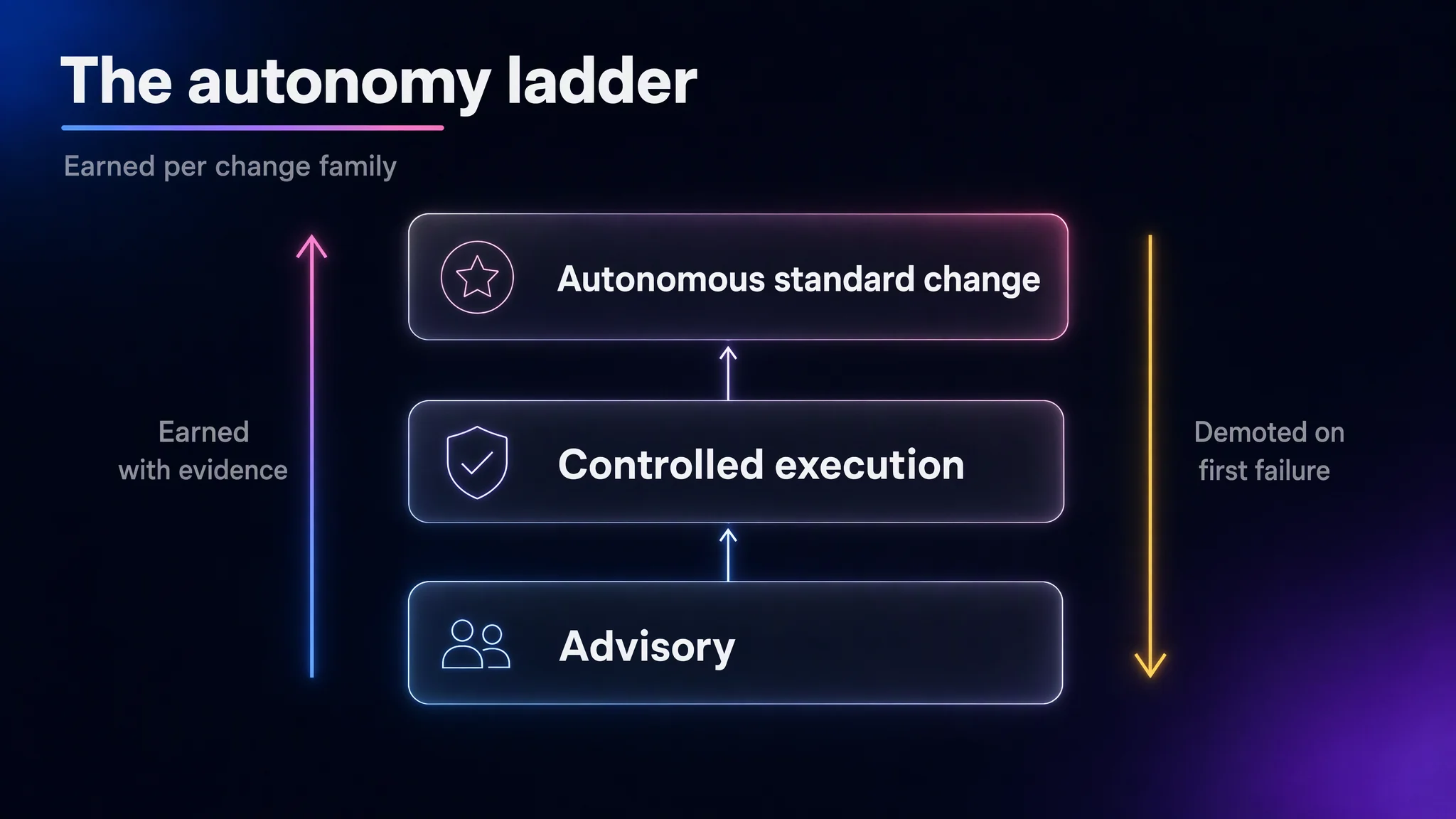
Source: The AI Delivery Factory, Chapter 27, Figure 27.5.
Trust is earned narrowly. An agent trusted to restart a stuck queue is not thereby trusted to resize a database. Autonomy granted on evidence from the audit spine is trust that a machine can check, which is why the supervisor can be shown the ladder rather than reassured about it. Two hard couplings:
- Demotion. In Book 09 Ch 12, the first failure returns the agent to advising on that task. Demotions stay available even when promotions are frozen.
- Control budget. When a domain’s control budget is spent, intake in that domain is throttled and no agent in it is promoted until the rates come back together (control budget).
Envelope zones, the delegation gate and suspension mechanics are on agent lifecycle.
The AI Skills Library and the graveyard failure
The Skills Library holds the department’s knowledge, and it is the asset that survives staff turnover (source claim, Book 2 Ch 20 §5.1; ADD proposal §4a.6). Run it as maintained machinery. The author, review, consume and evaluate duties are Book 2 Ch 20 §5.1 and §5.4; the retire duty is Research Paper 6 §4 item 3; the re-evaluation trigger on an ADR change is this page’s recommendation:
| Duty | Who | Control |
|---|---|---|
| Author skills | Subject-matter experts, as part of their actual job | Skill authorship is planned work, not a side task |
| Review and merge | Wranglers | Reviewed and merged like code, in the same repository discipline |
| Consume | Agents, at execution time | Agents load skills at run time, not from a portal no agent can reach |
| Evaluate | Platform and enablement | Continuous evaluation, and re-evaluation when an ADR or standard changes |
| Retire | Platform and enablement, as library owner | Stale skills are removed, not left alongside current ones |
The library sits beside the ADR and GIP repositories. ADRs and GIPs tell the agent what to respect; skills tell it how to do the work. Context-asset stewardship belongs to the platform lead as a duty, not as an eighth seat (accountability). Research Paper 6 recommends funding it as a standing budget line that outlives the programme (§4).
Where the values live. Without a ratified mission, an estate does not lack values. It has fifty prompted missions, one per system prompt, none ratified (source claim, Book 2 Ch 20 §5.1). The factory charter consolidates them into one versioned mission compiled into the prompts, skills and stop conditions.
The graveyard failure (source claim, Book 2 Ch 20 §8). The library is stood up, seeded once and never maintained. Agents then execute last year’s standards at speed.
- Recognise it: a skill contradicts a current ADR, or wranglers route around the library because they no longer trust it.
- Recover: put the library under continuous evaluation, and make skill authorship part of the experts’ job, reviewed and merged like code.
- Acceptance check (recommendation): every skill records its last evaluation date and the ADR versions it was checked against. A sample of skills changed since the last ADR release shows no contradiction.
One use for the Service Management fleet, with a boundary. Pointed at the department’s own defect data (breaks, exception queues, rework, late reports, complaints), the fleet can cheaply surface problem candidates. This is a generating loop, so it runs under loop-escape conditions. What it produces is a candidate and nothing more. A named human originator owns any intent that follows, and the business owns its own problem statement (source claim, Book 2 Ch 20 §5.2; intake on running the factory).
Department processes: the tenth recipe family
The stack describes what the department runs on. Its own end-to-end processes, such as access recertification, supplier onboarding and the change flow, are the agent-driven department process. This is the tenth and highest-agency recipe family: several agents with separate wranglers and identities, assembled last (source claim, Book 2 Ch 20 §5.5, Ch 23; Research Paper 2 §5.10; recipe catalogue).
Process rules (source claims unless marked):
| Rule | What it means in the build | Source |
|---|---|---|
| The workflow holds the process state; no agent does | A business event opens a durable workflow instance with fixed states: received, checked, prepared, approved, executed, closed, plus an exception state that returns to the wrangler. Each stage is a specialised agent with its own envelope, identity and wrangler. Every transition is logged with the identity and version of the agent that made it | Book 2 Ch 20 §5.5; RP2 §5.10 |
| Approvals are enforced by the workflow, not requested by a prompt | Human approval before execution, and separation between the preparing agent and the executing agent, sit in the deterministic layer, where no model can talk its way past them | Book 2 Ch 20 §5.5; workflow pattern |
| Highest class carries forward | The workflow carries the highest data class seen so far in the instance and enforces it on later stages | RP2 §5.10; data classes and lanes |
| Cross-department calls go through the agent gateway only | Steps that call another department’s agents use the agent gateway, never shared credentials | RP2 §5.10; MCP and connector broker |
| Assemble only after the stages run stably alone | Each stage first runs as a lower-class recipe (document pipeline, triage router, single bounded task agent) with its own wrangler and evidence, until its exception rate is boring. Only then compose under one workflow | Book 2 Ch 20 §5.5; RP2 §5.10 (the least-agency rule) |
| Failures go to the firm’s incident process | Agent and workflow failures raise incidents in the same ICT incident process and classification as any other failure, not a separate AI channel | RP2 §5.10; incident response |
| Kill switches at two levels | A kill switch per agent and per process; replay testing before any scope change; authorisation between agents | RP2 §5.10 |
Evidence per instance: every state transition with agent identity and version, each approval and its approver, exceptions and their resolution, and an evidence bundle per instance. Evaluation: end-to-end cycle time, straight-through rate, exception rate by stage, error escapes found in quality assurance, cost per case, and wrangler workload (RP2 §5.10).
How to read the agency class. Research Paper 2 rates this archetype A4 for its control bundle, because it has several separately owned identities. Between stages it is sequenced by code, so it behaves as a workflow whose stations are agents. Test effort and predictability are closer to a workflow than to a model-orchestrated multi-agent design.
Translocation: traffic in both directions
The process shape keeps moving after assembly (source claim, Book 2 Ch 20 §5.5):
- Codify down. When trajectory traces show an agent taking the same tool sequence in most runs over a sustained period, move that path into the workflow or deterministic code. Confirm equivalence with replay tests and keep the agent for the residual cases.
- Delegate up. When a procedural system’s exception queue absorbs skilled manual effort across varied resolution paths, hand the exceptions to an agent at the advisory rung behind a typed interface.
Both moves are evidence-led. Both are also why the agent share should not only rise.
Team shape
The department is staffed to the four archetypes Book 1 Ch 18 §4.1 designed. Book 2 Ch 20 §5.4 only instantiates them for the delivery factory (author model):
| Archetype | Runs | Delivery roles placed here (Book 2) |
|---|---|---|
| Platform and enablement | Landing zones, identity, network, security engineering, observability, governance automation | Owns the Skills Library and the ADR/GIP repositories |
| AI-agent operations | The control plane, the gateway, model serving and MLOps; “SRE for agents” | Home of the wrangler community of practice |
| Control and assurance | First-line evidence engineering and regulatory mapping, feeding the second line rather than replacing it | — |
| Business-facing product squads | Use cases, embedded in business lines, with the platform underneath | The adoption lead (Book 2 Ch 7) sits here, reading usage and steering what the department builds next |
Headcount shares, pods and the seven seats are on accountability. Where Book 1 and Book 2 differ on control and assurance, that page records the difference and follows Book 2.
Never split specification-writing from agent execution
The factory runs two cadences: a human-paced one where intent is written down, and a machine-paced one where agents execute it. Both must sit inside one product team, joined by the specification. The people who wrote the intent read what came back (Research Paper 6, §3.5, §4 item 1).
A firm that sets up a “specification department” feeding an “agent pool” has rebuilt the design/construction split that undid the first software factory (SDC), at machine speed, with the feedback loop cut in the same place. RP6 expects this to be the most common structural mistake, because it looks like sensible specialisation and agent capacity is easy to centralise.
How this fits the department model: the Agent-Driven Department may provide agent capacity centrally, through the two swarms on one platform. It must not take specification away from the product squads. Use cases, intent and the reading of results stay in the squads. The department provides the bounded workspaces and the wranglers’ tooling.
- Recognise it: intent writers and agent operators report to different leaders, or a squad hands a spec “over the wall” and receives a pull request with no one in the squad reviewing it.
- Recover: put both cadences back in one product team, and keep only the agent capacity central.
The consolidation boundary: what moves and what stays
Read without limits, the consolidation argument becomes “put everything under one function”. Proposals framed that way die in the executive committee: the CISO sees a land grab, and the CRO sees the first and second lines merging. Draw the line first, in writing, and defend it harder than the consolidation itself (source claim, Book 2 Ch 20 §4.3; Book 2 Ch 19 §8).
| Moves into the department (first-line build-and-run) | Stays outside it (second line, policy or business) |
|---|---|
| Cloud platform, cloud operations, cloud engineering (the ADD proposal adds cloud architecture) | CISO: security policy, refusal rules, threat intelligence, incident command for security incidents, audit liaison. The CISO keeps the security posture and runs the bridge when the incident is a security incident |
| Identity engineering and operations | CRO: all of second-line risk |
| Network engineering and operations | DPO: unchanged |
| Security engineering: tooling, gateways, API management, agent gateways, and in Book 09 gateway and broker policy implementation | Business lines: ownership of every business application, product decision and the accountability for it |
| The AI factory: model serving and MLOps | ADD proposal adds (proposal): compliance and regulatory affairs; investment-management and front-office trading technology |
| The agent delivery centre: agent operations, wrangling, control plane |
The ADD proposal draws the left-hand column as a target operating model: three layers under one accountable head. At the bottom is the substrate (cloud, identity, network, security). Above it sit agent operations (the AI factory, the agent delivery centre and the agent control plane). At the top are the agent-driven departments that run on both. Read the top layer together with the table: a department that runs on the platform keeps the ownership the right-hand column lists. That applies to compliance too.
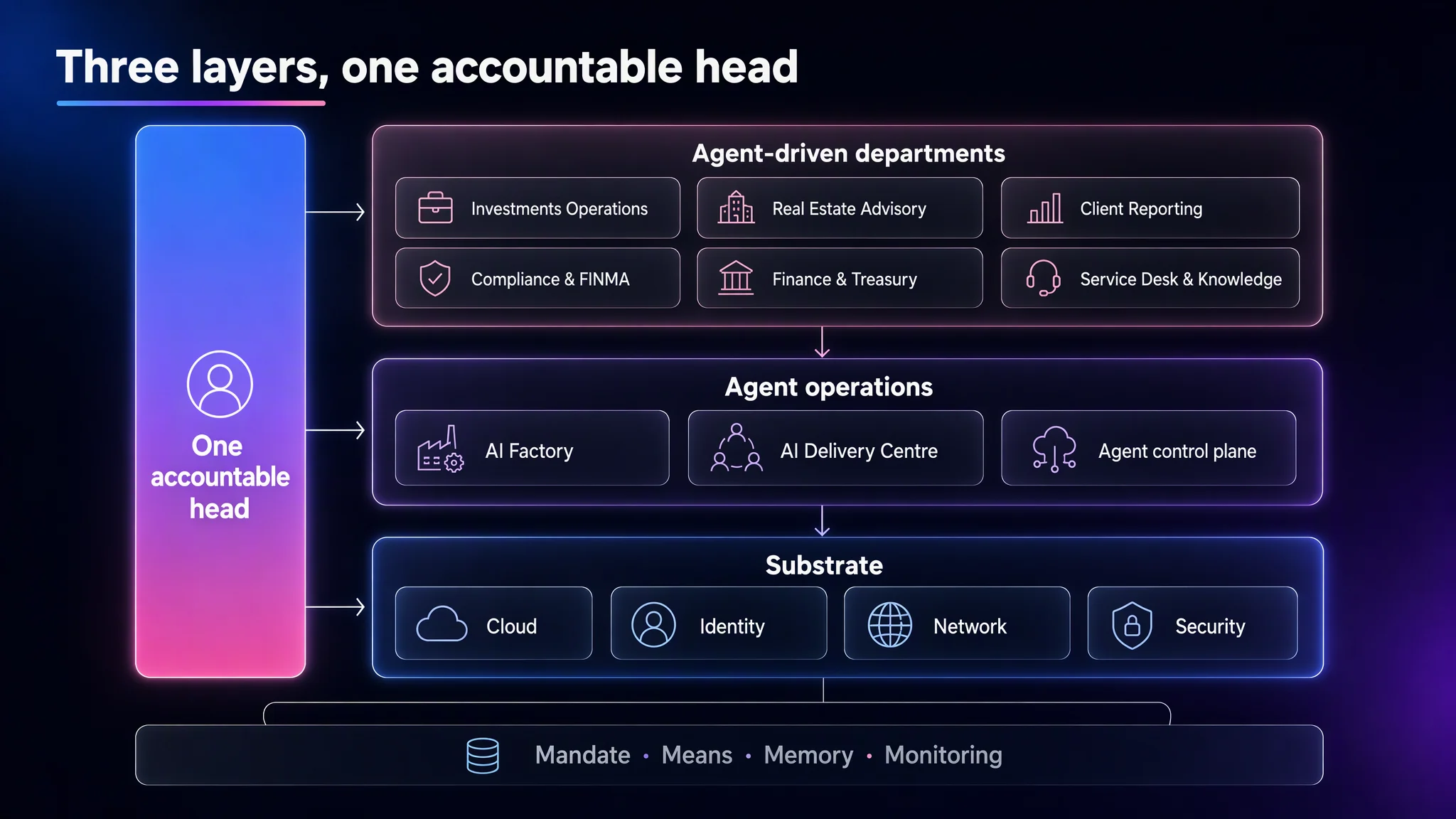
Three layers, one accountable head. The department names are the proposal’s firm-specific examples. This is the author’s proposal, not a deployed organisation. Source: ADD proposal (folder 03), Strategic Brief, target operating model.
Rules that make the line structural (source claims as cited):
- Evidence goes to the second line, never instead of it (Book 2 Ch 19 §8, Ch 20 §4.3). Book 09 Ch 12 makes this concrete. The second line reads the evidence record directly, through access granted under the CISO’s identity rules rather than by the department. The department cannot revoke that access, filter it, or decide when it refreshes.
- The department runs the door; the CISO decides what it refuses (Book 09 Ch 12, composite). The compromise in the composite: refusal rules are set by the CISO’s team and held as code in a repository the department deploys from. The CISO team’s approval is the only gate, with a two-working-day turnaround. The CISO accepted that this was faster and kept ownership. Treat the two days as the composite’s number, not a benchmark.
- The second line tests against artefacts the department did not make (Book 09 Ch 12): the CISO’s refusal rules, the signed list of control values (tolerances, thresholds, limits), and the signed control-budget band.
- The CISO takes a standing seat on the department’s steering group (Book 2 Ch 20 §6; ADD proposal §10 “Platform Steering”).
- The charter’s mission sits at the top of the stay-list. The CISO and CRO help write the charter rather than having it presented to them (factory charter; Book 2 Ch 20 §4.3, Ch 19).
- If you cannot draw the line convincingly, do not table the consolidation (Book 2 Ch 19 §8). This is the single mitigation without which the reorganisation should not go ahead.
How the CISO’s place in the three lines is designed is the firm’s decision. Book 09 says its split (security engineering in the first line, policy and refusal rules in an independent control function) is an operating-model position, not something regulation dictates, and it flags the question for legal review. The legal reading is on the regulatory map. RACI consequences are on accountability.
Order of consolidation
The sources agree on the principles and differ on the detail of the phasing. The steps below are this page’s synthesis of them. Where the sources differ, both are shown.
| Step | Action | Owner | Exit check | Source |
|---|---|---|---|---|
| 0 | (Optional wedge, proposal.) Settle single accountability for tenant-level cloud governance (tenant roles, identity governance, network baseline, platform guardrails), recorded in the RACI with a role catalogue, recertification and an exception register. Valuable on its own if the full consolidation cannot be decided this quarter | CIO and the platform head | RACI updated; the control is running | ADD proposal §0, §11.A |
| 1 | Write the two lists (moves, stays) before proposing any reporting-line change | Proposing head | Both lists in writing | Book 2 Ch 20 §7 |
| 2 | Take the stay-list to the CISO, the CRO and the DPO first, one at a time, and get each to agree the line before the consolidation is tabled | Proposing head | Each has agreed in writing; the CISO’s steering seat is agreed | Book 2 Ch 20 §7; Book 09 Ch 12 |
| 3 | Close the open questions before tabling: role evolution for each affected leader; which identity capabilities stay independent (policy, assurance); the change model for the control plane (automated standard change or CAB) and the evidence it keeps; which incident classes the department will hold as primary owner and which stay with application or service owners | Working group, named owner per question | Each question is at “position formed, awaiting endorsement” | ADD proposal §11.C |
| 4 | Convert the department you already own first, to prove the model; earn the contested moves with evidence | Proposing head | Routine platform change now runs as one department’s deployment | Book 2 Ch 20 §6–§7 |
| 5 | Move the operating layer before the surfaces that depend on it | Department head | — | Book 2 Ch 20 §7 |
| 6 | Before any pod moves, rewrite its on-call model jointly with the CISO’s team and sign it. Name exactly which incident classes the department holds as primary owner | Department head with the CISO | Signed on-call model; the pod moves only after signature | Book 2 Ch 20 §6; Book 09 Ch 12 |
| 7 | Move identity engineering before security engineering. Security engineering moves last, so nothing in flight breaks | Department head | Both on-call models signed | Book 2 Ch 19 §8, Ch 20 §6; Book 09 Ch 12; ADD proposal §10 |
| 8 | Release each later phase against evidence that the previous phase worked, never against a date | Executive committee | Measured waiting has fallen for the first phase | Book 09 Ch 12 |
Where the phasings differ. In Book 2 Ch 20 §6 (composite), the cloud teams convert first, and identity and security engineering follow a quarter later. In Book 09 Ch 12 (composite), the board approved a smaller first phase of cloud, the AI team, and identity engineering and operations, with network and security engineering to follow on evidence. The ADD proposal §10 phases cloud and the AI factory first, identity and network around month 4, and security engineering last (proposal). All three agree on stay-list first, security engineering last, and joint signed on-call before a pod moves. This page follows that common core. Where network moves is a local decision, and moving later on evidence is the safer default.
People move with their duties (source claim, Book 2 Ch 20 §6, Ch 19 §8). A consolidation that moves boxes on the chart without rewriting the operational reality underneath has moved nothing that matters. Plan these as costs in the business case, not as afterthoughts:
- keep respected leaders in place through the transfer; in Book 09’s composite, the same engineers stayed on the same rota for three months;
- publish the new career architecture within weeks, not quarters;
- protect pay bands for a defined window;
- fund a retention envelope before the announcement for the engineers recruiters will call first, and announce role changes in the first week;
- budget named backfill for in-flight programmes that the moves will slow;
- invite an independent finance review of the cost case in the first month and refresh it quarterly.
The ADD internal announcement turns this into public commitments (proposal). The department will not deploy autonomous agents without wrangler review until trust is earned. It will not bypass change control. It will not let agent decisions reach production without a named accountable human. It will not use the model as a pretext for headcount reduction that the operating model does not require.
Wranglers and adoption leads become more central, not redundant. Consolidation makes delivery faster. It does not make business expectations steadier (Book 2 Ch 19 §8).
In a small firm: name it, do not reorganise it
Where engineering already reports to one person, the work is naming, not consolidation (source claim, Book 2 Ch 20 §7). Declare the Agent-Driven Department explicitly, even if it is one team wearing the label. Stand up the six systems in build order and keep the ladder. The stay-list still applies. As a recommendation for a firm with no separate CISO, make the policy and refusal-rule owner someone other than the department head. Builder-and-tester of controls in one person is refused at any size (accountability).
Three things to do this week
- Draw the eight surfaces for one real agent and mark the owning team of each. That diagram is the consolidation case.
- Write the four-property definition against your estate, record which properties you can honestly claim, and state your agent share or admit you cannot.
- Put one runbook on the autonomy ladder explicitly. Name its rung and what would earn the next one. Before declaring a first department process, check that each stage already runs stably as its own recipe. If not, the stages are this quarter’s work.
(Source: Book 2 Ch 20 §7.)
Failure modes and recovery
| Failure mode | Recognise it | Recover | Source |
|---|---|---|---|
| Consolidating the second line by accident | The department signs the risk opinion on its own work, or owns a business decision the line should own | Redraw the stay-list publicly and move second-line and business accountabilities back out | Book 2 Ch 20 §8 |
| Stack without the department | All six systems run, but every agent incident still convenes a multi-team bridge | Treat the org change as the deliverable and the technology as the enabler | Book 2 Ch 20 §8 |
| Rung inflation | An agent acts autonomously on a runbook it has no record for; “trusted” is attached to the agent, not to agent + runbook + domain | Demote to advisory on that runbook and re-earn the rung with evidence | Book 2 Ch 20 §8 |
| Skills Library graveyard | A skill contradicts a current ADR; wranglers route around the library | Continuous evaluation; skill authorship as experts’ planned work, reviewed like code | Book 2 Ch 20 §8 |
| Department process declared, not assembled | Nobody can say which state a case is in without asking an agent; approval can be skipped by rewording the request | Walk back down the agency classes: state and approvals into a durable workflow, each stage its own recipe, recompose when exception rates allow | Book 2 Ch 20 §8 |
| Reorganisation as land grab | The internal story leads with authority and headcount instead of the fragmentation tax removed | Lead with the operating problem and the stay-list; protect people through the transition | Book 2 Ch 20 §8, Ch 19 §8 |
| Specification department | Intent writers and agent operators sit in different organisations | Rejoin them in one product team; centralise only agent capacity | RP6 §3.5, §4 |
| Agent share as a quota | The share appears in objectives or league tables; its numbers jump with no change in flow | Remove the target; keep the share as a descriptive measure from the evidence record | RP6 §4; Book 2 Ch 18 §4.4 |
| Pager moved before duties | A pod has transferred but its incident classes are undefined; first major incident has no clear primary owner | Write and sign the joint on-call model; move the pod only after signature | Book 2 Ch 20 §6; Book 09 Ch 12 |
| Revocable second-line access | Second-line read access to evidence is provisioned and controlled by the department | Re-grant under the CISO’s identity rules, beyond the department’s power to revoke or filter | Book 09 Ch 12 |
| Three clouds under three teams | Agent identity on one cloud, policy on another, each owned by a different team | Bring the primitives under the department’s one control plane | Book 2 Ch 20 §5.3 |
Acceptance checks
The department exists, and is survivable, when all of these hold:
- The four properties are held for every production agent, with evidence recorded against each.
- The agent share has a written definition, is computed from provenance in the evidence record (
executing_agent,initiator), is reported, and appears in no individual or team target. - The six systems are each in the inventory as System Name / System Type / Description / Purpose, maintained as they change.
- Every agent’s autonomy is recorded per runbook and per domain, with the evidence that earned each rung above advisory. The Event-Driven framework runs no runbook above the rung it has earned.
- The stay-list is written, agreed in writing by the CISO, the CRO and the DPO, and published.
- Second-line read access to the evidence record is granted under the CISO’s identity rules and cannot be revoked, filtered or scheduled by the department.
- Refusal rules are owned by the CISO’s function; changes to them go through the CISO team’s approval gate.
- Security incident command is with the CISO; a signed on-call model names the incident classes the department holds as primary owner.
- Each department process keeps its state in a durable workflow; approvals are workflow states; every stage ran stably as a lower-class recipe before composition.
- For every product, specification-writing and the reading of agent output sit in the same product team.
- A sampled agent incident convened only people who share the department’s rota and change process, plus the CISO where it was a security incident.
Source notes and conflicts
- Agent share: measure or not. Book 2 Ch 20 §4.1 requires the share to be measured and reported. Research Paper 6 §4 item 7 says not to measure agent participation, and names agent share of commits. The two are compatible if “measure” means a descriptive measure for steering the handover and RP6’s “do not measure” is read as “do not target or manage people by it”. RP6 itself adds “Measure flow, review latency and outcomes”, and its §3.5 frames the rule as “should not set targets on agent participation”. This page takes that reading and says so. A reader who takes RP6 literally should report the share only at department level, never per team or person.
- Phasing. Book 2 Ch 20 §6, Book 09 Ch 12 and the ADD proposal §10 phase differently (see order of consolidation). This page follows their common core.
- Control and assurance. Book 1 Ch 18 and Book 2 Ch 20 differ on whether the archetype brings second-line functions onto the plane. This page follows Book 2, as does accountability.
- ADD proposal status. Folder 03 is the author’s internal proposal for one firm, dated May 2026, with open questions in §11.C. The six-system catalogue appears in it first; Book 2 Ch 20 presents the same six systems as the author’s reference model. Its cost figures, staffing figures, named individuals and firm identity are deliberately not reproduced here.
- Vendor claims. The cloud primitive names are as reported in Book 2 Ch 20 (August 2026) and are marked for verification above.
- Regulation. Registration and logging obligations, their addressees and dates are on the regulatory map and regulatory calendar. This page does not restate them.
Source material
- Book 1, Chapter 18, The Implementation Roadmap (§4.1 the four team archetypes, which Book 2 Ch 20 §5.4 instantiates)
- Book 2, Chapter 16, The Automation Factory (§4.8 the two fleets; §4.9 trusted execution architecture)
- Book 2, Chapter 18, The Factory's Charter (§4.3 mandate as the stay-list stated negatively)
- Book 2, Chapter 19, The Motivations, Benefits and Difficulties (§8 the difficulties: loss of authority, morale, talent flight, transition drag)
- Book 2, Chapter 20, Agent-Driven Departments (§3–§8: definition, consolidation argument, stay-list, six-system stack, autonomy ladder, team shape, department processes, worked example, practical application, anti-patterns)
- Book 2, Chapter 23, The Ten Recipe Families (the agent-driven department process as the tenth family)
- Book 09 (Everything Is Green), Chapter 12, Who Holds the Dial (the boundary negotiation, refusal rules as code, phasing against evidence)
- Research Paper 2, Ten Solution Archetypes for Regulated Finance (§5.10 Archetype 10, agent-driven department process)
- Research Paper 6, The AI Factory versus the Software Factory (§3.5 failure catalogue; §4 what a CIO does differently)
- ADD proposal (folder 03), Strategic Brief §0, §3, §4, §4a, §4b, §6, §7, §10, §11 (author's firm-specific proposal, not a deployed organisation)
- ADD proposal (folder 03), Internal announcement: the six use cases and 'what we will and will not do' (draft, proposal)
Related guidance
-
 Accountability and OwnershipHold provenance and accountability apart on purpose: four named accountabilities per product, a human owner for every agent change, seven named seats, a signed Build/Run RACI and a first-line/second-line boundary that survives consolidation.
-
 The Factory CharterThe one ratified document the factory's organisation, business case and operating model hang off: mission, mandate and decision rights, operating principles and ordered values, each value with an owner, policy, metric and veto. Covers the clauses to adopt, who drafts, co-writes, signs and ratifies them, how they compile into running systems, and how drift and decoration are caught.
-
 Operate the Agent LifecycleInventory, register, sign, zone, review, suspend, recover and retire agents through a six-stage lifecycle with named human ownership, zone-specific authority and evidence at every transition.
-
 Run the AI Delivery FactoryOperate demand, capacity, the two worker classes, exceptions and evidence as one service: read two leading numbers, keep a handover backlog, gate construction on three conditions, run queues and alerts at agent volume, and count unused products as cost.
-
 The Enterprise Agent Control PlaneThe firm-owned services that make every agent action identifiable, decidable, approvable and reconstructable: the ownership boundary, six planes and their contracts, the Policy Decision API with its latency budget, the persistence schema, the build sequence and the tests that show it works.
- The Ten AI Product Recipe FamiliesThe ten recipe families and their design cards (flow, action scope, data classes, controls, evidence, evaluation, anti-patterns), how to fit a request and choose between neighbours, the pattern catalogue beneath them, the human duties each recipe must staff, who governs the catalogue, and the pipeline checks that catch family drift, families of one and orphans.
- Workflow PatternUse a workflow when code can determine the next step, even when some steps call a model: the eight workflow patterns with their forces and factory notes, why class 2 is the default, how code-orchestrated multi-agent flows stay workflows, how to codify a stable agent path down or delegate exceptions up, and a composite service-desk triage example read across frameworks and cloud pillars.
- Bounded-Agent PatternA class 3 agent lets a model choose the next step, but only inside a registered, validated and enforced envelope of Mandate, Means, Memory and Monitoring.
- The Audit Spine and the Evidence RecordHow to capture, join, protect, retain and prove per-action evidence: the AES v0.1.0 record contract, three capture points and one correlation ID, tiered immutable storage, retention and legal hold, replay rehearsal, the route-approval evidence gate, and the Claude-specific ways evidence goes missing.
- Control BudgetAn author proposal for a CRO-signed limit on how fast change may arrive relative to the firm's capacity to understand it: the CIO runs the line, the CRO signs the band, only changes with a full record count, two weeks outside the band queues intake automatically, quarter-end widening is signed in advance, and someone outside the squad reviews what the budget held back.
- Measure the FactoryRead usage first, then the seven-dimension scorecard; emit a served-request event that separates human from agent callers; label every reported number by evidence tier; watch the two leading numbers of a control gap; treat an unexplained sharp improvement as an alarm; and never turn a participation metric into a target.
- Respond to Agent IncidentsSort an agent failure into one of four incident shapes, suspend it in three verified layers, keep humans on every classification and disclosure decision, route one playbook to every authority that needs a cover sheet, and close each incident with a named control change.
-
 Route Regulatory Questions to Obligations and EvidenceA dated, article-level reference that routes AI design questions to the EU AI Act, DORA and its RTS, GDPR and sectoral rules, and turns each obligation into a control, an owner and evidence: change records under RTS 2024/1774 Art 17, the 4 h / 72 h / one-month incident clocks, the CIF hinge and its five artefacts, the three-count Register of Information reconciliation, Art 14(4) oversight controls, the Art 26(5) discharge, the FRIA gate, Art 49 and Art 50, SCHUFA-grade review and supplier controls.
- The Implementation RoadmapSequence the factory as a dependency graph, not a calendar: the closure order for the governance gap, a written portfolio threshold, six overlapping phases over eighteen months with entry conditions, exit evidence, 'not yet' lists and pass/soft-fail/hard-fail gate questions, tranche funding released on exit evidence, a programme RACI, size, maturity and sector calibration with four signed trade-offs, and the first week, thirty days and ninety days in dependency order.