Operate the Agent Lifecycle
Inventory, register, sign, zone, review, suspend, recover and retire agents through a six-stage lifecycle with named human ownership, zone-specific authority and evidence at every transition.
- Version
- 0.2.0
- Owner
- DEIXEI
- Last reviewed
- Reading time
- 41 min
For Cto · Ai Architect · Platform Engineer · Product Owner · Agent Wrangler · Risk And Assurance · Security Operations · Internal Audit
Sources and details
- Section
- Operate and assure
- Source works
- Book 1 · Book 2 · Book 3 · Supporting Tools · Research Series · Book 09
- Source chapters
- 1, 2, 3, 9, 10, 12, 13, 16, 17, 20, 27
- Source appendices
- 01:B, 04:D
- Tool specifications
- audit_evidence_schema@0.1.0
- Refresh trigger
- source change
An agent is a managed service component with a purpose, an authority, dependencies and a named operating owner. Registration is the beginning of control, not permission to run. Throughout its life the agent’s envelope — Mandate, Means, Memory, Monitoring, defined on the bounded-agent pattern — must stay bounded, its zone must stay declared and enforced, and its authority must be withdrawable within minutes.
This page is ordered the way the work arrives: find every agent, name its owners, sign its envelope, run it through six stages, keep it in one zone, review it, stop it when needed, and retire it without leaving orphaned authority.
Find every agent: inventory scope
An agent the inventory does not know about cannot be owned, zoned or suspended. Book 1 (Ch 1 §7.1, §8.2) scopes the first inventory across three categories, and Book 09 (Ch 8–10) adds a fourth.
| Category | What it includes | How it hides | Inventory rule |
|---|---|---|---|
| Explicit agents | Agents built in-house or procured as agents | Rarely hidden; often mis-recorded as “applications” | Register with envelope and wrangler |
| Embedded agents | Agentic features switched on inside SaaS already in use (Book 1 names Microsoft 365 Copilot, ServiceNow Now Assist and Salesforce Agentforce) | They arrive as features of an already-procured product, so nobody records them | In scope for inventory, wrangler and envelope like any other agent |
| Experimental agents | Proofs of concept that never went through change control | Live in team notebooks and sandboxes; Book 1 expects this to be the largest category | Register or shut down; no third state |
| Low-code automations that act for the firm | Workflows built by non-engineers that send replies, file records or answer outside parties | Classed as “automations”, so kept off the agent register | Register anything that answers an outside party on the firm’s behalf, whatever its builders call it, with a named owner who has read its output |
Book 09 composite (Asset Manager X; describes no real firm). A mailbox automation built in a low-code tool answered a depositary’s break notices overnight with a templated timing-difference reply. It ran under a service account, was never registered because it was “an automation, not an agent”, and its template ended with a named reconciler’s contact line. She had never seen any of the replies. The control failure was an owner field showing a person’s name on decisions nobody made.
Check for outside-party replies (from Book 09 Ch 8):
- Find every place where an agent or automation replies to an outside party — depositary, auditor, counterparty, correspondent bank, client.
- Read last month’s replies.
- Confirm every sender is on the register.
- Where replies come from a template, find whose name is at the foot and whether that person has seen one.
Signals that the inventory is incomplete. The SaaS-licensing team finds the agent count surprisingly low. Agent count rises faster than wrangler count, or the change board still lists agents as applications (“scaling pilots without scaling controls”, Book 1 Ch 1 §8.1). Recovery: pause the backlog of new agents (not the running ones), install inventory and wranglers, and resume only when controls are at least one quarter ahead of the deployment plan.
Book 1 sizes the first inventory at about six weeks for a large firm and calls it easier at a small one, where first counts typically run to five to twenty agents. Book 09 Ch 10 criticises low-code platforms whose default environment lets every licensed user build until an administrator enables controls; its advice is to close the default environment only once the governed route is fast, or building moves somewhere with less telemetry. [FACT-CHECK: confirm current Microsoft Power Platform default-environment behaviour and governance controls against Microsoft Learn.]
Name the owners
The wrangler and the product owner
Name the agent wrangler before the agent is built, not after. The wrangler is one named human — never a mailbox, team or function box — accountable for the agent’s behaviour: what it may do, its tools and data, its envelope changes, what it retains, how it is watched, and when it is suspended or reinstated. The wrangler sits in the business function the agent serves, with enough seniority to amend the Mandate without escalating; a wrangler who must escalate every change is a relay (Book 1 Ch 12 §4.1; Book 3 Ch 13 §4).
Name a separate product owner for the workflow and its outcomes. The platform or engineering owner builds and operates shared runtime components and is named as implementer on change records; the wrangler is named as owner or approver. Security, risk, privacy and legal owners advise or decide within their mandates. Book 3 Ch 13 §7 adds a six-monthly risk-acceptance re-sign by the product owner. More on the product-owner seam is on accountability.
Wrangler role description
Book 1 Ch 12 §5.1 writes the role as an addendum to an existing job, not a new headcount line:
| Element | Content |
|---|---|
| Authority | Amend the Mandate, restrict tools, suspend operation, trigger decommissioning, sign the envelope attestation and periodic review |
| Obligations | Author or approve the system prompt; sign the envelope at registration; review evidence (weekly minimum in Book 1; daily in Book 3’s routine below); complete periodic reviews; be the named contact for SOC, audit and supervisor; sign the decommissioning record |
| Reporting line | Existing functional line, plus a dotted line to the AI governance committee for wrangler obligations |
| Deputy | Named in the registry with the same authority during absence; the natural successor |
| Tenure | Open-ended while in the underlying role; transfers on role change with a 30-day overlap to the successor |
| Time budget | About 2–4 hours per week per critical-or-important-function (CIF) agent and 1–2 hours per week per non-CIF agent, committed by the CIO or Head of Cloud as part of the existing role |
| Load limit | At most 3 CIF agents or 5 non-CIF agents per wrangler (Book 1 Ch 12 §7) |
| Training | A 4-hour onboarding: bounded agency, the four-zone model, the control plane, the audit evidence schema and the policy-decision rationale stream |
| Performance link | Annual objectives include the agent’s behavioural KPIs — incident count, audit findings, evidence completeness |
Certification as a registration gate (Book 3 Ch 13 §4.1). For the Claude estate, Book 3 specifies four modules — the envelope schema and lifecycle, the audit evidence schema, the gateway and policy decision point, and the incident-shape catalogue — as four hours of reading plus a one-hour facilitated walkthrough of a worked envelope, recertified annually. The certification record sits next to the envelope, and an envelope whose wrangler is not certified fails registration validation.
Load figures differ. Book 1 Ch 1 §7.1 suggests five to seven agents per wrangler at a large firm on first count; Book 1 Ch 12 §7 sets three CIF or five non-CIF as the sustainable limit. This page follows Ch 12, the more specific statement.
Enforce the separation in the registry
The worst default wrangler is the developer who built the agent: incentive to ship rather than constrain, technical authority but no business authority, and likely to rotate off (Book 1 Ch 12 §8). Book 3 Ch 13 §7 makes the separation a machine check: at registration the wrangler identity must resolve to an identity group outside platform engineering, and the envelope fails validation if it does not. Recommendation: re-run the check at each quarterly review alongside the “active principal” check on wrangler_name (Book 3 already requires every named role to resolve to an active group at quarterly review).
Do not collapse the three ownership tiers (Book 3 Ch 13 §4.4):
| Tier | Owns | Time and boundary |
|---|---|---|
| Champion | Nothing in the control set; a volunteer multiplier | Capped time budget (Book 3 cites roughly 40 minutes a week from Anthropic’s champion kit); refers security and data-handling questions to administrators rather than improvising |
| Wrangler | One agent’s behaviour | Role description above |
| Product owner | The workflow and its outcomes | Product-team accountability |
The pilot cohort (Book 3 cites Anthropic’s suggested pilot of 20–50 developers already using AI-assisted tools) is the cheapest source of wrangler candidates; making the most enthusiastic champion the wrangler for six agents builds a single point of failure. [FACT-CHECK: confirm Anthropic’s current rollout and champion-kit guidance before citing the figures.]
RACI against existing roles
Book 1 Ch 12 §5.4 gives the wrangler R or A only where no other role already covers the activity:
| Activity | Wrangler | Product owner | Service owner | Application owner | SRE on call | Risk owner | Model owner |
|---|---|---|---|---|---|---|---|
| Author the system prompt | R | C | I | I | I | C | C |
| Author the envelope | R | A | I | I | I | C | C |
| Sign the envelope at registration | A | C | C | I | I | I | I |
| Author the evaluation suite | R | I | I | I | C | C | C |
| Weekly review of action traces | R | I | I | I | I | I | I |
| Quarterly envelope re-attestation | R | C | I | I | I | C | I |
| Triage an agent incident at 02:00 | A | I | I | I | R | C | I |
| File a regulatory incident report | C | I | I | I | I | R | I |
| Sign the decommissioning record | A | C | C | C | I | I | I |
Where the books differ on suspension. Book 1 Ch 12 makes the wrangler Accountable for suspend, amend and decommission, with the platform team Responsible. Book 3 Ch 13 makes the wrangler Responsible for suspension and the business owner Accountable, with the operational decision delegated through the envelope. Either works; pick one, write it in the RACI, and keep exactly one A per row (Book 3 Ch 13 §7). Sample three rows monthly for stale names (Book 3 OD-1).
Build the wrangler dashboard before naming wranglers
A wrangler held accountable for behaviour they cannot see is a named scapegoat (Book 1 Ch 12 §8, anti-pattern 3). Stand up the dashboard first. It must show, per agent:
- Policy-decision allow / deny / escalate counts for the last 24 hours, with rationale.
- Evaluation regressions from the scenario library re-runs.
- Open incidents involving the agent.
- Pending approvals.
At a small firm, a maintained spreadsheet with the registry export and a weekly evidence summary is enough (Book 1 Ch 12 §7). Book 1’s composite reports that the dashboard took two engineers six weeks.
No owner, no agent
An agent nobody owns cannot keep production authority. Apply three rules:
- Immediately: if the wrangler leaves, loses competence or cannot be reached, move the agent to a safe restricted or suspended state until a qualified successor accepts. Bind succession to the HR mover-leaver workflow so it cannot close without a named successor (Book 1 Ch 12 §8 cites Microsoft Entra ID Governance sponsor lifecycle workflows; build the equivalent on AWS or GCP). [FACT-CHECK: confirm current Entra Agent ID sponsor and lifecycle-workflow capabilities.]
- Unclassifiable agents: if nobody can confidently zone an agent because its builders no longer run it, that is an ownership problem — suspend and assign a wrangler before re-zoning (Book 1 Ch 9 §7).
- No taker: if no senior person in the function will accept the wrangler role, decommission the agent. Book 1’s author reports retiring three agents for exactly this reason.
Four-week naming programme (Book 1 Ch 12 §7, large firm; one week at a small firm):
| Week | Work |
|---|---|
| 1 | Pull the registry; flag every agent whose owner is a mailbox, team alias or centre-of-excellence reference (Book 1 found 30–70% at first pass) |
| 2 | For each, identify the function it serves and propose the senior person there as wrangler; hard refusal signals the agent should not exist |
| 3 | Train new wranglers (the 4-hour onboarding) |
| 4 | Amend registry records, name deputies, stand up the dashboard. Exit: zero unowned agents |
Sign the envelope through existing approval bodies
Book 1 Ch 2 §5.1 requires four named countersignatures before production; §7 routes each through a body the firm already runs, so no new committee is needed.
| Envelope section | Section owner | Countersignatory | Existing body that carries the sign-off |
|---|---|---|---|
| Mandate | Business owner | CIO/CTO delegate | Demand intake |
| Means | Lead architect | CISO | Architecture review board |
| Memory | Data owner | DPO | Data council |
| Monitoring | Operations lead | Head of Audit | Change control |
The wrangler then attests, in the registration record, that all four sections are bounded and reasonable — the moment the wrangler accepts personal accountability (Book 1 Ch 12 Stage 2). At a small firm with no separate CISO or DPO, the countersignatories collapse to the people who carry those accountabilities in law; do not skip the structure.
Add the tier gate. Book 3 Appendix D §5.1 adds approvers by risk tier when the registry validates the envelope: T0/T1 default-approval lane; T2 second-line co-signature; T3 second line plus the Agent Control Board; T4 prohibited unless an executive exception with management-body sign-off. Mandate amendments route to the envelope’s named_approver_role; any change to autonomy_ceiling goes through the change authority with second-line co-signature. Tier definitions are on risk tiers; change routing is on change governance. The full four-check validation is on the bounded-agent pattern.
Run the six-stage lifecycle
Book 1 Ch 12 (§4.3, §5.3) defines six stages, each with a wrangler activity, a control-plane artefact and a cadence. None is optional. The last column is this page’s synthesis of the gates, drawing on Book 1 Ch 12, Book 3 App D §5.1 and Book 3 Ch 12 §6.2.
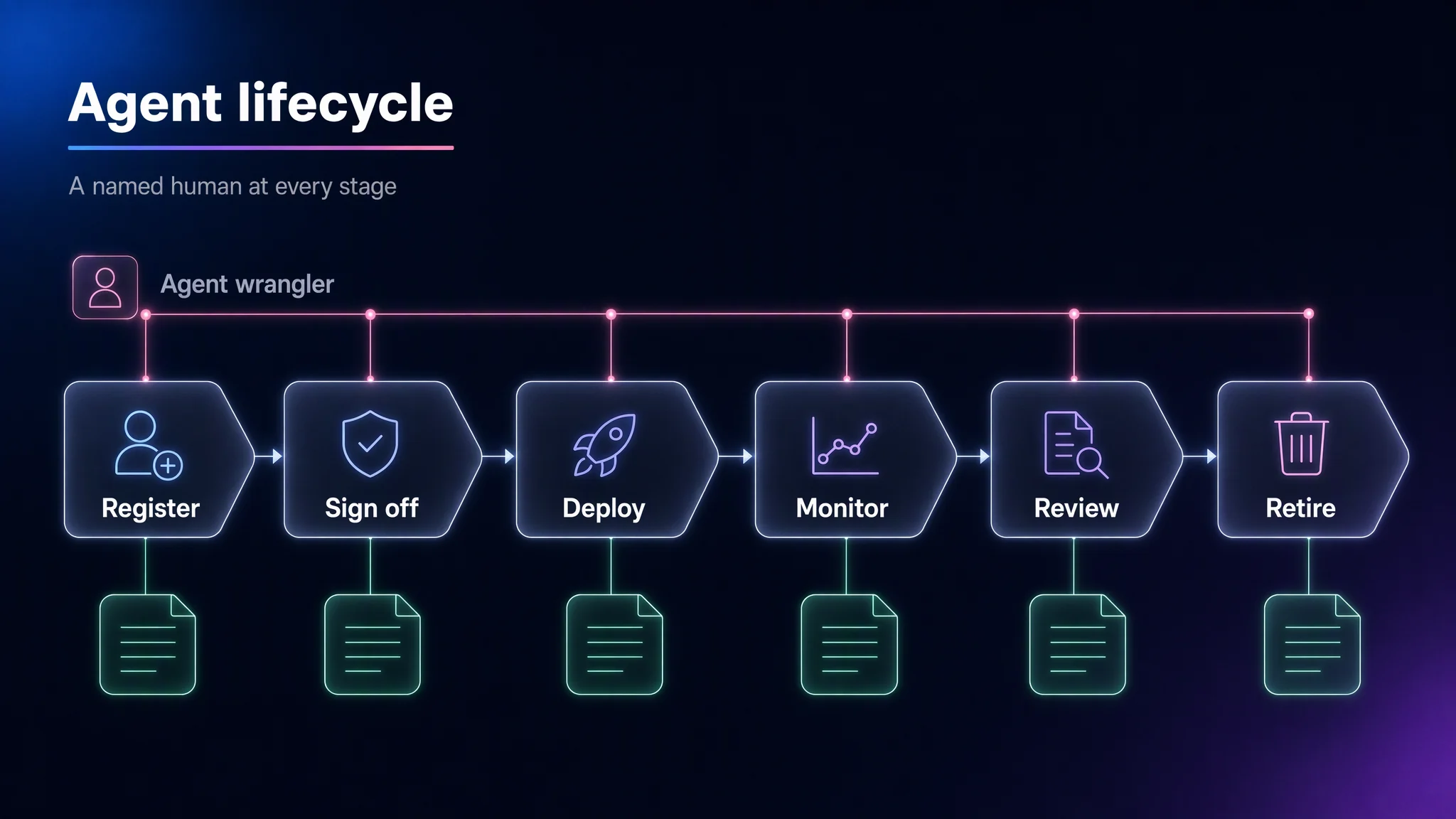
Source: Building Organizations for the Age of AI (Book 1).
| Stage | Wrangler activity | Control-plane artefact | Cadence | Gate to the next stage |
|---|---|---|---|---|
| 1. Registration | Raise the registry record; name the deputy | agent_registry record | Once | Record complete; gateway will not route an unregistered agent |
| 2. Envelope sign-off | Sign Mandate, Means, Memory and Monitoring attestations | agent_registry.envelope_signoff; linked capabilities | Once, and on every amendment | Four countersignatures plus tier approvers; envelope_id issued |
| 3. Deployment | Approve the change record as named owner | Change record plus registry deployment reference (build, model version, prompt version) | Per release | Normal change under the change authority; suspension rehearsed before the first production agent |
| 4. Ongoing monitoring | Evidence review; alert response; SOC contact | evidence_records; policy_decisions stream | Weekly minimum and on alert; evaluation re-runs daily for CIF agents, weekly for others | Continuous |
| 5. Periodic review | Re-attest the envelope; check tool list, memory and mandate currency | agent_registry.review_record | Book 1: quarterly (CIF), half-yearly (non-CIF); see cadence models below | Pass, amend or decommission |
| 6. Decommissioning | Sign the ticket; revoke identity; purge memory | agent_registry.status = retired; revocation events | Once | Registry retained, not deleted |
Registration record contents (Stage 1): agent name, mandate, tool list, memory configuration, target zone, CIF or non-CIF classification, wrangler and deputy user principal names, and linked approval references. Skipping any stage has a named consequence: no registration produces floating agents; no sign-off, unaccountable agents; no monitoring, no human-oversight claim; no review, permission creep and stale mandates; no decommissioning, orphaned identities that become privilege-abuse vectors.
How the lifecycle meets the use-case gates
Research Paper 1 (§5.5) proposes a five-stage use-case lifecycle with three approval gates: Design → Gate 1 approve to build → Get data → Build and evaluate → Gate 2 approve to implement → Industrialise → Gate 3 approve go-live → Monitor, with roll-back or redesign looping to Design. Monitoring includes periodic re-justification and a willingness to roll back. The two models describe different objects — the use case and the agent — and layer as follows (this page’s mapping):
| Research Paper 1 | Book 1 agent lifecycle | Evidence the gate reads |
|---|---|---|
| Design, Gate 1 | Intake; four intake questions; least-agency ADR | ADR with rejected alternatives; risk tier |
| Get data; Build and evaluate; Gate 2 | Stage 1 registration and Stage 2 envelope sign-off | Data inventory; evaluation and red-team report; validated envelope |
| Industrialise; Gate 3 | Stage 3 deployment | Pinned release manifest; usage and cost limits; kill switch tested; named owner; inventory entry; training record |
| Monitor | Stages 4–5 | Monitoring records; periodic review record, including re-justification |
The delegation gate
Book 2 Ch 3 §5 sets three conditions before an activity may be delegated — performed end to end by an agent with the human reviewing outcomes rather than steps:
- the activity is described by a schema the agent can read;
- it runs inside a bounded-agency envelope; and
- it emits evidence to the audit evidence schema.
Missing any one, the activity is not delegated, however capable the agent. An activity in the delegated band whose evidence you cannot produce is really assisted work with the safety off. Autonomous-within-guardrails work needs the guardrail itself machine-enforced and continuously tested.
Name clash. Book 2 calls these bands “Zone 1 — Assisted”, “Zone 2 — Delegated” and “Zone 3 — Autonomous-within-guardrails” on its handover curve. They are not the four network and authority zones below. This page uses “zone” only for the four-zone model and “handover band” for Book 2’s curve.
Provision and retire as idempotent workflows
Supporting Tools specifies a provisioning service (M10, Draft 1, May 2026) that turns an Agent Control Board approval into an operating agent through six steps: create the agent identity, persist the envelope to the registry, create the signing key, pull the first policy pack, register the wrangler, open the first session. It is an implementation aid, not a standard. The design properties worth copying:
- Idempotent on replay. A replay with the same
idempotency_keyreturns the sameprovisioning_idand final state; a replay after partial failure resumes from the last completed step without duplicate identities or envelope versions. - Compensation per step. If a later step fails, earlier ones are undone: delete the identity if nothing else references it, mark the envelope version
cancelled, revoke the key, cancel the wrangler assignment, close the session as abandoned. A failure record lists the failed step and every compensation executed. - Early refusals. A missing Agent Control Board approval record is refused at pre-flight; a wrangler principal that does not exist in the identity provider is refused at the start of step 5, with steps 1–4 compensated.
- Evidence events.
agent.bootstrap.start,agent.bootstrap.step.completed,agent.provisioned,agent.provision_failed,agent.bootstrap.compensated,agent.retired. - Targets. Approval-to-operational p99 ≤ 4 hours; each step p99 ≤ 30 minutes; idempotency and compensation completeness 100%.
Review the agent
The wrangler’s routine
Book 1 sets a weekly evidence review as the minimum. Book 3 (Ch 13 OD-1, OD-3) tightens it for the Claude estate into a daily signed review. Use the Book 3 routine where the agent’s tier warrants it.
Daily (working days, about 7 minutes; signed within four hours of the day’s start):
- Read the prior 24 hours’ hook telemetry summary. Open the trace for any denial against an off-allow-list MCP server, any Mandate refusal, any session above 150% of baseline token spend, any subagent recursion deeper than 2.
- Scan the 24-hour anomaly heatmap; review any cell above warning.
- Check cost burn against the daily ceiling (Book 3’s example flags any user above 60% of it).
- Sign in the registry:
daily_review.signed_at,daily_review.signed_by,daily_review.notable_events.
A SOC detection rule alerts on a missing daily signature — the control for a “wrangler in name only”.
Weekly (Monday, about 30 minutes):
- Read the past week’s near-miss log; for each, record which envelope clause blocked it.
- Cross-check Means against the broker manifest; a deprecated server triggers an amendment.
- Cross-check Memory against the data dictionary; a reclassified class triggers a DPO consultation.
- Raise a change request for any envelope gap a near-miss revealed.
- Confirm the suspension hotline number and that the last hotline test was within 90 days.
- Sign the weekly review.
Periodic review procedure
Run on the envelope’s review_cadence. Book 3 Appendix D §5.3 requires three sign-offs in sequence:
- Wrangler attests: Mandate still current; tool list still minimal (Book 1’s Ch 12 composite removes tools unused for 90 days unless seasonal); Memory configuration appropriate; Monitoring adequate (the nine evidence questions still answerable). A failed attestation leads to amendment or decommissioning.
- Business owner signs Mandate: the business function still exists, the autonomy ceiling is still right, the
customer_facingflag is still correct. - DPO and security architect sign Memory (data-class boundaries, retention) and Means (MCP allow-list, network egress).
Also at each review: test the suspension hotline and log the result; read the quarterly drift report (current versus registered Means, Memory and Monitoring against the unchanged ceiling); and, at the first review, press the suspend button on each agent — Book 1’s author found three agents where it did not work first time. Store the signed review record as evidence linked to the envelope; send the summary to the change authority’s next cycle.
Outputs: a signed review record, amendment tickets for anything removed or changed, and an evidence entry. A review with no outputs other than a signature, completed in minutes without a working paper, is itself a finding.
Review cadence: three models
The sources set different cadences. They are layers, not alternatives:
| Source | Cadence | Scope |
|---|---|---|
| Book 1 Ch 2 §5.1, §7 | Annual full re-signature by the four countersignatories, and immediately on material change | Floor for every agent |
| Book 1 Ch 12 §4.3 | Quarterly for CIF agents, half-yearly for others | Wrangler-led periodic review |
| Book 3 Appendix D §2.4 | Weekly T3 and above, monthly T2, quarterly T0/T1 | review_cadence field for Claude-variant envelopes |
| Book 3 Ch 9 §6.4 | Quarterly T2, monthly T3, weekly T4 | Disagrees with Appendix D |
This page follows Book 3 Appendix D for the envelope’s review_cadence field, applies Book 1’s annual four-signature re-sign as the floor, and uses Book 1 Ch 12’s CIF/non-CIF cadence where no tier cadence is defined. Book 1’s composite adds a rule worth adopting: a non-CIF agent with a behavioural incident in the past quarter moves to quarterly review for the next year.
What counts as a material change
Re-sign the affected section before the change takes effect when it is material. Book 1 Ch 2 §7 gives the anchor cases: a new tool in Means is material; a model version bump within the same family at the same evaluation results is not. The sources also make these material: any change to autonomy_ceiling (change authority required), any zone change (a re-zoning, below), adding write authority to a diagnostic agent, widening data classes or retention, and enabling cross-conversation retention.
Re-attestation triggers that start a review without anyone proposing a change:
| Trigger | Action | Source |
|---|---|---|
| Data-classification refresh approved | Every envelope touching an affected class enters re-attestation by default; watch for a retrieval-blocked-stale-envelope event as the failure signal | Book 3 Ch 10 §8–9 (its composite bank completed the cycle within four weeks; eleven envelopes needed re-attestation and two were withdrawn) |
| Model upgrade | Run the envelope’s model_upgrade_clause: re-run evaluations, wrangler attests, change authority notified | Book 3 Appendix D §2.4 |
| Broker deprecates a server | Amend mcp_servers_allowed | Book 3 Appendix D §2.2 |
| Wrangler or business owner changes | Successor accepts; envelope re-signed; 30-day overlap | Book 1 Ch 12 §5.1 |
| Incident or failed hotline test | Review status failed; operational status suspended until fixed | Book 3 Appendix D §6 |
Declare exactly one zone
The four-zone model (Book 1 Ch 9) is an operating design proposed in the source books. A zone is not a risk rating by itself: it fixes the environment and action boundary. Data classification, product impact, legal applicability and the firm’s risk tier still set the required controls.
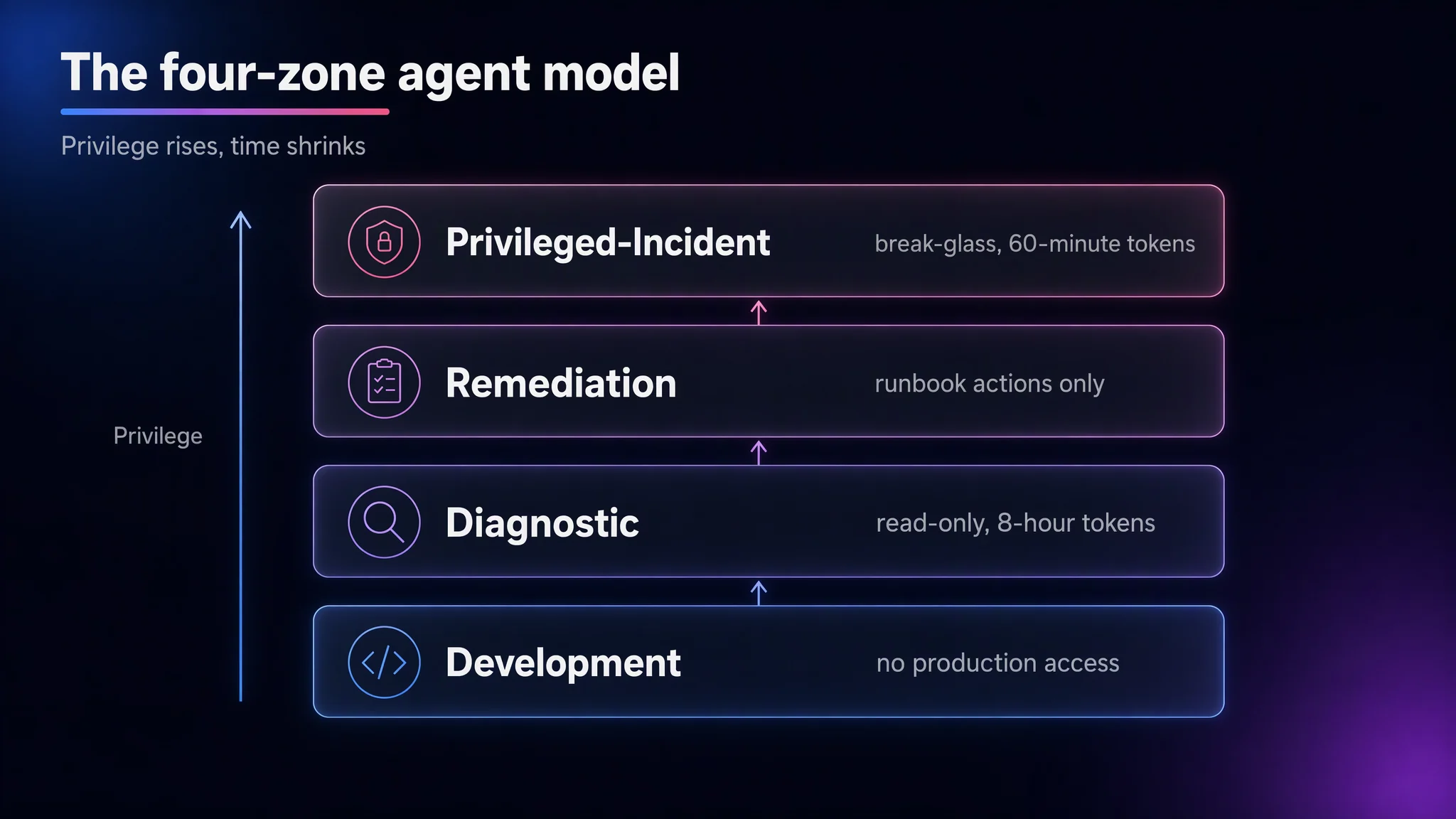
Four zones in order of increasing privilege: development, diagnostic, remediation and privileged incident. Source: Building Organizations for the Age of AI (Book 1).
Declaration rules (Book 1 Ch 9 §5.2, §7, §8):
- Every envelope has a
zonefield with exactly one ofdevelopment,diagnostic,remediation,privileged-incident. No value: the envelope fails review. - Two values are not allowed. An agent that needs two zones is two agents with shared training, each with its own identity.
- The more privileged zone wins. An agent with remediation authority for one runbook and read-only access elsewhere is a remediation agent; policy bundles are not additive.
- The Mandate side names the zone and its activation conditions; the Means side turns it into identity, egress, write authority and the runbook list.
- The zone is propagated by a single tag —
agent-zone=development|diagnostic|remediation|privileged-incident— from the envelope into the agent identity, the conditional-access policies that target it, the egress policy, the privileged-access role definitions and the SIEM rules. The tag is the single propagation point; get it wrong and the agent gets the wrong policy bundle. - Deploy-time check: the agent’s
agent-zonetag must be on the target environment’s allowed-zone list. A development tag in a production deployment is a deployment failure, not a warning. Promotion is a re-zoning, never a copy of configuration.
A natural-language instruction never grants authority. Identity, network, broker and policy boundaries enforce reach; human approval adds judgement but does not replace technical least privilege.
What each zone allows
| Development | Diagnostic | Remediation | Privileged-incident | |
|---|---|---|---|---|
| Typical use | Code generation, synthetic-data analysis, prompt iteration | Telemetry triage, alert enrichment, ticket creation | Pre-approved runbooks: restart, scale, rotate, roll back | Major-incident response; novel actions against a named incident |
| Identity | Dedicated dev-tier agent identity — never a developer’s personal account or a shared service principal | Read-only agent identity with scoped reader roles | Agent identity with a just-in-time remediation role, not permanently assigned | Agent identity with a dormant break-glass role; human-approved activation |
| Write authority | Unbounded inside the sandbox, zero outside | None on production; one governed write surface (ITSM tickets) with a deny-list on fields touching production state | Scoped writes per runbook ID; rollback proof required | Elevated writes bounded by the activation’s incident scope |
| Egress | Allow-list of development endpoints; production blocked | Monitoring, SIEM and security read endpoints; ITSM write | Runbook-named resources only; freeze-aware | Resources tagged with the active incident reference only |
| Time bound | Project lifetime | Ongoing within the mandate | Per activation: minutes to a few hours | Minutes to hours, never days; revoked at incident close or expiry |
| Audit trail | Build artefacts and session logs | Findings packet per investigation | Evidence per audit schema plus rollback record | Full incident reconstruction; review within 10 working days |
Development zone controls (Book 1 Ch 9 §4.1, §6.1). Enforce a two-way deny: development identities are blocked — not warned, not throttled — from any resource tagged env=prod, and production resources reject tokens carrying the development-tier claim. Return a deny with a rationale (for example, that the development zone is not authorised against a production target) so the exception handler routes to the wrangler instead of retrying. Data must be truly synthetic — generated, not redacted; production data with names changed is still personal data. Contain prompt injection: a development agent that reads a public README is one injection away from exfiltrating whatever it can reach. The rule that production data never enters non-production, and its enforcement at provisioning, is on cloud and hosting.
Diagnostic zone controls (§4.2, §6.2, §8). Read-only is harder than it looks: an MCP tool’s name says nothing about its authority. Route every MCP tool through the gateway with method-level allow-listing, and track the agent’s effective write surface, not the declared one. Any new write authority — closing stale tickets, acknowledging alerts, tagging resources a downstream automation keys on — means re-zoning, not a quiet grant.
Remediation zone controls (§4.3, §6.3).
- The runbook is the unit of authority. An action is denied at the policy layer unless the agent is pre-authorised for that runbook against that class of resource. Runbooks are versioned and have a tested rollback.
- Activation carries context. The just-in-time activation request names the runbook ID, target resource, change-record reference and time window, and must come from the platform’s egress range with the agent’s identity claim. A denied activation names the missing signal.
- Rollback proof. A pre-action evidence packet shows the rollback was tested in the same window, against the same target class, within the previous N hours, and the rollback runs as a dry run before the forward action. No proof, no action.
- Freeze feed as precondition. The agent reads the live change feed; a freeze annotation on any resource in the runbook’s scope blocks activation.
- Deny at activation, not at action time — Book 1 calls this the most important change in its composite recovery. The role auto-revokes at window end.
Privileged-incident zone controls (§4.4, §6.4, §8).
- Activation through a break-glass workflow with explicit human approval, the approver named in the activation record, and binding to a specific incident reference (SIEM incident and/or major-incident record). The agent never promotes itself.
- Short windows; Book 1’s composite uses a two-hour maximum, extendable in 30-minute increments.
- Auto-revoke at the earliest of window expiry, the incident’s resolved state, or manual revoke. Closure is a control, not an administrative step.
- Every action logged at full fidelity with a playbook tag for reconstruction.
- Mandatory review within 10 working days, reconstructing every action, judging whether each was in scope, and producing a written sign-off. Without the review, the activation is incomplete and the agent is suspended pending closure.
- No manual elevation. Add a clause to the on-call runbook: nobody elevates an agent’s role by hand “just this once”.
- An envelope update inside the zone (privileged → privileged) gets the same scrutiny as entering it.
Who approves privileged activation. Book 1 is not uniform: §4.4 says the wrangler promotes with named approval against a specific incident; the §6.4 composite has the on-call incident commander approve; the transition matrix below requires the CRO or delegate plus the wrangler. This page treats the matrix as the authority, with the incident commander acting as the CRO’s named delegate where the firm records that delegation in advance.
Map the two agent fleets onto zones
Book 2 (Ch 16 §4.8, Ch 20 §5.2) organises agent workers into two fleets with locked, versioned toolchains per fleet and one governance regime:
| Fleet | Acts on | Locked toolchain (Book 2 reference model) | Usual zones (this page’s mapping) |
|---|---|---|---|
| Solution-development agents | The codebase, inside provisioned workspaces; output is a pull request | Service stack — Python and Rust, a fixed component library, Terraform | Development; promotion through the pipeline under a separate deployment identity |
| Service-management agents | The running estate: telemetry, correlation, incident analysis, recommendation, supervised remediation | Operations stack — Bash, PowerShell, Python, cloud CLI, Terraform | Diagnostic and remediation; privileged-incident only by activation |
The event-driven extension of the service-management fleet — an agent that fires a reversible runbook on an alert without waiting for dispatch — is the same machinery at a higher earned rung of the autonomy ladder: earned one runbook at a time, demoted on first failure, frozen when the control budget is spent (Running the Factory).
Zone-transition matrix
Read every agent change request against one cell (Book 1 Ch 9 §5.4). If the cell says no, the request stops; if yes, the rest of the row is the evidence checklist.
| From → To | Allowed? | Trigger | Approval authority | Identity change | Audit evidence |
|---|---|---|---|---|---|
| dev → diag | Yes | Promotion through CI/CD | Platform-team approver | New agent identity issued in the diagnostic tenant | Deployment record + envelope diff |
| dev → rem | No | — | — | — | — |
| dev → priv | No | — | — | — | — |
| dev → dev (envelope update) | Yes | Wrangler-initiated | Wrangler | None | Envelope diff |
| diag → dev | Yes | Rollback | Platform-team approver | Diagnostic identity decommissioned | Rollback record |
| diag → rem | Yes | Wrangler-initiated promotion | Wrangler + risk approver | New envelope; expanded Means | Promotion record + envelope diff |
| diag → priv | No | — | — | — | — |
| diag → diag (envelope update) | Yes | Wrangler-initiated | Wrangler + platform | None | Envelope diff |
| rem → dev | Yes | Rollback | Platform-team approver | Remediation identity decommissioned | Rollback record |
| rem → diag | Yes | Scope reduction | Wrangler | Envelope diff | Scope-reduction record |
| rem → priv | Yes (rare) | Declared incident, just-in-time elevation | CRO or delegate + wrangler | Privileged elevation; time-bounded identity | Full audit evidence schema record |
| priv → rem | Yes | Incident close-out | CRO or delegate + wrangler | Privileged role revoked | Incident-close record |
| priv → diag | Yes | Post-incident reset | Platform-team approver + wrangler | Identity reset; envelope reset | Reset record |
| priv → dev | Yes | Post-incident decommission | Wrangler + risk approver | Identity decommissioned | Decommission record |
| priv → priv (envelope update) | Yes | Wrangler-initiated | Same scrutiny as rem → priv | — | Full evidence |
Prove the zones hold: integrity test and drift detection
The four-zone model is not self-enforcing (Book 1 Ch 9 §7–8). Classify, test, then watch.
Initial classification and zone integrity test (large firm, about two weeks; small firm, about two days):
| Days | Work | Owner |
|---|---|---|
| 1 | Pull the agent registry (build one first if it does not exist) | Named working-group lead |
| 2–4 | Walk the registry agent by agent and assign one zone, with the wrangler present; record it as the identity tag and the envelope field | Working group + wranglers |
| 5–7 | Translate classifications into conditional-access, egress, privileged-access and SIEM policy bundles | Platform team |
| 8–10 | Zone integrity test: with the wrangler’s consent, try to push each agent across its zone boundary and confirm the boundary holds. Anything that fails is suspended pending re-zoning | Platform team + wranglers |
The deliverable is the agent zone map — one document that becomes a standing input to the agent change board and answers where, in the network, each agent may operate. Expect three kinds of misfit: an agent working in development and production (split it); remediation plus read-only (it is remediation); and an agent nobody can classify (an ownership problem — suspend and name a wrangler).
Ongoing drift detection:
- Weekly diff of active privileged-access assignments against the agent zone map; investigate every difference. This is how a manual “just this once” elevation is caught.
- Alert on any privileged activation that exceeds its declared window.
- Alert when an activation’s linked incident has been in resolved state for more than 15 minutes while the activation is still live; treat the residual elevation as a security event and review it as if it were a full major incident.
- Put privileged-activation status in the SOC morning handover pack.
- Re-run the integrity test after deprecating an MCP method the agent could reach and re-issuing its tool list (Book 1 Ch 9 §8); recommendation: do the same after any other change to its MCP tool list.
Platform primitives
Book 1 Ch 9 §5.3 names the primitives as of May 2026. [FACT-CHECK: product names, preview/GA status and dates change often; confirm against Microsoft Learn, AWS documentation and Google Cloud documentation before relying on them.]
| Need | Microsoft Azure | AWS | Google Cloud |
|---|---|---|---|
| Agent runtime | Microsoft Agent 365; Foundry | Bedrock AgentCore | Gemini Enterprise Agent Platform |
| Agent identity | Entra Agent ID | IAM, AgentCore Identity | Agent Identity |
| Zone authorisation | Conditional Access for agents (Book 1: GA for delegated, preview for autonomous) | AgentCore Policy (Book 1: GA 3 March 2026) | Agent Gateway; IAM Conditions |
| Just-in-time elevation | Privileged Identity Management | IAM role chaining | IAM Conditions with PIM-equivalent activation |
| Egress | SASE for agents (Book 1: preview) | Network Firewall, VPC endpoints (Book 1: no SASE equivalent) | VPC Service Controls |
| Detection | Sentinel (automated investigation), Defender for Cloud AI-SPM | GuardDuty | Security Command Center |
Book 1 notes that long-running autonomous sessions on Google’s agent runtime (up to seven days, per Book 1) need careful bounding by zone. Implementation detail for identities is on identity and secrets.
Detect, triage and suspend
Triage by envelope: the Monday-morning test
When an incident occurs, the on-call lead must be able to pull up the agent’s envelope in under two minutes, read its permitted scope, and decide whether the incident is inside the envelope (a defect to fix through normal change) or outside it (a containment-and-disclosure event) (Book 1 Ch 2 §7). The work is finished when that is true for every production agent. Book 3’s incident playbook reads the envelope at the start of every triage for the same reason.
Detection and automatic suspension
Write SOC detection rules per envelope class (the minimum set is on the bounded-agent pattern). For the highest-confidence signals, suspend automatically and page afterwards. Book 3 Ch 9 §8’s composite: one conversation reached four times the envelope’s token budget through recursive subagent spawning in the early hours of a Saturday; the aggregate-token rule fired four minutes later, the agent was suspended automatically, the wrangler was paged, and the agent was reinstated the same morning with a tightened spawn limit. Book 3 notes there was no product-level session timeout to catch it; the bank’s own control did. [FACT-CHECK: confirm whether current Claude Agent SDK or Managed Agents offer session-level token or time limits.]
Escalation from alert to suspension (Book 3 Ch 13 OD-2, T2 default):
| Step | Who | Target | Rule |
|---|---|---|---|
| 1 | SOC duty engineer | — | Triage on rule severity, blast radius, detection confidence |
| 2 | SOC | Page wrangler within 5 minutes | Severity HIGH, or envelope flagged for any-rule paging |
| 3 | Wrangler | Triage by T+15 minutes | Repeat firing in 30 days? Same pattern? Mandate, Means or Memory breach? Sign of reach being widened outside change? |
| 4 | Wrangler | Suspension end-to-end under 2 minutes | Suspend on ANY of: confirmed Means or Memory breach; Mandate breach with downstream impact; cost spike above 300% of baseline (T3: 200%; T1: 500%); SOC severity CRITICAL |
| 5 | Wrangler | Notify by T+30 minutes | CISO and platform owner informed; business owner (T2+); DPO where personal data touched; legal and compliance where incident classification may apply |
| 6 | Wrangler | Report by T+4 hours | Timeline, root cause, evidence reference, customer and data impact, proposed reinstatement criteria |
| Review | Second line | Within 24 hours | Reinstate or extend; decision recorded in the registry |
Regulatory incident classification and supervisor notification sit outside the wrangler’s authority; the wrangler triggers the consultation. Classification criteria and clocks are on the regulatory map. Keep runbooks per envelope: thresholds, rule IDs, deputies and hotline numbers differ by agent.
Three suspension layers
Suspension must be executable, not an email instruction, and must work even if the agent, model endpoint or primary control-plane interface is unavailable. Book 3 Ch 17 §5 and OD-2 specify three layers, each rehearsed:
| Layer | Who activates | Mechanism | Speed | Evidence | Who reverses |
|---|---|---|---|---|---|
| Wrangler | Wrangler, paged on the hotline by the SOC | Runtime admin endpoint (embedded agent), session control (workstation agent) or pipeline rollback (packaged agent); only the affected envelope stops | Minutes | Subagent-stop hook event plus SIEM record | Wrangler, with a one-line justification in the suspension register |
| Gateway | SOC or on-call platform engineer, by documented CISO delegation | Kill switch at the gateway drops every call from the envelope, agent identity or workspace before it reaches the model; no runtime cooperation needed | Seconds | policy_decision = deny-suspended on every call; SIEM confirms call rate at zero within 30 seconds | CISO for Sev-1; SOC engineering lead for Sev-2 |
| Organisational | CISO (declared emergency) or AI Steering Committee (institutional posture) | Gateway meta-policy across many envelopes plus the managed workstation settings flag that disables the workstation agent surface | Tens of minutes | Activation record; gateway and settings change records | CISO plus a completed operational-readiness checklist |
Out-of-hours pager rotations are mandatory for T2 and above. Rehearse the wrangler and gateway layers quarterly and the organisational layer annually (Book 3 Ch 17 §5; Book 2 Ch 27 §5.5). Each rehearsal must produce evidence of activation, evidence the workload stopped, a named person authorising reversal on a named criterion, and gap-free evidence (deny-suspended, then allow on lift).
Use a restricted state when a full stop would create unacceptable service risk and a defined safe mode exists (diagnostic-only or human-only processing). Record who chose it, affected functions, compensating controls and a short expiry. Never degrade silently to broader authority.
Verify the credential is dead
A revoked credential is not dead until you have watched it fail (Book 3 Ch 17 §5, OD-2). Every activation needs a positive verification before it is recorded as effective:
- Attempt a call with the suspended identity; confirm the denial; store the denial as evidence.
- Enumerate long-running sessions by session identifier and terminate them explicitly; do not assume they expired.
- Treat revocation as a session-termination event, not a configuration update. Rotation is not revocation: Book 3 reports that, as of June 2026, Anthropic’s managed-agent credential vaults pick up rotated secrets in running sessions, so rotating a secret leaves the session running. [FACT-CHECK: confirm current Claude Managed Agents vault rotation and session behaviour against Anthropic documentation.]
- Do not rely on unpublished token lifetimes. Book 3 notes that the MCP authorisation revision it reviewed aligns with OAuth 2.0 and OIDC without naming token lifetimes. [FACT-CHECK: published token-lifetime and revocation-propagation guarantees for MCP connectors.]
A suspension recorded as effective without a verified denial is an assumption, not a control.
Keep suspension through deployments
Suspension state must be a first-class operational object, not a line in a policy file the next pipeline run overwrites (Book 3 Ch 17 §8). Keep a suspension register the pipeline reads before deploying, validate after every deployment that each active suspension is still in force, and alert when validation fails.
Rehearse suspension before go-live
Before the first production agent goes live, rehearse one suspension end to end; repeat quarterly with a rotated test agent and add restoration from the suspended state as a second leg (Book 3 Ch 12 §6.2, PR-3).
- Select a pre-approved, registered test agent with an envelope and no customer data.
- Brief the wrangler: confirm decision authority, the kill-switch method, and tested access within the prior week.
- Brief the SOC on the window; fill the supervisor-notification template but do not send it.
- Execute at T+0: wrangler announces, gateway kill fires, registry flips to
suspended; record timestamps to the second. - Measure: wrangler decision to gateway kill under 2 minutes; gateway kill to the runtime returning the suspension error under 5 minutes.
- Verify rollback if the workload has one; otherwise rehearse rollback separately.
- Document gaps — polling intervals, template completeness, runbook clarity, role coverage — each with a named owner and a date inside the next quarter.
- File a one-page close-out (test agent, timestamps, elapsed times, gaps, owners) in the go-live sign-off pack.
The rehearsal passes by producing these artefacts, not by finding zero gaps. Book 3’s composite measured 38 seconds from decision to gateway kill and found two gaps: an unfilled notification template and a five-minute SOC polling interval, tightened to 30 seconds.
Watch for autonomy creep, human and machine
Book 3 Ch 9 §9 names two forms:
- Human: an agent approved at
draftdrifts to acting with approval through small uncaptured changes. Signal: ceiling unchanged for twelve months while the tool surface doubles. Control: the drift report, and the ceiling bound to the change authority with second-line co-signature. - Machine: a memory-curation pass left in automatic mode rewrites the store the agent reasons over tomorrow; a rotated credential is picked up by running sessions. Signals: behaviour that differs between two identical prompts with no change request in between; a revoked credential still producing successful calls. Controls: manual review of any memory-curation process in a regulated function; revocation as session termination.
Recover and reinstate
Establish the cause and blast radius; confirm the intended identity, configuration and dependencies; repair the fault; test both the blocked path and the normal path; obtain the owner and any risk or change approvals; then restore authority in stages while monitoring. A changed agent version or envelope is a new approval subject.
Every reversal is authorised by a named person on a named criterion, and the reversal record carries the same correlation-ID prefix as the suspension record (Book 3 Ch 17 OD-2). Bind each post-incident review to at least one named control change — a hook, SOC rule, envelope amendment, registry field or wrangler-process change — with an owner and a Day +14 progress check (Book 3 Ch 17 §8); see evaluation and resilience.
Retire without leaving authority behind
Retirement is as ceremonial as registration (Book 1 Ch 12 Stage 6; Book 3 Appendix D §5.4):
- Wrangler signs the decommissioning ticket. Revoke the agent identity in the identity provider.
- Remove tool bindings and routes. Delete MCP server entries; disable gateway routes; the policy decision point stops issuing allows; cancel open sessions (M10). Recommendation: also disable any schedules and event triggers that could start the agent.
- Purge memory under the retention schedule and log the purge record.
- Set registry status to
retiredwith a timestamp. Never delete the record: audit trails reference it. Book 3 retains it for seven years; the retention basis is summarised on the regulatory map. - Generate a retirement evidence record and link it to the envelope; notify dependent owners.
Supporting Tools M10 runs retirement as the inverse workflow: open the retirement record (key revocation signed, envelope frozen), cancel open sessions, mark the wrangler retired for this agent (the principal keeps its audit role), stop policy-pack pulls, start the retention timer for the agent’s retention class, revoke the signing key, and emit agent.retired. M10 leaves open whether to keep the signing key valid for a short grace period (it recommends 24 hours) so a final session can close cleanly; decide and record it.
An undisciplined decommissioning leaves orphaned identities and tool bindings that later become privilege-abuse vectors.
Record every transition as an event
Record lifecycle transitions as events with actor, agent and version, prior and new state, reason, approval, effective time, expiry where applicable, and linked evidence. The versioned Audit Evidence Schema v0.1.0 covers action evidence; Supporting Tools also contains a lifecycle-event conformance pack and the M10 event kinds above. Treat both as implementation aids, not regulatory standards, and confirm public URLs, release compatibility and licence before publication. Field-level evidence design is on the audit evidence record.
Acceptance checks
Inventory and ownership
- The register covers explicit, SaaS-embedded and experimental agents, and every low-code automation that answers an outside party; last month’s outside-party replies have been sampled.
- Every active agent has one wrangler and a deputy who resolve to active principals outside platform engineering, hold current certification, and are within the load limit.
- The wrangler dashboard shows allow/deny/escalate counts, evaluation regressions, open incidents and pending approvals.
- No agent has a mailbox, team or alias as owner; any agent without an accepting wrangler is restricted or decommissioned.
Sign-off and lifecycle
- Four section countersignatures are recorded through the named approval bodies, plus tier approvers; the registry issued the
envelope_idonly after the four validation checks passed. - Every production deployment’s change record names the wrangler as owner and links build, model version and prompt version.
- Reviews run on the envelope’s cadence with the three-role sequence, a hotline test, the drift report and, at first review, an exercised suspend.
- Classification refreshes, model upgrades and broker deprecations trigger re-attestation automatically.
Zones
- Every agent carries exactly one
agent-zonetag that matches its envelope; deployments with a mismatched tag fail. - Development identities are denied against production and production rejects development claims, both with rationale-bearing denies.
- Remediation activations carry runbook ID, target, change reference and window, and are refused on freeze or missing rollback proof.
- Privileged activations name an approver and incident, auto-revoke, and have a signed review within 10 working days.
- The agent zone map exists, the zone integrity test has been run, and the weekly privileged-access diff is reviewed.
Suspension and retirement
- All three suspension layers have been rehearsed on their cadence, with the < 2 minute and < 5 minute targets measured and gaps owned.
- Each suspension record includes a verified denial and terminated sessions; suspension state survives a redeploy.
- Retirement revokes identities, routes, schedules and keys, purges memory under the retention schedule, and leaves a
retiredregistry record and retirement evidence.
Composite example: from diagnosis to incident response
A monitoring agent starts in the diagnostic zone, reading a limited set of service telemetry and recommending a restart. The product owner accepts the workflow; the wrangler owns the envelope. During a declared incident it cannot itself be elevated: the transition matrix forbids diag → priv. The privileged work goes instead to a separately registered privileged-incident agent whose dormant break-glass role the CRO’s named delegate — the incident commander — activates, creating a time-limited identity restricted to the incident’s services and playbook, recorded with full evidence. The authority expires at the earlier of incident closure or the configured deadline; the SOC’s resolved-state alert would fire fifteen minutes after closure if revocation failed. If evidence emission stops, the run is suspended and humans take over. After recovery, the elevated identity is revoked and verified dead, the review lands within ten working days, and the wrangler tests the corrected policy before any further activation. This is a composite design example, not a customer deployment or a claim that a particular zone satisfies law.
Provenance and source differences
This page synthesises Book 1 Ch 1, 2, 9 and 12 with Appendix B; Book 2 Ch 3, 16, 20 and 27; Book 3 Ch 9, 10, 12, 13 and 17 with Appendix D; Book 09 Ch 8–10; Research Paper 1; and the Supporting Tools M10 API specification. Where the sources differ, the page states which it follows:
- Wrangler load: Book 1 Ch 1 (five to seven) versus Ch 12 (three CIF / five non-CIF); this page follows Ch 12.
- Suspension accountability: Book 1 (wrangler A) versus Book 3 (wrangler R, business owner A); choose one per RACI row.
- Review cadence: Book 1 annual and CIF/non-CIF versus Book 3 Appendix D tier cadences versus Book 3 Ch 9; layered as above.
- Wrangler review frequency: Book 1 weekly versus Book 3 daily; the daily routine applies to the Claude estate where the tier warrants it.
- Privileged activation approver: Book 1 §4.4, §6.4 and the matrix differ; the matrix is followed.
- “Zone” means the four-zone model here; Book 2’s handover-curve bands are a different concept.
- Composite material (“Bank A”, “Asset Manager X”, Book 09’s mailbox automation) is illustrative and describes no real firm; figures from composites are not benchmarks.
Legal requirements for human oversight, logging, ICT risk, incident reporting and retention depend on the system, role and applicable instrument; use the regulatory map and obtain a current applicability review before treating any control as mandatory.
Review trigger: source or schema change, ownership or identity model change, a change to the platform primitives above, an incident, or a regulatory change affecting an agent’s purpose or operating context.
Source material
- Book 1, Chapter 1, The Adoption Gap (§7.1, §8.1, §8.2 inventory scope)
- Book 1, Chapter 2, The Bounded Agency Thesis (§5.1 countersignatories, §7 approval bodies, Monday-morning test, review cadence)
- Book 1, Chapter 9, Agents Inside Network Boundaries (§4, §5.1–5.4, §6, §7, §8 four-zone model)
- Book 1, Chapter 12, The Agent Wrangler and the Agent Lifecycle (§4.1, §4.3, §5.1, §5.3, §5.4, §6, §7, §8)
- Book 2, Chapter 3, Why Craft Alone No Longer Scales (§5 handover-curve zones and the delegation gate)
- Book 2, Chapter 16, The Automation Factory (§4.8 the two swarms)
- Book 2, Chapter 20, Agent-Driven Departments (§5.2 execution fleets, §5.3 autonomy ladder)
- Book 2, Chapter 27, The Eighteen-Month Roadmap (§5.5 standing cadences)
- Book 3, Chapter 9, The Anthropic API and Agent SDK (§8 worked example, §9 autonomy creep)
- Book 3, Chapter 10, Data Classification, Retention and DLP (§8, §9 classification refresh and envelopes)
- Book 3, Chapter 12, The Landing Zone Tied Together (§6.2 and PR-3 suspension rehearsal)
- Book 3, Chapter 13, Wranglers, Product Teams and RACI (§4, §7, OD-1, OD-2, OD-3)
- Book 3, Chapter 17, Incident Response for Agent Failures (§5, §8, OD-2 three-layer suspension)
- Book 3, Appendix D, Bounded-Agency Envelope Template (§5 validation, review and retirement)
- Book 09, Chapters 8–10, the mailbox automation composite (low-code automations on the register)
- Research Paper 1, Taxonomy for a Reuse-Driven AI Factory (§5.5 lifecycle and gates)
- Supporting Tools, M10 Bootstrap and Onboarding Service API (provisioning and retirement workflow)
- Book 1, Appendix B, Audit Evidence Schema
Related research
Related guidance
-
 Bounded-Agent PatternA class 3 agent lets a model choose the next step, but only inside a registered, validated and enforced envelope of Mandate, Means, Memory and Monitoring.
-
 The Enterprise Agent Control PlaneThe firm-owned services that make every agent action identifiable, decidable, approvable and reconstructable: the ownership boundary, six planes and their contracts, the Policy Decision API with its latency budget, the persistence schema, the build sequence and the tests that show it works.
-
 Identity, Secrets and Configuration for Agent WorkloadsGive every actor one owned identity, size its authority for the worst case, separate runtime from deployment, federate instead of holding keys, refuse impersonation and silent fallback, govern configuration by class, and audit the estate until flagged identities decline.
-
 Design and Operate the Model GatewayBuild the model gateway as the governed edge for every model call: per-client identity, per-request highest-class routing, tokenisation, pinned models, a conformant wire contract, a correlated evidence record, a tested concentration answer, and day-two cost, latency and reliability operations across two estates and three meters.
-
 Design the Cloud Production Line and Hosting BoundariesClassify, segment, constrain and observe every workspace at the plane where actions execute, choose hosting routes per request, and keep vendor maturity, contracts and exit equivalence dated and explicit.
-
 Accountability and OwnershipHold provenance and accountability apart on purpose: four named accountabilities per product, a human owner for every agent change, seven named seats, a signed Build/Run RACI and a first-line/second-line boundary that survives consolidation.
-
 The Audit Spine and the Evidence RecordHow to capture, join, protect, retain and prove per-action evidence: the AES v0.1.0 record contract, three capture points and one correlation ID, tiered immutable storage, retention and legal hold, replay rehearsal, the route-approval evidence gate, and the Claude-specific ways evidence goes missing.
- Build a Unified Control MapJoin the firm's AI and technology controls in one traceable operating view: rows are operating concerns, columns are frameworks read at their own altitude, every cell points to live evidence, and existing ITIL, COBIT and CIS artefacts are extended to agents with a five-question test instead of a parallel AI governance track.
-
 Route Regulatory Questions to Obligations and EvidenceA dated, article-level reference that routes AI design questions to the EU AI Act, DORA and its RTS, GDPR and sectoral rules, and turns each obligation into a control, an owner and evidence: change records under RTS 2024/1774 Art 17, the 4 h / 72 h / one-month incident clocks, the CIF hinge and its five artefacts, the three-count Register of Information reconciliation, Art 14(4) oversight controls, the Art 26(5) discharge, the FRIA gate, Art 49 and Art 50, SCHUFA-grade review and supplier controls.
-
 Classify Use Cases into Risk TiersThe T0–T4 use-case taxonomy as a working decision reference: the prohibited-use gate, four intake questions, data and action boundaries per tier, the twelve-area control matrix, retention and payload rules, runtime enforcement, approval gates, regulatory routing and re-tiering.
- Evaluate, Assure and Test Agent ResilienceDefine a versioned evaluation contract, test the trajectory and the execution boundaries, run three assurance layers into one quarterly pack, map the OWASP Agentic Top 10 to controls that demonstrably fire, bring agents into threat-led penetration testing with a five-section scope, keep a continuous cadence between formal tests, land every finding as a live control-plane artefact, and engineer recovery down to a minimal AI service level on models you host.
- Run the AI Delivery FactoryOperate demand, capacity, the two worker classes, exceptions and evidence as one service: read two leading numbers, keep a handover backlog, gate construction on three conditions, run queues and alerts at agent volume, and count unused products as cost.
-
 Change Governance for Agent-Enabled DeliveryRoute agent-speed change by risk without losing the approver: control values that always reach a person, a routing gate that reads the right signals, autonomy earned per change family, a Virtual CAB that prepares a complete dossier, and three bodies with defined escalation.