Build a Unified Control Map
Join the firm's AI and technology controls in one traceable operating view: rows are operating concerns, columns are frameworks read at their own altitude, every cell points to live evidence, and existing ITIL, COBIT and CIS artefacts are extended to agents with a five-question test instead of a parallel AI governance track.
- Version
- 0.1.0
- Owner
- DEIXEI
- Last reviewed
- Reading time
- 27 min
For Cto · Ai Architect · Risk And Assurance · Internal Audit · Platform Engineer
Sources and details
- Section
- Govern and prove
- Source works
- Book 1 · Book 2 · Book 3 · Book 09 · Whitepaper · ADD proposal · Supporting Tools
- Source chapters
- 4, 5, 6, 7, 8, 11, 15, 16, 19
- Source appendices
- 01:A, 04:I
- Tool specifications
- audit_evidence_schema@0.1.0
- Refresh trigger
- regulatory change
The unified control map is an author-proposed way to maintain one operational view of controls that are described by different frameworks and legal instruments. It gives a firm a shared structure for assigning owners, implementing controls and finding evidence. It is not a regulator-endorsed framework, a compliance certificate, or proof that one mapped control satisfies several requirements.
Reading the labels. Source claim means a book states it. Author model means a structure the books propose (the map’s rows and columns, the three altitudes, the ten pillars, the five-question test, the four-week rollout). Recommendation is this page’s own synthesis. Bank A is a composite firm. Framework editions and clause numbers are given as the sources cite them and carry [FACT-CHECK] where this page has not confirmed them against the purchased standard. Article-level legal mapping and regulatory dates live on the regulatory map and regulatory calendar; this page names instruments and links there.
Use this map to make a control decision
Use the map when a new AI-enabled product, agent, platform change or supervisory request crosses organisational boundaries. Start with the operational concern and the decision the firm must make. Then identify each applicable obligation or chosen standard separately and link it to the control that implements it. The question to ask in every meeting is which row are we on? Everyone then points at the same row from their own column (Book 1 Ch 4 §5).
Keep four categories distinct:
| Category | What it contributes | How to record it |
|---|---|---|
| Binding law | Duties imposed by an applicable legal instrument for the relevant entity, role, system and jurisdiction. DORA and the EU AI Act are EU regulations; their applicability and relevant provisions must be determined for the specific case. | Instrument, article, jurisdiction, applicable entity/role, effective date and legal owner. Link to the official text. |
| Supervisory interpretation | Authority communications that explain supervisory expectations or apply existing rules to a sector or use case. | Issuing authority, document, date, status and the legal basis it interprets. Do not silently promote guidance into legislation. |
| Standards and control frameworks | Voluntary or contractually adopted practices, unless made binding through another instrument or commitment. Examples used in the source synthesis include ITIL, COBIT, CIS Controls, ISO/IEC 42001, NIST and OWASP guidance. | Exact edition/version, adoption basis, scope and the practices the firm chose to implement. |
| Firm design and recommendation | The firm’s operating choices and this reference’s proposed way to organise them. | Mark as policy, control design, engineering recommendation or author model; name the accountable approver. |
The cited EU instruments are official texts. This page does not interpret their detailed scope or current amendment status; check the consolidated text and applicability before relying on a legal mapping. Accessed 14 November 2026: DORA, Regulation (EU) 2022/2554 and Artificial Intelligence Act, Regulation (EU) 2024/1689. The operating map itself is the author’s synthesis, not an endorsed crosswalk.
Integration is supported; this map is not endorsed
Two claims are easy to blend and must be kept apart.
What the source argues (Book 1 Ch 4 §4.5; Whitepaper Part II §1). Several supervisory and standard-setting publications point the same way: the EBA’s factsheet on the AI Act and banking found no significant contradictions between the AI Act and EU banking law and framed integration as the remaining work; EIOPA’s Opinion on AI governance asks for AI principles to be addressed in an integrated, coherent way documented at organisational level across the lifecycle; BIS FSI Insights No 63 and the FSB’s report on the financial-stability implications of AI treat AI risks largely as extensions of existing risk categories. Book 1 reads these together as endorsement of integrating AI governance into the existing operating model, and the whitepaper’s corollary is that operational coherence, one model with clear ownership and a queryable evidence pipeline, is what a supervisor now inspects.
What this page concludes. Those publications support building one integrated operating model instead of separate AI programmes. They do not endorse this particular map, its rows or its anchors, and they are not binding law. The regulatory map records the EBA’s own description of its factsheet as a mapping exercise rather than guidance or a final supervisory position. Use the publications as rationale for integration in a board paper; never cite them as approval of the firm’s map. Titles, dates and reference numbers are on the regulatory map, with a pending fact-check.
The practical consequence (source claim). A third-party row read by the CRO under DORA and by the CISO under OWASP supply-chain risk is one problem seen from several angles. Solve the row once and populate the columns; the Register of Information entry, the AI Act technical documentation and the ISO/IEC 42001 supplier register then draw on one populated record instead of three submissions.
Build the map around operating concerns
Do not begin with seven framework workbooks. Maintain one row per operational concern and keep independent evidence references for every applicable obligation or framework control. The frameworks answer different questions; a common row makes them comparable without claiming equivalence. No column is the master (Book 1 Ch 4 §8): rows are the operating layer, columns are angles on it.
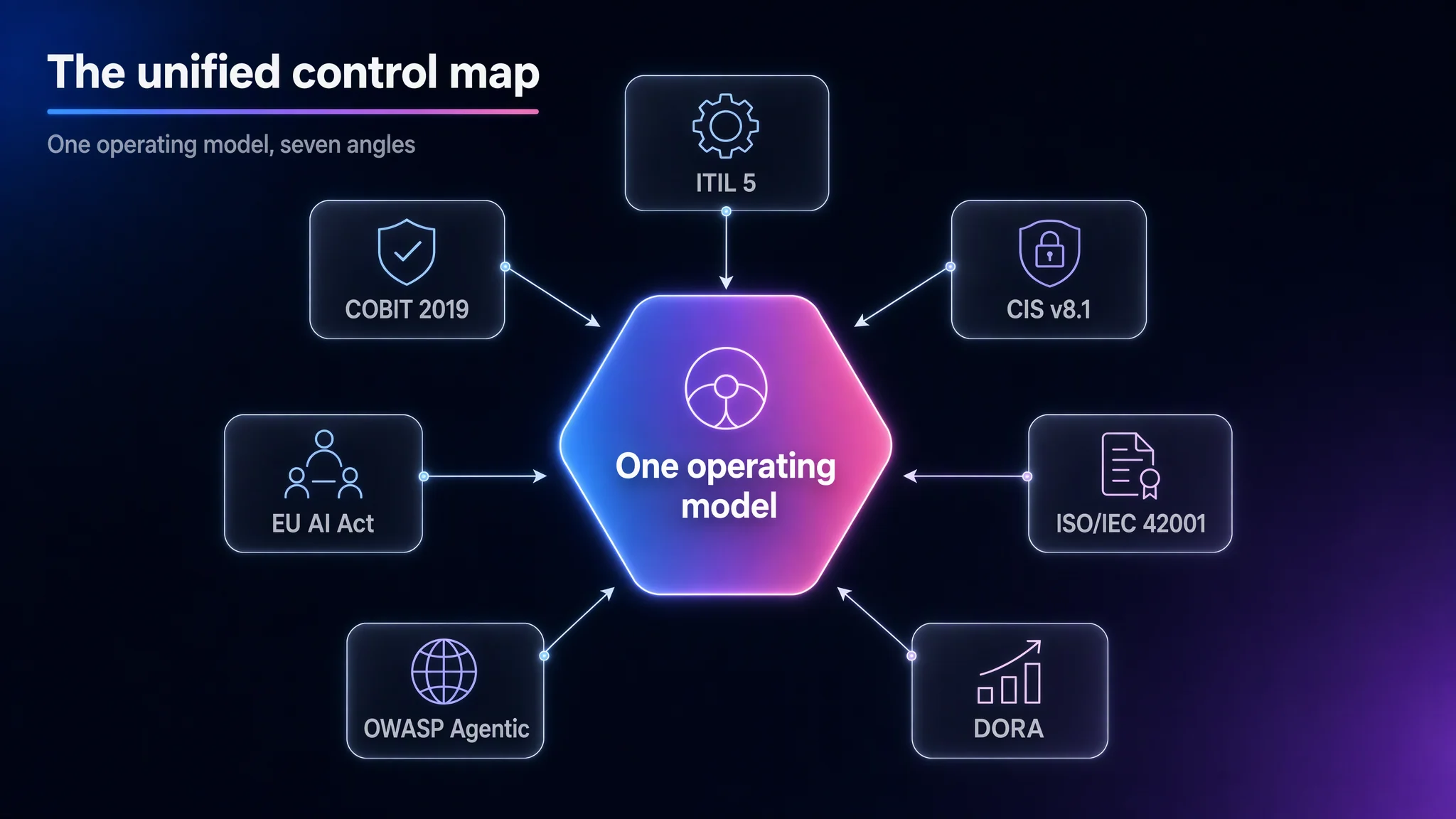
Source: Building Organizations for the Age of AI (Book 1).
| Operating concern | Questions to resolve | Control and evidence examples |
|---|---|---|
| Inventory and configuration | What agents, models, tools, datasets, environments and owners exist? Which version is running? | Reconciled registry/CMDB entry, approved configuration, drift report and change history. |
| Identity and access | Which human, workload or agent identity acts? What can it reach, and where is authority enforced? | Identity binding, least-privilege grants, policy decision, denied-call evidence and revocation test. |
| Change and release | Who may approve this change class? Which checks must pass before release? | Versioned change dossier, required human decisions, test results, deploy record and rollback evidence. |
| Data and memory | What data may be read, retained, retrieved or written? Which classification and lineage apply? | Data-owner approval, scope policy, lineage pointer, retention rule, access log; for records, the Authority Process trail. |
| Human oversight | Who owns behaviour and workflow outcomes? When must the agent stop and defer? | Named agent wrangler, product owner, approval route, review record and suspension path. |
| Incident and resilience | How is an unsafe action contained, investigated and recovered? | Incident record, correlated action evidence, containment decision, recovery verification and regression test. |
| Third-party and supply chain | Which provider, model, connector or subprocessor is in the path? What change or outage could affect service? | Supplier and dependency records, contractual review, version/change notices, concentration assessment and a rehearsed exit (vendor concentration and exit). |
| Control parameters | Which tolerances, thresholds, limits and materiality levels decide what a person sees or what passes unseen? | The signed control-value list, an owner per value, and routing of every change to that owner (change governance). |
This selection is a practical starting set, not an exhaustive legal inventory. Book 1 Appendix A contains a broader example crosswalk (fourteen concerns, seven framework columns and an audit-anchor column); validate each framework reference against its current edition and each legal reference against the official instrument. A cell in a crosswalk is a navigation pointer, not evidence that the control is implemented.
Why the control-parameter row exists (Book 09 Ch 5, 8, 9, 12, composite). A reconciliation described as a key control in the firm’s ISAE 3402 report, the controls report its clients’ auditors relied on (“breaks above tolerance are investigated”), depended on a tolerance value that operations set and nobody listed. A changed value widened the band and breaks cleared silently for about two months. When a control’s effect depends on a parameter, the parameter is part of the control: it belongs on this map’s row with an owner, and every change to it is routed to that owner whatever the diff looks like. The list, its fields and the routing rule are on change governance. Check: every control in the firm’s external controls report that depends on a parameter has that parameter on the list.
Starter anchors for the five rows most often asked about
Book 1 Ch 4 §5 gives five rows a CIO should be able to recall in a meeting. The framework anchors below are the source’s; legal anchors are named by instrument and topic only, with articles on the regulatory map. Treat every cell as a starting pointer to validate, not a finding.
| Concern | ITIL practice | COBIT 2019 objective | ISO/IEC 42001 (as cited) | OWASP Agentic | Legal pointer (see regulatory map) |
|---|---|---|---|---|---|
| Incident response | Incident Management | DSS02, DSS03 | A.10 | ASI01, ASI02, ASI08 | DORA incident classification and reporting; AI Act serious-incident reporting |
| Third-party risk | Supplier Management | APO10 | A.10.4 | ASI04 | DORA ICT third-party risk, Register of Information and designated-provider regime; AI Act value-chain duties |
| Human oversight | Service Level Management | EDM02, EDM05 | A.3 | ASI09 | AI Act human oversight; sectoral senior-management oversight |
| Audit logging and traceability | Monitoring and Event Management | DSS01 | A.6.2.6 | Cross-cutting (all ASI items) | AI Act record-keeping and automatic logs; DORA ICT risk management |
| Data classification and governance | Information and Knowledge Management | APO14 | A.7 | ASI06 | AI Act data governance; GDPR |
[FACT-CHECK: the ISO/IEC 42001:2023 Annex A anchors. In this page's reading, A.10 covers third-party and customer relationships (so it fits the third-party row better than incident response), and event logging sits under the A.6.2 lifecycle controls at a different sub-clause. Book 1 is also internally inconsistent: Ch 4 uses A.6.2.6 for audit logging while Ch 16 §5.2 uses it for human oversight. Confirm every anchor against the purchased standard before use.] CIS anchors the source gives for these rows: Control 17 (incident response), 15 (service-provider management), 14 (security awareness), 8 (audit-log management).
The source’s lead row for the AI era is audit logging and traceability, because AI Act record-keeping asks for more granularity than DORA’s general ICT logging. The operational contract for that row is the Audit Evidence Schema.
Read the frameworks at three altitudes
ITIL, COBIT and CIS are not legacy overhead to be replaced by DORA and the AI Act; they are the operating vocabulary those instruments assume already exists (Book 1 Ch 5 §3; Whitepaper Part II §2). Each sits at a different altitude, answers a different question and produces a different artefact for a different audience.
| Altitude | Framework (edition as cited) | Audience | Question it answers | Artefact it produces | What it supplies to AI obligations |
|---|---|---|---|---|---|
| Practice | ITIL (the source cites ITIL 5, with ITIL 4 running in parallel) | Operations and service owners | How is the work done, day to day? | Practice statements, KPIs, procedures | Change Enablement, Release and Deployment Management are what AI quality-management duties presume; Service Configuration Management is what DORA’s ICT inventory assumes; Incident Management is what DORA’s incident articles and AI Act post-market monitoring assume |
| Governance | COBIT 2019 (40 objectives in EDM, APO, BAI, DSS, MEA) | Board and executive | What has the board directed and what is management held to? | Objective statements, owners, performance measures | The chain from board-approved AI strategy to operational accountability; risk (APO12), security (APO13), data (APO14), build (BAI03), monitoring (MEA01) and internal control (MEA02) give AI duties a pre-existing grammar |
| Enforcement | CIS Controls v8.1 (18 controls, 153 safeguards; IG1–IG3) | Platform and security engineering | What does the platform enforce at runtime? | Safeguard configurations, test results | Asset and software inventory (1, 2), account and access management (5, 6) and audit-log management (8) are the conditions that make AI duties enforceable rather than aspirational |
[FACT-CHECK: ITIL 5 launch date and module structure as cited in Book 1 Ch 5 §4.1 (the Product and Service Lifecycle Model, the 6C AI capability model, the AI Governance extension module); whether ISACA has since published a dedicated COBIT focus area for AI beyond the 2025 paper "Leveraging COBIT for Effective AI System Governance".]
Cadence (recommendation, from Book 1 Ch 4 §7–8). Column owners review source changes monthly, queue updates quarterly, ratify with row owners and publish with a redline. The map’s row sign-off is quarterly.
Implementation group by firm size (source). CIS IG1 is essential hygiene, IG2 mid-maturity, IG3 enterprise scale; Book 1 maps these onto firm size.
Standards that answer specific supervisory questions
Book 3 App I §7 and §9 assign each standard a job. Use the table to decide which document to hand over when a supervisor asks a particular question (author model; editions as cited). The source phrases two of the questions itself (the GenAI risk taxonomy and the red-team attack taxonomy); the other question wordings are this page’s framing of what each standard is used for:
| Supervisor’s question | Standard the firm answers in | Use in the operating model | Accountable role (source) |
|---|---|---|---|
| What is your AI management system? | ISO/IEC 42001:2023 | The AIMS spine; certification on a three-year cycle; Internal Audit aligns its schedule to it | Executive sponsor with Head of Model Risk |
| How do you assess AI risk? | ISO/IEC 23894 with NIST AI RMF as adoption template | Risk methodology; RMF cross-walk | Head of Model Risk |
| What is your generative-AI risk taxonomy? | NIST AI 600-1 (Generative AI Profile, twelve risks) | Built into the risk-assessment methodology | Head of Model Risk |
| What attack taxonomy is your red team scoped against? | MITRE ATLAS plus NIST AI 100-2 (adversarial ML) | Red-team and threat-led testing scope | CISO |
| What is your agent threat model? | OWASP Top 10 for Agentic Applications (ASI01–ASI10), with the OWASP LLM Top 10 for the model layer | Mitigations per item; the coverage scorecard below | CISO |
| How do you develop generative AI securely? | NIST SP 800-218A | Secure-development tasks in the SDLC | CISO |
| What is your security and privacy baseline? | ISO/IEC 27001 and 27701 | ISMS and privacy extension | CISO; DPO |
Book 3 states that ISO/IEC 42001 Annex A overlaps 80–90% with AI Act quality-management requirements, so one AIMS evidences much of both. [FACT-CHECK: the 80–90% overlap figure is the author's and has no cited primary source.] NIST instruments are not certifiable; they are templates for scoping and articulating. Do not record “ATLAS compliant” or “NIST compliant” as a control status.
Extend existing artefacts with the five-question test
The failure the map exists to prevent is parallel governance: an AI track with its own control catalogue, change board and evidence stream beside ITIL, COBIT and CIS. By the second annual cycle the two drift and the auditor finds the drift (Book 1 Ch 5 §8). The alternative is to extend each existing practice, objective and control to the new actor class.
The five-question test (author model, Book 1 Ch 5 §5). Apply it to any framework artefact (an ITIL practice, a COBIT objective, a CIS safeguard) to produce its AI-extended version:
| # | Question | What to write down | Framework home (source) |
|---|---|---|---|
| 1 | Actor | Who or what performs this practice, objective or control? Which actors will an agent replace or extend? | The practice or objective itself |
| 2 | Mandate | For each agent in scope: what it may do, as scope, outcome and exclusions, in three sentences; and the human override path where required | Bounded agent envelope; human-oversight row |
| 3 | Means | Identity, entitlements and tools, stated so the platform can enforce them (not written undertakings) | CIS 5 and 6; identity and secrets |
| 4 | Memory | What state the agent can read, write and retain across sessions | COBIT APO14; CIS 3 |
| 5 | Monitoring | The evidentiary artefact the action produces | ITIL Monitoring and Event Management; CIS 8; the AES record |
Two rules (source). The answers are written before the agent ships. And a single agent action that fails any of the five questions is in incident territory even with no operational impact. The test is therefore both a design control and a runtime control.
Output. Three short artefacts per agent, one per altitude, for the same envelope. None replaces the existing artefact; the existing one stays primary for existing actor classes.
Composite example (Bank A, Book 1 Ch 5 §6). A first-line service-desk triage agent was put through the test in a forty-minute session with its wrangler, the COBIT BAI09/BAI10 objective owner and the CIS Control 1 owner. The answers: Actor, a registered agent with a named owner from service-desk leadership. Mandate, three ticket queues; classify, de-duplicate, draft; resolve only password-reset and known-workaround sub-classes; never close an escalated ticket; never write to a ticket touching a regulated process; any action revertible by an analyst within 24 hours. Means, its own agent identity scoped to the three queues, with no change-management or CMDB write access. Memory, 90 days of ticket history for de-duplication, its own drafts, no cross-session retention of user-identifying content. Monitoring, an evidence record per action, weekly drift evaluation, and escalation if first-contact resolution falls below 70% week on week or a de-duplication merges across the regulated-process boundary. The artefacts: two paragraphs on the ITIL Service Configuration Management practice, a one-page extension each for BAI09 and BAI10, and a two-sentence note on CIS safeguard 1.1.
Pre-flight check (source). Before running the test, confirm the underlying practices are alive. Ask three randomly chosen practice owners for last quarter’s KPI; if two cannot answer, the framework is shelf-ware. Refresh three high-value practices to operational reality first; extending a dead practice produces a dead extension. Check for parallel governance: do agent change records flow through the same Change Enablement practice as other changes? If they go to a separate AI change board, fold it back (one Change Enablement practice, with the Virtual CAB convened for non-trivial agent changes).
Put the vocabulary on the platform pillars
Book 1 Ch 5 §4.2 reads the cloud control plane as ten capability pillars: nine that predate AI and one net-new pillar, AI platform control. Each pillar is a capability, not a team. The table puts the framework vocabulary on each pillar with the question an auditor can reasonably ask (author model; regulatory anchors are on the regulatory map).
| Pillar | ITIL practice | COBIT | CIS | Primary Azure component (as cited) | Auditor’s question |
|---|---|---|---|---|---|
| Identity | Service Configuration Mgmt | APO13, DSS05 | 5, 6 | Entra ID, Entra Agent ID | Show me every identity that touched system X this week, including agents. |
| Network | Infrastructure and Platform Mgmt | APO13, DSS05 | 12, 13 | VNets, Firewall, Private Endpoints, SASE | Demonstrate that no agent in dev can reach production data. |
| Security | Information Security Mgmt | APO13, DSS05 | 4, 7, 10, 13 | Defender for Cloud, Sentinel, Purview, AI-SPM | How quickly can you detect prompt injection? |
| Compute | Service Configuration; Capacity and Performance Mgmt | BAI03, DSS01 | 4 | AKS, App Service, Container Apps, Foundry runtime | What runs your critical or important functions? |
| Data | Service Configuration Mgmt | APO14, MEA02 | 3 | Storage, SQL, Cosmos DB, Purview catalogue | Where is sensitive data, and who can read it? |
| Integration | Service Catalogue; Supplier Mgmt | APO10, DSS01 | 15 | API Management, Service Bus, APIM MCP | Which APIs and MCP servers are exposed, and who calls them? |
| Observability | Monitoring and Event; Incident Mgmt | MEA01 | 8 | Monitor, Application Insights, Sentinel, Foundry tracing | Show me the audit trail for action Y. |
| Governance | Change Enablement; Risk Mgmt | EDM03, APO12, MEA02 | 1, 2 | Azure Policy, PIM, Access Reviews | Who approved this exception? |
| Automation | Release; Deployment Mgmt | BAI03 | 16 | Bicep/Terraform/AVM, Azure DevOps, GitHub Actions | Was this deployed through an approved pipeline? |
| AI platform control | Service Validation and Testing | APO12, APO14, MEA01 | 1, 8 (extended) | Foundry Agent Service, Agent Governance Toolkit | What can this agent actually do? |
AWS and Google equivalents per primitive are on the enterprise control plane and landing zone. Pick one cloud as primary; the table’s rows do not change. [FACT-CHECK: Azure product names and preview/GA status as of May 2026 per Book 1 Ch 5; several were in preview.] FinOps is a slice across pillars, not a pillar; treating it as the only non-technical lens is a named anti-pattern (“cloud as the hosting team”).
Cloud-governance evidence for the platform pillars
The ADD proposal’s cloud-governance decision paper (§4.2, §7) gives a compact evidence map for the governance, identity and network pillars. Recommendation: use it as the evidence column for those rows.
| Governance point | Framework expectation (as cited) | Evidence a reviewer can retrieve |
|---|---|---|
| One accountable owner per cloud control plane (identity, network, guardrails) | Cloud Adoption Framework / Microsoft Cloud Security Benchmark operating model: platform guardrails, asset owners remediate within them | Approved RACI naming the owner |
| Role catalogue with owners, approval patterns, audit trail for privileged access | CIS and IAM practice: documented role owners, time-bound elevation (PIM/JIT), break-glass | Role catalogue: owner, purpose, allowed scopes, last review date |
| Periodic recertification of role assignments | CIS Microsoft Azure Foundations Benchmark: periodic review of privileged role assignments [FACT-CHECK: benchmark version; the source cites v5.0.0] | Access-review records with outcomes and exceptions |
| Audit readiness through documented governance | FINMA Circular 2023/1 for Swiss entities (see the regulatory map) | Exception and risk-acceptance register with approvals |
The control is deliberately small: a quarterly baseline review with ad-hoc reviews for new or changed roles, run incrementally (for example one role a week), so that “show me the state of privileged-role governance” always has a current answer.
Set up and maintain the control map
- Choose the scope. Name the product, legal entities, jurisdictions, services, criticality and lifecycle boundary. Record exclusions and who accepted them.
- List the operating concerns. Reuse the rows above, then add concerns from the product’s data flows, threat model, risk assessment and service obligations.
- Attach source references independently. For each concern, capture the exact legal article or standards clause, edition and applicability decision. Keep source references in separate fields; do not merge different requirements into one paraphrase.
- Name the control owner and executor. The owner is accountable for the control’s design and outcome. Identify the system or team that enforces it and the person who reviews exceptions.
- Locate the execution boundary. State where the rule is actually checked: registration, identity service, tool broker, pipeline, release gate, runtime policy point or operational response. Documentation and training alone do not enforce a prohibition.
- Define evidence and failure behaviour. Specify the event or record emitted on success, denial, exception and recovery; define the expected query, retention owner and what happens if evidence capture is unavailable.
- Test and review. Exercise the permitted and forbidden path, sample evidence, review exceptions and reconcile the map after a material change in law, architecture, policy or product risk.
For agent actions, link to the versioned Audit Evidence Schema v0.1.0 rather than inventing a competing event envelope. The schema’s nine question groups help make an action reconstructable; the schema alone does not determine which data may be recorded, retention, access, legal compliance or completeness of collection. The spec’s public availability, licence and compatibility should be confirmed before publication.
Roll it out in four weeks, then run it quarterly
Book 1 Ch 4 §7 proposes a four-week start (author model). Demonstration beats coverage.
| Week | Action | Output |
|---|---|---|
| 1 | Publish the map to the executive, operational-risk and model-risk committees and to the CRO, CISO, compliance, audit, architecture and the sponsor of the largest AI deployment. Include the integration rationale above, labelled as rationale, not endorsement | Map in front of every column owner |
| 2 | Populate four rows for one deployed agent: incident response, third-party risk, human oversight, audit logging. Mark any cell that does not populate cleanly gap and route it to the next post-incident review or audit cycle. Do not populate fourteen rows | Four populated rows, gaps listed |
| 3 | Replace parallel readiness assessments with one. Firms typically run four to eight (DORA gap analysis, AI Act gap analysis, CIS hygiene, ITIL maturity, ISO/IEC 42001 readiness, OWASP self-attestation, sectoral preparation). Re-issue them against the rows: each row is a programme, each column on that row a deliverable | One consolidated view instead of pairwise comparisons |
| 4 | Brief the board: one operating model; the integration rationale; one row populated for one agent and the evidence trail it produces | Board paper |
Steady state.
- Row ownership. Each row has a named owner (at a large firm, a director with an executive sponsor); each column has a named owner who tracks source changes.
- Quarterly sign-off per row. Compliance signs each row quarterly and lodges the signed quick reference with Internal Audit as the standing answer to “show me your compliance posture for AI agents” (Book 1 Ch 4 §7). Compliance also owns a one-sentence supervisor narrative per row and the version-pinned policy-as-code commitments derived from each row, operated by the platform.
- First and second line. The first line uses the map to run agents safely at business speed; the second line validates column populations and co-owns the map. A map kept only by the second line as a check on the first is not yet the firm’s map.
- Change intake. A named coordinator follows the source channels (Official Journal, ESA news, the OWASP project, ISACA, the ITIL publisher), reviews monthly, queues updates quarterly, ratifies with column owners and publishes with a redline.
Scope by size (author’s estimates). At a 50,000-employee firm, operationalisation is a 12–18-month programme in an enterprise GRC platform with each cell linked to live evidence, four to six FTE and a budget the source puts at several million euros. At a 1,000-employee specialist firm, the map fits on a wiki page; operationalisation is a six-month project with one FTE, and existing operational-risk and audit functions absorb the line work.
Render the OWASP column testable
The OWASP Agentic column is the one most easily filled with assertions. Book 3 Ch 19 makes it testable with a coverage scorecard: one row per ASI item, binding to the firm’s own controls catalogue rather than OWASP’s text. The assurance programme that runs it is on evaluation and resilience; this map needs only its contract.
| Column | Content |
|---|---|
| ASI item | ASI01 to ASI10 |
| Mitigating controls | References to controls on this map, with chapter or control ID |
| Status | mitigated, partial, or not applicable |
| Last tested | The test or evidence record showing the control fires, with date |
| Residual risk, next test date | Added in the source’s full version |
Rules (source claims, Book 3 Ch 19 §4.2, §8, OD-3).
- Green needs a re-runnable test on the firm’s estate, by a named person. A control on paper is not a mitigation; a cell whose design is green but whose test is missing is amber.
- A supplier’s finding count is an input to a test, never the test.
partialmoves tomitigatedonly after remediation closes and a re-test confirms.not applicableis conditional: for example inter-agent communication is not applicable only while no multi-agent flow is in production, and becomespartialthe day one registers without the required controls.- Expect at least one amber cell per cycle. Ten green cells with no recent test references mean the red team is not intrusive enough or the scorecard is signed too easily.
- Ownership: CISO and Head of Model Risk jointly; monthly update with new evidence; quarterly sign-off.
An OWASP register that shares no controls with the firm’s DORA control universe is the sign that the map was never applied; both registers will drift.
Make guidance machine-readable
The map tells people which controls apply. Agents and pipelines need the same answer at the point of action. The Supporting Tools design for this is the ops chk command reading signed, versioned, OSCAL-shaped guidance packs (design status: use cases drafted 14 May 2026; the pack format spec is not yet drafted). The spec’s stated intent is to extend OSCAL, not redefine it, adding unified-control-map cross-references, effective and expiry dates, signed release manifests (Sigstore) and channel metadata (stable, preview, internal).
Answer vocabulary for ops chk advise:
| Answer | Meaning | Exit code |
|---|---|---|
permitted | The guidance allows the situation | 0 |
permitted_with_conditions | Allowed with stated conditions | 0, with informational output |
not_permitted | The guidance forbids it | 4 |
requires_human_review | A person must decide | 0, with informational output |
Other sub-actions: lint (static check of an artefact such as a deployer manifest; findings are SARIF-shaped and any level=error exits 4), show (pack metadata: pack_id, version, published_at, expires_at, signer, control domain, rule count) and refresh (pull and verify signed packs).
How it ties to the map.
- One answer can cite several framework controls without duplicating rules: the pack fills
findings[].equivalents[]with the equivalent controls across, for example, DORA, the AI Act and ISO 27001. That field is the map’s row, rendered for a machine. - Every answer is recorded as an evidence record carrying
pack_id,pack_version, the query,findings[]and adecision_hint. There is no anonymous advice. - Stale packs: past expiry and risk class high or above, the tool refuses (exit 4); below high, it warns and proceeds. While the centre is degraded, the leaf keeps answering from its cached pack within a configured grace period and annotates each record with
payload.pack_freshness; past the grace period the same high/below-high rule applies. - Signature verification is not optional. There is no flag to skip it.
- A high rate of stale-pack warnings is itself an operational anomaly.
Source inconsistency to resolve before implementing. The use cases name record kinds such as chk.advise.warning, chk.refresh.unreachable and chk.refresh.signature-invalid, but the AES v0.1.0 kind pattern allows exactly two lower-case dotted segments with underscores (^[a-z][a-z0-9_]*\.[a-z][a-z0-9_]*$). Three-segment kinds (and the hyphen in the last one) would fail validation. Recommendation: express the variant in the payload (for example kind: chk.advise with a warning flag) until the spec is reconciled. Pack authoring and recall governance are on policy, audit and actuals.
Evidence, acceptance and recovery
A map is useful only when a reviewer can follow a concern to its source, implementation, evidence and accountable owner. Accept a row when:
- the requirement or chosen practice has an exact source reference and recorded applicability decision;
- one named owner can explain the control’s purpose, enforcement point and exception route;
- a test demonstrates both an allowed and a denied or escalated path;
- a reviewer can retrieve evidence for the relevant product and version, including failed attempts;
- a control failure has an assigned containment, recovery and corrective-action path;
- every parameter the control depends on is on the control-value list with an owner;
- the row carries a quarterly sign-off no older than one quarter; and
- a change to a source, control or system triggers review of affected rows.
If a control fails, contain the affected capability first, preserve the relevant configuration and evidence, and decide whether the gap sits in the requirement interpretation, control design, enforcement, telemetry or operating ownership. Correct the specific failure, rerun the denied and permitted tests, and update the linked map rows and evidence references. Do not mark the concern green because a policy document exists or because a crosswalk cell is populated.
Anti-patterns
| Anti-pattern (Book 1 Ch 4 §8, Ch 5 §8) | How to recognise it | Recovery |
|---|---|---|
| Map as the deliverable | No recent edits to supporting cells | Anchor the next deployment, supplier onboarding or incident explicitly to a row; a live map changes every quarter |
| Map as compliance theatre | Citation density far above evidence density: references, but no live logs, registers or training records | Three-by-three live-evidence sample: pick three rows at random, three columns each, and demand the live evidence. Cells without it are cells the firm is not controlling |
| Taxonomy war | ”Which framework is in charge?” keeps recurring; every column owner holds a veto | Rule that no column is the master; anchor every meeting on the row |
| Static map | The latest regulatory update on the map predates the latest supervisory milestone | Named coordinator, monthly review, quarterly update, redlined publication |
| Second-line-only map | The first line does not use it | Second line co-owns and validates; first line operates with it |
| Parallel governance | Agent changes go to a separate AI change board | Fold back with the five-question test |
| Framework shelf-ware | Two of three practice owners cannot state last quarter’s KPI | Refresh the practices before extending them |
Example: one agent action, several independent lenses
Composite illustration. A diagnostic agent reads a service alert, correlates it with configuration records and recommends a remediation. The firm records the identity, scope, tool calls, policy decisions and outcome. A control owner links the inventory and access controls to adopted security/framework practices; legal counsel separately determines which DORA or AI Act provisions apply to the entity and system; the service owner records the firm’s operational response standard. These links share one evidence trail but retain distinct legal or standards references. This is a design example, not a real deployment, legal conclusion or proof of conformity.
Provenance and refresh
This page synthesises Book 1 Chapters 4–7 and 16 and Appendix A, Book 2 Chapters 5 and 8, Book 3 Chapters 11, 15 and 19 and Appendix I, Book 09 Chapters 5, 8, 9 and 12, the whitepaper Part II, the ADD cloud-governance decision paper, and the Supporting Tools evidence-schema and ops chk material. Book 1’s infographics 01, 02, 08, 10, 11, 12 and 14 informed topic coverage: bounded agency, perimeter, convergence, control-plane structure and evidence. They are topic signals, not legal evidence. The source crosswalk and selected diagrams need edition, freshness, meaning and reuse-rights review. The two linked source figures are not copied into the site; rights and freshness should be confirmed before any image reuse.
Review trigger: regulatory change, new standards edition, control-plane or schema change, significant incident, or change to the product’s risk classification. Before publication, have legal/regulatory reviewers verify every legal mapping against the current official texts and have the control owners confirm the framework editions, clause anchors and evidence claims.
Source material
- Book 1, Chapter 4, The Unified Control Map (§4.5 the integration claim; §5 the five key rows; §7 Monday morning and scope by size; §8 anti-patterns)
- Book 1, Chapter 5, The Framework Backbone and the Cloud Control Plane (§3 thesis; §4.1 three altitudes; §4.2 ten pillars; §5 framework-on-pillar table and five-question test; §6 worked example; §8 anti-patterns)
- Book 1, Chapters 6–7, DORA and the EU AI Act
- Book 1, Chapter 16, Data as the Enterprise Multiplier (§5.2 ISO/IEC 42001 anchor for human oversight)
- Book 1, Appendix A, Unified Control Map Quick Reference
- Book 2, Chapters 5 and 8, product specification and Policy / Audit / Actuals Loop
- Book 3, Chapters 11 and 15, evidence capture and change authority
- Book 3, Chapter 19, Red-Team, Prompt Injection and Continuous Control Testing (§4.2 Layer 2; §5; §8 scorecard anti-pattern; OD-3 coverage scorecard)
- Book 3, Appendix I, Regulatory Mapping (§7 standards mapping; §9 cyber and agentic standards mapping)
- Book 09 (Everything Is Green), Chapters 5, 8, 9 and 12 (tolerances, thresholds and limits as parts of key controls)
- Whitepaper, Building Organisations for the Age of AI, Part II §1–2 (the integrated regulatory substrate; the framework backbone)
- ADD proposal, Cloud Governance Accountability decision paper (§4.2 role-governance control; §7 standards and evidence map)
- Supporting Tools, use case ops chk (docs/use_cases/05_ops_chk.md) and chk pack format (spec/chk_pack_format)
- Supporting Tools, Audit Evidence Schema v0.1.0 and reference architecture
Related guidance
-
 The Enterprise Agent Control PlaneThe firm-owned services that make every agent action identifiable, decidable, approvable and reconstructable: the ownership boundary, six planes and their contracts, the Policy Decision API with its latency budget, the persistence schema, the build sequence and the tests that show it works.
-
 Close the Policy, Audit and Actuals LoopRun governance as a standing comparison of declared policy against emitted records, route only the exceptions to the second line, and govern the policy packs that drive the comparison.
-
 The Audit Spine and the Evidence RecordHow to capture, join, protect, retain and prove per-action evidence: the AES v0.1.0 record contract, three capture points and one correlation ID, tiered immutable storage, retention and legal hold, replay rehearsal, the route-approval evidence gate, and the Claude-specific ways evidence goes missing.
-
 Route Regulatory Questions to Obligations and EvidenceA dated, article-level reference that routes AI design questions to the EU AI Act, DORA and its RTS, GDPR and sectoral rules, and turns each obligation into a control, an owner and evidence: change records under RTS 2024/1774 Art 17, the 4 h / 72 h / one-month incident clocks, the CIF hinge and its five artefacts, the three-count Register of Information reconciliation, Art 14(4) oversight controls, the Art 26(5) discharge, the FRIA gate, Art 49 and Art 50, SCHUFA-grade review and supplier controls.
-
 Operate the Agent LifecycleInventory, register, sign, zone, review, suspend, recover and retire agents through a six-stage lifecycle with named human ownership, zone-specific authority and evidence at every transition.
- Bounded-Agent PatternA class 3 agent lets a model choose the next step, but only inside a registered, validated and enforced envelope of Mandate, Means, Memory and Monitoring.
- Evaluate, Assure and Test Agent ResilienceDefine a versioned evaluation contract, test the trajectory and the execution boundaries, run three assurance layers into one quarterly pack, map the OWASP Agentic Top 10 to controls that demonstrably fire, bring agents into threat-led penetration testing with a five-section scope, keep a continuous cadence between formal tests, land every finding as a live control-plane artefact, and engineer recovery down to a minimal AI service level on models you host.
-
 Change Governance for Agent-Enabled DeliveryRoute agent-speed change by risk without losing the approver: control values that always reach a person, a routing gate that reads the right signals, autonomy earned per change family, a Virtual CAB that prepares a complete dossier, and three bodies with defined escalation.
- The Authority ProcessGenerative output is never a record. Label drafts, cite their sources, and turn a draft into an authoritative record only through one owned, eight-step process per record class: validation, business rules, data quality, reconciliation, a named human approval with rationale, immutable audit logging, posting through a write API only the process may call, and a separation-of-duties check with a visible exception register.
- Vendor Concentration and ExitMeasure concentration on three axes against 70% and 85% discussion triggers, keep a tested successor for every material model usage, record eight contract-cleavage points per route, prove evidence portability with a 15-item checklist, and rehearse exit on one material use case every year with a filed close-out report.
-
 Classify Use Cases into Risk TiersThe T0–T4 use-case taxonomy as a working decision reference: the prohibited-use gate, four intake questions, data and action boundaries per tier, the twelve-area control matrix, retention and payload rules, runtime enforcement, approval gates, regulatory routing and re-tiering.
-
 Prepare a Governed Landing Zone for AI DeliveryDesign the management-group hierarchy, enforce guardrails in deny mode, give humans and agents the same paved workspace, integrate the eight agent-platform components, close the perimeter, and prove the zone is done with seven observable exit criteria and a second-line sign-off.
-
 Identity, Secrets and Configuration for Agent WorkloadsGive every actor one owned identity, size its authority for the worst case, separate runtime from deployment, federate instead of holding keys, refuse impersonation and silent fallback, govern configuration by class, and audit the estate until flagged identities decline.
-
 Schemas, Conformance Packs and the ops ToolchainWhat the versioned Supporting Tools schemas hosted under /aes/v0.1.0/ require, how to validate against them, where the source specification contradicts itself, and what the planned ops CLI, Claude plugins and service conventions define.