Close the Policy, Audit and Actuals Loop
Run governance as a standing comparison of declared policy against emitted records, route only the exceptions to the second line, and govern the policy packs that drive the comparison.
- Version
- 0.2.0
- Owner
- DEIXEI
- Last reviewed
- Reading time
- 25 min
For Cto · Ai Architect · Platform Engineer · Risk And Assurance · Internal Audit
Sources and details
- Section
- Govern and prove
- Source works
- Book 2 · Book 09 · Supporting Tools · Research Series · Book 3
- Source chapters
- 3, 7, 8, 9, 17
- Tool specifications
- audit_evidence_schema@0.1.0
- Refresh trigger
- source change
Governance that runs once a quarter is a photograph of an estate that changes daily. At agent speed it is not even a good photograph: the change arrival rate grows with the delivery rate, and a human reading every row becomes the slowest part of the system. This page describes how to run governance as a continuous loop: a machine compares declared policy with the records the production line emits, matches pass silently, and only the departures reach a person, who is in the second line.
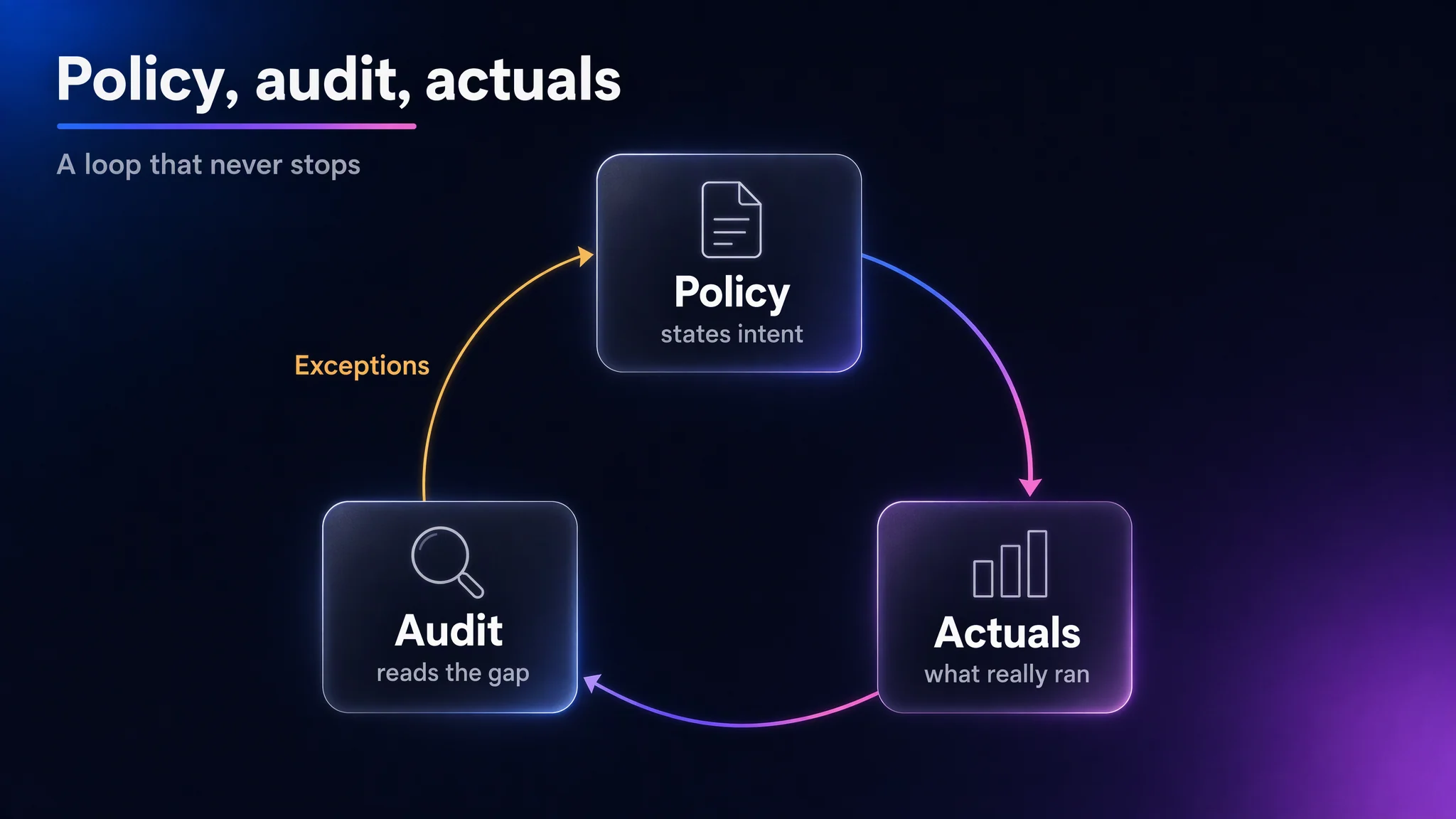
At a glance: policy states intent, actuals record what ran, audit reads the gap, and exceptions revise the policy. The detailed diagram is under Run the loop by six mechanics. Source: The AI Delivery Factory, Chapter 8, Figure 8.1.
The three sides, defined precisely
The earlier draft of this page defined audit as “the evidence a control emitted” and actuals as “service outcomes”. That did not match the source. This page now follows Book 2, Chapter 8 (§3, §4.2 and §5), which also matches Working Paper 05 §3.7.
| Side | What it is | What it is made of now | What it is not |
|---|---|---|---|
| Policy | Declared intent: what must be true | Policy-as-code for infrastructure and pipelines; machine-readable architecture decisions (ADRs) and standing practices (GIPs) that agents read while they build; written standards, which the supervisor still reads first | Prose that no engine and no agent can read. Book 2 calls that a wish, not a control |
| Actuals | The records of what the estate did, emitted by construction as the line runs | Deployment records, agent action records, configuration changes, identity grants, connection logs, measured data-quality values, all written to the nine-question evidence envelope of the Audit Evidence Schema | A sweep or a binder put together before an audit, which records only what someone remembered to collect |
| Audit | The continuous comparison of policy against actuals, run as a query over the evidence surface (the audit spine) | Standing queries that run on every new record. A match is recorded and passes. A departure raises an exception | A team that interrupts delivery to gather proof |
Service outcomes such as incidents, cost, latency and user overrides count as actuals only when they are emitted as records the comparison can read. A data product’s measured freshness against its declared SLO is one example. The gap is the loop’s output, and it feeds back into policy, the recipe or the platform control. If a finding changes nothing upstream, it comes back.
The idea is not new. The author’s 2024 book stated the loop and argued that pipelines should self-register what they do. What changed is that all three sides became machine-readable and fast enough to keep pace with the agent lane. The evidence format is set out on the audit spine page.
Run the loop by six mechanics
Book 2, Chapter 8, §5 gives six mechanics. Each one is restated here with the check that shows it is in place.
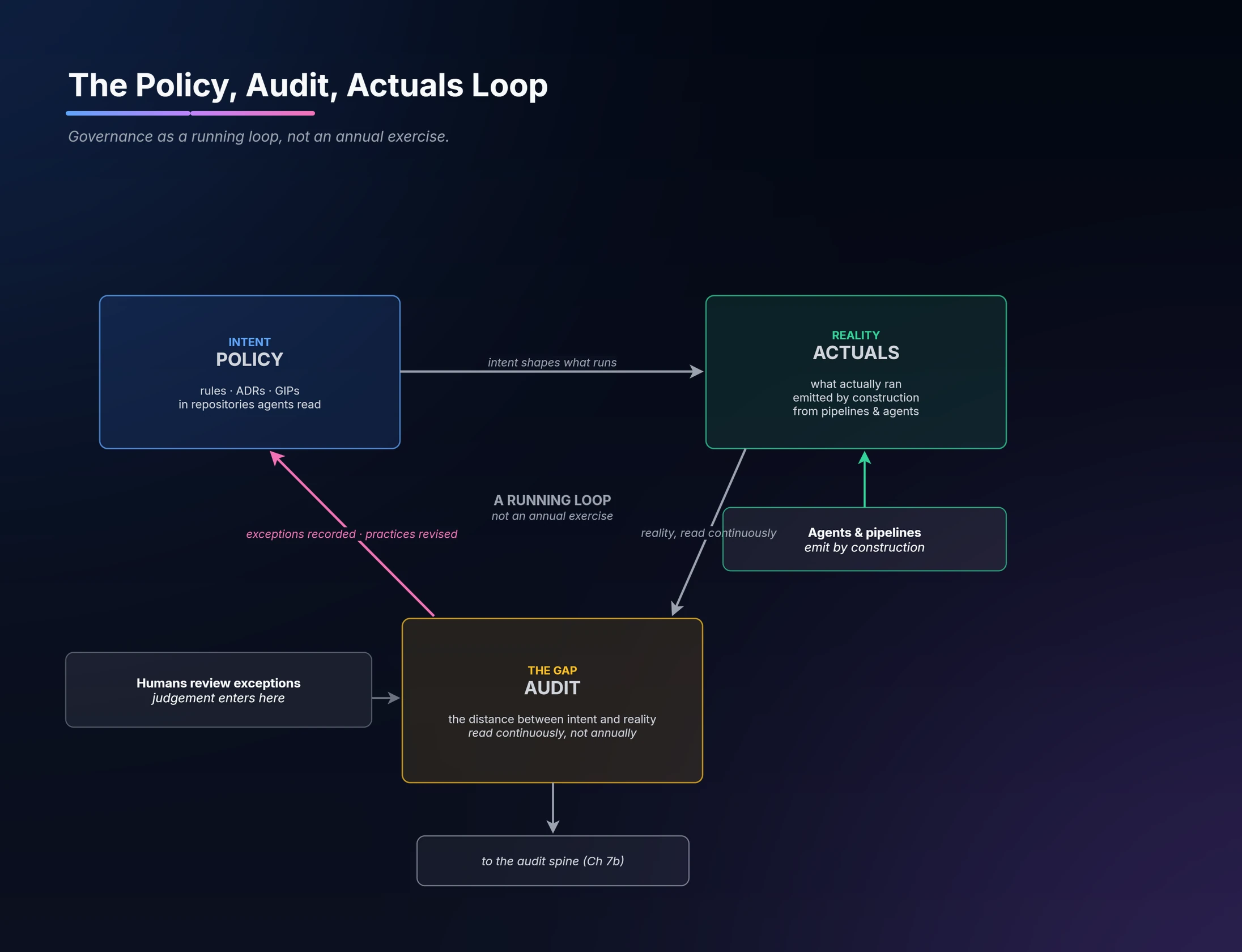
The policy, audit and actuals loop. Source: The AI Delivery Factory, Chapter 8, Figure 8.1.
| # | Mechanic | Acceptance check |
|---|---|---|
| 1 | Declare policy where the machinery can read it. Infrastructure rules become policy-as-code; build conventions become machine-readable ADRs and GIPs. | For each control in scope you can name the engine or agent that reads it. If you cannot, the control is advisory, so label it that way. |
| 2 | Emit actuals by construction. The paved road writes deployment, agent-action and configuration records as it acts. | Every actuals source used by a comparison writes to the evidence surface without a human step. A missing emitter raises an exception. It is never read as a clean result. |
| 3 | Run audit as a continuous query. Comparisons run as the records arrive, and matches pass silently. | The comparison is triggered by new records, not by a calendar. Matches are recorded, so you can show the comparison ran. |
| 4 | Route exceptions, not everything. Only departures reach a person, with enough context to decide. | A reviewer can rule on any row without opening another system (see the row content below). |
| 5 | Tell deliberate departures from accidental ones. A declared, reviewed exception is recorded as known. An undeclared departure is a finding. | The queue shows both states separately, and a declared departure carries its rationale, owner and end date. |
| 6 | Feed the gap back. A recurring exception is a defect in the policy, the recipe or the platform control. | Every class of exception that recurs has an upstream change ticket with an owner. |
Book 2 singles out mechanic 4 as the one most governance fails on. The comparison is rarely impossible. What breaks is the attempt to make people read all of it.
The standing query and the silent match
Each control in the loop is one standing comparison. Write one record per control, as follows. This structure is this page’s recommendation, assembled from Book 2, Chapter 8, §6 and Book 09, Chapter 7.
- Policy reference. The rule, its version and the pack it belongs to (see policy packs).
- Actuals source. Which emitted records the rule is compared against: resource state, identity grants, database connection logs, agent action records, or data-quality measurements.
- Trigger. Run on every new record of that kind. A weekly query is acceptable as a first step but is not the target state.
- Match behaviour. Record the match and raise nothing.
- Departure behaviour. Raise an exception row carrying context. If the departure fixes itself before anyone reviews it, close the row automatically and record the remediation.
- Enforcement mode. Either report (the platform records the departure) or refuse (the platform blocks the change at creation or update).
- Exception owner. The second-line role that rules on rows the first line has not fixed.
When to switch a rule from report to refuse
Book 09, Chapter 7 describes a composite firm (Asset Manager X). Its production-data rule only reported departures until the last week of April and refused from then on. Its more routine rules (encryption, region, logging) were each moved from report to refuse once the queue had shown, for about a month, that refusal would not stop anyone’s work. Report mode has a cost. In the composite, a production copy sat in a development environment for six days because the rule only reported it. Use these criteria to decide when to switch. They are this page’s synthesis of that account:
- The queue for the rule has been read and worked for a sustained period, roughly a month in the source example.
- Most departures had a legitimate alternative that the platform now offers. Examples are a masked extract on request, or a standing request that grants a privileged role for four hours and records itself.
- The remaining legitimate departures can be declared in advance (see declared departures).
- The rule is inherited from the scope where resources are created, such as the management group, organisation or folder, so new teams and new agents fall under it without opting in.
Keep the declared path quicker than the workaround. In the composite, a senior engineer argued that some defects only reproduce on real data. The answer was to make masked extracts available in minutes. The rule itself stayed in place.
Platform instruments (vendor-specific)
As of November 2026, per Book 2, Chapter 8, §4.9 and Book 09, Chapter 7 notes. [FACT-CHECK: confirm current product behaviour and names against Microsoft, AWS and Google Cloud documentation before publication.]
| Cloud | Declare and refuse | Detect and compare | Notes from the source |
|---|---|---|---|
| Azure (Book 2’s reference platform) | Azure Policy definitions and initiatives assigned at management-group scope. The deny effect is evaluated on the create or update request. deployIfNotExists remediates after the resource provider succeeds | Azure Policy compliance state, queried through Azure Resource Graph (the PolicyResources table) | One engine handles both preventive and detective work. Classification is held as tags and management-group placement |
| AWS | Service control policies (SCPs) in AWS Organizations, which set maximum permissions | AWS Config rules and conformance packs. Config also offers proactive evaluation before provisioning | Detective and preventive work are split across two instruments: cleaner, but two things to reason about |
| Google Cloud | Organization Policy Service constraints down the resource hierarchy | Security Command Center plus config-validation tooling | Same pattern |
Across all three, the loop depends on wiring each provider’s compliance surface into one exception queue. Three consoles that nobody watches together do not form a loop. In the composite, the instruments were already licensed and switched on, with an unread compliance report. The work lay in connecting them and giving them an owner.
Starter rules: what the loop finds first
Book 2 and Book 09 both report the same first findings. They are composite examples, but the source claims they recur in every estate the authors have reviewed. Start with these, then add the rule that causes you the most audit friction (secrets, production access, dependency-vulnerability remediation or change approval).
| Rule (policy) | Actuals source | Typical departure | Typical ruling |
|---|---|---|---|
| Production data never sits in a non-production environment | Data classification reported by the non-production subscription or workspace, plus provisioning requests | An engineer, or an agent reproducing a defect, copies the real book into development | Self-remediated (the copy is deleted). Once the rule refuses, the requester is offered a masked extract |
| Privileged access is time-bound and just-in-time | Identity platform elevation records | A grant opened for a migration and left standing for weeks | Revoke. Approve a time-boxed extension only where a legitimate case is declared. Check for dependants first: in the composite, scheduled jobs belonging to another team were running under the account |
| Consumers reach a system of record only through its registered data service | Database inbound connection logs | An unregistered direct read that appears on no diagram | Escalate to the owning squad for remediation and to architecture for root cause |
| An agent acts only inside its declared envelope | Agent action records compared with the envelope on the registry (bounded agent) | An agent reads a resource its statement omits | In the Book 09 composite, the owner widened the statement, giving a reason and her name. Narrowing the agent instead is this page’s addition. The check reaches only agents on the register, so registration comes first |
| Virtual CAB conditions hold in production | CAB decision conditions compared with deployment and sample-review records | A deployment goes ahead before a go-with-conditions condition is met | Second-line finding. See change governance |
| Data products meet their declared SLOs | Measured freshness, completeness and accuracy compared with the data contract (data and API integration) | A feed misses its freshness threshold | Remediated, accepted with a time-box, or escalated. The row must list every consuming product, including any agent that read the stale values in the breach window |
The source treats a quiet loop with suspicion. A loop that surfaces nothing has not proven the estate clean. It has shown that it is not looking.
Design the exception queue
A continuous loop without a queue moves the bottleneck. It does not remove it. The queue is the unit the second line works from.
Row content. Book 2, Chapter 8, §6 lists the minimum context: which policy, which actual (resource or record), since when, and whether a declared exception already covers it. Add the following where they apply: the original justification for a grant and its age, the offending connection and the service it bypassed, or the data contract, the measured value and the consuming products. The page recommends also carrying the policy pack and version that produced the comparison, plus a link to the evidence record, so the ruling can be reconstructed later. These are content requirements, not a published schema. Use your evidence schema’s fields where they exist.
Outcomes. Each row ends in exactly one state:
| Outcome | Who | Evidence required |
|---|---|---|
| Remediated (including auto-cleared) | First line, often before the second line sees the row | The remediation record, which the loop records without a reviewer |
| Accepted with a time-box | Second line | Reason, owner, end date. The row reopens at expiry |
| Escalated | Second line | Named recipient (owning squad, architecture, risk committee) and a closing date |
| Known (declared departure) | Second line confirms | The declaration that existed before the departure |
Health metrics. Book 2’s warning sign for a failing queue is depth that only grows and a median exception age that climbs week on week. This page recommends tracking at least:
- queue depth over time, by rule and by owner;
- median and oldest exception age;
- the share of rows auto-cleared by remediation;
- recurrence by rule, which feeds mechanic 6;
- rows open past the agreed service level. The Supporting Tools catalogue defines
report.exceptions.openfor this: open exceptions older than the SLA, grouped by kind, with owner and days open.
Recovery when the queue drowns. Tune what raises an exception, auto-clear departures that fix themselves, and name a second-line owner with authority to escalate. A queue nobody owns works as a log, not a control.
Group refusals and exceptions by rule, not by team. A rule that refuses hundreds of changes tells you something different from one that refuses six, and a refusal counts changes rather than causes. In the Book 09 composite, a fifth of the summer’s routine refusals (encryption, region, logging) came from a single squad whose services were built from a template older than the logging rule. The fix was the template.
Declared departures versus findings
The loop’s job is to make sure no departure is invisible, not to prevent every one. The source states two rules.
- A declared departure is known. It is recorded before the departure, with a reason, an owner, an end date and its review. It arrives in the queue already marked, and the second line confirms it in minutes. Book 09’s example is a privileged grant held for three weeks while a supplier upgraded a system. Book 2’s is a client-facing micro-site deliberately built outside the standard UI practice.
- An undeclared departure is a finding. Never treat it as known after the fact.
Declaring must be cheap. If declaring is slow or punished, engineers route around the loop, and exceptions disappear from the record because they go unrecorded, not because they stopped happening. Book 2, Chapter 3, §8 calls this rigid standardisation and treats each declared deviation as a sign that a guideline is missing. This page recommends that declaring be a short form or a field in the change, that the declaration be visible in the same queue, and that recurring declarations against the same practice trigger a review of that practice.
Who owns what: the first line federates, the second line adjudicates
Book 2, Chapter 8, §4.6 states the author’s position in response to data mesh’s principle of federated computational governance. The firm takes the computational half: enforcement is done by the platform, and a standard enforced by hand at agent speed exists in name only. It refuses the idea of a federation in which the second line is one peer among the domain owners.
| Party | Owns | Does not do |
|---|---|---|
| First line (product teams, platform, agent owners) | How they work inside the declared boundaries; remediation; declaring departures; answering for them | Decide which of their own breaches are acceptable |
| Second line (technology risk, compliance) | The boundaries; ruling on exceptions the first line has not fixed or chooses not to fix; answering to the supervisor | Sit in a forum negotiating standards as one domain voice among many |
| Floor | Regulatory obligations, which no federation can vote to relax | — |
The Book 09 composite puts it in operational terms. The first line may fix anything it likes before the second line sees it. What is left belongs to the second line, because if the people who run the controls also rule on which breaches are acceptable, the second line has nothing left to test. Internal audit, as the third line, runs its own queries and audits the second line’s resolutions. See accountability. Statements about which regulation requires independent change approval are on the regulatory map, not here.
Policy packs: the unit the loop enforces
A policy pack is a pre-approved bundle of controls (Book 2, Chapter 8, §4.2): constraints assigned at management-group scope, checks that run in the pipeline, and the decisions the gateway takes on each request. A pack attaches to a kind of product, meaning a combination of agency class, risk tier and data class, not to a project. Products inherit it by scope. A recipe binds its pack through its policy gates, and a product built from the recipe inherits the pack without negotiating it. The classification line in the bill of material is what lets policy-as-code select the pack.
Govern changes to packs as changes to the rules
Changing a pack changes what the loop treats as compliant, so pack changes need their own discipline. The Supporting Tools stream specifies this as a proposed service: the M8 Pack Authoring and Publisher Service, ADR D28, status Proposed, API Draft 1. The model below follows that draft. It is a design proposal, not an adopted standard.
Pack classes. advisory, controlled, mandatory. Pack class is unrelated to agency class.
Lifecycle. Draft, then review (co-author and approver), then CAB (for significant changes), then sign, then publish to the registry as a signed artefact, then propagate to edges and leaves.
Roles and separation.
- Authoring claims are separate from approval claims (
pack.author.group_risk,pack.author.it_standards,pack.coauthor,pack.approver,pack.publisher,pack.recall.initiator,pack.reader). - Above
advisory, a pack cannot be sole-authored. It needs at least one co-author, and the approver cannot be the same person (UPN) as the author. The service refuses withm8.sole_author_forbidden. The target is that 100% of packs aboveadvisoryhave an approver distinct from the author. mandatorypacks can route to a set of approvers. Approval requires MFA and conditional access.
Validation before signing. In order: schema validation (chk_pack_format, which is owed and not yet published), OSCAL completeness, cross-references to the unified control map, lint rules, then simulation. Simulation runs the draft against a fixture corpus. If the draft permits something the previous version refused, or refuses something it permitted, the change is material and is routed to CAB automatically.
Significant-change classifier. The following are always significant and need a Virtual CAB decision before publication: a class change (advisory to controlled to mandatory), a new rule in a mandatory pack, a severity change (warn to error), or a control reference that maps to a new regulatory framework. The API’s CAB-route endpoint also names changes that touch the unified control map. Cosmetic or wording changes are not significant and need only the approver. Changing the rules requires applying the rules. See change governance.
Recall is first-class. A version is marked recalled with a recall_reason, and optionally a supersede_with version. It is not deleted. It stays in the registry so audit can reconstruct what was in force. Downstream tools stop using a recalled pack within the same SLO as new-pack propagation. If a recall affects an active deployment, the recall goes ahead and the affected deployments raise a P1 alert.
Draft service-level objectives (30-day windows unless stated):
| Measure | Target |
|---|---|
| Author save to publish, clean path without CAB | p99 ≤ 30 min |
| Publish to leaves using the pack | p99 ≤ 15 min |
| Recall propagation | p99 ≤ 15 min |
| Published packs signed (Sigstore) | 100%, continuous |
Approver distinct from author (above advisory) | 100%, continuous |
Failure handling. If the signer or the registry is unreachable, publishing is refused and the draft stays unpublished, with a P1 alert if the problem persists. A significant pack without a CAB decision is refused at publish. If validation fails after a draft was saved, validation runs again before publish, and publish is refused with diagnostics.
Open design questions in the source: forking a version when two authors work in parallel; cross-pack dependencies (a recall of pack B should warn holders of pack A); reminders for drafts left open for weeks; strict OSCAL or OSCAL-shaped extensions.
Distribute packs and handle stale ones
Packs travel from the centre to the edge by the same secure channel that carries evidence back to the centre, in the opposite direction (Supporting Tools data flows §2). Signatures are verified both at the edge and at the leaf. A pack with an invalid signature is rejected and raises an anomaly record.
- Record
pack_versionon every decision. Every advisory or lint result records thepack_idandpack_versionthat produced it, so audit can say which rules informed which decision. - Expiry. Each published pack carries an
expires_at. - Past expiry, behaviour depends on risk. Below the high-risk threshold, tools warn loudly and proceed, emitting a warning record. At or above it, they refuse. CAB evaluation refuses a high-risk change whose template has expired.
- Degraded centre. If the centre cannot publish, leaves keep using the last validated pack within a configured grace period, and each record is annotated with
pack_freshness(time sincepublished_at). That lets the exception engine find decisions made under degraded conditions afterwards. Past the grace period, the same warn or refuse split applies. - Watch adoption. The report catalogue includes
report.pack.adoption(pack drift across leaves),report.pack.expired-in-use(which leaves are not refreshing: a process failure or a channel failure) andreport.signature.failures.
Reports for the three lines of defence
The Supporting Tools report catalogue (docs/reports/01) defines named, signed, versioned reports over the same evidence lake. The lake is the same for everyone. Each line reads it through its own lens. A selection:
| Line | Report | What it shows | Cadence or scope |
|---|---|---|---|
| First | report.completeness.per-agent | Sessions opened and closed cleanly, by agent, so a wrangler investigates before the second line raises an exception | Daily |
| First | report.deploy.outcomes | Deployments succeeded, rolled back, or rolled back with issues | Daily |
| First | report.identity.unbound | Hosts where identity binding failed. Silent failures become visible | Daily |
| Second | report.exceptions.open | Open exceptions past the SLA, by kind and owner | Daily |
| Second | report.cab.condition-fulfillment | go-with-conditions decisions, whether each condition was met, and any deployment that went ahead with conditions unmet | Weekly |
| Second | report.deploy.cab-exemptions | Deployments with a null required_cab_decision, each with its cited rationale | Weekly |
| Second | report.pack.expired-in-use | Advisories produced under expired packs | Daily |
| Third | report.audit.lake-integrity | Sampled hash-chain and counter-signature verification, without trusting the centre’s own claims | Sampled |
| Third | report.audit.access-trail | Who queried the evidence, when, and what was returned | Period |
| Third | report.audit.exception-resolution | Sample of closed exceptions with reasoning, time to resolution and second-line owner, so the audit covers the second line’s response | Sample |
Every report run is itself a record (kind=report.run, carrying report_id, report_version and parameters), and every delivery is also a record (kind=report.deliver). A report can therefore be reproduced, and the audit of the audit is preserved. Third-line reports are starting points only. Internal audit writes its own queries.
Read revealed values from the record
The loop has a second use (Book 2, Chapter 8, §4.8; Working Paper 05 §3.7). Policy holds the firm’s stated values in executable form. Actuals show its revealed values. Audit measures the gap between them. To make that practical:
- For each declared value that carries a veto, count each quarter how often its policy fired a veto and how often a waiver was granted against it, and show the trend.
- A veto that fired is a value that cost something. A value with no recorded cost in two consecutive quarters is examined and then either sharpened or removed. This is Working Paper 05’s six-step method, step 6.
- The factory produces the record and the second line reads it and draws the conclusions. A factory that judges its own values evidence is marking its own work.
- Treat the mission and values as versioned machinery. Each compiled artefact (shared prompt preamble, skill, policy, autonomy criterion or stop condition) declares the mission version it derives from, so the record can show which version an agent was running under (§3.3). Working Paper 05 marks “value drift” between the human and machine estates as an expected failure it has not yet seen documented.
Report automated approvals alongside refusals. In the Book 09 composite, the one line in the monthly summary that was not a refusal was the count of changes the routing gate approved without anyone reading them. It is the line most easily overlooked.
Exercise: the minute after a breach
Book 09, Chapter 7 describes a one-meeting exercise that shows whether a rule actually executes or is only described.
- Bring together the platform lead and the head of second-line technology risk.
- Take the five rules the risk function tests most often.
- For each rule, each person writes down separately, without comparing, what happens in the minute after somebody or something breaks it.
- “A refusal and a record” means the rule executes. “It will show up in the next review” means it is only described.
- Where the two answers differ, record a finding with an owner and a date. In the composite, four of the five matched. The fifth, a data-residency rule, turned out to be enforced for resource creation but only sampled quarterly for model calls served from another region.
This page recommends running it again whenever a pack changes class or a new enforcement point, such as the model gateway, goes live.
Advice is not enforcement
Skills, playbooks, standing instructions and prompts help people and agents interpret policy, but they are advisory. Book 09 records an agent that read a correct classification in its instructions and built the prohibited copy job anyway. The platform rule that read the same classification stopped it. A mandatory boundary needs a mechanism at the point where the agent acts: a deny assignment, a network boundary, an identity scope, a broker rule, or a release gate.
- Record for each control whether it is advisory or enforced.
- If a single control can fail on its own, such as one sentence of prompt standing between an agent and data it should not reach, treat it as a finding. Add a control that fails in a different way, such as a broker rule tying each call to the case. Do not reword the prompt or add a guardrail that reads the same prompt.
- Build containment into the execution environment before an incident, not into the prompt. Book 3 (Deploying Claude Safely), Chapter 17 §5 cites a vendor case whose doctrine is that prompts are suggestions and constraints belong in the harness: sandboxed execution, and a checkpoint on what the agent touched before it gets wider access. See the landing zone for containment by platform design.
- As this page’s recommendation, do not add a human approval to make up for a missing technical boundary.
Roll it out one control at a time
- Pick one policy that causes audit pain. One control running in a loop beats a design for all of them running on none.
- Map its current loop honestly. Can an engine or agent read the policy? Are its actuals emitted or reconstructed? How often does the comparison run? Which existing exceptions have no expiry?
- Move it to continuous and stand up the queue. Express the policy as code, wire the actuals, write the standing query, route the departures, and enable auto-clear.
- Name the second-line owner and give declared departures a place in the system.
- Widen. Add the next rule only once this one’s queue is healthy.
For scale: in a firm of a few thousand, run this as a platform-team programme with shared policy-as-code, one queue per policy domain and second-line adjudication. In a firm of a few hundred, one person owns the whole loop for the first control. The controls stay the same as the firm shrinks. Only the headcount running them changes. In the Asset Manager X composite (Book 2, Chapter 8 §6, and Book 09, Chapter 7), the standing queries, queue and routing rule took about a fortnight and needed no new platform purchase. The weekly meeting went from 90 minutes of reconciliation to a 15-minute review of escalations. These are composite, illustrative figures.
Failure modes and recovery
| Failure | Recognise it | Recover |
|---|---|---|
| Policy without actuals | ”We will know at the next audit” | Wire one actuals source to one policy before writing any new standard |
| Audit without feedback | The same class of gap is remediated again and again | Treat recurrence as a defect in the policy, recipe or platform control; open an upstream change |
| Evidence theatre | Proof assembled the week before a review | Make actuals a by-product of delivery |
| Queue nobody reads | Depth only grows; median age climbs | Tune triggers, auto-clear, name an owner with authority to escalate |
| Invisible deliberate departure | Engineers route around the loop | Make declaring cheap and visible |
| Stale or recalled pack in use | report.pack.expired-in-use rows; signature failures | Refuse above the risk threshold; fix the refresh channel; recall and supersede |
| Unregistered asset | An agent or automation not on the register is outside every check | Make registration the first enforcement point; no credential or route without it |
| Self-adjudication | First line closes its own exceptions as accepted | Restrict “accepted” and “known” outcomes to the second line |
Acceptance checks
- Each control in scope has a policy reference, an actuals source, a standing query, an enforcement mode and a second-line owner.
- A test fixture that breaks each rule produces an exception row with full context. A fixture that conforms produces a recorded match and no row.
- A declared departure arrives marked as known, and the same departure undeclared arrives as a finding.
- Queue depth and median age are reported, and an alert fires when they grow for consecutive weeks.
- Every decision record carries
pack_idandpack_version. Recalling a pack in a test environment stops its use within the target window, and the recalled version stays retrievable. - A pack change above
advisorycannot be published by its author alone, and a material change cannot be published without a CAB decision. - The minute-after-breach exercise has been run and its mismatches are recorded as findings.
Source status
- Source claims. The loop, its six mechanics, the exception discipline and the federation position are from Book 2, Chapter 8. The report-to-refuse sequence, the declared-departure examples and the minute-after-breach exercise are from Book 09, Chapter 7.
- Composite examples. Asset Manager X and its people are composites. All figures attributed to the firm are illustrative, not benchmarks.
- Proposals. The pack governance model, stale-pack behaviour and report catalogue are Supporting Tools designs, at draft or proposed status. Field and report names are given as the source spells them.
chk_pack_formatis owed and has not been published. - This page’s own synthesis. The standing-query record, the switch criteria, the outcome table, the health-metric list, the declaration mechanics, the re-run trigger for the exercise and the acceptance checks.
Regulatory obligations and dates are kept on the regulatory map.
Source material
- Book 2 (The AI Delivery Factory), Chapter 8, The Policy / Audit / Actuals Loop
- Book 2 (The AI Delivery Factory), Chapter 3, Why Craft Alone No Longer Scales (§8, rigid standardisation)
- Book 2 (The AI Delivery Factory), Chapter 9, The Audit Spine
- Book 09 (Everything Is Green), Chapter 7, The Machine That Says No
- Supporting Tools, docs/api/m8_pack_publisher.md (M8 Pack Authoring + Publisher Service API, Draft 1) and planning/decisions_log.md D28 (Proposed)
- Supporting Tools, docs/architecture/04_data_flows_and_sequences.md §2 Policy-down, and docs/use_cases/05_ops_chk.md UC-chk-1 and UC-chk-5
- Supporting Tools, docs/reports/01_control_functions_and_reports.md, Control Functions and Reports
- DEIXEI Research Series, Working Paper 05, Mission and Values of the AI Factory (§3.3, §3.7, §4.1)
- Book 3 (Deploying Claude Safely), Chapter 17, Incident Response for Agent Failures (§5, containment by harness design)
Related research
Related guidance
-
 The Audit Spine and the Evidence RecordHow to capture, join, protect, retain and prove per-action evidence: the AES v0.1.0 record contract, three capture points and one correlation ID, tiered immutable storage, retention and legal hold, replay rehearsal, the route-approval evidence gate, and the Claude-specific ways evidence goes missing.
-
 Build a Unified Control MapJoin the firm's AI and technology controls in one traceable operating view: rows are operating concerns, columns are frameworks read at their own altitude, every cell points to live evidence, and existing ITIL, COBIT and CIS artefacts are extended to agents with a five-question test instead of a parallel AI governance track.
- Accountability and OwnershipHold provenance and accountability apart on purpose: four named accountabilities per product, a human owner for every agent change, seven named seats, a signed Build/Run RACI and a first-line/second-line boundary that survives consolidation.
-
 Route Regulatory Questions to Obligations and EvidenceA dated, article-level reference that routes AI design questions to the EU AI Act, DORA and its RTS, GDPR and sectoral rules, and turns each obligation into a control, an owner and evidence: change records under RTS 2024/1774 Art 17, the 4 h / 72 h / one-month incident clocks, the CIF hinge and its five artefacts, the three-count Register of Information reconciliation, Art 14(4) oversight controls, the Art 26(5) discharge, the FRIA gate, Art 49 and Art 50, SCHUFA-grade review and supplier controls.
-
 Change Governance for Agent-Enabled DeliveryRoute agent-speed change by risk without losing the approver: control values that always reach a person, a routing gate that reads the right signals, autonomy earned per change family, a Virtual CAB that prepares a complete dossier, and three bodies with defined escalation.
-
 Prepare a Governed Landing Zone for AI DeliveryDesign the management-group hierarchy, enforce guardrails in deny mode, give humans and agents the same paved workspace, integrate the eight agent-platform components, close the perimeter, and prove the zone is done with seven observable exit criteria and a second-line sign-off.
-
 Govern APIs, Data Products and Retrieval Agents Can TrustTurn interfaces and data into owned, versioned capabilities that applications and agents consume under identity, entitlement and evidence controls, and give agents access to meaning, limits and authority, not only bytes.
-
 The Enterprise Agent Control PlaneThe firm-owned services that make every agent action identifiable, decidable, approvable and reconstructable: the ownership boundary, six planes and their contracts, the Policy Decision API with its latency budget, the persistence schema, the build sequence and the tests that show it works.
-
 Build a Living Product Bill of Material and RecipeDescribe what an AI product contains and how the firm builds it in one versioned specification shared by pipelines, agents and assurance teams, including the classification line, readiness grades and reuse generations.
- Run the AI Delivery FactoryOperate demand, capacity, the two worker classes, exceptions and evidence as one service: read two leading numbers, keep a handover backlog, gate construction on three conditions, run queues and alerts at agent volume, and count unused products as cost.