The Implementation Roadmap
Sequence the factory as a dependency graph, not a calendar: the closure order for the governance gap, a written portfolio threshold, six overlapping phases over eighteen months with entry conditions, exit evidence, 'not yet' lists and pass/soft-fail/hard-fail gate questions, tranche funding released on exit evidence, a programme RACI, size, maturity and sector calibration with four signed trade-offs, and the first week, thirty days and ninety days in dependency order.
- Version
- 0.1.0
- Owner
- DEIXEI
- Last reviewed
- Reading time
- 64 min
For Cto · Cio · Ai Architect · Platform Engineer · Programme Manager · Risk And Assurance · Internal Audit · Cfo
Sources and details
- Section
- Adopt and fund
- Source works
- Book 1 · Book 2 · Book 3 · Book 09 · Research Series
- Source chapters
- 1, 2, 11, 12, 18, 19, 20, 27
- Source appendices
- 01:G
- Tool specifications
- audit_evidence_schema@0.1.0
- Refresh trigger
- source change
This page answers one question for the people who must fund, staff and defend the work: what do we build first, in what order, and what has to be true before the next investment clears? It gives the sequence, the gates, the money rule, the owners and the calibration for firms of different size, maturity and sector, and it ends with the first week, the first thirty days and the first ninety days.
Which roadmap this page follows (owner decision D4). The source works give four phased plans, and they are not the same object. This page takes the six-phase, eighteen-month roadmap of Book 1 (Ch 18–19, App G) and Book 3 (Ch 20) as the canonical spine. It folds Book 2’s (Ch 27) phase content and “not yet” lists into those phases, and it uses Book 09’s ninety-day sequence (Closing) as the first-90-days view of the same spine. Where the books differ, the difference is stated in place or in source differences; nothing is blended silently.
Reading the labels. Source marks what a book states. Author model marks the books’ own frameworks (the phases, thresholds, sizing bands, ratios and cell advice are practitioner models from the author’s engagements, not industry standards or supervisory expectations). Recommendation marks this page’s synthesis, such as the phase crosswalk and the register columns it adds. Bank A, Bank D, Asset Manager X and Insurer I are composite firms. Regulatory dates and article-level legal statements are not restated here; follow the links to the regulatory map and the regulatory calendar.
The decisions this page supports
| Decision | Owner | Section |
|---|---|---|
| Should we build a factory at all, or buy? | CIO, CFO, CRO | The gate before the map |
| What do we close first in the governance gap? | CIO | Closure order |
| In what order do capabilities land, and why can’t we reorder them? | Programme manager, factory architect | The roadmap is a dependency graph |
| When does a phase close, and what happens when it does not? | Phase owner, audit committee | The six phases and Running a gate review |
| When is money released? | CFO, audit committee | Funding |
| Who is accountable for each programme activity? | CIO, CRO | Programme RACI |
| How does the plan change for our size, maturity and sector? | CIO, countersigned by CRO | Calibration and The four signed trade-offs |
| What do we do this week, this month, this quarter? | Foundation-phase owner | Week one, The first thirty days, The first ninety days |
| What does the board see, and when? | Executive sponsor, CRO | Board reporting |
Closure order for the governance gap
Before any phase plan, Book 1 Ch 1 §5.3 gives the order in which a firm typically closes the six gaps its adoption diagnostic exposes (the diagnostic itself is on the readiness diagnostic). Numbers in brackets are the diagnostic’s question numbers.
| Step | Gap closed | Nature | Where it is specified |
|---|---|---|---|
| 1 | (1) Agent inventory | Weeks | Agent lifecycle: inventory scope |
| 2 | (3) A named wrangler per agent | Weeks | Accountability |
| 3 | (2) A bounded-agency record per agent | Weeks | Bounded agent |
| 4 | (6) The unified control map | Programme | Control map |
| 5 | (4) Policy as code | Programme | Enterprise control plane |
| 6 | (5) Audit evidence | Programme | Audit evidence |
The failure the order prevents (source). Firms start with policy-as-code and the evidence pipeline because platform work looks like progress. Without the inventory, the owners and the envelopes, those platforms have no operating layer to act on. The first three steps need no platform engineering; the last three are the programme that the phases below deliver.
Recognition signal (Book 1 Ch 1 §8.1). Agent count rising faster than wrangler count, or the change board still listing agents as “applications”. Recovery: pause the backlog (not the agents already running), install inventory and wranglers, and resume only when controls run at least one quarter ahead of the deployment plan.
The gate before the map: a written portfolio threshold
Book 2 Ch 27 §4.2 and Book 09 (Closing, line 9) put one decision ahead of every arrow on the roadmap: is the portfolio big enough to justify building a platform? The full sourcing method, including the Research Series four-gate framework, lives on build, configure or consume. The roadmap needs only the gate itself.
| Element | Author model (Book 2 Ch 27 §4.2; Book 09 Closing) |
|---|---|
| Form | How many products, on how many genuinely shared patterns, over what horizon, before the platform investment clears; below that line, buy. |
| Default values | At least 8 products over 24 months, on at least 3 genuinely shared patterns, of which at least one is a shared data contract with declared quality SLOs (Book 09: a stated promise about its meaning, freshness and quality), not a shared piece of infrastructure. |
| What may be calibrated | The numbers, to your estate. Not the data clause. |
| ”Genuinely shared” test | Count the overlap from the bills of material you already hold. Two products both on Kubernetes do not share a pattern; two that instantiate the same recipe and read the same governed retrieval store do. If you cannot count the overlap, that is the first finding (see BOM and recipes). |
| Signatories | Book 09: the CIO, the CFO and the CRO. Book 2 §7: take it to the CFO and CRO before the board. |
| Timing | Signed before the first platform hire and before anything below it is funded. |
| Below the line | Buy, and say so. Book 2 notes that its own layered-model working paper reaches the same view: below a certain scale, buy most lower layers and keep in house what regulation effectively requires (identity, observability, evaluation). A “buy” outcome is a success. |
| Re-test | Annually, in the continue / shrink / expand decision (standing cadences). |
Composite example (Book 2 Ch 27 §6). Asset Manager X wrote its threshold more than a year after starting. The count from its BOMs was eleven candidate products on four shared patterns, one of them a portfolio-positions data contract with declared quality SLOs. The gate cleared, and would have cleared in month one, but nobody knew. The source’s point: clearing an unwritten threshold is luck, not discipline.
The roadmap is a dependency graph
Layers and two horizons
Book 2 Ch 27 §4.1 reads the six-layer product portfolio (see the factory model) upward as the build order:
| Layer | Content | Funding model (source) |
|---|---|---|
| L0 | Engineering chassis: identity, telemetry, scaffolding, classification | Roots: durable platform funding, product-grade ownership, service levels, a standing team with a roadmap |
| L1 | AI primitives: model gateway, evaluations, retrieval | Roots |
| L2 | Capability services teams configure rather than build | Roots |
| L2.5 | Experience layer: how it reaches people | Roots |
| L3 | Horizontal workflow products | Canopy: business cases with named sponsors, benefit hypotheses and adoption numbers |
| L4 | Domain products | Canopy |
Three consequences follow (source):
- Nothing on a layer works until the layer below holds weight. Retrieval cannot resolve entitlements without an identity plane that answers questions about humans and agents; an evaluation harness cannot be a release gate without an evidence path to emit into.
- Do not make the roots justify themselves product by product. A platform funded from passing feature projects becomes a tax and dies when its sponsoring project closes.
- The graph is also the trust sequence. A client-facing channel is not exposed before the evidence spine runs, for the same reason a change family is not given autonomous standard-change before its record is clean (change governance).
Book 2 resolves the graph into two horizons: a foundation horizon (months 0–6: gate signed, chassis and first primitives standing, governance in force, wranglers appointed before any agent ships, two lighthouses running) and a scale horizon (months 6–18: control plane completed, agents at governed volume, run disciplines in standing operation, delivery economics instrumented). Book 2 reports that roughly two-thirds of the fundable items fall in the foundation horizon; staff it accordingly.
Layered horizon model, for comparison. Research Paper 1 §8 proposes three adoption horizons (H1 foundations, first six months; H2 composition, months 6–18; H3 scale, months 18–36) as planning assumptions. Its H1 and H2 sit inside this page’s eighteen months; H3 is beyond the roadmap and belongs to Phase 6.
Sequencing inside a layer
Inside one layer, Book 2 Ch 27 §4.3 adds a second rule drawn from compounding mechanics (ranked in Research Paper 8 §3.2):
- Schema and policy first. Agree the evidence schema and the policy packs before the services that emit into them. A policy pack gains consumers by scope, without anyone acting; a service built ahead of the schema emits the wrong shape and every consumer inherits the error.
- Then running services, which compound only through consumers who choose them.
- Then templates, which compound only at creation and rebuild.
- Shared libraries last: weakest compounding, highest fork rate.
The retrofit penalty
Both books price inversion, with different magnitudes and both as estimates:
- Book 1 (Ch 18 §2, §8; App G §G.4): starting with use cases and retrofitting governance costs three to five times the original Foundation effort, plus the cost of stopping and re-registering floating agents.
- Book 2 (Ch 27 §2, §8): retrofitting identity, observability and scaffolding onto shipped products costs an order of magnitude more, citing the author’s layered-model working paper, which labels the figure (and the five-to-ten-times reduction in marginal product cost from reuse) a practitioner estimate.
Use either figure to frame the argument, never as business-case arithmetic. Composite (Book 2 Ch 27 §6): Asset Manager X had eleven agents in production before a chassis and before wranglers; correcting that consumed most of a year.
The programme dependency DAG
Book 1 App G §G.2 draws the six phases left to right with five cross-cutting nodes above them (data dictionary, model usage registry, AI gateway, wrangler appointments, the Authority Process) and two assurance lanes below that cross every phase (DORA Article 19 reporting readiness; EU AI Act Article 14 oversight evidence; obligations on the regulatory map). Solid edges are hard (predecessor at pass before the successor starts); dashed edges are soft (predecessor in progress).
| Edge | Type | Why (source rationale, paraphrased) |
|---|---|---|
| Foundation → Identity and Network | Hard | Identity is the first row of the control map; the map must exist first. |
| Foundation → First Bounded Agents | Hard | Agents are chosen against a registry, not a vendor pitch. |
| Identity and Network → First Bounded Agents | Hard | Zones and per-agent identity are what release Phase 3. |
| First Bounded Agents → Control Plane | Hard | The plane is shaped by what the first agents teach. |
| Identity and Network → Control Plane | Hard | The plane reads the SIEM’s normalised schema; without it the nine-question record cannot be stitched in five minutes. |
| Data dictionary → First Bounded Agents, Control Plane | Hard | An agent’s read scope is bounded against a dictionary entry, or not bounded. |
| Model usage registry → Control Plane, Scale-out | Hard | The policy decision point cannot decide on a usage it cannot see (model governance). |
| AI gateway → Control Plane | Soft in Phase 4, hard into Phase 5 | The gateway must be generalised before scale-out (model gateway, MCP and connector broker). |
| Wrangler appointments → every phase from 3 | Hard | Lagging appointments produce the floating-agent incident. |
| Authority Process → every phase | Hard | It makes the wrangler’s suspend and amend authorities enforceable (Authority Process). |
| Control Plane → Scale-out | Hard | Scaling without the plane multiplies whatever is broken. |
| Scale-out → Continuous Operation | Hard, calendar-overlapped | Virtual CAB, incident library and macroprudential dialogue stand up during scale-out. |
Rules for using the DAG (source). Compress within a phase, never across the DAG. No calibration cell runs First Bounded Agents before Identity and Network, or Scale-out before Control Plane. At every checkpoint the programme manager asks two questions: have my predecessors reached pass, and have I produced what my successors need?
The six phases: crosswalk of the three source plans
Recommendation. The canonical names and months are Book 1’s. Book 3 adds a four-week Phase 0 (Mobilise), which this page treats as the on-ramp of Foundation. Book 2’s phases cut the same eighteen months differently and are mapped by content.
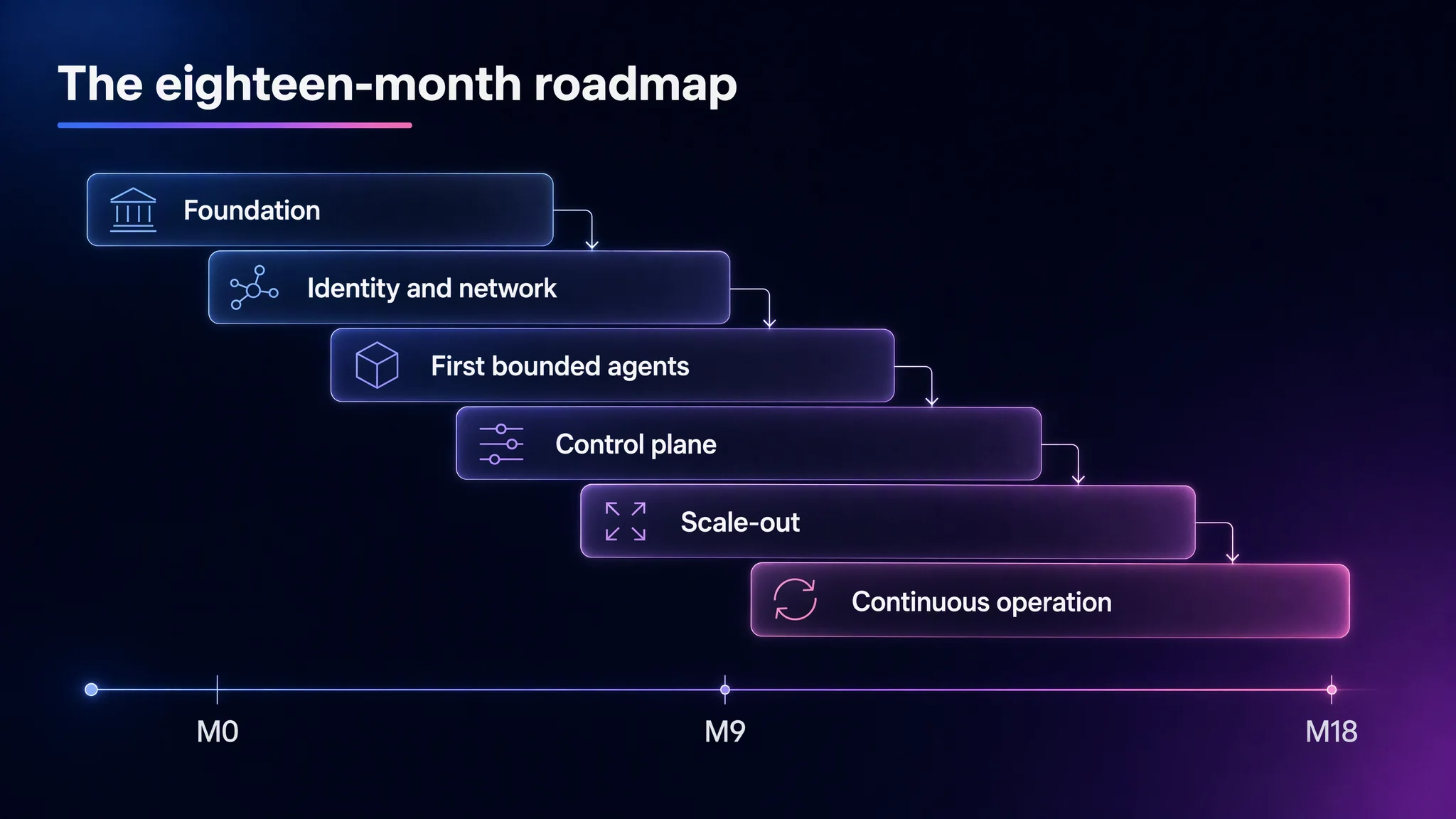
Source: Building Organizations for the Age of AI (Book 1).
| Canonical phase (Book 1) | Months | Book 3 Ch 20 (Claude deployment) | Book 2 Ch 27 (delivery factory) | Book 09 first 90 days |
|---|---|---|---|---|
| 0. On-ramp | Weeks 0–4 | Phase 0 Mobilise (weeks 0–4) | Day one: write the gate | Lines 1–3, 9 |
| 1. Foundation | 1–3 | Phase 1 Foundation (0–3) | Phase 1 Gate and chassis (1–4): gate, names, wranglers, taxonomy | Lines 2–3 |
| 2. Identity and Network | 3–6 | Phase 2 Landing Zone (3–6) | Phase 1 chassis items: identity, evidence spine, scaffolding, gateway, harness | Lines 4–7 |
| 3. First Bounded Agents | 4–9 | Phase 3 First Bounded Agents (4–9) | Lighthouses (Phases 1–2); Phase 2 Primitives and first recipe (3–8) | Line 8 |
| 4. Control Plane | 6–12 | Phase 4 Industrialise (6–12) | Phase 3 Capability services and the loop (6–11); Phase 4 Automation factory (8–14) | Not in 90 days |
| 5. Scale-out | 9–15 | Phase 5 Scale (12–18) | Phase 5 Agent scale-out (11–16) | Explicitly excluded |
| 6. Continuous Operation | 15–18+ | Phase 6 Continuous Operation (18+) | Phase 6 Continuous operation (15+) | — |
Two placements are this page’s reconciliation and should be read as such. Book 3’s Landing Zone brings the gateway and the evidence pipeline into months 3–6, and Book 2 and Book 09 put a single model door and one evidence record into the first wave; Book 1 completes both inside its Control Plane phase. The page therefore starts the gateway and evidence record as minimum viable in Phase 2 and makes them complete and generalised at the Phase 4 exit, which matches the App G edge “AI gateway → Control Plane, soft in Phase 4, hard into Phase 5”. Book 3 itself describes its Phases 1 and 2 as Book 1’s Foundation and Control Plane with a Claude-shaped payload; the crosswalk above maps by content instead, because Book 1 places Identity and Network between them.
The phases overlap deliberately: Phase 3 starts in month 4 while Phase 2 finishes; Phase 4 starts in month 6 while 2 and 3 are active. They are ramps, not a relay. Book 3 OD-1 dates assume a March start; shift the band to your start month and keep the durations.
The six phases: entry, work, exit evidence and “not yet”
Each phase below gives its owner, entry condition, work, the gate questions with the artefact that answers each, and the “not yet” list. Gate questions are Book 1 App G §G.1 unless marked; additions from Book 3 OD-1 and Book 2 §5.3 are marked [B3] or [B2]. Exit criteria do not change with firm size; calibration changes calendar and substance, not the gate.
Phase 0. On-ramp (weeks 0–4)
Owner: executive sponsor at executive-committee level, with the AI Platform Owner (Book 3). Entry: a decision to proceed. Work [B3]: sponsor appointed; AI Platform Owner named; core squad formed (platform engineering, security, data, model risk, legal, compliance, enterprise architecture, an internal-audit observer, selected business leads); five first-wave use cases, no more; shadow-AI freeze declared (it stops proliferation, it does not retire existing tools). [B2] the portfolio threshold written and signed.
| # | Gate question | Evidence |
|---|---|---|
| 0.1 [B3] | Programme charter signed by the executive sponsor? | Signed charter |
| 0.2 [B3] | Steering committee decision paper approved (see the executive decision paper)? | Committee minute |
| 0.3 [B3] | Use-case backlog of 15–20 candidates beyond the first wave? | Backlog |
| 0.4 [B3] | Deployment-route assessment drafted with provisional preferences (not a final decision)? | One-page route summary (deployment routes) |
| 0.5 [B2] | Portfolio threshold signed, or a written decision to buy? | Signed threshold |
Not yet: final route decision, any production agent, any platform hire before 0.5.
Phase 1. Foundation (months 1–3)
Owner: Foundation-phase director reporting to the CIO or Head of Cloud. Entry: Phase 0 closed. Exit test in one sentence (Book 1 Ch 18 §4.2): the firm can answer in writing, signed at architecture council, what agents run here, who is accountable for each, what each may do, and is that written and signed by a named person.
Work. Diagnostic; control map sketched; agent inventory (incomplete by design); the four team archetypes named with placeholder owners; landing-zone gap analysis; data-dictionary status for the top fifteen business-critical domains; AI risk appetite in three or four paragraphs signed by the CRO; the four trade-offs signed. [B3] route and plan-tier decision finalised; initial registries (model usage, agent, MCP server); envelope template published; MCP allow-list shape; five-tier use-case taxonomy drafted (risk tiers); training and certification curriculum designed; competence workstream started. [B2] the head of the factory and factory architect held for real; taxonomy v1 published and the classification line written into every new AI product’s BOM; intake opened problem-first; wranglers certified; split mandate signed; both lighthouses started.
| # | Gate question | Evidence |
|---|---|---|
| 1.1 | Unified control map drafted at the seven-framework level (ITIL, COBIT, CIS, ISO 42001, DORA, EU AI Act, OWASP) and signed at architecture council? | Signed map; council minutes |
| 1.2 | AI risk-appetite statement (3–4 paragraphs) signed by the CRO? | Signed paragraphs |
| 1.3 | Baseline agent inventory complete to honest tolerance, with a named wrangler or placeholder per entry? | Registry export; wrangler reconciliation |
| 1.4 | Landing-zone gap analysis complete (FSI Landing Zone, AWS Financial Services Lens or GCP Cloud Foundation Toolkit)? | Signed gap analysis with remediation backlog |
| 1.5 | Four team archetypes named with owners and approved at executive committee? | Org-design artefact |
| 1.6 | Data-dictionary status baselined for the top fifteen domains? | Domain coverage report |
| 1.7 | Eighteen-month envelope approved in three tranches releasing on phase exits, not dates? | Audit-committee minutes; tranche schedule |
| 1.8 [B3] | Steering committee approved the risk taxonomy and adoption policy; first five use cases have named owners and preliminary envelopes; security and procurement positions documented; jurisdictional constraints documented; certification and training plan has named cohorts and a budget line? | Minutes; envelopes; position papers; training plan |
| 1.9 [B2] | All new AI work classified; one product inheriting identity, telemetry and classification without assembly; harness seeded from three incidents; one suspension rehearsal completed? | BOM query; product record; harness cases; rehearsal record |
Soft fail: incomplete long tail on 1.3 or 1.6. Hard fail: 1.1, 1.2, 1.5 or 1.7 unanswered. Not yet [B2]: recipes for exotic patterns; agents at volume; any reorganisation.
Book 1 Ch 19 §7 adds a formal close: Foundation closes when (a) the calibration-matrix cell is signed, (b) the trade-off page is countersigned, (c) the one-page playbook is published to the four archetype owners, and (d) the audit-committee tranche schedule reflects all three.
Phase 2. Identity and Network (months 3–6)
Owner: Head of Identity (or Head of Platform Engineering with identity in scope). Entry: control map signed (hard edge). Exit test (Book 1 Ch 18 §4.2): any new agent automatically receives a unique, time-bounded identity, sits in a designated zone and is under enforced Conditional Access with no manual configuration, and an auditor can trace identity, zone and policy to one record in under five minutes. If the pipeline can mint an unregistered agent, the gate is not passed.
Work. Per-agent verifiable identities, rotation cadence, access packages mapping identity to mandate (identity and secrets); the four-zone model, Conditional Access at zone boundaries, hardened egress (agent lifecycle: zones, landing zone); SIEM normalisation. [B3] gateway live with routing, logging, DLP, tokenisation and budgets; managed workstation settings distributed with hooks emitting to the SIEM (coding-agent workstation); MCP broker with the allow-list enforced; evidence pipeline with each of the nine Audit Evidence Schema questions assigned to the capture point that owns it; data classification refreshed (data classes and lanes). [B2] observability and evidence spine agreed as a schema before any service emits; scaffolding and paved roads shipping with their machine-readable expressions; model gateway emitting a record per call and enforcing per-pod token budgets; shared evaluation harness.
| # | Gate question | Evidence |
|---|---|---|
| 2.1 | Every production agent holds a per-agent verifiable identity with rotation configured? | Identity-provider registry export |
| 2.2 | Four-zone model (development, diagnostic, remediation, privileged-incident) deployed in at least one production tenant? | Network policy export; tenant config |
| 2.3 | Conditional Access active for at least three autonomy levels? | Conditional Access export |
| 2.4 | Identity and network logs in the SIEM in a documented normalised schema? | SIEM schema document; sample query |
| 2.5 | Auditor traces any agent’s identity, zone and policy to one registry record without manual reconciliation? | Recorded trace walkthrough |
| 2.6 | Access packages mapping identity to mandate built and tested for at least three live agents? | Access-package definitions |
| 2.7 [B3] | Landing-zone seven: no pilot depends on personal accounts; every interaction flows through the gateway; every MCP call is allow-listed; every workstation runs managed settings; every embedded agent has an envelope; every material action has evidence; the data dictionary governs what each agent sees — and second-line sign-off obtained? | Sign-off record; gateway and broker exports |
| 2.8 [B3] | Suspension rehearsal completed? | Rehearsal record with decision-to-stop time |
Soft fail: 2.2 with zones compressed to two or three, documented in the ICT risk register. Hard fail: 2.1, 2.4 or 2.5. Not yet (recommendation, derived from the phase order and the autonomy trade-off): production agents outside the first wave; autonomous identity beyond the signed autonomy ambition (only the Global tier’s ambition reaches autonomous-in-preview).
Phase 3. First Bounded Agents (months 4–9)
Owner: Head of AI-Agent Operations (or an acting head named by the CIO). Entry: identity and zones release the phase (hard edge); wranglers appointed and certified. Selection rule: chosen for learning value, not headline value: two to four agents in a Specialist firm, up to six or more in a Global one, each with a named wrangler, registered identity, designated zone, documented mandate and pre-deployment evaluations. Why sixty days: most first incidents arrive in the second month, not the first.
Work. Wrangler-led operation (agent lifecycle); a sixty-day production review per pilot. [B3] the first wave typically drawn from policy assistant, IT service-desk runbook assistant, developer change assistant, regulatory change analyst and financial research assistant; champions per desk with a pre-approved security and data-handling answer pack owned by the CISO and DPO. [B2] two lighthouses: an enterprise knowledge assistant over internal policies and documentation (it exercises the whole chassis and is the governed alternative to shadow AI) and one domain product in the deepest proprietary-data moat; one strong team’s practice converted into an enterprise recipe; a failure-mode register beside each product’s spec at the release gate; the first three recipe families (content assistant, grounded knowledge assistant, document processing pipeline) written up from what is already running.
| # | Gate question | Evidence |
|---|---|---|
| 3.1 | At least two agents reached sixty days of bounded-agency production without an unrecovered incident? | Registry status; incident register |
| 3.2 | Each production agent registered with a named wrangler, deputy, signed envelope attestations and signed runbook? | Registry record per agent |
| 3.3 | Audit Evidence Schema (nine questions per action) operating end to end? | Evidence-record sample; wrangler review log |
| 3.4 | First DORA Article 19 incident dry-run executed with evidence pulled from the platform, not reconstructed? | Dry-run after-action report (incident response) |
| 3.5 | At least one near-miss documented in the incident library with a named lesson? | Incident-library entry |
| 3.6 | Pre-deployment evaluation suite recorded weekly across the sixty days? | Evaluation export |
| 3.7 [B3] | Benefits and control issues measured against each use case’s evaluation set; at least one pilot stopped, redesigned or narrowed; channel questions answered by people other than the champion? | Pilot reviews; stop decision; champion-channel record |
| 3.8 [B2] | One product type created end to end through an approved recipe with no hero; both lighthouses in real use with adoption numbers, not deployment numbers? | Recipe run record; usage telemetry |
Soft fail: 3.4 deferred to early Phase 4 (Book 1’s author prefers it in Phase 3). Hard fail: 3.2 — an unregistered agent is a floating agent. Not yet [B2]: standardising every pattern, or writing a recipe family that nothing in production has earned; coding agents at volume; any model-decides-next-step family.
The stopped pilot (3.7) is Book 3’s “institutional proof the bank can say no”. Composite (Book 3 Ch 20 §6): Bank A retired a Tier 2 pilot three weeks in when value did not materialise, and later suspended a Tier 3 agent for six weeks after an evaluation refresh caught a regression; the supervisor read both as maturity.
Phase 4. Control Plane (months 6–12)
Owner: Head of Platform Engineering, Head of AI-Agent Operations as deputy. Entry: Phase 3 learnings available; SIEM schema in place; model usage registry visible (hard edges). Exit test: every production agent governed end to end inside the control plane with no shadow paths, and control and assurance can pull the nine answers for any action in the last thirty days within five minutes without the platform team — the test of the system under the condition a regulator applies.
Work. The control plane in full: registry, Policy Decision API with rationale-rich responses, evidence pipeline, approval workflows, observability, model usage registry, evaluation harness, AI gateway generalised (enterprise control plane). [B3] Virtual CAB integrated into the change cadence; model-upgrade playbook live with versioned evaluation suites, staged rollout and rollback per envelope (model governance); quarterly red-team campaigns; quarterly board reporting begins; cost dashboards move to operate mode. [B2] capability services including the tool broker with its MCP server template and the first two or three systems of record wrapped once; the policy/audit/actuals loop; certification tiers computed from evidence; the structured-data analyst recipe once the shared data contract exists; then the automation factory (recipe to governed delivery path in a morning, the upgrade job, the measurement system, classification-and-triage and review-and-compliance recipes).
| # | Gate question | Evidence |
|---|---|---|
| 4.1 | The control plane holds every production agent end to end, no shadow paths? | Registry coverage; gateway routing audit |
| 4.2 | Policy Decision API serves rationale-rich responses under 50 ms p99 in-region on at least one bounded path? | API performance dashboard |
| 4.3 | Control and assurance can pull the nine answers for any production action in the last 30 days within five minutes? | Recorded query walkthrough |
| 4.4 | Model usage registry live with 18 fields per record? | Registry export |
| 4.5 | AI gateway handles external model calls with token discipline and tokenisation policy? | Gateway audit |
| 4.6 | Approval workflows operate for the three autonomy levels with rationale captured? | Approval-record sample |
| 4.7 | Model usage registry reconciled against the foundation-model catalogue? | Reconciliation report |
| 4.8 [B3] | 100% of production agents in the registry; 100% of material actions evidenced; model changes under change control; standard onboarding pattern documented and at least one business unit beyond the first wave onboarded through it? | Coverage reports; onboarding record |
| 4.9 [B2] | New products inherit identity, logging, policy and evidence automatically; the loop answers an auditor’s question in one query; setup lead time has fallen materially; an estate-wide recipe upgrade has run under named review; a factory scorecard shows inherited share? | Product records; query; scorecard (factory measurement) |
Soft fail: 4.2 live on one path but not generalised. Hard fail: 4.1 — shadow agents at Phase 4 close trigger a thirty-day floating-agent recovery before Phase 5. Not yet [B2]: coding agents at volume until this phase’s controls inherit by default; pricing the cost case before you can measure it.
Phase 5. Scale-out (months 9–15)
Owner: Head of Cloud Platform. Entry: the control plane operating end to end (hard edge); a measured factory with automatic evidence. Exit test: the estate is defensible at scale — the CIO can stand before the supervisor and account for each production agent, who wrangles it and what its most recent incident was, and the supervisor takes away evidence rather than open questions.
Work. Agents at a published cadence; modernisation against the entanglement diagnostic at the calibrated scope; exit rehearsal; first threat-led penetration test with agents in scope. [B3] business-unit rollout; shadow-AI decommissioning moves from inventory to remediation; vendor-concentration and exit posture reviewed quarterly (vendor concentration and exit); first annual internal audit of the operating model. [B2] agents on the floor under the two-speed SDLC and the wrangler pattern; the embedded domain copilot and the bounded task agent (the first families where a model decides the next step), reaching tools only through the broker; the control budget signed by the CRO; the channel pilot on the lowest rung.
| # | Gate question | Evidence |
|---|---|---|
| 5.1 | Agent count growing on a defensible published cadence (10–15 per quarter for a 50k firm; 2–3 for a 1k firm), all governed inside the plane? | Quarterly cadence report |
| 5.2 | Modernisation backlog closing against the entanglement diagnostic, target 30% of items improved by month 15? | Entanglement-index movement |
| 5.3 | Exit rehearsal completed at least once, with primitive-equivalence gaps named and remediated? | Exit-rehearsal after-action |
| 5.4 | First TLPT with agents formally in scope run and filed? | TLPT report; supervisor filing |
| 5.5 | First EU AI Act Article 25 value-chain attestation issued and accepted? | Attestation artefact |
| 5.6 | Four team archetypes still operating at scale, no regression to pre-roadmap shapes? | Org-design audit |
| 5.7 [B3] | Default approved workbench for the target populations; local wranglers and champions in place; shadow AI measurably reduced; exit and suspension rehearsed on one material use case with the close-out filed against the register-of-information row? | Adoption metric; close-out report |
| 5.8 [B2] | Agent-assisted change moving through the line with visible provenance; control budget measured, evidence-quality-weighted, with its two automatic consequences agreed in writing? | Provenance records; signed control budget |
Soft fail: 5.3 completed only on paper (acceptable by design for the Specialist tier, which runs a paper plan and table-top; see calibration). Hard fail: 5.6 — organisational regression is the slowest failure to recover from. Not yet [B2]: autonomous standard-change across the board (autonomy is earned per change family, never granted in bulk); multi-agent families (research crew, agent-driven department process) while their stages are still proving themselves one at a time.
Phase 6. Continuous Operation (months 15–18 onward)
Owner: Head of Cloud Platform jointly with the Head of AI-Agent Operations. No exit: annual renewals, with the prior year’s evidence pack as input and the next roadmap delta as output (Book 3). The roadmap’s job from month eighteen is to draft the next roadmap (Book 1).
Work. Virtual CAB through three autonomy levels; incident library on cadence; registries and data dictionary maintained as living artefacts; macroprudential dialogue. [B3] monthly Agent Control Board; quarterly steering committee; quarterly evaluation refresh; semi-annual red team; annual internal audit; annual third-party and exit review; ongoing training. [B2] the standing cadences; the transformation handed over to a running department; the last two families assembled only from stages already stable as lower-class recipes, with the agent gateway and agent-card shelf; partner agents federated last, each onboarded as an ICT third party.
| # | Steady-state check | Evidence |
|---|---|---|
| 6.1 | Virtual CAB approving changes through three autonomy levels with documented Change Dossiers (17 fields)? | CAB record sample (change governance) |
| 6.2 | Incident library updated on cadence (weekly for a 50k firm; monthly for a 1k firm) with named lessons? | Library update log |
| 6.3 | Next eighteen-month roadmap drafted and approved at executive committee by month 18? | Approved roadmap |
| 6.4 | Agent registry, model usage registry and data dictionary maintained as living artefacts with measurable churn and audit sign-off? | Quarterly audit attestation |
| 6.5 | Macroprudential dialogue engaged through industry association, supervisor channels and voluntary contributions? | Engagement log |
No soft fail: the firm is in steady state or it is not. Hard fail: 6.4 — registry rot means the firm has declared victory. Still gated [B2]: autonomy per change family and per stage, never by phase.
Running a gate review
Book 1 App G §G.0 sets the procedure. Take the phase’s table to the meeting, ask each question aloud, and confirm that the named artefact exists, is signed and is inspectable.
| Outcome | Condition | Consequence |
|---|---|---|
| Pass | Artefact exists and is inspectable | Gate closes |
| Soft fail | Artefact incomplete in a named way | Gate closes with the carry-forward documented, an owner and a calendar date |
| Hard fail | Artefact cannot be evidenced | Programme manager escalates to the audit committee; the tranche does not release |
Rules that make the gate real (source):
- Pass, soft fail and hard fail describe artefact evidence, not schedule. A missed criterion re-scopes the phase; it does not re-date the tranche.
- The escalation path is the audit committee, because the tranche release sits on its calendar: the budget gate disciplines the artefact gate. Composite (Book 1 Ch 18 §1): Bank A’s audit-committee chair asked two questions — what exits Phase 1 that did not exist before, and what stops tranche two being spent until it does.
- The gate question has a yes-or-no answer, never “yes for our size”.
- Exit criteria are observable in evidence, not a self-assessment (Book 3 OD-1).
- Walk the relevant programme RACI rows with the phase owner at every exit.
Funding: tranches released on exit evidence
The rule (Book 1 Ch 18 §3, App G §G.1 1.7; Book 2 Ch 27 §4.4). Structure the eighteen-month envelope as three tranches, each released against a phase’s exit evidence on the audit committee’s calendar, never against a date.
| Tranche | Buys | Releases when (Book 2) |
|---|---|---|
| 1 | The foundation horizon | Envelope approved at Phase 1 entry (Book 1 composite: Bank A, €110m envelope with €20m against Foundation exit) |
| 2 | Lighthouses into production; control plane build | The foundation exit set is met, including a lighthouse in production with adoption numbers |
| 3 | Scale horizon | Inside the scale horizon, against evidence that every production agent is governed |
Why money is the hard part (Book 2 §4.4). Money out precedes money back by two to three quarters. Board patience is the factory’s working capital; the only interim dividend it accepts is evidence — a signed threshold, a product created end to end from a recipe, a new product that inherited identity, logging, policy and evidence without bolting them on. A phase with no exit evidence visibly shortens the patience runway (factory measurement).
Related money rules (Book 2 §4.4; detail elsewhere).
- Run showback off one reconciled ledger through both horizons; treat chargeback as a later, explicit go/no-go decision.
- Define the unit before targeting it: cost per governed AI product in production (fully loaded build cost plus the allocated share of platform run cost, over products live under a complete envelope with complete evidence). Detail on build, configure or consume.
- Enforce per-pod token and inference budgets at the gateway (alerts at 50, 75 and 90 per cent, refusal at 100) — see model gateway.
- Split mandate. Write the share of first-wave agent capacity going to estate and readiness work versus lighthouses as a signed number on the same page as the gate, re-signed at each review; the author default is roughly 70/30, ordered worst-first (method on agent readiness).
- Fund a capability sequence, not a brand. Test any funding paper by striking every invented proper noun; if the argument collapses, it was a brand. A board cancels a programme whole; it rarely cancels an identity platform with its own payback line.
Run obligations attach the day a build item ships
Book 2 Ch 27 §4.3 adds the rule most plans discover late: the run obligation starts the day the build item ships, not in a closing phase. Every obligation created in a phase stays live in every later one. Treating them as a final phase produces, at month fifteen, a large estate with no operating rhythm — the same failure as no controls, later and dearer.
| When this ships | This obligation starts | Cadence | Owner | Detail |
|---|---|---|---|---|
| The evidence spine emits its first record | Evidence pack as a standing report | Standing | Platform; control and assurance | Audit evidence |
| The first suspension path exists | Kill-switch drill; first rehearsal before the first production agent | Quarterly (wrangler and gateway layers); annual (organisational layer) | AI-agent operations | Agent lifecycle |
| An agent touches a production path | Incident handling as a live rota | Continuous | AI-agent operations | Incident response |
| The first pinned model version | Model upgrades handled as change events | Every 8–12 weeks (Book 2) | Model risk; platform | Model governance |
| The first production agent | Wrangler review; incident library updates | Weekly to monthly by size (Book 1) | Wranglers; AI-agent operations | Agent lifecycle |
| Evaluation suites per envelope | Evaluation refresh | Quarterly (Book 3) | Head of model risk | Evaluation and resilience |
| Red-team capability | Campaigns | Quarterly in Phase 4, semi-annual in steady state (Book 3) | Security | Evaluation and resilience |
| A material vendor route | Exit rehearsal and third-party review | Annual (Book 3) | Procurement lead; AI Platform Owner | Vendor concentration and exit |
Operations grow ahead of agents. AI-agent operations headcount must grow ahead of the agent count, or the cadences pause (Book 2 §5.3; Book 1 Ch 18 §8). Track the headcount-to-agent ratio as a leading signal.
Standing cadences and the initiative register
Standing cadences (Book 2 Ch 27 §5.5)
| Cadence | Frequency | Reads | Owner |
|---|---|---|---|
| Roadmap review | Fortnightly (weekly in a small firm) | Backlogs, telemetry, the register’s open rows, the control budget’s position | Head of the factory |
| Kill-switch drill | Quarterly for wrangler and gateway layers; annually for the organisational layer | Time from decision to suspension; evidence of activation and stop; reversal authority | AI-agent operations |
| Deprecation review | Quarterly; annual pass feeds the renewal book | Both sides of the deprecation ledger | Factory architect, platform lead |
| Renewal book | Annual | The thin-SaaS (bought) estate scored against buy-versus-build: stays bought, flips, contested | Head of the factory, product lead |
| Continue / shrink / expand | Annual, alongside the renewal book | Patience runway first, then the portfolio threshold re-tested | CIO, with the CRO’s control-budget position |
Book 2 treats the autonomy ladder (advisory → controlled execution → autonomous standard-change, earned per change family, gated by the control budget, demotion immediate on first failure) as the roadmap’s real progress instrument: count the change families that have honestly climbed a rung, not the phase bar. Mechanics: change governance and control budget.
The initiative register
Every fundable item sits on one row of one register (Book 2 §5.1 item 11; Book 09 first week, day four). “If an item will not fit on a row, it is not an initiative yet; it is an intention.”
| Column | Source | Content |
|---|---|---|
| Deliverable | Book 2 | What the item delivers |
| Gate / exit evidence | Book 2, Book 09 | The one demonstrable artefact, named before work starts |
| Metric | Book 2, Book 09 | The number that will show it |
| Named owner | Book 2, Book 09 | A person, not a team |
| Mandating standard | Book 2 | The internal standard that requires it |
| Phase and DAG predecessors | Recommendation | Canonical phase; the items it depends on |
| Gate status | Recommendation | Pass / soft fail (with carry-forward owner and date) / hard fail |
| Run obligation | Recommendation | The obligation that starts when it ships, with cadence and owner |
Acceptance: anyone can answer “what is in the plan and who owns it” from the register without a two-week exercise; no row lacks a named owner (a blank owner is Book 2’s ownership-failure signal).
Programme RACI
Book 1 App G §G.3 gives fourteen programme activities across ten roles. One A per row; R may repeat; C and I are not interchangeable. Abbreviations: Cloud = Head of Cloud Platform; Identity = Head of Identity; AI Ops = Head of AI-Agent Operations; Compliance = Head of Compliance; IA = Head of Internal Audit; CDO = Chief Data Officer.
| # | Activity | A | R | C | I |
|---|---|---|---|---|---|
| 1 | Drafting the unified control map | CIO/CTO | Cloud; CISO; Compliance | Identity; CDO; AI Ops; CRO; IA | CFO |
| 2 | Writing and signing AI risk appetite | CRO | Compliance | CIO/CTO; Cloud; CISO | Identity; CDO; AI Ops; IA; CFO |
| 3 | Baseline agent inventory | CIO/CTO | Cloud; AI Ops | Identity; CISO; IA | CDO; CRO; Compliance; CFO |
| 4 | Identity build | CIO/CTO | Identity; CISO | Cloud; AI Ops | CDO; CRO; Compliance; IA; CFO |
| 5 | Network build and four-zone deployment | CIO/CTO | Cloud; CISO | Identity; AI Ops | CDO; CRO; Compliance; IA; CFO |
| 6 | Registry build (14 collections) | CIO/CTO | Cloud; AI Ops | Identity; CISO; CDO; IA | CRO; Compliance; CFO |
| 7 | Policy plane and Policy Decision API | CIO/CTO | Cloud; CISO; AI Ops | Identity; CDO; CRO; Compliance; IA | CFO |
| 8 | Evidence pipeline / AES collection | CIO/CTO | Cloud; CISO; AI Ops | Identity; CDO; Compliance; IA | CRO; CFO |
| 9 | Model usage registry build | CIO/CTO | Cloud; CDO; AI Ops | CISO; Compliance | Identity; CRO; IA; CFO |
| 10 | Data dictionary for the top 15 domains | CDO | (A does the work) | CIO/CTO; Cloud; AI Ops | Identity; CISO; CRO; Compliance; IA; CFO |
| 11 | AI-agent operations function set-up and staffing | CIO/CTO | AI Ops | Cloud; CFO | Identity; CISO; CDO; CRO; Compliance; IA |
| 12 | First DORA Article 19 dry-run | CRO | Cloud; CISO; AI Ops | CIO/CTO; Compliance; IA | Identity; CDO; CFO |
| 13 | First AI Act conformity attestation | Head of Compliance | (A does the work) | CIO/CTO; Cloud; CISO; CDO; AI Ops; CRO; IA | Identity; CFO |
| 14 | CTPP-aware vendor selection and contracting | CFO | Cloud; Compliance | CIO/CTO; CISO; AI Ops; CRO; IA | Identity; CDO |
The five A-assignments most often got wrong (source). Risk appetite is the CRO’s (management-body risk ownership), not the CIO’s. The data dictionary is the CDO’s, not the platform’s. The first Article 19 dry-run is a risk exercise, so the CRO’s. The first conformity attestation is a regulatory artefact, so Compliance’s. Vendor selection under critical-third-party concentration is a financial-resilience question, so the CFO’s.
The empty-title failure. A Head-of-AI title with no A anywhere is the most common RACI defect Book 1 reports. Book 1’s text says the Head of AI-Agent Operations holds A on row 11 and R on rows 6–9 and 12, but its own table puts A for row 11 with the CIO/CTO and AI Ops as R (reproduced above as the table gives it; see source differences). Recommendation: if your Head of AI-Agent Operations is a real role, give it the A on row 11 explicitly; in any case, give any coordination title an A or close it.
Two ways to read it. By column, as the role-induction sheet each new role-holder walks through; by row, as the gate-review tool at each phase exit. The agent-tier RACI and the Build/Run decision matrix are on accountability; the programme Executive Sponsor, AI Platform Owner and Agent Control Board chair seats come from Book 3 (the executive decision paper).
Calibration: size, maturity and sector
What never compresses (Book 1 Ch 18 §4.3, Ch 19 §4.2). Bounded agency as the operating discipline; the wrangler as the accountability primitive (a named human whose phone rings); the Audit Evidence Schema as the evidence form. Book 2 adds the order: schema and policy before services, chassis before products, wranglers before agents, the loop before agents at volume, the client channel last. Book 09 adds one combination to refuse at any size: one person who builds the controls on the agents and also tests whether they work.
What compresses is the infrastructure around that spine: zones, control-plane depth, headcount, modernisation surface, rehearsal cadence, macroprudential reach. Each compression is a signed trade-off.
Size tiers (author model, Book 1 Ch 19 §4.1–§4.2 and §5)
| Element | Specialist | Regional | National | Global |
|---|---|---|---|---|
| Headcount | 500–2,000 | 2,000–10,000 | 10,000–50,000 | 50,000+ |
| IT staff | 50–150 | 200–800 | 800–4,000 | 4,000+ |
| Agents entering 2026 | 1–10 | 10–40 | 40–150 | 150–500+ |
| Foundation duration | 2 months | 2–3 months | 3 months | 3–4 months (cross-LoB, region, regulator) |
| Identity zones | 2 (dev+diag, rem+priv merged) | 3 (rem+priv merged) | 4 | 4, multi-tenant |
| Autonomy ambition | Delegated only | Delegated + privileged-approval | Full Conditional Access | Autonomous in preview |
| First bounded agents | 2 | 3–4 | 5–6 | 6+ across LoBs |
| Control-plane build | Managed | Managed + ~1k LOC custom | Custom, full 14 collections | Custom, multi-region, multi-hyperscaler abstraction |
| Agent count at month 18 | 8–15 | 25–60 | 80–200 | 200–500+ |
| AI-agent operations | 2 FTE + managed-service partner | 6–10 FTE | 20–35 FTE | 50–100+ FTE |
| Modernisation scope (of 13 entanglement sources) | 2–3 | 4–6 | 8–10 | 10–13 |
| Exit-equivalence rehearsal | Paper plan, annual table-top | Paper plan, biannual table-top | One live rehearsal | Two live, multi-region |
| TLPT including agents | Outsourced, every 3 years | Outsourced + co-led, every 3 years | Internal + external, every 3 years | Internal, every 2 years, multi-jurisdiction |
| Macroprudential dialogue | National association | + sectoral EU body | EU sectoral bodies + NCA | + JST + bilateral with ESAs |
| 18-month envelope | €1m–€5m | €5m–€20m | €20m–€60m | €60m–€200m+ |
Each tier’s typical surprise (Book 1 Ch 18 §4.3). Specialist: the exit criteria do not compress — the same signed-map question, answered after six weeks with four people instead of four months of negotiation. Regional: internal politics over which entanglement sources to modernise. National: the data dictionary that never quite finishes, because domain dependencies appear only when the first agent reads across two domains. Global: the multi-hyperscaler abstraction takes three to four times the designed effort (composite Bank A: ten weeks instead of six).
AI-agent operations sizing (Book 1 Ch 18 §4.1): 2–5% of IT headcount today, growing to 5–10% over 18–24 months. The four team archetypes and their shares are on accountability: team archetypes.
Control-plane build resourcing (Book 1 Ch 11 §7)
| Firm | Build | Team | Effort | Run-rate after build |
|---|---|---|---|---|
| 50,000 employees | Nine months in three phases: identity and registry (m1–3, pipeline blocks unregistered agents); policy and observability (m3–6, Policy Decision API under 50 ms p99, every action policy-decided); approval and evidence (m6–9, evidence records carry the AES; internal audit runs its first AI-governance audit by month 12) | Ten-person platform team plus an embedded squad per business line | ~80–100 person-months | 6–8 platform engineers |
| 1,000 employees | Six months (m1–2, m2–4, m4–6), consuming toolkit defaults and managed services rather than writing them | Four people: two engineers, an architect, a risk-and-controls partner | ~24 person-months | 2–3 platform engineers; estate capped at 30–50 agents |
The order is identical; integration intensity differs. Neither firm treats the toolkit as the deliverable.
Maturity entry points and the twelve-cell matrix
Book 1 Ch 18 §4.3 and Ch 19 §4.4 give three entry points: Level 1–2 (Foundation extends to 4–5 months; Phases 2 and 3 run sequentially; first agents in months 6–10), Level 3 (Foundation 3 months; Phases 2 and 3 overlap from month 4), Level 4+ (Foundation 2 months; Phases 2 and 3 in parallel from month 2; Control Plane by month 7–8). App G §G.4 refines this into four levels against three sizes:
- L1: limited cloud footprint; no inventory, control map, wrangler concept or risk appetite.
- L2: landing zone present; partial inventory; control map drafted but not applied; risk appetite drafted, unsigned.
- L3: mature landing zone; working unified IdP; published (incomplete) inventory; map applied across most LoBs; risk appetite signed.
- L4: L3 plus an established AI lab, more than fifty agents in production, a completed internal-audit cycle on agents, and at least one TLPT including agents filed.
| Size | L1 | L2 | L3 | L4 |
|---|---|---|---|---|
| 50k | Foundation 5–6 mo. Risk: headcount the maturity cannot support; politics before platform. Advice: hire the Head of AI-Agent Ops before week four. | Foundation 3–4 mo. Risk: federated and discovered counts differ 4–5×. Advice: run discovery in parallel; do not accept LoB self-reports. | Foundation 2–3 mo; Phases 2–3 parallel from m3 (Bank A cell). Risk: control-map politics, six months to land. Advice: LoB sessions first, consolidation second, signed by month eight. | Enter at Identity and Network (one-month refresh); Phase 4 by m6. Risk: AI-lab patterns leak into production. Advice: re-audit the lab before Phase 5; expect 10–20% to fail registration. |
| 5–10k | Foundation 4–5 mo; data dictionary dominates cost. Risk: partial headcount running all four archetypes. Advice: outsource the zone build to a partner in Phase 2; bring it in house at Phase 6. | Foundation 3 mo. Risk: risk appetite never reaches the CRO; Phase 2 stalls. Advice: put the CRO conversation on the critical path in week two. | Foundation 2 mo; Phases 2–3 parallel from m2; Phase 4 by m7. Risk: AI-agent ops named, never resourced. Advice: two FTE by month 4, or admit the platform team runs it in disguise. | Enter at Identity and Network; Phase 4 by m5. Risk: portfolio outgrew the platform. Advice: run the entanglement diagnostic in month one regardless. |
| 1k | Foundation 4 mo; two zones; no autonomous agents this roadmap. Risk: wrangler discipline treated as ceremony. Advice: name a wrangler for every agent in week one, even at three agents. | Foundation 3 mo (Bank D cell); Phase 4 via managed services. Risk: managed-service dependency without a documented CTPP position. Advice: document the CTPP trade-off at sign-off, not at incident. | Foundation 1–2 mo; Phase 4 largely operational from m6. Risk: estate richer than operations capacity; the three-CIF-agents-per-wrangler ceiling breached. Advice: cap agent cadence at review capacity, not throughput. | Enter at Identity and Network; Phase 4 by m4. Risk: bespoke patterns that break at the next regulatory cycle. Advice: benchmark against the macroprudential dialogue quarterly. |
State maturity from evidence. Book 1 calls the wishful self-assessment the most expensive calibration mistake: the CRO finds the truth in the first incident, the supervisor in the first thematic review. Require a registry export or equivalent record per maturity claim, not a narrative. The broader self-scoring instrument is on the readiness diagnostic.
Sector cuts (Book 1 Ch 18 §4.3, Ch 19 §4.3)
The phase shape and the spine artefacts are identical across sectors. Three things change: the centre of gravity of the agent estate, the supervisor relationship and the regulatory anchor. Obligation detail and dates are on the regulatory map and regulatory calendar.
| Banking | Asset management | Insurance | |
|---|---|---|---|
| Centre of gravity | The DORA register; critical-or-important-function identification is the precondition | The portfolio-management chain; authority lives in fund-operations records, holdings, valuations and NAV | The actuarial chain; CIF mapping covers underwriting, claims, asset management, actuarial |
| Typical estate | Customer disputes, KYC, AML, credit decisioning, treasury, regulatory reporting | Portfolio commentary, client reporting, NAV reconciliation, research summarisation | Claims triage, underwriting assistance, policyholder communications, actuarial-model documentation |
| Supervisor | Home NCA, plus the ECB JST for significant institutions | Home securities regulator, plus ESMA | Prudential insurance supervisor |
| Anchor named by Book 1 | DORA; EBA and FSB for the macroprudential dialogue | AI Act high-risk treatment for agents in investment decisions; value-chain attestations once external research agents are consumed | EIOPA Opinion BoS-25-360; IAIS Application Paper |
| Sector-specific Foundation work | CIF identification | Data-product discipline is harder; CIF mapping shorter | Deliberate adaptation of Solvency II model-validation processes (written for deterministic actuarial models). Composite: Insurer I extended Foundation by one month for this reconciliation |
Failure mode: mis-mapping the sector (Book 1 Ch 19 §8). An asset manager that copies a retail bank’s Foundation spends months on CIF mapping for functions unlike a bank’s; an insurer that reviews AI Act oversight without the EIOPA opinion misses the supervisor’s first question. Identify centre of gravity, anchor and supervisor first, then sequence Foundation against them.
Cloud equivalents per phase (vendor-specific, dated)
As of May 2026, per Book 1 Ch 18 §4.4, the same primitives map onto three estates. The choice follows existing investment and exit-equivalence design, not vendor superiority. [FACT-CHECK: product names and preview/GA status — Entra Agent ID Conditional Access (delegated GA, autonomous preview), Agent 365, AgentCore Identity/Registry/Policy, Google Agent Identity and Agent Registry under Gemini Enterprise — against current Microsoft, AWS and Google documentation.]
| Phase | Microsoft | AWS | Google Cloud |
|---|---|---|---|
| Foundation | FSI Landing Zone reference implementation | Well-Architected Financial Services Lens; Control Tower; Security Hub | Cloud Foundation Toolkit financial-services blueprint |
| Identity and Network | Entra Agent ID with Conditional Access | IAM with AgentCore identity primitives; Network Firewall | Agent Identity; BeyondCorp Enterprise; VPC Service Controls |
| First Bounded Agents | Agent 365 with Foundry Agent Service | AgentCore Registry with Strands and Bedrock | Agent Registry under Gemini Enterprise with Vertex AI Agent Builder |
| Control Plane | Cosmos DB, APIM, Sentinel, Purview | DynamoDB, API Gateway, AgentCore Policy, CloudTrail, Bedrock Guardrails | Firestore, Apigee, Agent Gateway, Cloud Logging, Vertex AI safety filters |
Book 2 Ch 27 §5.4 (as of August 2026) adds the first-wave question to put to any provider: is an agent a first-class subject its authorisation surface can answer entitlement questions about, or a service principal with a comment field? Model access is close to commoditised; agent identity is the differentiator, and a gap there lands on the bottom layer. Book 2 also judges AWS AgentCore Policy (Cedar, gateway-enforced) the strongest declarative agent-authorisation surface of the three at that date; its own footnote records AgentCore Policy as a preview (December 2025). [FACT-CHECK: AgentCore Policy availability status (preview or GA) and the comparative claim against current AWS, Microsoft and Google documentation.] Detail: cloud and hosting, deployment routes.
The four signed trade-offs
Every calibration choice is signed by the CIO during Foundation and countersigned by the CRO (Book 1 Ch 18 §5.2, Ch 19 §7). The CRO is not approving the choices in the abstract; the CRO countersigns that the risk appetite accommodates them. If the CRO refuses, redraft the choice, not the risk appetite. The page goes into the ICT risk register with triggered reviews.
| Trade-off | Options (source) | Record on the sheet |
|---|---|---|
| Zones | Two merged (Specialist), three (Regional), four (National, Global) | Choice; one-line rationale; the residual ICT risk of each merger; the trigger that reopens it |
| Control-plane build | Managed; managed plus ~1k LOC custom; full custom (14 collections) | Choice; rationale; the sovereignty and vendor-roadmap exposure accepted; CTPP position (App G 1k/L2 advice) |
| Autonomy ambition | Delegated only; delegated plus privileged-approval; autonomous in preview | Choice; rationale; signed before First Bounded Agents starts |
| Modernisation scope | Which of the thirteen entanglement sources this roadmap works (2–3 Specialist … 10–13 Global) | The named sources; rationale; what is deferred |
Each line also carries a requirement label (Book 1 uses [REQ], [EXP], [REC], [PREF]) and triggered-review points at month 12 and month 18, plus an event trigger: crossing a size tier or jumping a maturity level forces a redraft (Book 1 Ch 19 §8, freezing the calibration). Book 1 Ch 18 §7 suggests a 45-minute CRO meeting before Foundation ends.
For the CFO (Book 1 Ch 19 §7). Three deliverables: the cell-specific budget envelope adjusted for the four trade-offs, with named contingencies (a zone merge defers an integration cost; a managed plane accepts a vendor-roadmap exposure); the sector-cut cost differential; and the maturity-uplift reconciliation (the cost of moving up a level if the honest assessment sits below aspiration), tabled with the CRO’s paragraph. The CFO signs the tranche schedule as conditioned on the countersigned trade-offs and the cell’s exit criteria.
The executive decision paper
Book 3 Ch 2 (“The Executive Ask”) describes what goes to the AI steering committee to close Phase 0: a decision paper, not a strategy deck — one page of decisions and one page of referenced artefacts, which the chair can run in fifteen minutes. Seven items, in this order:
- The default platform, subject to standing procurement, security, legal and data-protection conditions and the deployment-route decision (Book 3 names Claude; generalise to your chosen fabric).
- The control-plane principle: the firm owns policies, registries, evidence, observability, suspension authority and risk acceptance; the provider supplies the model.
- The eighteen-month roadmap at phase granularity with named exit criteria.
- The first-wave use cases with named business owners, wranglers and proposed risk tiers.
- The initial prohibited-use list: Book 3 lists autonomous credit, trading, payments and customer communication, and biometric and emotion-recognition use cases, plus anything the second line considers material.
- Funding for the landing zone, gateway, integrations, training and certification, and the operating model (Book 3 cites a typical 9–15-month build envelope before steady state; see source differences).
- Governance scaffolding: an Agent Control Board with a named chair, an AI Platform Owner with sufficient authority, and the rule that every production agent carries an envelope and per-action evidence.
Acceptance. If the committee will not sign, the platform build does not start. Unconditional approval is itself a warning sign (ask whether the paper was read). The expected outcome is approval with three to five named conditions and a return date inside ninety days.
Board reporting cadence
Book 3 Ch 20 §5 and OD-2: six reports on three frequencies. A roadmap without a cadence drifts; a cadence without a roadmap is theatre.
| Cadence | Report and body | Owner | Output | Escalation trigger |
|---|---|---|---|---|
| Monthly | ACB → AI steering committee | ACB chair; AI Platform Owner co-signs | Minutes; agents and changes approved; exceptions; incidents; attestations | Material incident; scorecard amber→red; attestation slippage on more than one envelope |
| Quarterly | Steering committee → ExCo | Executive sponsor chairs; AI Platform Owner presents | Summary; metrics catalogue; OWASP scorecard; incident and exception registers | Concentration threshold breached; amber findings unresolved for more than one cycle; route change |
| Quarterly | Risk report → CRO | CRO, with model risk, CISO, DPO, legal and compliance | Incidents and near-misses by shape; Article 19 classifications; shadow-AI status | Repeat incident shape; classification escalation; near-miss aggregation |
| Quarterly | Value report → steering committee | Business owners; AI Platform Owner co-signs | Time saved; cycle time; cost per task per use case | Negative ROI for more than two cycles; evaluation-set regression |
| Annual | Board paper → management body | CFO or CIO; CRO countersigns | Strategic posture; supervisor dialogue summary; concentration position; exit readiness | Default-fabric decision; unresolved concentration breach; supervisor follow-up letter |
| Annual | Exit-rehearsal report → management body | Procurement lead; AI Platform Owner co-signs | Close-out: use case, scope, timings, gaps, continuity quantification | Evidence-portability or continuity failure; supervisor exit-strategy query |
Rules (source).
- Risk and value are separate reports, written by different lines of defence and read in the same sitting. Merged, someone averages them into a colour.
- Two non-negotiable thresholds: a material (DORA Article 19 major) incident triggers a management-body briefing within the calendar quarter, not at the next scheduled committee; a repeat incident shape within four quarters triggers a Virtual CAB exception and a steering-committee root-cause review.
- Label every number by evidence tier (independently attested, institutionally measured, estimated with visible formulas, vendor self-reported); an adjustable estimate never reaches the board as measured fact. The tier rules and the eight-category metrics catalogue are on factory measurement. The leading indicator Book 3 puts first: the share of AI-assisted work inside approved channels with usable evidence.
- The board slide and the working roadmap are the same document (see failure modes).
Book 1 Ch 18 §7 frames the first board conversation in three slides: (1) eighteen months, six phases, four team archetypes — sequence is not negotiable, cadence is; (2) the firm’s calibration cell and the four countersigned trade-offs; (3) what the firm will stop doing, what it will demonstrate and what it costs.
Competence workstream
Book 3 Ch 20 §4.2 starts a competence workstream in Foundation and runs it to month eighteen, because the management body is accountable for the firm holding the ICT knowledge its arrangements need (DORA Article 5; see regulatory map), and “we hired people who have used it” is not an artefact.
- Curriculum per role: users, engineers, wranglers, approvers; named cohorts and a budget line are a Phase 1 exit item.
- Vendor certification as an artefact (vendor-specific, dated). As of August 2026, per Book 3 Ch 20, Anthropic runs four role-based certifications delivered through Pearson; Book 3 recommends Claude Certified Architect: Professional for the AI Platform Owner’s role profile, with the certificate filed in the third-party-risk file. [FACT-CHECK: certification names, eligibility (Book 3 says Partner Network members only at launch), internal-staff access and pricing against Anthropic and Pearson registration pages.]
- A vendor certification evidences product competence, not model-risk competence; it supplements the model-risk curriculum and never replaces it.
- Track completion, failed knowledge checks and refresher compliance (Book 3 metrics catalogue, training category).
Grassroots adoption (Book 3 Ch 20 §4.4, vendor-specific). Book 3 points to Anthropic’s champion kit (a thirty-day playbook at about forty minutes a week, with the success test that questions are answered by people other than the champion) and communications kit, with two hardenings: Legal validates any commercial claim in draft announcement copy against the executed contract, and the CISO and DPO pre-position an approved security and data-handling answer pack. [FACT-CHECK: current content of the Claude Code champion kit and communications kit.] Book 3 also notes Anthropic’s Claude Cowork enterprise deployment guide (dated 29 April 2026 in the source), whose maturity model and six-month rollout land roughly on Phases 0–3: read the vendor model as a capability axis and this roadmap as a defensibility axis. [FACT-CHECK: the guide’s five maturity levels and six rollout phases from the guide itself.]
Week one: the baseline
Three sources give a week-one move. They agree that none of it is technical.
Book 1 (Ch 11 §7; Ch 12 §7): the three artefacts a regulator can be shown in week two.
- Count the agents in production and record a registry-as-spreadsheet baseline (it will be replaced). Scope it across explicit, embedded-in-SaaS and experimental agents (Book 1 Ch 1 §7; the experimental category is usually largest). Expect federated and discovered counts to differ by 2–4× (Book 1 Ch 18 §7; App G’s 50k/L2 cell says four to five); the gap is a finding.
- Write the wrangler list: one human per agent, by name, with a deputy. No mailboxes or team aliases. Book 1 reports 30–70% of owner fields at first pass are a mailbox, alias or generic centre-of-excellence reference. At a 50k firm this is a four-week exercise (find, propose, train with the four-hour onboarding, amend the registry and stand up the dashboard); at a 1k firm, a one-week sprint. An agent no senior human will accept should not exist.
- Draft the bounded-agency envelope for the three highest-risk agents, signed by the wrangler (bounded agent).
Load limits (Book 1 Ch 12 §7): about three critical-or-important-function agents per wrangler, five non-CIF. Test each wrangler’s suspend authority operationally at the first review.
Book 2 Ch 27 §7 and Book 09: the five days.
| Day | Book 2 | Book 09 |
|---|---|---|
| 1 | Write the gate (threshold, data clause), count from the BOMs, take it to CFO and CRO | Pull the two leading numbers (median open-PR wait; uncommented approvals on large changes) and have the twenty-change sample drawn |
| 2 | Name the head of the factory and the factory architect; set the wrangler-certification date ahead of the first agent’s | Find the owner of the setting that decides what goes through without review; list known control values; send the CRO a definition of “understood” |
| 3 | Baseline setup lead time, review latency, change-failure rate, evidence completeness, inherited share, and idea-to-governed-product time on the last three shipments | Fill the two seats; name the other five owners, declaring shared seats; list people whose absence is a change-calendar risk and one unrecorded thing each knows |
| 4 | Write the split mandate, the exit evidence per first-wave capability, and the register | Give each of the nine ninety-day lines one register row |
| 5 | Book the board conversation you are dreading | Same; answer the request for the visible thing with the order, and report the control-budget number nobody can give yet |
The seven owners and the blank test are on accountability; the leading numbers and sample method are on the readiness diagnostic.
The first thirty days: Mobilise
Book 3 Ch 20 §8 gives Phase 0 as four weeks, each with a deliverable. Generalised from the Claude case; vendor-specific items marked.
| Week | Work | Deliverable |
|---|---|---|
| 1 | Appoint the executive sponsor and AI Platform Owner; form the core squad | Named team with seats filled; draft inventory of current AI usage, tools and pilots |
| 2 | Draft the five-tier risk taxonomy and prohibited-use list (risk tiers); select the five first-wave use cases; draft the envelope template | Signed by the AI Platform Owner and second-line representatives |
| 3 | Choose the deployment route for pilots (deployment routes); design the gateway pattern; draft the MCP allow-list standard; identify pilot data sources and owners. Vendor-specific (as of August 2026, per Book 3 Ch 20 §4.2 and §8, citing Ch 5): confirm the Claude Enterprise plan as the identity floor, since SCIM, the Compliance API and zero data retention are not available below it. [FACT-CHECK: plan-tier feature availability against Anthropic’s current plan documentation.] | Route decision paper; gateway design |
| 4 | Present the decision paper; approve pilot scope and controls; start the landing-zone build; launch the first training cohort; name a champion per pilot desk | Steering-committee minute closing Phase 0 |
Acceptance (source). By day 30: charter, team, use-case backlog, risk taxonomy, envelope template, route preference, gateway design, MCP standard, a training cohort, a champion per pilot desk backed by an approved answer pack, and a steering-committee mandate. Without these, the programme is still in Phase 0, whatever the calendar says.
The first ninety days, in dependency order
The first ninety days are the opening of Phases 0–2 with the two lighthouses started. Book 09’s nine lines (Closing) are the canonical view; each holds weight only if the line before it does. Book 2’s first-wave slice (§5.1) is shown against each line.
| # | Line (Book 09) | Done when (paraphrased) | Book 2 first-wave item |
|---|---|---|---|
| 1 | Put the two numbers and the sample before the risk committee | Median review wait and uncommented-approval share on large changes reported weekly, split by heavy and light assistant users; the twenty-change sample redrawn monthly by someone outside the teams; the CRO sees both before the dashboard does | — (Book 2 day three baselines) |
| 2 | One owner for the routing line; list the control values; ask for the band | The no-review setting (gate line or reviewer-assignment rules) has one first-line owner and a procedure for moving it; every client-affecting tolerance, threshold and limit is on one list signed complete by the second line; the CRO has agreed what counts as understood | — (control budget) |
| 3 | Name the delivery owner and the architect; certify agent owners before the first agent | Both seats held as the job, not a second job; the other five named; every agent owner trained and appointed before any agent reaches production | 1. Name two of the seven; certify wranglers |
| 4 | Identities a machine can reason about | Every agent has its own scoped identity; access review answers entitlement questions about agents as readily as people | 2. Identity for humans and agents |
| 5 | One evidence record, shape agreed first | The questions are fixed; first services record at the moment they act; an automated approval leaves the same entry as a human one; one query answers the sample and the morning drill | 3. Observability and evidence spine |
| 6 | A single door in front of every model call | No production call bypasses it; each call records caller, model, pinned version and cost; a per-team budget refuses at its limit | 5. The model gateway |
| 7 | Seed shared evaluation cases from the last three incidents | The three cases run before every merge they apply to; no incident review closes until its case is added | 6. The shared evaluation harness |
| 8 | A common starting point with two lighthouses on it while still wet | One new application inherits identity, logging, secrets, deployment path and evidence without assembly, with machine-readable instructions in the same commit; two products on it (one everybody uses, one only you could build), measured by use; the 70/30 split signed beside it | 4. Scaffolding and paved roads; 7–8. The two lighthouses; 9. The split mandate |
| 9 | If building a platform, set the threshold first | A signed document with numbers, agreed by CIO, CFO and CRO before the first platform hire; below the line, a decision to buy said out loud | 0. Write the gate |
Book 2 adds two lines Book 09 leaves implicit: write the exit evidence for each capability before starting it (item 10 — a capability whose exit evidence you cannot name is funded on faith) and put everything on one register (item 11). Note that Book 09 lists the threshold last and makes it conditional (“if you are about to build a platform”); Book 2 puts it first (“item 0”) because it is written for a firm that is. If you intend to build, sign line 9 before line 4 starts spending.
What not to do in the first ninety days (Book 09; Book 2 Phase 1 “not yet”). No agents at volume. No client-facing channel. No team of agents. No new department or reorganisation. No recipes for exotic patterns. Each needs the lines above it to hold first.
At small size (Book 09; Book 2 §7). In a firm of a few hundred people the seven owners are seats shared among three or four people, declared; the threshold will usually say buy, which turns the ninety days towards renewal terms and identity. A firm of a few thousand under one technology head gets the organisational work nearly free: borrow the operating model, size controls with DORA proportionality (see regulatory map), and run the threshold hardest, because it is the most likely to fail it. Proportionality right-sizes how a control is implemented, not whether you can show it works.
Roadmap failure modes
Consolidated from Book 1 Ch 18 §8 and Ch 19 §8, Book 2 Ch 27 §8 and Book 3 Ch 20 §7.
| Failure | Recognise it | Recover |
|---|---|---|
| Skip Foundation, start with use cases (B1) | Agents in production to wranglers named meaningfully above 1 | Halt new deployment for thirty days; run an emergency Foundation; re-register every agent before resuming |
| Declare victory early (B1) | AI-agent ops headcount not growing ahead of agent count; evaluation pass rate trending down; platform team reassigned after Phase 4 | Pause new deployment; harden operations; resume when operations capacity is demonstrably ahead |
| Under-resource the data work (B1) | Foundation “complete” with the dictionary two-thirds done; first incident traceable to stale definitions | Put weak data-domain documentation inside the calibrated modernisation scope |
| Calibrate down the exit criteria (B1) | A gate answered “yes for our size” | Restore the invariant gate question; calibrate calendar and substance only |
| Roadmap as a Gantt chart, not a learning system (B1) / planning document, not operating one (B3) | More than a week for the CIO to get accurate status from a phase owner; board slide and working plan diverge; a phase closed on the slide whose exit criteria were never met | Re-establish exit criteria as gates; treat variance as expected; re-scope rather than re-date; make the board slide the slide on the programme wall |
| Wishful maturity (B1) | A level claimed from a human IdP and a stale inventory | Require registry-export evidence per maturity claim; recalibrate |
| Mis-mapping the sector (B1) | Another sector’s Foundation checklist in use | Identify centre of gravity, anchor and supervisor; resequence Foundation |
| Freezing the calibration (B1) | Month-12/18 triggered reviews missed; tier or maturity boundary crossed without redraft | Event and calendar triggers on every trade-off; redraft on crossing |
| Factory as a programme with an end date (B2) | A completion date, a brand, no line for recipe maintenance or context stewardship; every drill and upgrade cycle scheduled in the final phase | Rewrite as a capability sequence; make Phase 6 explicit and permanent; attach each run obligation to the phase its build item lands in; fund context stewardship as its own line |
| The layer nobody owns (B2) | Platform justified product by product; a private identity model in a business line; a blank, undeclared seat; register rows without owners | Enforce the root/canopy funding boundary; write down who holds which hat. A blank seat means you have a pilot |
| Shadow road wins on friction (B2) | Recipes defined far exceed recipes adopted; zero consumers per catalogue asset two quarters after publication; prototypes outside every boundary | Make the governed path the fastest; offer a promotion path measured in days, not a memo |
| Reordering for the demo (B2) | A client-facing or domain product scheduled before the evidence spine; split mandate drifted without re-signing; a tranche released on a date | Re-sequence to the graph; re-scope instead of re-dating; put the retrofit cost on the slide next to the delay it prevents |
| The gate nobody wrote (B2) | Nobody can state the threshold; “shared patterns” are infrastructure; products cannot reuse each other’s data | Count from the BOMs now and act on it; buying late beats building wrong |
| Phase compression (B3) | All phases in six months; foundations, registries, envelopes and evaluation suites missing | Book 3’s estimate: six compressed months need about nine of remediation. Two months of Phase 1 is Phase 0 in disguise |
| Phase extension (B3) | Eighteen months drifting to thirty-six; sponsor gone, platform owner reassigned | Fix the phase durations at Phase 0 and defend them |
| Board reporting that hides risk (B3) | Adoption, value and cost reported without incidents and near-misses; value sourced from a vendor console | Report the four together; apply evidence-tier labels retroactively to the last four quarters |
| No exit rehearsal (B3) | Clauses and alternatives held, never run | Annual rehearsal on one material use case with a named owner and a filed close-out (vendor concentration and exit) |
| Three programmes, three sponsors (B3) | Separate governance, delivery-factory and vendor-deployment programmes with their own steering committees | One calendar: the three roadmaps nest; run them as one, as this page does |
Book 1 names the common shape: each failure treats the roadmap as a delivery plan rather than a learning regime that produces deliverables.
Acceptance checks
A practitioner, auditor or second-line reviewer can check the roadmap is operating with these tests.
- A signed portfolio threshold with numbers and the data clause exists, dated before the first platform hire — or a written decision to buy.
- The first three closure-order artefacts (inventory, wrangler list, top-three envelopes) exist and reconcile: registry count equals the count in platform logs.
- Every register row has a deliverable, exit evidence named before work began, a metric, a named person and a mandating standard.
- Each closed phase has a gate record: every question asked, its artefact linked, outcome pass/soft/hard, and carry-forwards with owner and date.
- Each tranche release in the audit-committee minutes cites exit evidence, not a date.
- The trade-off sheet is countersigned by the CRO, lodged in the ICT risk register, with month-12 and month-18 reviews on the calendar.
- Every run obligation for a shipped build item has a cadence, an owner and a last-executed date; the first suspension rehearsal predates the first production agent.
- AI-agent operations headcount has grown at least as fast as the production agent count over the last two quarters.
- The programme RACI has one A per row, the five exception As as listed, and no coordination title without an A.
- The maturity claim cites a registry export or equivalent per criterion.
- Risk and value reports are separate, read in the same sitting, and every board number carries an evidence-tier label.
- At least one pilot has been stopped, redesigned or narrowed, and the decision is recorded.
- By Phase 4 exit, an assurance reviewer (not a platform engineer) pulls the nine answers for a sampled action from the last thirty days in five minutes.
Source differences and open checks
- Three phase models. Book 1 (Foundation, Identity and Network, First Bounded Agents, Control Plane, Scale-out, Continuous Operation) is the canonical spine. Book 3 numbers its phases 0–6, adding Mobilise and naming Landing Zone, Industrialise and Scale; its Scale runs months 12–18 against Book 1’s 9–15. Book 2 cuts the months differently (Gate and chassis m1–4 … Agent scale-out m11–16) within two horizons. The crosswalk above is this page’s mapping by content. Research Paper 1 §8 uses a third horizon model (6/18/36 months).
- Book 3’s self-mapping. Book 3 Ch 20 §4 says its Phases 1 and 2 are Book 1’s Foundation and Control Plane; Book 1 has Identity and Network between them. The page maps Book 3’s Landing Zone to Phase 2 and completes its gateway and evidence items at Phase 4.
- Book 3’s citation. Book 3 Ch 20 §4 cites the delivery-factory roadmap as Book 2 Ch 22; it is Book 2 Ch 27 in the current manuscript.
- Retrofit magnitude. Book 1: 3–5× the Foundation effort. Book 2: an order of magnitude. Both are practitioner estimates.
- Maturity scales. Book 1 Ch 18–19 use three entry points (L1–2, L3, L4+); App G uses four levels (L1–L4) against three sizes (1k, 5–10k, 50k). The durations differ in places: Ch 19 gives Level 4+ a two-month Foundation, while App G’s 50k/L4 cell enters at Identity and Network after a one-month refresh. The page shows both and recommends App G’s cell as the lookup.
- Tier count. Book 1 Ch 18 §4.3 is headed “five sizing tiers” but describes four plus a sub-500 outlier row; App G uses three sizes. The page uses Ch 19’s four-tier table for substance and App G’s three sizes for the matrix.
- Global modernisation scope. Book 1 Ch 18 says all thirteen entanglement sources; Ch 19’s table says 10–13. The page shows 10–13.
- Bank D sizing. Book 1 Ch 18 §6.2 and Book 2 describe Bank D at about 3,500 employees as Specialist tier, which Book 1 bounds at 500–2,000. Treat Bank D as an illustrative small firm, not a tier anchor.
- Build envelope. Book 3 Ch 2 cites a 9–15-month build envelope before steady state, against eighteen months elsewhere; read it as the build portion inside the eighteen-month roadmap.
- Programme RACI row 11. Book 1 App G §G.3’s prose says the Head of AI-Agent Operations holds A on row 11; its table gives A to the CIO/CTO with AI-Agent Ops as R. The page reproduces the table and flags the choice as a recommendation.
- Wrangler load. Book 1 Ch 1 §7 says one wrangler holds no more than five to seven agents at a 50k firm; Ch 12 §7 says about three CIF and five non-CIF. The page uses Ch 12’s CIF-sensitive limit.
- Regulatory references. TLPT, Article 19 dry-runs, Article 25 attestations, Article 28(8) exit strategy, AI Act deferrals and proportionality are named here only as exit artefacts; their legal content and dates are on the regulatory map and regulatory calendar.
- Open fact-checks. Cloud product names and statuses (Book 1, May 2026; Book 2, August 2026); Claude plan-tier features, certifications, champion and communications kits, and the Cowork deployment guide (Book 3, August 2026) — each marked in place.
Source material
- Book 1 (Building Organizations for the Age of AI), Chapter 1, The Adoption Gap (§5.3 how to use the diagnostic, closure order; §7 Monday morning by firm size)
- Book 1, Chapter 11, The Enterprise Agent Control Plane (§7 build sequence and resourcing by firm size; what to do this week)
- Book 1, Chapter 12, The Agent Wrangler and the Agent Lifecycle (§7 Monday morning, naming wranglers)
- Book 1, Chapter 18, The Implementation Roadmap, by Firm Size (§3 thesis; §4 team archetypes, six phases, sizing tiers, sector cuts, maturity entry points, cloud equivalents; §5 roadmap table and four trade-offs; §6 Bank A and Bank D; §7 Monday morning; §8 anti-patterns)
- Book 1, Chapter 19, Implementation Playbook by Firm Size (§4 tiers, compression table, sector cuts, maturity entry points; §5 one-page playbook; §7 calibrating Monday morning; §8 calibration failures)
- Book 1, Appendix G, Programme Phasing, Dependency Map, RACI, and Maturity Calibration (§G.0–G.4)
- Book 2 (The AI Delivery Factory), Chapter 27, The Eighteen-Month Roadmap (§3–§5 dependency graph, portfolio threshold, sequencing rules, run obligations, tranches, first-wave slice, split mandate, six phases, standing cadences; §7 practical application; §8 anti-patterns)
- Book 3 (Deploying Claude Safely), Chapter 2, Why Claude Becomes the Default (The Executive Ask)
- Book 3, Chapter 20, The 18-Month Roadmap and Reporting to the Board (§3–§5, §7, §8; OD-1 phase timeline; OD-2 board reporting cadence; OD-3 metrics catalogue)
- Book 09 (Everything Is Green), Closing, An Afternoon With a Pencil (ninety days in dependency order; the first week; at your size)
- Research Paper 1, AI Reference Architectures and Design Patterns: A Taxonomy for a Reuse-Driven AI Factory (§8 adoption horizons)
- Research Paper 8, Reusability and the Compounding Factory (§3.2 asset classes ranked by compounding)
Related guidance
-
 Readiness DiagnosticFour self-assessment instruments at four altitudes: the six-question CIO self-diagnostic (can the firm govern agents at all?), the ten-pillar control-plane scorecard (0–60), station readiness (lowest of four, 0–3), and ten evidence-scored statements (0–20, pilot/building/running). How to score on records, how to read the results together without averaging them, and which page to start from for each weak answer.
- Build, Configure or ConsumeThe layered sourcing decision: a signed portfolio threshold (8 products, 24 months, 3 shared patterns including shared data) decides whether building is available at all; Research Paper 7's four gates decide each capability; Book 2's five weighted dimensions score the contested cases. Covers the annual estate sort, the audit-log export clause for rented workflows, the model-sourcing breakeven test and register, and who owns what is built.
- Control BudgetAn author proposal for a CRO-signed limit on how fast change may arrive relative to the firm's capacity to understand it: the CIO runs the line, the CRO signs the band, only changes with a full record count, two weeks outside the band queues intake automatically, quarter-end widening is signed in advance, and someone outside the squad reviews what the budget held back.
- The Factory CharterThe one ratified document the factory's organisation, business case and operating model hang off: mission, mandate and decision rights, operating principles and ordered values, each value with an owner, policy, metric and veto. Covers the clauses to adopt, who drafts, co-writes, signs and ratifies them, how they compile into running systems, and how drift and decoration are caught.
-
 The AI Delivery Factory: Operating ModelThe factory's six connected parts, the control gap it closes, the handover curve that governs what agents may take over, and how to start one without rebuilding your tooling.
- The Enterprise Agent Control PlaneThe firm-owned services that make every agent action identifiable, decidable, approvable and reconstructable: the ownership boundary, six planes and their contracts, the Policy Decision API with its latency budget, the persistence schema, the build sequence and the tests that show it works.
-
 Assess Agent Readiness Across the EstateCheck the estate's control foundations, grade the stations a change must cross on evidence, route work by the weakest station, fund readiness worst-first with a stated split, and make bought products machine-operable at renewal.
-
 Identity, Secrets and Configuration for Agent WorkloadsGive every actor one owned identity, size its authority for the worst case, separate runtime from deployment, federate instead of holding keys, refuse impersonation and silent fallback, govern configuration by class, and audit the estate until flagged identities decline.
- Prepare a Governed Landing Zone for AI DeliveryDesign the management-group hierarchy, enforce guardrails in deny mode, give humans and agents the same paved workspace, integrate the eight agent-platform components, close the perimeter, and prove the zone is done with seven observable exit criteria and a second-line sign-off.
-
 Design and Operate the Model GatewayBuild the model gateway as the governed edge for every model call: per-client identity, per-request highest-class routing, tokenisation, pinned models, a conformant wire contract, a correlated evidence record, a tested concentration answer, and day-two cost, latency and reliability operations across two estates and three meters.
- Choose and Contract Claude Deployment RoutesDecide, per use-case class, which route carries Claude into production (Anthropic API, Claude Platform on AWS, Bedrock, Google Cloud, Microsoft Foundry, plus the Microsoft 365 Copilot surface); record who operates, bills and processes; size the diligence to the processor; check residency, zero data retention and HIPAA per feature; sign a contracting matrix row; and run Agent SDK or hosted agents with the controls the product does not supply. Provider-specific and dated.
-
 Govern MCP Connectors Through a BrokerAdmit, tier, pin and enforce every MCP server through one registry and two enforcement points, keep tokens audience-bound, govern A2A delegation through its own registry and gateway, and expose client-facing agent channels only through the same policy layer.
-
 Accountability and OwnershipHold provenance and accountability apart on purpose: four named accountabilities per product, a human owner for every agent change, seven named seats, a signed Build/Run RACI and a first-line/second-line boundary that survives consolidation.
-
 The Audit Spine and the Evidence RecordHow to capture, join, protect, retain and prove per-action evidence: the AES v0.1.0 record contract, three capture points and one correlation ID, tiered immutable storage, retention and legal hold, replay rehearsal, the route-approval evidence gate, and the Claude-specific ways evidence goes missing.
- Model Governance: Usage Registry and Upgrade LifecycleGovern models at the grain regulators ask about: a catalogue for what exists, an 18-field usage registry for what is used, risk classified per usage, a registry the policy decision point reads by usage_id, pinned model IDs, and a four-phase upgrade lifecycle from Day −14 to Day +90 with numeric rollback thresholds.
-
 Route Regulatory Questions to Obligations and EvidenceA dated, article-level reference that routes AI design questions to the EU AI Act, DORA and its RTS, GDPR and sectoral rules, and turns each obligation into a control, an owner and evidence: change records under RTS 2024/1774 Art 17, the 4 h / 72 h / one-month incident clocks, the CIF hinge and its five artefacts, the three-count Register of Information reconciliation, Art 14(4) oversight controls, the Art 26(5) discharge, the FRIA gate, Art 49 and Art 50, SCHUFA-grade review and supplier controls.
- Regulatory Calendar for AI in EU Financial ServicesThe stop-the-press calendar rebuilt as a dated register: AI Act stages after the AI Omnibus, DORA and its RTS/ITS, CTPP designations, ESA and supervisor guidance, national laws such as Italy's Law 132/2025 with corrected dates, and harmonised standards, each with status, as-of date, official source and the reference pages it moves, plus the change-trigger procedure for when an item moves.
- Vendor Concentration and ExitMeasure concentration on three axes against 70% and 85% discussion triggers, keep a tested successor for every material model usage, record eight contract-cleavage points per route, prove evidence portability with a 15-item checklist, and rehearse exit on one material use case every year with a filed close-out report.
- The Authority ProcessGenerative output is never a record. Label drafts, cite their sources, and turn a draft into an authoritative record only through one owned, eight-step process per record class: validation, business rules, data quality, reconciliation, a named human approval with rationale, immutable audit logging, posting through a write API only the process may call, and a separation-of-duties check with a visible exception register.
-
 Operate the Agent LifecycleInventory, register, sign, zone, review, suspend, recover and retire agents through a six-stage lifecycle with named human ownership, zone-specific authority and evidence at every transition.
- Respond to Agent IncidentsSort an agent failure into one of four incident shapes, suspend it in three verified layers, keep humans on every classification and disclosure decision, route one playbook to every authority that needs a cover sheet, and close each incident with a named control change.
- Run the AI Delivery FactoryOperate demand, capacity, the two worker classes, exceptions and evidence as one service: read two leading numbers, keep a handover backlog, gate construction on three conditions, run queues and alerts at agent volume, and count unused products as cost.
- Measure the FactoryRead usage first, then the seven-dimension scorecard; emit a served-request event that separates human from agent callers; label every reported number by evidence tier; watch the two leading numbers of a control gap; treat an unexplained sharp improvement as an alarm; and never turn a participation metric into a target.
- Evaluate, Assure and Test Agent ResilienceDefine a versioned evaluation contract, test the trajectory and the execution boundaries, run three assurance layers into one quarterly pack, map the OWASP Agentic Top 10 to controls that demonstrably fire, bring agents into threat-led penetration testing with a five-section scope, keep a continuous cadence between formal tests, land every finding as a live control-plane artefact, and engineer recovery down to a minimal AI service level on models you host.
-
 Change Governance for Agent-Enabled DeliveryRoute agent-speed change by risk without losing the approver: control values that always reach a person, a routing gate that reads the right signals, autonomy earned per change family, a Virtual CAB that prepares a complete dossier, and three bodies with defined escalation.
-
 Classify Use Cases into Risk TiersThe T0–T4 use-case taxonomy as a working decision reference: the prohibited-use gate, four intake questions, data and action boundaries per tier, the twelve-area control matrix, retention and payload rules, runtime enforcement, approval gates, regulatory routing and re-tiering.
- Build a Living Product Bill of Material and RecipeDescribe what an AI product contains and how the firm builds it in one versioned specification shared by pipelines, agents and assurance teams, including the classification line, readiness grades and reuse generations.
- Bounded-Agent PatternA class 3 agent lets a model choose the next step, but only inside a registered, validated and enforced envelope of Mandate, Means, Memory and Monitoring.