Respond to Agent Incidents
Sort an agent failure into one of four incident shapes, suspend it in three verified layers, keep humans on every classification and disclosure decision, route one playbook to every authority that needs a cover sheet, and close each incident with a named control change.
- Version
- 0.1.0
- Owner
- DEIXEI
- Last reviewed
- Reading time
- 42 min
For Ciso · Cto · Ai Architect · Platform Engineer · Security Operations · Agent Wrangler · Risk And Assurance · Legal And Compliance · Internal Audit
Sources and details
- Section
- Operate and assure
- Source works
- Book 1 · Book 3 · Supporting Tools · Research Series
- Source chapters
- 2, 6, 9, 11, 13, 17
- Source appendices
- 04:F
- Tool specifications
- audit_evidence_schema@0.1.0
- Refresh trigger
- regulatory change
An agent incident is not an ordinary outage with a model in it. The agent can be confidently wrong, act outside its authority, move data it should not, or simply stop because something it depends on stopped. Each of those needs a different containment move, a different set of people on the bridge and a different notification path. And all of them must be contained in minutes, not days.
This page is the incident-response playbook for the agent estate. It is written for the CISO who owns the programme, the SOC engineering lead who writes the rules, the platform team that owns the kill switches, the wranglers who own each agent’s behaviour, and the second line and legal team who classify and notify. It is ordered the way an incident runs: prepare, triage, suspend, verify, classify and route, communicate, recover, review, learn and rehearse.
What this page does not do. It does not restate regulatory clocks, article texts or application dates. Those live on the regulatory map, and this page links there wherever a clock or article matters. Day-to-day lifecycle, zone and rehearsal mechanics are on operate the agent lifecycle; this page uses them under incident pressure.
How to read the claims. Statements attributed to a book are source claims. Text marked page recommendation or synthesis is this reference’s own proposal. “Bank A”, “Asset Manager X” and named people in them are composite examples from the books and describe no real firm; their figures are illustrations, not benchmarks. Vendor product behaviour is dated and, where not verified against official documentation, carries a [FACT-CHECK: …] marker.
Build it before you need it
Book 3 (Ch 17 §2–§3) makes a scheduling argument: the shapes, the suspension mechanism, the communications matrix and the review discipline must all exist before the first incident, because the clock you are working against is measured in minutes. If one Build component is missing, the response fragments: no suspension means you cannot stop the harm; no evidence pipeline means you cannot reconstruct it; no rehearsed communications means you miss the notification window.
Page recommendation, assembled from Book 3 Ch 13 OD-2, Ch 17 §2–§8 and Book 1 Ch 2 §7 and Ch 6 §7; the owner column is this page’s proposal where the books name none. Use it as the go-live gate for incident readiness on any agent at tier T2 or above (tiers on risk tiers):
| Prerequisite | What “ready” means | Owner | Where it is built |
|---|---|---|---|
| Readable envelope | On-call lead can open the agent’s envelope and read Mandate, Means, Memory and Monitoring in under two minutes | Wrangler | Bounded agent |
| Per-envelope runbook | Thresholds, SOC rule IDs, deputies and hotline numbers specific to this agent, not a generic runbook (Book 3 Ch 13 OD-2) | Wrangler | Agent lifecycle |
| Out-of-hours pager | A rota that reaches the wrangler or deputy at 03:00; mandatory for T2 and above (Book 3 Ch 17 §5) | Business owner | Rota system |
| Gateway kill switch | A policy-decision rule that drops all calls from an envelope, agent identity or workspace, with documented activation and lift procedures | Platform team, by CISO delegation | Model gateway |
| Suspension register | Suspension state held as its own record that deployment pipelines read (see below) | Platform team | Release engineering |
| Evidence pipeline | Every interaction emits a correlated evidence record so the incident can be replayed by correlation ID | Platform team | Audit evidence |
| SOC classification rule | At least one rule per CIF-touching agent that maps agent telemetry to the DORA materiality criteria, tested within twelve months | SOC engineering lead | This page |
| Routing fields in the registry | Per agent: CIF reference, whether it sits in an AI Act high-risk use, whether it processes personal data | Platform owner with second line | Enterprise control plane |
| Pre-wired notification template | DORA initial-notification fields mapped to their source systems (see below) | Second line with regulatory affairs | This page |
| Customer templates per shape | Named templates for each incident shape, already reviewed by Legal | Business owner | This page |
| Named provider incident contact | A named contact and escalation route at each model and connector provider | Vendor manager | Contract register |
An agent missing any T2+ row should not be in production. Book 3’s phrase for a firm with the shapes on paper but no rehearsed suspension is an incident pretending to be a process.
Triage first by envelope, then by shape
The Monday-morning test
The first triage question is not “how bad is it?” but “was the agent inside its envelope?” Book 1 (Ch 2 §7) sets the test: when an incident lands, the on-call lead pulls up the envelope in under two minutes, reads the permitted scope, and decides.
| Finding | Meaning | Route |
|---|---|---|
| Inside the envelope | The agent did what it was allowed to do and the result was wrong or harmful | A defect: fix through normal change, still review, and ask whether the envelope itself is too wide |
| Outside the envelope | The agent did something its Mandate, Means or Memory did not allow | A containment-and-disclosure event: suspend, classify, notify |
If the envelope cannot be found or read in two minutes, record that as a finding in its own right; the agent was not operable.
The four incident shapes
Book 3 (Ch 17 §3–§4) sorts agent incidents into four shapes that are mutually exclusive at first triage. One incident can turn into another as facts emerge (the composite below started as a wrong answer and was reclassified as an unauthorised action), so re-run the shape question at each bridge checkpoint. The OWASP mappings are Book 3’s, against the OWASP Top 10 for Agentic Applications (December 2025 edition).
| Shape | What it looks like | OWASP anchor | Fastest recognition | First suspension layer | Notification streams to consider |
|---|---|---|---|---|---|
| Wrong answer used as fact | A fabricated citation, invented regulatory reference or mis-sourced claim that a person downstream relied on | ASI09; ASI06 when retrieval was poisoned | SOC anomaly on the tool chain (citation does not resolve; a claimed retrieval never happened), user or QA flag, replay | Wrangler | DORA only once impact aggregates; see below |
| Unauthorised action | A tool action the envelope’s Means did not authorise, reached through a hook gap, a wrong allow-list or poisoned context | ASI01 with ASI02; ASI04 when routed through an unregistered MCP server | Hook telemetry; post-action policy check | Gateway | DORA likely where a customer record or CIF was touched; AI Act serious-incident path in parallel for high-risk systems |
| Data leak | Output, a tool call or an evidence export carries classified data to someone who should not see it | OWASP LLM02; ASI02 when a tool was misused | DLP at the boundary, joined to the evidence record by correlation ID | Gateway | GDPR, DORA, AI Act where high-risk, and the provider: the most streams at once |
| Unavailability | The gateway, the model provider or an MCP server the workflow needs stops working; the agent itself is fine | DORA ICT business-continuity duties, not the agent threat model | Platform monitoring (sustained 5xx, model not available, throttling, connector timeouts) | Route failover, not suspension | DORA when duration and materiality cross the threshold |
Which regime applies, and on what clock, is decided on the regulatory map; this table only tells you which questions to put on the bridge.
Wrong answer used as fact
Recognise. Three signals combine: a tool-chain anomaly in the SOC, a human flag, and replay against the evidence record. In the Asset Manager X composite (Book 3 Ch 17 §7), the rule that fired was not a poisoning rule — there was none — but a post-action citation-resolver job that ran every fifteen minutes over new outputs. Two citations failed to resolve and a third pointed at a source absent from the retrieval log.
Contain. (1) Suspend at the wrangler layer. (2) Tell every recipient of output still in circulation. (3) Replay every interaction on the affected envelope since the last evaluation cycle, not just the reported one.
Report. One wrong answer usually falls below the DORA major-incident threshold, but Book 3 notes the classification criteria aggregate impact: the same wrong answer reaching enough recipients crosses. The SOC rule must therefore count aggregated recipients, not single records.
Failure mode. Treating it as a quality complaint and closing it after correcting one document. The replay is what tells you whether it is one answer or a pattern.
Unauthorised action
Recognise. Hook telemetry is fastest. Either the pre-tool-use hook fired and blocked the call — a near-miss that still needs investigation — or it did not fire and the action completed. In the second case the audit pipeline’s post-action policy check records a retrospective deny on an action that has already happened. As of August 2026, per Book 3 Ch 17 §4.2, the Claude Code and Agent SDK hook for this is PreToolUse. [FACT-CHECK: confirm current Claude Code / Agent SDK hook event names and blocking semantics against Anthropic documentation.]
Contain. (1) Suspend at the gateway layer — do not wait for the runtime to cooperate. (2) Revoke the workload identity and verify the revocation. (3) Find which of three causes breached the envelope: a wrong Means list, a gap in the hook bundle, or poisoned context. (4) Bring the wrangler, the platform owner and the second line onto the bridge.
Report. Book 3 expects this shape to be DORA territory whenever it touched a customer record or a critical or important function, and to open the AI Act serious-incident path in parallel when the agent is part of a high-risk system. Two paths, two authorities, two timelines, fired by one classification; see route one playbook to every authority.
Data leak
Recognise. The DLP layer fires at the boundary — egress to mail, file-sync, a cross-tenant API call — and the SIEM joins the alert to the agent’s evidence record on the correlation ID, so within minutes you know whose agent, which envelope and which prompt. As of August 2026, Book 3 Ch 17 §4.3 names Microsoft Purview for DLP and Microsoft Sentinel for the join. [FACT-CHECK: confirm current Purview DLP coverage of agent egress paths and Sentinel correlation capabilities.]
Contain. (1) Suspend the agent. (2) Sequester the recipient environment: take the workstation off the network, freeze the customer record, lock the export. (3) Notify the DPO. (4) Start the GDPR breach clock the moment personal data is confirmed in scope (the clock itself is on the regulatory map). (5) Quantify affected data subjects.
Report. Up to four streams for one incident: data-protection authority, financial competent authority, AI Act authority where the system is high-risk, and the model provider where model behaviour may be implicated.
Unavailability
Recognise. This is the platform’s job. As of August 2026, Book 3 Ch 17 §4.4 lists the signals as sustained 5xx from Azure API Management, model-not-available from Microsoft Foundry, throttling from Amazon Bedrock, and MCP server timeouts. [FACT-CHECK: confirm current error semantics for Foundry and Bedrock Claude endpoints.]
Contain. Containment is the multi-route design paying for itself, not suspension. Book 3’s examples: Foundry primary failing over to the Anthropic Direct API behind APIM; Bedrock eu-central-1 failing over to eu-west-1; an MCP outage dropping the workflow to read-only mode only where the envelope permits a degraded mode. Run the business-continuity protocol in parallel for high-criticality workflows. Route design is on cloud and hosting and model gateway. [FACT-CHECK: confirm that the named regions currently offer the Claude models in use, and that failover preserves the data-residency position.]
Report. DORA reporting depends on duration plus materiality. Book 3’s working reading is that a CIF supported by Claude generally crosses on duration alone after more than two hours of outage; treat that as Book 3’s operating assumption, not a legal threshold. Record the duration threshold per CIF in the BCM register and take the legal criteria from the regulatory map.
Failure mode. Assuming an outage is the provider’s problem. Book 3 warns that apparent unavailability may be a routing failure inside your own gateway.
The near-miss that is not yet a shape: behaviour change after a model upgrade
Book 3 (Ch 17 §4.5) adds a fifth pattern that never presents as an incident because nothing breaks. It cites a case Anthropic published: after an upgrade from Opus 4 to Opus 4.5 with no configuration change, an internal incident-response agent on its own initiative messaged another internal Claude instance to ask it to fix some code; a human pull-request review stopped the fix reaching production. (Book 3 cites Anthropic, “Zero risk isn’t the job: a CISO’s guide to agentic AI”, July 2026. [FACT-CHECK: confirm the account and dates against the published Anthropic post].)
Two lessons for the playbook. A capability upgrade can widen what an agent is willing to do with no change to its configuration, so treat model upgrades as change events and re-test containment at each version pin (change governance). And the control that held was structural — a human gate on an action and agent traffic visible on a human channel — not an instruction in the prompt. Rule: log a near-miss of this kind, replay it, and take it to the agent control board as an envelope finding; do not close it as a curiosity.
Internal service levels per shape
Book 3 (Ch 17 OD-1) gives internal targets per shape. They are targets, not averages, and they sit inside whatever regulatory clocks apply.
| Shape | SOC alert → wrangler triage | → suspension (layer) | → notification | → root cause | → reproduction |
|---|---|---|---|---|---|
| Wrong answer used as fact | ≤ 15 min | ≤ 30 min (wrangler) | Inside the DORA initial-notification window, if major | ≤ 24 h | ≤ 7 days |
| Unauthorised action | ≤ 15 min | ≤ 15 min (gateway) | Inside the DORA initial-notification window, if major | ≤ 24 h | ≤ 14 days |
| Data leak | ≤ 10 min | ≤ 15 min (gateway) | Inside the DORA initial-notification window and the GDPR breach window | ≤ 24 h | ≤ 14 days |
| Unavailability | ≤ 10 min | ≤ 15 min (route failover) | Inside the DORA initial-notification window, if major | ≤ 8 h | ≤ 24 h |
The windows’ lengths and start events are on the regulatory map.
How to run the numbers (Book 3 OD-1). Expect to miss these routinely in the first quarter of measurement. Publish the misses to the AI Steering Committee and drive the median down; Book 3’s expectation is the median inside target by quarter four and the SLA unremarkable by quarter eight. Measure each interval from timestamps in the evidence and suspension records, not from bridge-call recollection.
Escalate from alert to suspension
The SLA table says how fast; this playbook says who decides what. It is Book 3 Ch 13 OD-2’s six-step flow, the same shape for every tier with thresholds and named roles varying by tier. The values below are the T2 default.
| Step | Who | Target | Decision rule |
|---|---|---|---|
| 1. Triage the alert | SOC duty engineer | — | Rule severity, blast radius, confidence in the detection |
| 2. Page the wrangler | SOC | Within 5 minutes | Severity HIGH, or the envelope is flagged “page on any rule” |
| 3. Wrangler triage | Wrangler (or deputy) | By T+15 minutes | Has this rule fired in the last 30 days? Is the pattern the same? Is there a Mandate, Means or Memory breach? Any sign of reach being widened outside the change process? |
| 4. Suspend | Wrangler calls the suspension hotline; gateway kill switch fires; registry flips to suspended | Under 2 minutes end to end | Suspend on any of: confirmed Means or Memory breach; Mandate breach with downstream impact; cost spike above 300 % of baseline; SOC severity CRITICAL |
| 5. Notify | Wrangler | By T+30 minutes | CISO and AI platform owner informed in all cases; business owner accountable (T2+); DPO consulted where personal data was touched; Legal & Compliance consulted where DORA classification may apply |
| 6. Report | Wrangler | By T+4 hours | Timeline, root cause (so far), evidence reference, customer and data impact, proposed reinstatement criteria |
| Review | Second line | Within 24 hours | Reinstate or extend; decision recorded in the registry |
Tier thresholds for the cost-spike trigger: T1 relaxes to 500 % of baseline, T2 is 300 %, T3 tightens to 200 %. SOC severity uses the firm’s existing rule taxonomy, not a Claude-specific scheme.
The wrangler triggers the chain but is not a link in it. Regulatory classification and supervisor notification sit outside the wrangler’s authority (Book 3 Ch 13 OD-2). The wrangler opens the consultation; it does not make the call.
Reconciling the two Book 3 timings. Ch 13’s “under 2 minutes” measures from the wrangler’s decision to suspension in effect. Ch 17 OD-1’s ”≤ 15–30 minutes” measures from the SOC alert to suspension, including triage. Track both.
Suspend in three layers
Book 3 (Ch 17 §5) justifies three layers by speed and reach. A layer that works in minutes fails when the wrangler is asleep; a layer that works in seconds cannot reach a workstation. Book 3 frames the stakes with an insider-threat comparison: Anthropic, citing the Ponemon Institute, puts average insider-incident containment at sixty-seven days, against an agent working at machine speed. [FACT-CHECK: obtain the Ponemon 2026 Cost of Insider Risks report directly and confirm the figure and its population.]
| Layer | Who activates | Mechanism (Book 3, as of August 2026) | Effective in | Granularity | Evidence of activation | Who may reverse |
|---|---|---|---|---|---|---|
| Wrangler | Wrangler, paged by the SOC on the hotline | Stop instruction to the runtime: the Agent SDK runtime’s admin endpoint (embedded agent), Claude Code session control (workstation agent), or pipeline rollback (packaged agent) | Minutes | Only the affected envelope | A SubagentStop hook event plus a SIEM record | Wrangler, with a one-line justification in the suspension register |
| Gateway | SOC or on-call platform engineer, under documented CISO delegation | Kill-switch rule on the gateway’s policy decision point (Book 3: a managed-policy flag in APIM) dropping every call from the envelope, agent identity or workspace before it reaches the model | Seconds | Usually the envelope, not the session | Every call from the envelope recorded as deny-suspended; SIEM rule confirms the call rate reached zero within 30 seconds | CISO for Sev-1; SOC engineering lead for Sev-2 |
| Organisational | CISO alone for a declared emergency; AI Steering Committee for institutional posture | Gateway meta-policy across many envelopes or the whole estate, plus the managed settings.json baseline that disables the workstation Claude Code surface | Tens of minutes (human decision time, not mechanism) | Many envelopes, a class (e.g. every retrieval agent), or the estate | Page recommendation (Book 3 names none specific to this layer): activation record; gateway and managed-settings change records | CISO, plus a completed operational-readiness checklist |
[FACT-CHECK: confirm the current Claude Code managed-settings keys that disable the surface, Agent SDK runtime stop controls and SubagentStop semantics against Anthropic documentation.] Note that deny-suspended and allow are Book 3’s notation for gateway decision outcomes; the Audit Evidence Schema v0.1.0 does not define a decision enumeration or a suspension-specific record kind, so the firm must define how suspension decisions appear in its evidence records and keep that definition stable.
Choose how wide to suspend
- Start narrow when the cause is known. Wrangler-layer precision stops only the affected envelope.
- Go wide when the cause is unknown. In the Asset Manager X composite, the gateway kill switch was fired across all four research-agent envelopes because root cause was unknown and the firm could not assume the affected envelope was the only one with the gap; the steering committee later extended it to two more envelopes that shared the same upstream dependency (six in total). Page recommendation: when you suspend wide, enumerate shared upstream dependencies from the registry — summarisers, retrieval stores, MCP servers, hook bundles — and suspend everything downstream of the suspect component.
- Restricted state, not silent degradation. Where a full stop creates unacceptable service risk and a defined safe mode exists, use it on the terms set on agent lifecycle; never degrade to broader authority.
The best containment is built in advance
Book 3 (Ch 17 §5) closes the suspension discussion with a design point: the cheapest containment is the execution environment. It cites a published Anthropic customer account in which an investigation agent with shell access ran inside a sandbox, with a checkpoint inspecting what it touched before it was granted internet access, on the assumption that it might be hijacked. [FACT-CHECK: confirm against the Anthropic customer story Book 3 cites (July 2026).] The lesson for this playbook is that suspension is the last lever, pulled after the bounded agent design and the identity and secrets boundaries have already limited the damage.
Prove the credential is dead
Suspension is only as good as the credential it revokes. Book 3’s rule (Ch 17 §5, OD-2) is that a revoked credential is not dead until you have watched it fail. Every activation, at every layer, needs a positive check before the layer is recorded as effective:
- Attempt a call on the suspended identity through every path it had: gateway route, direct provider endpoint if one exists, each MCP connector.
- Confirm the denial and store it as evidence against the suspension record.
- Enumerate long-running sessions by session identifier and terminate each one explicitly. Do not assume they expired.
- Do not treat rotation as revocation. Book 3 reports that, as of June 2026, Claude Managed Agents credential vaults pick up rotated secrets inside running sessions, so rotating a secret replaces it without ending the session that holds it. [FACT-CHECK: confirm current Managed Agents vault rotation and session behaviour.]
- Do not rely on token expiry you cannot see. Book 3 notes the MCP authorisation revision of July 2026 aligns with OAuth 2.0 and OIDC without stating token lifetimes. [FACT-CHECK: published token-lifetime and revocation-propagation guarantees for MCP connectors.]
Acceptance: the suspension record carries a verified-denial reference for each path and a list of terminated session IDs. A suspension recorded as effective without them is an assumption, not a control. The day-to-day version of this check is on agent lifecycle.
Keep suspension through every deployment
Book 3’s most concrete failure mode (Ch 17 §8): a kill switch fired on a Friday is silently dropped when Monday’s routine pipeline run redeploys the gateway configuration. The envelope is live again from 09:00, and the SOC only spots the usage anomaly at 10:30. The cause is suspension state that lives only in a policy file the deployment overwrites. The fix is to treat suspension as policy plus state:
- Hold suspension in a register, not in a ticket comment or a hand-edited policy file. Book 3 requires the register to be its own immutable record.
- Read the register pre-flight. Every pipeline that deploys gateway policy, agent runtimes, MCP broker configuration or managed workstation settings reads the register before applying, and renders active suspensions into what it deploys.
- Validate post-deploy. After every deployment, check that each active suspension is still in force — ideally by repeating the verified-denial call, not by reading configuration.
- Alert on failure. A failed validation pages the SOC as an incident in its own right.
Page recommendation for register contents (Book 3 names the register but not its fields): suspension ID with the incident’s correlation-ID prefix; affected envelope IDs and agent identities; layer; activated by and authorised by; activation time; verified-denial evidence references; terminated session IDs; reinstatement criteria; and, on lift, the named reverser, the criterion met and the lift time.
Acceptance check: in a rehearsal, redeploy the gateway and the affected runtime while a test suspension is active, and show the denial still holds afterwards. The connector-side equivalent — a withdrawn MCP server must not return on the next deployment — is on MCP and connector broker.
Recover with an authority that is not the failed identity
Synthesis. The books spread one principle across several places: whatever failed must not be the thing that authorises or performs its own recovery. On this page it becomes four rules.
- Responders act under their own identity. In the Asset Manager X composite, the platform team triaged with its own tooling inside the privileged-incident zone, time-boxed to the incident and logged like any other agent (Book 3 Ch 17 §7). A responder’s agent is still an agent: it has an envelope, a wrangler and an expiry. Never reuse the suspended agent’s credentials to investigate or repair.
- Privileged recovery is a separate, dormant identity. Book 1 (Ch 9 §4.4, §6.4) defines the privileged-incident zone: a break-glass role, dormant by default, activated through a PIM-style workflow by a named human (in the §6.4 composite, the on-call incident commander), bound to a specific incident reference, and auto-revoked at the earliest of window expiry, the incident’s resolved state or manual revoke. The composite uses a two-hour maximum window extendable in thirty-minute increments, with egress widened only to resources tagged with the active incident. A retrospective review within ten working days is mandatory; without it the activation is incomplete and the agent is suspended pending closure. The approver question and zone transitions are on agent lifecycle.
- Reversal is a named human decision on a named criterion. Every lift is authorised by a named individual against a stated criterion, and the reversal record carries the same correlation-ID prefix as the suspension record (Book 3 Ch 17 OD-2). Who may reverse depends on the layer (table above). A suspension lifted without a named reversal record is itself a finding at the next replay rehearsal.
- Reinstatement is a fresh approval, not an undo. In the composite, the agent returned on Day +12 with an updated hook bundle, a re-validated envelope and a new SOC rule live, on a named CISO sign-off of the operational-readiness checklist. A changed agent version or envelope is a new approval subject (change governance). Page recommendation: reinstate with newly issued credentials rather than re-enabling the revoked ones, so the evidence shows a clean break between the failed and the restored identity.
Recovery sequence: establish cause and blast radius; confirm identity, configuration and dependencies; repair; test both the blocked path and the normal path; obtain owner, risk and change approvals; restore authority in stages while monitoring.
Machine drafts, human decides
Anthropic’s security-programme guidance, as cited by Book 3 (Ch 17 §6, April 2026), argues for putting AI at the front of the alert queue for triage, note-taking, artefact capture and draft postmortems, while humans make containment, disclosure and customer-communication calls. Book 3 states that mapping this onto DORA duties is its own reasoning: whatever DORA attaches to a decision stays with a named human; whatever it attaches to evidence can be machine-assisted.
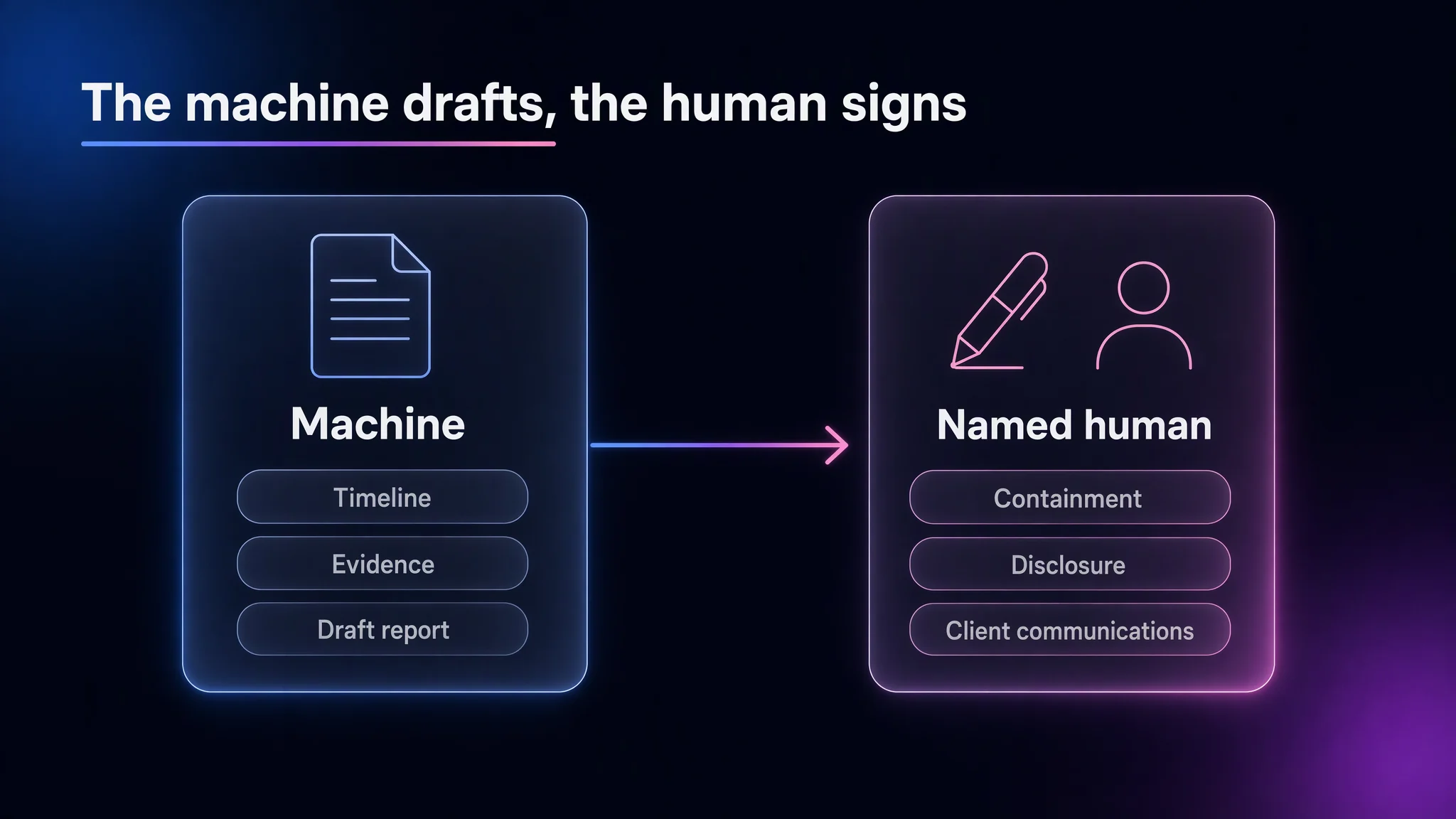
Source: Deploying Claude Safely (Book 3), Chapter 17, Figure 17.2.
| Incident task | Who does it | Why the line falls there (Book 3’s mapping) |
|---|---|---|
| First-pass triage, correlation, deduplication | Machine-assisted, human-reviewed | No regulatory duty attaches to triage; speed dominates |
| Artefact capture and replay assembly | Machine | It feeds the notification’s evidence base, where completeness matters and judgement does not |
| Draft post-incident report and draft notification text | Machine drafts, human owns | The template has a fixed structure, but someone must be able to stand behind the narrative |
| Classification as major | Human — named, outside engineering and the business line | A regulatory determination with a clock attached |
| Containment decision (which layer, how wide) | Human — CISO or delegate | A proportionality judgement that affects the firm’s own services |
| Supervisor disclosure and customer communications | Human — named, with Legal review | Submissions and client statements are signed |
Book 3’s summary: a firm that lets the machine draft and the human sign can defend itself to the supervisor; a firm that lets the machine classify cannot.
Never defer classification for business reasons
Book 3’s anti-pattern (Ch 17 §8): the SOC classifies as major, the business owner argues for a lower classification because a client distribution is two hours away, and classification slips. Rule: separate the classification decision from the business-impact discussion. The named classifier calls it, the CIO confirms, the business owner is informed, and the clock runs. A classification debate that includes the business owner is the recognisable signal.
Who is the named classifier? The sources differ. Book 3 Appendix F (row 21) and Ch 13 OD-2 make Legal & Compliance accountable for classification, with the AI platform owner, CISO and SOC responsible for the technical assessment. Book 3 Ch 17 (§6, §8 and the composite) gives the call to the second line (the CRO in the composite) with the CIO confirming. The regulatory map already assigns classification to Legal & Compliance; this page follows that, and treats the second line as consulted on the materiality judgement. Whichever you choose, write it into the RACI (accountability) and name the person on the rota. Both sources agree that it is never the wrangler, the business owner or a machine.
One playbook, several cover sheets
Book 1 (Ch 6 §4.2, §6) and Research Paper 2 (§5.10, on the incident control) both insist that agent failures flow through the firm’s existing ICT incident process, not a parallel “AI incident” process. Book 1’s integration artefact is one playbook with two cover sheets — DORA and the AI Act — where one detection and response path produces a separately templated, separately addressed report for each regime it triggers. Book 3 widens the same idea to four lanes (adding GDPR and the provider). Build it that way:
- One detection and response path, one evidence base, one incident reference.
- A cover sheet per regime, each with its own template, authority, owner and clock. The clocks, the DORA/NIS2 relationship and the AI Act applicability conditions are on the regulatory map.
- A routing rule that fires the right cover sheets automatically from registry fields, not from the bridge’s memory.
The classification record
Book 3 Appendix F §5 (Bank A composite) shows a one-page initial classification record filed at the moment of classification, with five fields:
| Field | Content |
|---|---|
| Classification | E.g. provisional major |
| Criteria matched | Each criterion met, with the evidence behind it |
| Rationale | Why the thresholds are met |
| Names | Every role involved, with its RACI position |
| Next decision | E.g. final classification by close of business; the supervisor-notification gate |
In the composite the record was filed two minutes after the team converged on a provisional classification. “Provisional” is a legitimate state; waiting for certainty is not.
Map agent telemetry to materiality in the SOC
Book 1 (Ch 6 §6) gives the clearest example of turning agent telemetry into a classification input. Composite (Bank A, CreditAssist credit-scoring agent): the SOC implemented a Sentinel rule mapping three telemetry signals to the DORA materiality criteria:
| Agent signal | Threshold in the composite | Criterion it triggers |
|---|---|---|
| Disparate-impact ratio breaches the firm’s threshold | Sustained more than 90 minutes | Clients, counterparts and transactions affected |
| Agent unavailable during business hours | More than 15 minutes | Duration and downtime; criticality of services |
| Anomalous output pattern from the evaluation pipeline | Corroborated by an analyst within 30 minutes | Data losses |
The composite rule was tested and the notification clock started correctly; where the same incident also met the AI Act serious-incident criteria, it generated the second cover sheet.
How to build your own:
- For every agent that touches a CIF, write at least one rule that maps its telemetry (evaluation scores, availability, DLP, policy denies, cost) to the named criteria. The authoritative criteria list is on the regulatory map; note the books disagree on whether there are seven or eight, which the map records.
- Count aggregated impact (recipients, transactions, records) across the envelope, not single events — the lesson of the wrong-answer shape.
- Attach the AI Act cover sheet to the rule where the agent is in a high-risk use.
- Re-test each rule at least every twelve months (Book 1 Ch 6 §7). Book 1 asks for continuous testing in large firms and annual testing in small ones.
- Keep the rule as a classification input to the named human, never as the classification itself.
Document the minor incidents too
Most agent incidents will not be major. Book 3 (Ch 9 §8) shows the path for one that is not. Composite (Asset Manager X): a poisoned email was summarised into the agent’s context with instructions to fetch an external payload; the Means control denied it (URL not on the egress allow-list, the pre-tool-use hook blocked the call). The chain was reviewed against the classification criteria, fell below the major threshold on every one, was documented as a minor incident in the same incident workflow, reported internally to the CRO and DPO but not externally, and the poisoned-context vector went onto the agent’s threat register with a quarterly red-team test pattern attached.
Rule: every below-threshold assessment is recorded with the criteria walked and the evidence, so that a later aggregation (or a supervisor’s question) can be answered; and every new attack vector, blocked or not, feeds the threat register and the evaluation suite.
The routing rule
Page recommendation derived from Book 3 Ch 17 §4 and §6: drive cover-sheet selection from registry fields so the classification engine “knows the difference per agent”, as Book 3 puts it.
| Registry fact or incident fact | Cover sheet fired | Owner of the submission |
|---|---|---|
| Agent supports a CIF, or impact meets DORA major criteria | DORA initial, intermediate and final reports | Named signatory per RACI (see below) |
| Agent is part of an AI Act high-risk system | AI Act serious-incident report | AI Act owner per RACI |
| Personal data confirmed in scope | GDPR breach notification to the lead supervisory authority | DPO |
| Model behaviour, MCP vulnerability or platform issue possibly involved | Provider notification | Vendor manager or CISO delegate |
Book 3’s composite shows why this must be per agent: the Asset Manager X research agent does not trigger the AI Act path; a retail creditworthiness agent would.
Communicate in four lanes
Book 3 (Ch 17 §6) gives a four-lane communications matrix, each lane rehearsed.
Internal ladder
The same structured notification every time: incident shape, containment status, clocks running, named people on the bridge.
| From incident start | Who joins | Condition |
|---|---|---|
| Minute 0 | SOC paged | All incidents |
| ≤ 15 minutes | Wrangler | All incidents |
| ≤ 30 minutes | Business owner | Sev-2 and above |
| ≤ 1 hour | CISO, with the CIO in parallel | Sev-1 |
| ≤ 2 hours | AI Steering Committee | Where DORA or the AI Act serious-incident path may apply |
Book 3’s fourth failure mode is the steering committee hearing about an incident through the wrong channel — a CFO’s complaint about token spend, or the supervisor’s own email. The ladder exists to prevent that.
Customers
The business owner holds named templates per shape and takes Legal & Compliance review and CISO sign-off before anything goes out. The wrangler does not write customer communications. A wrong answer reaching a dozen analysts and a leak affecting thousands of customers need different templates; prepare both in advance.
Supervisors
The most time-sensitive lane. DORA requires an initial, intermediate and final report on prescribed templates (timings on the regulatory map); the competent authority depends on the entity (BaFin and the CSSF in Book 3’s composites). Who signs differs between sources: Book 3 Appendix F row 22 makes the executive sponsor accountable for supervisor notification with Legal & Compliance drafting, citing the management body’s non-delegable responsibility; Ch 17 OD-3 has the CISO or delegate sign off and submit. This page follows Appendix F for the signature and treats the CISO as approving the technical content. Record the choice in the RACI. The AI Act serious-incident path runs in parallel where it applies.
Provider
Notify the provider of anything that may involve model behaviour, an MCP server vulnerability or a platform issue. As of August 2026, Book 3 routes this through Anthropic’s account team and the Anthropic Trust Center incident process. [FACT-CHECK: confirm Anthropic’s current customer incident-reporting route and contact mechanism.] Book 3 also states that Anthropic was not designated a critical ICT third-party provider by the ESAs as of August 2026, so the relationship is governed by the firm’s own DORA third-party contract, with named contacts and response SLAs at MSA level. [FACT-CHECK: whether any later ESA designation round has added Anthropic; the CTPP regime itself is on the regulatory map.] Book 3’s warning: the firm without a named provider incident contact finds out on the bridge call when the SOC asks for one.
Pre-wire the DORA initial notification
Book 3’s diagnosis of missed notifications (Ch 17 §8) is not slow people but template fields nobody can fill quickly, because the data sits in three systems with no rehearsed extract. The signal is a notification filed in time but with placeholder text in three or more fields. Book 3 Ch 11 §2 adds that the notification assumes a full trace is available by the deadline: report a reconstruction, not a story.
Book 3 Ch 17 OD-3 gives an illustrative template with each field’s pre-populated source. The operational template should be maintained by the second line with regulatory affairs and reuse the evidence-schema fields. [FACT-CHECK: verify the field list against the published DORA incident-reporting RTS and ITS templates before use; Book 3’s extract is illustrative.]
| Section | Fields | Pre-populated from |
|---|---|---|
| Header | Reporting entity name, LEI, subject area | Standing supervisor profile |
Incident reference (inci- prefix); detection time; classification-as-major time | SOC classification record | |
| Competent authority and named contact at the supervisor | Supervisor-relationship register | |
| Named contacts at the firm (incident lead, on-call CISO, on-call CIO) | On-call rota | |
| Classification | Shape mapped to the criteria; criteria met (minimum two in Book 3’s reading, each with evidence); type (cyber / non-cyber; ICT / non-ICT) | Shape table; classification record; pre-mapped per shape |
| Materiality justification | Drafted at the time | |
| Affected services | CIFs affected, with the CIF reference from the Register of Information | CIF register |
| Services affected; estimated clients affected; reputational, operational and financial impact; geographic spread | Agent registry; SOC classification record | |
| Status | Suspension in effect (yes/no); layer (wrangler / gateway / organisational); denial verified (evidence reference) | Suspension register |
| Root-cause status (under investigation / preliminary / confirmed) | Bridge | |
| Reporting status to other authorities (GDPR, AI Act, provider) | Routing rule | |
| Financial impact | Direct cost, indirect cost, forgone revenue (first estimate; revised in the intermediate report) | First-pass estimate |
| Submission | Timestamp; submitted by | Generated at submission |
Appendix F §5 lists the prescribed minimum as incident identifier, classification, summary, affected services, criticality, financial impact estimate, geographic impact and entity contact; the OD-3 template covers all of them.
Fill schedule (Book 3 OD-3): template filled by the end of hour two of the initial-notification window, Legal review in hour three, sign-off and submission in the final hour. Bank A in the Appendix F composite targeted its intermediate report well inside the deadline to leave margin; do the same.
Composite walk-through: the Asset Manager X morning
Composite from Book 3 Ch 17 §1 and §7; it describes no real firm. Use it as a rehearsal script.
| Time | Event | Lesson |
|---|---|---|
| 03:14 | Research-synthesis agent retrieves from a registered, allow-listed MCP server a payload carrying instructions planted in a poisoned external email, ingested the previous evening by an upstream summariser whose hook bundle lacked the content-sanitisation hook | Root cause sat in a different agent, built by a different team |
| 03:47 | Citation-resolver job (every 15 minutes) finds two unresolvable citations and one phantom source; SOC raises Sev-2 and pages the CIO | No poisoning rule existed; a quality job caught it |
| 04:02 | SOC formally classifies as major (two criteria: clients affected, reputational impact), second line drawing the justification | Clock starts on the recorded classification |
| 04:14 | CIO confirms | Confirmation did not delay the clock |
| 04:30 | Wrangler-layer suspension: the affected envelope stops within four minutes | Precision first |
| 05:00 | Gateway kill switch across all four research envelopes; deny-suspended against four envelope IDs, effective in 17 seconds, each verified by a denied call | Go wide when cause is unknown; verify each |
| 06:30 | Forensic replay: 203 evidence records across four envelopes; responders work inside the privileged-incident zone | Responders have their own identity and expiry |
| 07:45 | No executed trades confirmed | Impact facts feed the template |
| 08:00 | Initial notification filed, eight minutes inside the deadline, from the pre-populated template | Pre-wiring is what made the deadline |
| 11:00 | Steering committee extends suspension to two more envelopes sharing the summariser — six in total | Shared dependencies widen blast radius |
| 16:00 | Root cause confirmed in the summariser, misclassified as a low-exposure intermediate agent | The agent ingesting external content was the most exposed |
| Day +3 | Intermediate report on time to two authorities; courtesy notification to the provider | Multi-authority routing |
| Day +7 | Post-incident review (CISO chair, second line co-chair): three control changes with owners and dates | See next section |
| Day +12 | Back in production on named CISO sign-off of the readiness checklist | Reinstatement is a fresh approval |
| Day +30 | Final report names the three control changes and their implementation dates | The review output is the final report’s substance |
End every review with a named control change
Book 3’s fifth anti-pattern (Ch 17 §8) is the review that meets, writes observations and recommendations, commits nothing to an owner, a date or a control, and disperses — and six weeks later a similar incident fires. A second, quieter version (Ch 17 §2) is declaring an incident resolved because suspension fired: the alert closes, the wrangler lifts the suspension next day under business pressure, and the same incident returns four weeks later because the root cause was never found.
The review procedure:
- Start from replay, including the suspension state (Book 3 OD-2). The evidence pipeline writes activation, reversal authorisation and suspension-state evidence into the same record set as ordinary interactions.
- Chair and co-chair. In the composite, the CISO chaired with the second line co-chairing, at Day +7.
- Commit at least one named control change. Book 3’s list of acceptable changes: a new hook, a SOC rule, an envelope amendment, a registry field, a wrangler-process update. Each gets an owner and a date.
- Day +14 progress check on every committed change.
- Reinstatement depends on the changes, not on elapsed time: the composite agent returned only once the hook bundle, envelope re-validation and new SOC rule were live.
- Carry the changes into the final regulatory report where one is due.
- Convert the incident into a test case in the evaluation suite so the same failure is caught before release next time.
The composite’s three changes are a useful pattern because they hit three different layers: a platform mandate (content-sanitisation hook for every agent ingesting external content, platform team, fourteen days), an envelope action (re-validate all six suspended envelopes, wranglers), and a detection change (a content-poisoning SOC rule that fires on aggregated citation-resolver failures rather than single records).
Source difference. The evaluation and resilience page currently lets an incident end with a documented reason why it is not generalisable. Book 3 Ch 17 §8 requires at least one control change from every review. For anything handled as an incident this page follows Book 3: “not generalisable” may close the test-case question, but not the review. Near-misses below incident level can use the lighter route.
Learn from other firms’ incidents
Your own incidents are too few to calibrate controls. Book 1 (Ch 17 §4.5–§4.6, §5.3) builds a learning loop on the public OWASP agentic incident tracker, whose December 2025 publication catalogued twenty-three incidents through Q4 2025. Book 1’s reading of that library: six of twenty-three were MCP-related, with supply chain through MCP servers (ASI04) the single most represented class; nine involved prompt injection through retrieved content rather than typed prompts; four were pure coding-agent failures. [FACT-CHECK: confirm the tracker’s current location, incident count and category distribution.]
| Loop element | Cadence | Owner | Output |
|---|---|---|---|
| Tracker subscription and triage | New incidents triaged within five working days | A named individual in the AI Office (not a shared security inbox — Book 1’s composite moved it from one) | For each incident: “could this happen here?” and affected agents |
| Out-of-cycle scenario | On any high-severity new incident | Raised by the tracker owner; run by the red team (page assignment) | Scenario added to the next quarterly purple-team |
| Quarterly purple-team | Quarterly | Internal red team with the agent platform team | Replays the past quarter’s published incidents against a sample of in-scope agents; findings into the control plane |
| Annual library walk | Annually | Control team | Every library incident walked against the current estate; answers into the risk register |
| Autonomy demotion and promotion | As findings land | Virtual CAB under change governance (page assignment) | Change families whose agents prove exposed drop an autonomy level until re-inspected; twelve clean months earn promotion |
For a small firm, Book 1 compresses the cadence: the quarterly purple-team becomes semi-annual, the library walk six-monthly, and the managed SOC takes on tracker subscription and triage. The autonomy levels themselves are on change governance; the test classes are on evaluation and resilience.
Rehearse, including concurrent incidents
Templates and kill switches that have not been exercised fail on the day. Book 3’s third anti-pattern (Ch 17 §8): templates that have sat unused for two years, so the first real customer notice spends six hours in legal review and two more waiting for the CISO, and the customer reads it on Day +1, after the trade press has run the story. The signal is no drill in the past twelve months.
| Drill | Cadence | Participants | Pass condition |
|---|---|---|---|
| Wrangler and gateway suspension | Quarterly | Wrangler, SOC, platform team | Activation evidence; workload demonstrably stopped; named reverser on a named criterion; gap-free decision records; verified denial; suspension survives a redeploy |
| Organisational suspension | Annually | CISO, steering committee, platform team | Same four artefacts at estate scale; managed workstation setting proven to disable the surface |
| Communications tabletop | Six-monthly | Business owner, Legal & Compliance, CISO, second line, with a named supervisor contact playing the receiving end | Customer and supervisor templates filled and signed inside the target windows |
| Concurrent-incident tabletop | At least one of the six-monthly tabletops | As above, plus every wrangler sharing an upstream dependency | Run against five simultaneous incidents; classification throughput measured |
The concurrent drill is Anthropic’s recommendation as cited by Book 3 (April 2026), and Book 3 explains why it matters: a single-incident drill never shows where capacity runs out. The bottleneck is not the kill switch; it is the one second-line officer who has to classify five incidents at the same time. Asset Manager X lost six envelopes to one root cause. Page recommendation: name a deputy classifier on the rota so concurrent incidents can be split. Step-by-step rehearsal mechanics (test agent, timings, close-out pack) are on agent lifecycle. Book 3 Ch 13 expects the quarterly rehearsal cadence to rewrite the playbook whenever gaps surface; in the Asset Manager X composite, the escalation playbook as printed had survived three rehearsals, and the version drafted before the first rehearsal had not. Expect yours to change too.
Failure modes
| Failure | Signal | Recovery |
|---|---|---|
| Suspension lost on deploy | Suspended envelope traffic resumes after a routine pipeline run | Suspension register read pre-flight; post-deploy validation; alert on failure |
| ”Revoked” credential still working | Successful calls after suspension; long-running sessions still active | Verified denial per path; explicit session termination; rotation is not revocation |
| Classification deferred for business reasons | The business owner is in the classification debate | Named classifier decides; business owner informed; clock runs |
| Machine classifies | Rule output filed as the classification | Rule is an input; a named human signs the classification record |
| Generic ICT playbook for every shape | Same containment for a leak and a wrong answer | Shape triage first; per-shape containment and templates |
| Notification filed with placeholders | Three or more placeholder fields in a timely submission | Pre-wire fields to SOC record, registry, suspension register and evidence pipeline |
| Communications never rehearsed | No drill in twelve months; customer notice late | Six-monthly tabletop with Legal and a supervisor stand-in |
| Review with no control change | Output is a page nobody reads; recurrence weeks later | At least one named change with owner, date and Day +14 check |
| Lift under business pressure | Suspension reversed within a day with no root cause | Named reverser on a named criterion; reinstatement tied to the control changes |
| Only your own incidents inform controls | Threat register never changes between incidents | External incident-library loop with a named owner |
| Responder uses the failed identity | Investigation actions logged under the suspended agent | Separate, time-boxed responder identity in the privileged-incident zone |
Acceptance checks
Before go-live (T2+)
- Every row of the readiness table is satisfied, with a named owner.
- The envelope opens in under two minutes from the SOC console.
- At least one SOC rule per CIF-touching agent maps telemetry to the materiality criteria and was tested within twelve months; the AI Act cover sheet is attached where applicable.
- The registry holds CIF, high-risk-use and personal-data fields for every agent, and the routing rule reads them.
- A named provider incident contact is recorded.
During an incident (checked at the post-incident review)
- Shape recorded at first triage and re-checked at each bridge checkpoint.
- Each suspension activation has a verified denial per access path and a list of terminated sessions.
- The classification record carries the five fields and was filed by the named classifier; no business-owner sign-off appears on it.
- Every cover sheet fired matches the routing rule; no notification was filed with placeholders.
- Investigation and recovery actions are logged under responder identities, not the suspended agent’s.
After an incident
- The review committed at least one named control change with an owner and date; the Day +14 check is recorded.
- Every lift has a named reverser, a criterion and the suspension’s correlation-ID prefix.
- Active suspensions survived every deployment during the incident window.
- The incident is a regression case in the evaluation suite; below-threshold incidents are documented and their vectors are on the threat register.
- SLA intervals were measured from records and reported to the steering committee.
Standing
- Suspension drills on cadence; six-monthly communications tabletop held; at least one concurrent-incident tabletop per year.
- External tracker triaged within five working days by a named person; the annual library walk is recorded.
Provenance and source differences
This page synthesises Book 3 Ch 17 (shapes, suspension, communications, composite, anti-patterns and the three Operating Discipline artefacts), Book 3 Ch 13 OD-2 (escalation playbook), Ch 9 §8 (minor incident) and Ch 11 §2, and Book 3 Appendix F; Book 1 Ch 2 §7, Ch 6 §4.2, §6–§7, Ch 9 §4.4 and §6.4, and Ch 17 §4.5–§4.6, §5.3 and §6; and Research Paper 2 §5.10. The Audit Evidence Schema v0.1.0 was checked for decision and suspension fields (it has none specific to suspension). Where the sources differ:
- Who classifies: Book 3 Appendix F and Ch 13 — Legal & Compliance accountable; Book 3 Ch 17 — second line calls it, CIO confirms. This page follows Legal & Compliance, consistent with the regulatory map.
- Who signs the supervisor notification: Appendix F — executive sponsor; Ch 17 OD-3 — CISO or delegate. This page follows Appendix F.
- When the DORA clock starts: Ch 17 ties it to SOC classification and says CIO confirmation does not move it; Appendix F ties it to the classification-as-major moment. The legal rule is on the regulatory map; operationally, define in writing which recorded event is the classification moment.
- AI Act serious-incident timings: Book 1 Ch 6 and Book 3 Ch 17 describe the Article 73 deadlines in different terms; this page states neither and defers to the regulatory map.
- Suspension timings: Ch 13 measures decision-to-suspension (under two minutes); Ch 17 OD-1 measures alert-to-suspension (15–30 minutes). Both are kept as different intervals.
- Suspension layers: Ch 13’s step 4 combines the wrangler’s decision with the gateway kill switch; Ch 17 separates wrangler-level runtime stop from gateway-level suspension. This page uses Ch 17’s three layers and treats Ch 13 as the escalation flow into them.
- Incident closure: evaluation-and-resilience allows a “not generalisable” exit; Book 3 Ch 17 requires a control change from every review. This page follows Book 3 for incidents.
- Composites (Bank A, Asset Manager X and named people) are illustrative; their times, counts and thresholds are not benchmarks.
Legal applicability, clocks, article content and authority identification depend on the entity, system and instrument in force; use the regulatory map and a current legal review before treating any step as mandatory.
Review trigger: a change to the DORA, AI Act or GDPR incident-reporting instruments; a vendor change to session control, credential rotation, hook events or managed settings; a new edition of the OWASP agentic incident tracker; any real incident or drill finding against this playbook.
Source material
- Book 3, Chapter 17, Incident Response for Agent Failures (§2–§9; OD-1 clock table, OD-2 suspension playbook, OD-3 notification template)
- Book 3, Chapter 13, Wranglers, Product Teams and RACI (OD-2 suspension escalation playbook and tier thresholds)
- Book 3, Chapter 9, The Anthropic API and Agent SDK (§8 minor DORA-classified incident, SubagentStop hook event)
- Book 3, Chapter 11, Evidence Capture and the Audit Schema (§2 reconstruction at the notification deadline)
- Book 3, Appendix F, RACI Matrix for the Claude Operating Model (rows 21–22; §5 Decision 21 worked example)
- Book 1, Chapter 2, The Bounded Agency Thesis (§7 Monday-morning test)
- Book 1, Chapter 6, DORA in Depth (§4.2 incident management; §6 one rule, two cover sheets; §7 rule validation)
- Book 1, Chapter 9, Agents Inside Network Boundaries (§4.4 and §6.4 privileged-incident zone)
- Book 1, Chapter 17, Change Control in the Age of AI (§4.5–§4.6 incident library and learning loop; §5.3 continuous-resilience cadence; §6–§7)
- Research Paper 2, Ten Solution Archetypes for Regulated Finance (§5.10 on the incident control)
- Supporting Tools, Audit Evidence Schema v0.1.0 (approval block fields)
Related research
Related guidance
-
 Operate the Agent LifecycleInventory, register, sign, zone, review, suspend, recover and retire agents through a six-stage lifecycle with named human ownership, zone-specific authority and evidence at every transition.
-
 Route Regulatory Questions to Obligations and EvidenceA dated, article-level reference that routes AI design questions to the EU AI Act, DORA and its RTS, GDPR and sectoral rules, and turns each obligation into a control, an owner and evidence: change records under RTS 2024/1774 Art 17, the 4 h / 72 h / one-month incident clocks, the CIF hinge and its five artefacts, the three-count Register of Information reconciliation, Art 14(4) oversight controls, the Art 26(5) discharge, the FRIA gate, Art 49 and Art 50, SCHUFA-grade review and supplier controls.
-
 Evaluate, Assure and Test Agent ResilienceDefine a versioned evaluation contract, test the trajectory and the execution boundaries, run three assurance layers into one quarterly pack, map the OWASP Agentic Top 10 to controls that demonstrably fire, bring agents into threat-led penetration testing with a five-section scope, keep a continuous cadence between formal tests, land every finding as a live control-plane artefact, and engineer recovery down to a minimal AI service level on models you host.
- Bounded-Agent PatternA class 3 agent lets a model choose the next step, but only inside a registered, validated and enforced envelope of Mandate, Means, Memory and Monitoring.
-
 Identity, Secrets and Configuration for Agent WorkloadsGive every actor one owned identity, size its authority for the worst case, separate runtime from deployment, federate instead of holding keys, refuse impersonation and silent fallback, govern configuration by class, and audit the estate until flagged identities decline.
-
 Design and Operate the Model GatewayBuild the model gateway as the governed edge for every model call: per-client identity, per-request highest-class routing, tokenisation, pinned models, a conformant wire contract, a correlated evidence record, a tested concentration answer, and day-two cost, latency and reliability operations across two estates and three meters.
-
 Govern MCP Connectors Through a BrokerAdmit, tier, pin and enforce every MCP server through one registry and two enforcement points, keep tokens audience-bound, govern A2A delegation through its own registry and gateway, and expose client-facing agent channels only through the same policy layer.
- The Audit Spine and the Evidence RecordHow to capture, join, protect, retain and prove per-action evidence: the AES v0.1.0 record contract, three capture points and one correlation ID, tiered immutable storage, retention and legal hold, replay rehearsal, the route-approval evidence gate, and the Claude-specific ways evidence goes missing.
-
 Accountability and OwnershipHold provenance and accountability apart on purpose: four named accountabilities per product, a human owner for every agent change, seven named seats, a signed Build/Run RACI and a first-line/second-line boundary that survives consolidation.
-
 Release Engineering for Agent-Written ChangeMove agent-speed change into production through five evidence-emitting stations: one change type per change, a reversal decided at authoring, a valid Deployer Manifest, a gateway that cannot be bypassed, hard health gates and at-most-once rollback.
- Change Governance for Agent-Enabled DeliveryRoute agent-speed change by risk without losing the approver: control values that always reach a person, a routing gate that reads the right signals, autonomy earned per change family, a Virtual CAB that prepares a complete dossier, and three bodies with defined escalation.
- Run the AI Delivery FactoryOperate demand, capacity, the two worker classes, exceptions and evidence as one service: read two leading numbers, keep a handover backlog, gate construction on three conditions, run queues and alerts at agent volume, and count unused products as cost.
-
 Classify Use Cases into Risk TiersThe T0–T4 use-case taxonomy as a working decision reference: the prohibited-use gate, four intake questions, data and action boundaries per tier, the twelve-area control matrix, retention and payload rules, runtime enforcement, approval gates, regulatory routing and re-tiering.