Worked Example: Research Assistant
A composite Asset Manager X request is split into a grounded assistant and a deterministic routing workflow instead of a multi-agent research crew, then written down twice: as the ten-field design record and as a filled bounded-agency envelope, with two contrasting envelopes and their alert thresholds.
- Version
- 0.2.0
- Owner
- DEIXEI
- Last reviewed
- Reading time
- 17 min
For Cto · Ai Architect · Product Leader · Platform Engineer · Risk And Assurance
Sources and details
- Section
- Worked examples
- Source works
- Book 1 · Book 2 · Book 3
- Source chapters
- 2, 22
- Source appendices
- 02:C, 04:D
- Refresh trigger
- source change
Case status. Asset Manager X, Bank A and Bank D are composites. This page shows decisions and records, not evidence about any real institution. Model identifiers, routes, costs and prices are the composites’ values as of May 2026, per Book 3 Appendix D, and will be out of date; treat them as the shape of the record, not as a recommendation of a model.
This page has three parts. Part 1 takes the product-shape decision (Book 2 Ch 22). Part 2 writes the result down as the ten-field design record and as a filled Claude envelope (Book 3 App D). Part 3 gives two contrasting envelopes (a Claude Code review subagent, and an HR assistant from Book 1) so you can see how the same four sections tighten or loosen with the job.
Part 1: the product-shape decision
The request
The research team receives about four hundred pages of broker research each morning. Analysts first decide which half-dozen documents matter, then compare them with the firm’s own position notes, holdings and committee minutes. The sponsor proposes a “research crew” of seven collaborating agents.
Apply the decision sequence
The full sequence and escalation criteria are on choosing the AI product shape. In the composite, it took fifty minutes.
| Question | Answer in the case | Consequence |
|---|---|---|
| Is AI needed? | Partly. Much of the morning volume is broker research arriving in known formats through two aggregators; deciding which documents to read is largely routing and deduplication, with no generation (the file-name distribution settled the argument) | Cut out the part that needs no model |
| Prediction or generation? | Both: relevance scoring is prediction; synthesis is generation | Two products with different owners, not one |
| Enterprise facts needed? | Yes, decisively: the value is synthesis against the firm’s own notes, holdings and minutes, data only the firm holds | Grounded retrieval with permission-aware access and citations |
| Are the steps known? | Yes: find relevant documents, read them against the firm’s position, note disagreements, draft a paragraph | Nothing needs to decide its own next step |
| Agency class | Class 1 grounded assistant for synthesis; class 2 workflow in front for routing and deduplication | Code determines the next step in both |
| Reuse (tier by tier) | Existing landing zone; the governed retrieval store another assistant already uses; model gateway with a mid-tier model and a small classifier already catalogued; workflow templates and connectors; conversation shell and citation component | Seven of eight capabilities inherited; two new ingestion connectors built |
| Policy | The pre-approved policy pack for a class 1 grounded design over confidential data attached without a meeting | Second-line question resolved in minutes, not a six-week assessment |
| Hosting route | Private tenancy, because the corpus carries confidential data and occasionally material non-public information (MNPI) | The composite firm’s decision for its data classes, not a universal rule; map your own classes on data classes and lanes |
Preserve the human boundary
The second line asked what stops an analyst treating a synthesised paragraph as research fit to send out. The answer went into the design record as a residual risk with a control: output carries its citations, the drafting surface is marked draft, and outbound compliance review is unchanged. The system assists analysts; it does not turn generated text into client-ready research.
What was rejected, and the revisit trigger
| Alternative | Decision | Reason |
|---|---|---|
| Class 2 only (workflow, no generation) | Rejected | Synthesis needs grounding against internal material |
| Class 3 bounded agent for peer comparison (find comparables, pull filings, build the table) | Deferred with a trigger | Steps are less predictable. Revisit when the evaluation harness holds a quarter of graded peer-comparison outputs |
| Class 4 multi-agent “crew” | Rejected on the 3-to-4 evidence rule | Seven named roles, but no demonstrated single-agent degradation and every role reporting to the same head of research: no separate ownership boundaries |
A deferral with a measurable trigger is a commitment, not a refusal. The “crew” was a metaphor, not a requirement.
Outcome (composite, read the following spring)
- The routing workflow went live in five weeks and the grounded assistant in eleven, against a vendor’s eight-week promise for something roughly seven times larger.
- Nine analysts use it daily. Usage telemetry showed the routing workflow, not the assistant, carried the larger share of time saved: unpredicted, and it changed what the next two requests looked like. Measure use before you claim value (factory measurement).
- The two aggregator connectors were contributed back to the catalogue and reused by a regulatory-watch product.
Part 2: writing it down
The classification line
The six values the sequence produces, carried in the repository manifest and the catalogue entry (Book 2 Ch 22 §5.4; semantics on BOM and recipes):
reasoning and orchestration / knowledge and grounding / class 1 / tier 2 / confidential / composable capability
That is: anatomy tier / pattern family / agency class / risk tier / data class / reuse generation. Search, policy-as-code, the catalogue and the pattern arbiter all read it.
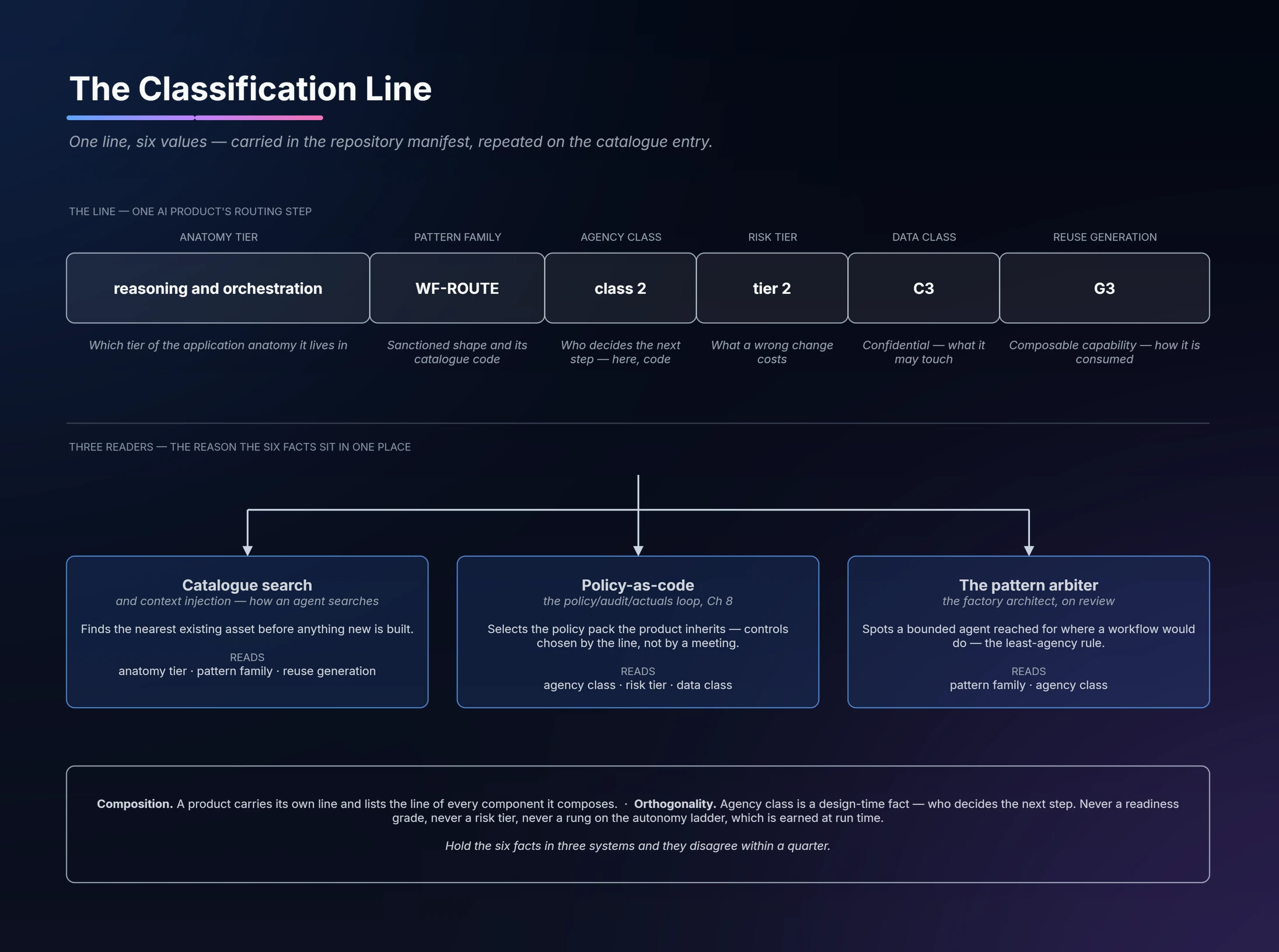
The classification line: one line, six values, carried in the repository manifest and repeated on the catalogue entry. Source: The AI Delivery Factory, Chapter 5, Figure 5.1.
The design record (ten fields)
An architectural decision record in a repository agents can reach, superseded rather than edited when it changes (Book 2 Ch 22 §5.5). Filled for this case:
| # | Field | This case |
|---|---|---|
| 1 | Problem and business owner | Morning triage and synthesis of broker research against internal positions; head of research |
| 2 | Classification line | As above |
| 3 | Chosen agency class, and every lower class rejected with the reason | Class 1 assistant plus class 2 routing workflow; class 2-only rejected (synthesis needs grounding); class 3 deferred with trigger; class 4 rejected |
| 4 | Patterns used per anatomy tier | Grounded retrieval with citation enforcement and permission-aware retrieval; routing/deduplication workflow; conversation shell |
| 5 | Catalogue assets reused; new assets proposed | Seven of eight capabilities reused; two aggregator connectors proposed for contribution |
| 6 | Model class and hosting route | Mid-tier model and a small classifier via the gateway; private tenancy for confidential data and MNPI |
| 7 | Policy pack and residual risks | Pre-approved class 1 confidential pack; residual: synthesis mistaken for publishable research (controls: citations, draft marking, unchanged compliance review) |
| 8 | Evaluation plan and acceptance thresholds | Graded outputs in the evaluation harness; see the envelope below for the composite threshold |
| 9 | Named accountable human for the operational scope | The wrangler (see envelope) |
| 10 | Exit or fallback strategy | What happens if the model, vendor or pattern fails; see vendor concentration and exit |
Sequencing rule (Book 2 Ch 22 §8): no branch until the record exists. A record committed after the first substantial pull request is retrospective justification; you can tell from the timestamps. If writing it takes more than an hour, the fields are wrong. Field 3 is the one that changes behaviour: a record that lists only the chosen class is a receipt; one that lists the rejected classes and why is a decision.
Research Paper 1 gives the same ten-field record (§7.5) with slightly different names: “classification code” for field 2, “processing lane” for the hosting route in field 6 and “control bundle” for the policy pack in field 7. This page uses Book 2’s names.
The envelope record: the Claude variant
The design record says what the product is. The envelope says what each running agent may do, with what, remembering what, and how it is watched. Book 3 Appendix D gives a filled record for Asset Manager X’s research-synthesis agent, envelope ASMX-RES-SYN-001, registered 14 March 2026 and reviewed at 60 days in production. The rule it enforces: no production Claude agent ships without a registered envelope. The runtime refuses to start without an envelope ID, the gateway refuses to forward without one in the headers, and a SOC rule fires on any successful model call that lacks one.
How the two books’ records relate. Book 2’s case and Book 3’s envelope both describe research synthesis at the same composite firm, written in different books, and they differ in two places. Book 2 chooses private tenancy; Book 3’s envelope routes through the direct Anthropic API behind the firm’s API gateway (Sweden Central with paired-region failover). Book 3’s agent also has WebFetch to five external financial-data domains, which Book 2’s design (internal corpus plus ingestion connectors) does not need. This page follows Book 2 for the product-shape decision and Book 3 for the envelope format and field values. Page recommendation: if you adopt Book 2’s design, remove WebFetch from Means unless the design record names a need for it, and set deployment_route to the route your data-class policy permits (deployment routes).
Mandate
| Field | Value | Why |
|---|---|---|
use_case_class | research_synthesis | |
risk_tier | T2 | Regulated process support, no autonomous customer impact |
business_owner_name / _role | Céline, CIO | |
wrangler_name / _role | Ines, senior research analyst, equity desk | Must resolve to an active directory identity at registration and every review |
named_approver_role | Head of investment research plus head of model risk (second line) | Second line required for T2 and above |
autonomy_ceiling | draft | execute_autonomously is allowed only at T0 and T1 |
fria_reference | null | Not an Annex III use case; the trigger rules are on the regulatory map |
usage_policy_alignment | Not investment advice; hitl_control_ref ASMX-HITL-001 (every synthesis signed by the analyst before external use); disclosure path research_note_footer | [FACT-CHECK: the Anthropic Usage Policy version and high-risk category list Book 3 cites; confirm against the current policy] |
customer_facing | false | |
change_authority_ref | Virtual CAB minutes reference | Registration is a change (change governance) |
Means
| Field | Value | Note |
|---|---|---|
deployment_route | direct_api_apim | See the route difference above |
model_id / model_fallback | claude-sonnet-4-6 / claude-opus-4-7 (wrangler override only; cost flag on activation) | Must be on the vendor’s current model list at instantiation. [FACT-CHECK: model identifiers and availability are as of May 2026] |
mcp_servers_allowed | broker-policy-library, broker-research-archive, broker-financial-news | Must be a subset of the broker manifest; the runtime refuses a deprecated server (MCP and connector broker) |
built_in_tools | Read, Grep, WebFetch | Bash and Write usually disabled outside development zones |
cost_ceiling_usd_per_day / _per_month | 50 per analyst / 1,500 aggregate | A zero budget is invalid: no budget, no production envelope. Enforced at the model gateway |
extended_thinking_budget_tokens | 50,000 per session | 0 disables extended thinking |
data_classes_permitted | Public; Internal; Confidential non-customer; Confidential customer-financial via tokenisation | Must be disjoint from the excluded list; an overlap is a registration error |
data_classes_explicitly_excluded | Restricted untokenised; Strictly confidential | Runtime denies, gateway denies, SOC alerts |
network_egress_allow_list | Five named financial-data vendor domains | |
gateway_route_ref | The gateway route that resolves to workspace identity and the policy decision point |
Memory
| Field | Value | Note |
|---|---|---|
conversation_memory | per_session | cross_session is not permitted at T2 and above |
retrieval_scope | Curated research index; policy library | Each entry resolves to a registry record with classification and retention |
vector_store_access | Enabled, research index only | Enabled with no named index is a registration error |
prompt_cache_ttl | 1h for system prompt and research-style guide | Book 3: one-hour cache writes cost 2× input, reads 0.1×; in the composite this is the difference between about USD 2,000 and USD 200 a month. Use 1h only where the write pays back within the hour. [FACT-CHECK: prompt-caching TTL options and multipliers against current Anthropic pricing] |
persistent_storage | none | Deliberately no Files API, which Book 3 records as not eligible for zero data retention; tokenisation carries client context instead [FACT-CHECK: current ZDR eligibility of the Files API] |
memory_eviction_rules | evict_on_session_end | Every Memory field must name when eviction fires |
memory_audit_obligation | true | Always true at T2 and above |
cross_conversation_retention | false | Overriding to true at T2+ needs second-line co-signature, a time-bound eviction trigger and a sensitive-disclosure clause |
Monitoring
| Field | Value | Note |
|---|---|---|
hook_bundle_ref | Workstation hook bundle extended for SDK with SubagentStart / SubagentStop | |
evaluation_suite_ref | 200-sample synthesis-quality test set, threshold 92% match on golden answers | Must resolve to a registered set with sample size and threshold |
soc_detection_rules | Token spend > 200% of baseline; cross-class data retrieval; off-allow-list MCP attempt; subagent recursion depth > 3; configuration change from a non-policy source | Minimum: at least one denial-rate rule and one cost rule |
evidence_capture_ref | Audit Evidence Schema, nine questions on every material action | Audit evidence |
review_cadence / review_owner_role | Monthly (T2) / the wrangler | Weekly at T3+, quarterly at T0 and T1 |
incident_playbook_ref | Hallucinated synthesis used as a citation | Incident response |
suspension_contact_role / _phone | Wrangler out of hours, deputy head of research; hotline tested quarterly (last test logged) | The hotline is tested at every quarterly review and the test is logged in the registry |
model_upgrade_clause | Re-run evaluation within 24 hours; wrangler attests within 2 working days; Virtual CAB notified within 5 working days; Mandate re-validated | Model governance |
What the envelope did in sixty days
Six near-misses, each stopped by a different clause: three Mandate refusals (autonomy ceiling draft), one Means denial (an off-allow-list MCP attempt), one Memory eviction (cross-conversation retention false prevented a disclosure carrying over between sessions), and one Monitoring suspension (a token-spend spike at 03:14 on a Saturday). The one minor incident was a poisoned external email summarised into context that triggered an off-list URL fetch; the Means denial fired and the chain was documented internally as below every reporting threshold. Book 3’s framing for the board: the agent that gets suspended six times in sixty days is the agent that is being run.
Validation and lifecycle checks
| Stage | Check (Book 3 App D §5) |
|---|---|
| Registration | Schema (required and triggered conditional fields); cross-reference (data classes in the dictionary, MCP servers in the broker manifest, wrangler identity active, model on the vendor list); FRIA where triggered; risk-tier routing (T0/T1 default lane; T2 second-line co-signature; T3 plus the Agent Control Board; T4 prohibited without executive exception) |
| Every invocation | Means allow-list fails closed with a structured error to the SIEM; Memory eviction executes at its trigger and is logged; nine-question evidence emitted with envelope_id as a correlation key |
Review (per review_cadence) | Wrangler attests Mandate, minimal tools, memory and monitoring; business owner signs Mandate; DPO signs Memory; security architect signs Means; summary to the Virtual CAB |
| Retirement | Wrangler signs decommissioning; identity revoked; tool bindings and gateway routes removed; memory purged per schedule; registry status retired, record kept seven years; deletion is forbidden |
Lifecycle operations are on agent lifecycle.
Part 3: two contrasting envelopes
A Claude Code review subagent (Bank A, Book 3 App D §4)
A subagent that checks incoming pull requests against the bank’s recipe (secure-development standards, regulatory-coding controls, data-handling patterns) and leaves a structured comment for a human reviewer. It runs inside Claude Code via the Agent SDK, in git worktree isolation. Envelope BANK-A-RISKTECH-CODEREVIEW-007. The differences from the research envelope are the lesson:
| Field | Research synthesis (T2) | Code review subagent (T1) | Why it differs |
|---|---|---|---|
autonomy_ceiling | draft | recommend: posts a comment, never approves | Every PR keeps a named senior reviewer |
deployment_route | direct_api_apim | foundry (set through managed settings) | Route follows the estate, not the use case [FACT-CHECK: Claude Code routing to Microsoft Foundry via managed settings, as of May 2026] |
model_fallback | Named, override only | null | No fallback at T1 |
mcp_servers_allowed | Three research brokers | The bank’s recipe broker; security-controls broker | |
built_in_tools | Read, Grep, WebFetch | Read, Grep, Edit (worktree only) | Plus worktree_isolation: true |
| Cost ceilings | USD 50/day per analyst; 1,500/month | USD 100/day per engineer; 25,000/month | |
| Extended thinking | 50,000 tokens | 0 (disabled) | |
| Data classes permitted | Up to confidential customer-financial via tokenisation | Internal only (bank source code); Public explicitly excluded | The subagent must not pull from public sources |
| Egress | Five vendor domains | Internal Git and artefact repository only | |
prompt_cache_ttl | 1h | 5m | Engineers iterate fast |
| Eviction | Session end | Session end or PR close | |
| Evaluation | 200 samples, 92% match | 150 historical PRs with reviewer-validated comments, 90% precision, re-run nightly | Held at 91–93% in the first 30 days |
| SOC rules | Includes recursion depth > 3 | Includes worktree escape | |
| Review cadence | Monthly | Quarterly | |
| Model-upgrade clause | 24 h / 2 days / 5 days; Mandate re-validated | 48 h / 5 days / 10 days; Mandate not re-validated unless the tool surface changes |
At 30 days (composite). About 180 PRs a week. The worktree-escape rule fired three times, each an engineer pointing the subagent at a working-tree path by mistake; denied and corrected. The off-list MCP rule fired once, on a deprecated recipe-broker name an engineer had cached locally; denied and purged. Coding-agent workstation controls are on coding agent workstation.
An HR policy assistant (Bank D, Book 1 Ch 2 §6.1)
Book 1’s envelope is the vendor-neutral one-page template, signed by four countersignatories (business owner with a CIO/CTO delegate; lead architect with the CISO; data owner with the DPO; operations lead with the head of audit). Its worked example is a well-bounded HR assistant at a composite specialist bank of about 3,500 staff.
| Section | Filled values |
|---|---|
| Mandate | Scope: colleagues’ HR policy questions (leave, benefits, pay enquiries, standard people processes). Outcome: grounded answer citing the HR policy document; route to a human HR specialist when the confidence threshold rejects. Exclusions: no legal advice, no interpretation of edge-case grievances, no transactions (cannot change a leave balance, approve a request or alter pay). Autonomy: advisory only. Override: nothing to reverse because nothing transacts; escalation to a named HR partner is one click |
| Means | Own service-principal identity, distinct from the caller’s. Read-only HR policy knowledge base plus a few employee-scoped read APIs returning only the caller’s data (today’s leave balance, pay date). No write APIs. Credential lifetime: minutes per session. Excluded: payroll write, HRIS write, performance-management read |
| Memory | Reads: policy index plus per-colleague reads at session time. Writes: audit log of question-answer pairs and ephemeral session context. Nothing colleague-identifiable persists beyond the audit window; anonymised aggregates feed the evaluation harness. No other agent reads this memory. Data ceiling: personal data, no special category |
| Monitoring | Trace fields: question, retrieved citations, answer, confidence, escalation flag, latency, model version, prompt-template version. Evaluations: weekly factuality against a curated set; monthly drift; continuous policy-conformance check (does it cite a policy; is the policy current; does the answer contradict the text). Alerts: factuality regression > 2 percentage points to the wrangler; escalation rate > 1.5× baseline to HR operations. Wrangler: HR-tech operations lead; second line: HR director |
Book 1’s point: the high first-contact resolution comes from how tight the envelope is, not how powerful the model is. Its readiness test (the Monday-morning test): when an incident occurs, can the on-call lead open the envelope in under two minutes and decide whether the incident is inside it (a defect to fix) or outside it (a containment and disclosure event)?
Book 1 and Book 3 envelopes are layers, not rivals
| Aspect | Book 1 (vendor-neutral) | Book 3 App D (Claude variant) | This page follows |
|---|---|---|---|
| Form | One-page template, plain-English fields, four countersignatories | Machine-readable registry record with enums and validation rules, read by runtime, gateway and SOC | Book 1 as the governance document; Book 3 as its enforced form |
| Autonomy vocabulary | Advisory / controlled execution / autonomous standard-change | recommend / draft / execute_with_approval / execute_autonomously | Book 3 for Claude agents; map both to Book 2’s agency classes on bounded agent |
| Review cadence | Annual baseline; re-sign on material change; a model version bump within a family at the same evaluation results is not material | By tier (weekly T3+, monthly T2, quarterly T0/T1); every model upgrade re-runs the evaluation on a clock | Book 3 for production Claude agents. Book 1’s “not material” judgement predates Book 3’s model-upgrade clause and should not be used to skip it |
Takeaways
- Divide the request by control flow and responsibility before choosing a model or framework; the product-shape guide gives the sequence, and workflow and bounded agent describe the shapes.
- Write the design record before the first branch, with rejected classes and their reasons.
- Register one envelope per running agent, with a budget, an evaluation threshold, alert thresholds and a tested suspension contact, before production.
- Compare envelopes across agents: the differences (ceiling, egress, data classes, cadence) should each trace to a reason in the design record.
Related worked examples: a migration through the factory, and an inspection answered from the record, which shows how the envelope and evidence fields are read back by a supervisor.
Source material
- Book 2 (The AI Delivery Factory), Chapter 22, The Shape of an AI Product (§5.4 classification line; §5.5 design record; §6 the research crew that became an assistant; §8 risks)
- Book 3 (Deploying Claude Safely), Appendix D, Bounded-Agency Envelope Template (Claude Variant) (§2 schema; §3 API agent record; §4 Claude Code subagent record; §5 validation and lifecycle)
- Book 1 (Building Organizations for the Age of AI), Chapter 2, The Bounded Agency Thesis (§5 envelope template; §6.1 HR assistant at Bank D; §7 Monday-morning test)
- Book 2 (The AI Delivery Factory), Appendix C, The Pattern Catalogue (pattern names referenced by design-record field 4)
- Research Paper 1, Taxonomy for a Reuse-Driven AI Factory (§7.5 the design record)
Related guidance
-
 Choose the Shape of an AI ProductA least-agency decision sequence for choosing a product design: agency classes and their trade-offs, the eight questions, evidence for every step up, the consequence matrix that caps action scope, the cut-set review for agents, the other selection dimensions, and the design record.
-
 Workflow PatternUse a workflow when code can determine the next step, even when some steps call a model: the eight workflow patterns with their forces and factory notes, why class 2 is the default, how code-orchestrated multi-agent flows stay workflows, how to codify a stable agent path down or delegate exceptions up, and a composite service-desk triage example read across frameworks and cloud pillars.
- Bounded-Agent PatternA class 3 agent lets a model choose the next step, but only inside a registered, validated and enforced envelope of Mandate, Means, Memory and Monitoring.
-
 The AI Delivery Factory: Operating ModelThe factory's six connected parts, the control gap it closes, the handover curve that governs what agents may take over, and how to start one without rebuilding your tooling.
- Classify Use Cases into Risk TiersThe T0–T4 use-case taxonomy as a working decision reference: the prohibited-use gate, four intake questions, data and action boundaries per tier, the twelve-area control matrix, retention and payload rules, runtime enforcement, approval gates, regulatory routing and re-tiering.
- Operate the Agent LifecycleInventory, register, sign, zone, review, suspend, recover and retire agents through a six-stage lifecycle with named human ownership, zone-specific authority and evidence at every transition.
-
 The Audit Spine and the Evidence RecordHow to capture, join, protect, retain and prove per-action evidence: the AES v0.1.0 record contract, three capture points and one correlation ID, tiered immutable storage, retention and legal hold, replay rehearsal, the route-approval evidence gate, and the Claude-specific ways evidence goes missing.
-
 Design and Operate the Model GatewayBuild the model gateway as the governed edge for every model call: per-client identity, per-request highest-class routing, tokenisation, pinned models, a conformant wire contract, a correlated evidence record, a tested concentration answer, and day-two cost, latency and reliability operations across two estates and three meters.
-
 Govern MCP Connectors Through a BrokerAdmit, tier, pin and enforce every MCP server through one registry and two enforcement points, keep tokens audience-bound, govern A2A delegation through its own registry and gateway, and expose client-facing agent channels only through the same policy layer.
-
 Choose and Contract Claude Deployment RoutesDecide, per use-case class, which route carries Claude into production (Anthropic API, Claude Platform on AWS, Bedrock, Google Cloud, Microsoft Foundry, plus the Microsoft 365 Copilot surface); record who operates, bills and processes; size the diligence to the processor; check residency, zero data retention and HIPAA per feature; sign a contracting matrix row; and run Agent SDK or hosted agents with the controls the product does not supply. Provider-specific and dated.
-
 Worked Example: A Migration Through the FactoryA composite data-centre exit walked as a reusable decision trail: purpose sheet, recipe boundary, inventory as a discovery control, the control loop, transform review with adversarial cases and business reconciliation checks, rehearsals run by role, and the effort test that tells a factory from a pile of tools.
- Worked Example: An Inspection Answered From the RecordComposite supervisory walkthrough: for each question a supervisor asks about automated approval and agent actions, the evidence that answers it, the query that produces it, who runs it, and the questions the record cannot answer without a written rule.