Assess Agent Readiness Across the Estate
Check the estate's control foundations, grade the stations a change must cross on evidence, route work by the weakest station, fund readiness worst-first with a stated split, and make bought products machine-operable at renewal.
- Version
- 0.2.0
- Owner
- DEIXEI
- Last reviewed
- Reading time
- 24 min
For Cto · Ai Architect · Platform Engineer · Product Leader · Risk And Assurance
Sources and details
- Section
- Build the platform
- Source works
- Book 1 · Book 2 · Book 09 · Research Series
- Source chapters
- 1, 3, 4, 5, 27
- Refresh trigger
- source change
Agent readiness is a property of the delivery environment. It decides which work lane a change can use and how much of the work can be verified by machine. It is not a product-risk classification and never authorises autonomy by itself: a station can be easy for an agent to change and still support a critical function whose controls demand close human oversight.
This page works at two levels. First, a short check of the estate’s control foundations: whether the firm can govern agents at all. Then the main method: grading the stations a change must cross, routing work by the weakest one, and funding readiness where low capability blocks the most value.
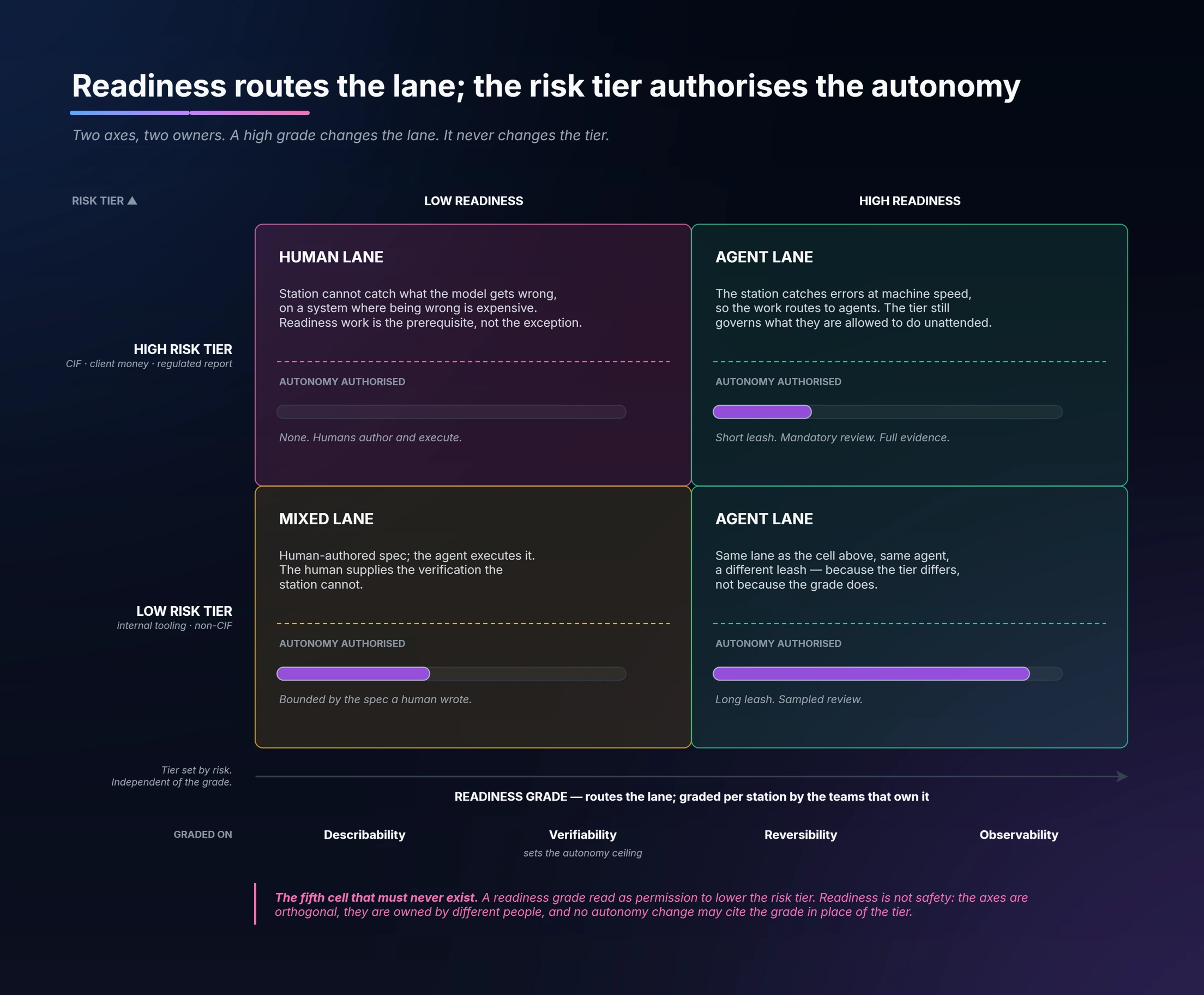
Readiness routes work; the independently owned risk tier authorises autonomy. Source: The AI Delivery Factory, Chapter 4, Figure 4.1.
Check the estate control foundations first
Station grades assume an operating layer exists. Book 1 offers three quick estate-level checks. They are governance diagnostics, not readiness scores; never average them with station grades or into one number.
The Adoption Gap Diagnostic: six questions
Book 1 (Chapter 1 §5) proposes six yes/no questions, answerable in minutes:
| # | Question | ”No” looks like | ”Yes” looks like |
|---|---|---|---|
| 1 | Can you produce, within an hour, a complete inventory of every agent in the firm, including agents embedded in SaaS tools? | A committee spreadsheet, updated monthly, suspected incomplete | A live registry reconciled with deployment, runtime and identity records |
| 2 | For each agent, can you state in one sentence what it may do, with which tools, over which data? | ”It does claims triage” | A bounded-agency record with mandate, means, memory and monitoring |
| 3 | If an agent acts wrongly today, can you name the accountable human within fifteen minutes? | A committee or “the business sponsor” | A named wrangler, individually accountable |
| 4 | Can the platform refuse a policy-violating agent action at runtime and evidence the refusal? | Policy in a long document; refusals appear as audit findings months later | Policy-as-code at the API layer, deny events in the evidence pipeline |
| 5 | Could you hand a regulator, this week, a structured timeline of any agent action in the last 90 days, including its reasoning? | Logs exist, reasoning is not captured | Evidence records populated automatically and queryable |
| 6 | Has a named person connected the firm’s framework, operational-resilience, AI and agentic-security obligations into one artefact? | Each owned separately; an annual workshop | A unified control map, owned and under change control |
Scoring bands (Book 1, author’s bands): “no” to four or more: the firm has no operating layer for agents; “no” to two or three: adoption without a control plane; “yes” or credible “in progress” on at least five: the position from which scaling is safe. Score warn-only policy-as-code as “no” on question 4; the source says that middle ground does not survive a serious incident review. The author reports a mean of about 1.4 out of six across the CIOs he ran it with, and a best credible score of 4; treat that as anecdote, not benchmark.
Closure order: inventory (1) → wranglers (3) → bounded-agency records (2) → unified control map (6) → policy-as-code (4) → audit evidence (5). Starting with 4 and 5 because they feel like progress fails: without 1–3 the platform has no operating layer to act on. Related pages: The bounded agent, Accountability, Control map.
Control-plane pillar scorecard and the 90-day plan
Score each of the ten cloud capability pillars on three dimensions (Book 1 Ch 5 §7):
| Dimension | 0 | 1 | 2 |
|---|---|---|---|
| Ownership clarity | No accountable owner | Owner named, mandate unclear | Accountable owner with mandate |
| Policy coverage | Controls on paper only | Some controls enforced as code | Controls enforced and evaluated as code |
| Observability | Not observable | Partly observable | Evidence answers the pillar’s auditor question |
The 0/1/2 descriptions are this page’s anchors; the source defines the three dimensions and the 0–2 scale but not the wording of each level. Each pillar scores 0–6; the total is out of 60. The author reports no organisation above 50 on a first pass.
The 90-day plan. Pick the two lowest pillars (the source expects AI platform control, plus Integration or Observability) and plan to move one pillar from 2 to 5 in 90 days. A plan to move all ten by one point is, in the source’s word, theatre. Run a weekly 40-minute forum (wrangler lead chairing, one representative per framework team and per pillar under work) until the pillars stabilise. In parallel, extend one practice per framework altitude: change enablement, managed data and asset inventory are the source’s suggested starting points.
Platform maturity gap
Book 1 (Ch 1 §4.2) adds a Wardley-mapping lens: plot each layer an AI estate rests on (identity, data pipelines, model serving, deployment) on the evolution axis genesis → custom-built → product → commodity. Agents behave in production when those layers sit near product or commodity. A layer still custom-built (bespoke identity glue, hand-rolled pipelines, a model-serving stack one team owns) will show up first as cost, then as an incident. Use it to explain why a station’s platform layer grades low, not as a score.
Assess stations, not repositories
A station is a unit a change must cross: a repository, pipeline, vendor platform, approval workflow, data service or other component with an interface and an owner. A cross-cutting change moves at the pace of the least-ready station on its own path. Repository-only inventories miss bought products and configured platforms, which are often where the time goes: in Book 2’s composite Asset Manager X, 61 stations replaced 340 repositories, and eight non-repository stations explained a disproportionate share of delay.
Start with the last two or three cross-cutting changes. List every station each crossed, including manual and vendor-managed steps, and for each record the days spent there and whether the effort went on tools (provisioning, chasing approvals, reconstructing evidence, unwritten dependencies) or on judgement (what data means, where the rollback point sits, who may decide). A station with no diffable surface is a finding, not an omission.
The four readiness properties
| Property | Question | Artefact signal (cheap, gameable) | Outcome signal (hard to fake) | Typical owner |
|---|---|---|---|---|
| Describability | Can an agent learn what this system is and how work is done here? | Standing context exists; decision records; published API spec | Agent clarification rate; tasks abandoned for missing or wrong context | Product team |
| Verifiability | Can a wrong change be caught cheaply, automatically and fast? | Test coverage percentage, strict typing, pipeline run time | Escaped-defect rate on agent-authored change; review effort per merged change | Product team |
| Reversibility | Can a wrong change be undone cheaply? | Rollback path documented; flags in use | Mean time to revert, measured on real reverts; blast radius of the last three incidents | Platform team |
| Observability | Can the outcome be seen by the agent and the firm? | Telemetry emitted; health endpoints | Share of changes whose effect was confirmed from actuals within 24 hours | Platform team |
Owners as given in Book 2 Ch 4 §5.1; outcome signals are read from the audit spine.
Grade from outcomes; a station’s grade moves only when its outcomes move. Describability can be back-filled quickly (agents write serviceable standing context fast); verifiability is slow and dear, because a test of correct behaviour needs someone who knows what correct is.
Existing standards are readiness infrastructure
Book 2 (Ch 4 §4.2) and Paper 4 note that most readiness infrastructure was specified for other reasons and is already approved in many firms. The mapping below is this page’s synthesis of which property each standard mainly serves:
| Standard | Mainly serves | How |
|---|---|---|
| SPDX, CycloneDX | Describability | A machine-readable inventory of components, versions and dependencies (the BOM core) |
| OpenSSF Scorecard | Verifiability | Repository hygiene checks: branch protection, CI, dependency practice |
| SLSA | Verifiability, reversibility | Build provenance and integrity; supports “same inputs, same artefact” |
| Open Policy Agent | Verifiability (organisation layer) | Policy-as-code gates an agent’s change meets at machine speed |
| OpenTelemetry | Observability | Structured, correlated telemetry from change to outcome |
Readiness has four layers
| Layer | Diagnostic question | Common constraint |
|---|---|---|
| Codebase | Can the agent read, change and verify the software? | Missing context, fragile tests, non-deterministic builds |
| Platform | Can environments and deployment paths be provisioned without a queue? | Manual tickets; a nine-day environment wait in front of an excellent repository |
| Toolchain | Do the tools expose machine-operable interfaces and structured results? | GUI-only operation, unstructured output, unstable exit codes, non-diffable configuration |
| Organisation | Are standards, approval conditions and policies machine-readable and enforceable? | Controls exist only in documents |
When readiness looks fine and throughput does not move, look at the toolchain layer first.
Hyperscaler view (as of 2026, per Book 2 Ch 4 §4.4). All three clouds can express all four properties; differences are ergonomic. Azure: Policy and initiatives (organisation layer), tagging and Deployment Stacks (reversible infrastructure), Azure Monitor and Application Insights. AWS: Config rules and Control Tower guardrails, Service Catalog, CloudFormation stack sets and change sets, CloudWatch and X-Ray; the authors read Config conformance packs as the more coherent organisation-layer story at scale. Google Cloud: Config Controller and Policy Controller, Cloud Deploy and Cloud Build, Cloud Logging and Cloud Trace. [FACT-CHECK: service names and capabilities against current documentation]
Score each station 0 to 3 and take the lowest
Book 09 (Closing) supplies written anchors that this page adopts as its default scale. They are the authors’ starting point, not an industry standard. If a station sits between two anchors, take the lower.
| Score | Learn (describability) | Catch (verifiability) | Undo (reversibility) | See (observability) |
|---|---|---|---|---|
| 0 | Nowhere written, or only in one person’s head | No tests of intended behaviour | Only a restore or a vendor ticket gets you back | Noticed only when a person, or a client, spots it |
| 1 | In a document that has fallen out of date | Tests prove the code runs, not that it does the right thing | A way back exists but is manual and never rehearsed | In a report, days later |
| 2 | Recorded where a machine reads it; mostly current | Behaviour tests on the main paths; a repeatable build | Each change ships with its way back, rehearsed now and then | On a dashboard the same day |
| 3 | Recorded, current, and updated in the same commit as the system | Behaviour tests on the paths that matter; checks finish in minutes | Every change has a tested way back, and no state a bad change could corrupt beyond a revert | The system reports the intended outcome within minutes, in a form an agent can read |
Anchors paraphrased from Book 09 Closing; keep the source’s levels and the rule below.
Rules.
- Station score = the lowest of its four. A system an agent can describe but cannot undo is not ready for anything the agent might get wrong.
- Change score = its lowest station.
- Score-to-handover mapping (the handover curve, set per station): 0–1, an agent assists and a human reads every step; 2, bounded, repetitive work can be handed over with the outcome checked rather than the steps; 3, the station is a candidate for standard changes without a reviewer, inside machine-enforced limits, subject to the risk tier.
- No composite index. Book 2 Ch 4, Paper 4 and Book 09 agree: per-station, per-property grades only. An estate average of a min() function hides the variance that matters and acquires a target within two cycles.
When an activity will not move: the three-input diagnostic
Book 2 (Ch 3 §5) explains a stuck activity on the handover curve by one of three missing inputs, not by agent capability:
| Input | Question | Typical fix |
|---|---|---|
| Schema maturity | Is the system described in a form an agent can consume? | Interface specifications, data contracts, BOM entries |
| Context maturity | Are the architecture and its constraints written where the agent reads them? | Standing-context files, decision records, injected catalogue entries |
| Skill maturity | Is the operation encoded as a repeatable procedure rather than a habit? | Recipes, runbooks as code, agent skills |
Zone gates tighten as autonomy deepens. An activity enters delegated work only when it is described by a schema, runs inside a bounded-agency envelope and emits evidence; an activity claimed as delegated whose evidence cannot be produced is still assisted work with the safety off. Autonomous-within-guardrails needs the guardrail itself machine-enforced and continuously tested.
Route the lane and authorise autonomy separately
| Station readiness | Risk tier | Default routing |
|---|---|---|
| High | Lower | Agent lane, long leash, sampled review, as policy sets |
| High | Higher | Agent lane, short leash, mandatory review, full evidence |
| Low | Lower | Mixed lane: a person writes or validates the specification; an agent performs bounded, verifiable work |
| Low | Higher | Human lane; readiness work is the prerequisite |
Verifiability is the ceiling on unattended work: if a station cannot catch a wrong change at machine speed, the work span must stay short enough for a person to inspect. The cell that must never exist is one where a high readiness grade is read as permission to lower the tier. Any autonomy change cites the risk tier, never the readiness grade.
Prioritise by bottleneck and centrality
Rank stations by readiness deficit multiplied by dependency centrality, and fund from the top. Centrality is countable (Book 2 Ch 4 §5.4):
- number of downstream consumers;
- number of cross-cutting changes in the last four quarters that touched the station;
- whether it supports a critical or important function.
The least-ready stations are disproportionately the shared, old and central ones: systems of record, integration buses, entitlements, reference data. Agents widen that gap, because every other station accelerates and the queue in front of the slow one grows. A ranked list that annoys nobody senior was probably ranked by enthusiasm rather than centrality.
Split the first agent capacity: about seventy-thirty
Worst-first is right and politically fragile: a programme with nothing visible for a year loses its funding. The sources resolve this differently, and this page presents them as layers:
| Source | Position |
|---|---|
| Paper 4 §3.5 | A split mandate (majority to readiness, minority to visible features) with no ratio, because it depends on board patience and how far central stations sit below the bar |
| Book 2 Ch 27 §5.2; Book 09 Ch 2 | A stated default: roughly 70 per cent of first-wave agent capacity and readiness money to estate work, ordered worst-first by grade × centrality; roughly 30 per cent to two lighthouses. Calibrate: a patient board can run 80/20; a firm two quarters from a hostile review cannot |
| Book 2 Ch 4 §8 | A recovery move for a programme already spending on demos: move a fixed minority share of agent capacity, “a quarter” as a defensible starting number, to the top three stations on the worst-first list |
This page follows Book 2 Ch 27 as the starting default, with Paper 4’s caveat that the number is a calibration, not a law. Two conditions keep the ratio honest:
- Write it on the same page as the gate and the ranked list, and re-sign it at every review; drift runs one way, toward the visible thirty.
- Instrument both sides for exit evidence: the estate side shows per-station grades that moved on outcome signals; the lighthouse side shows adoption, not deployment. A lighthouse shipped and unused is inventory.
Report elapsed time on cross-cutting change, not agent-lane throughput; compare where agent capacity is spent against the centrality ranking.
Readiness work is governed change
Much readiness debt can be repaid by the agents that benefit from it: standing context, back-filled documentation, characterisation tests, structured logging, BOMs, version migrations. That work gets no exemption. It flows through the same change governance and policy, audit and actuals loop: reviewed pull requests, under a named wrangler, with the same evidence as any change.
Defend against negative readiness
The inputs to this loop are the artefacts whose plausible-but-wrong versions do most damage. A generated document that misdescribes a system misleads every future agent and nothing executes it to prove it false; a generated test that asserts today’s buggy behaviour locks the bug behind a green tick. Both raise the score and lower the reality.
| Control | How | Owner |
|---|---|---|
| Ordering | Verify the verifiers first: tests before documentation, because tests are hardest and everything else leans on them | Station owner |
| Adversarial second agent | A second agent with the opposite brief tries to break the generated tests and contradict the generated documentation | Wrangler commissions it |
| Sampling chain | The wrangler samples the adversarial findings; internal audit samples the wranglers’ sampling | Wrangler; internal audit |
| Human review of characterisation tests | The engineers who understand the system review generated tests file by file (the slow, expensive, essential part in Book 2’s example) | Named service engineers |
| Outcome check | Grade moves only when intervention, restart and review-effort measures move | Assessor |
Standing-context files are owned like code; their layering and periodic audit are on The SDLC at agent speed.
Bring technology management into readiness
Agents reprice the unglamorous discipline of radar, lifecycle, version currency, deprecation and golden paths (Paper 4 §3.1, §3.4; Book 2 Ch 4 §4.1, §5.3).
The paved road is paved twice. Once in the firm’s platform, once in the model’s weights: models are most competent where public code and documentation are densest. Tolerating a bespoke alternative commits the firm to hand-writing in context, for every agent and task, what the model would otherwise know. Paper 4 states this as a direction, not a magnitude.
Agent-specific version discipline. The published evidence Paper 4 cites shows version confusion is a live failure mode; it does not show newer is better. The case is uniformity and legibility: declare and pin a single version of each technology for the whole estate, say which one in standing context, and add tests that break when code calls an API belonging to another version. Four major versions of one framework are four dialects for every agent to confuse. “The agent keeps suggesting an API we do not have” is usually version sprawl, not an agent defect.
Add a third axis to the radar. Keep the rings (adopt, trial, assess, hold) for capability and fit, and add a readiness rating in two parts:
| High intrinsic (models handle the technology well) | Low intrinsic | |
|---|---|---|
| High local (our instantiation is current, tested, described) | Put agent work here | Works for you, badly for every model; budget permanent hand-written context |
| Low local | Cheapest readiness money: fix currency and context | Deprecation candidate; it forecloses agent capacity everywhere it touches |
An entry may read adopt / hold: Book 2’s composite Bank A kept a bespoke 2016 Java framework on adopt for capability, but marked it hold on readiness, with no new services on it and its context funded and owned like code until the estate leaves it. Run one radar session on the twenty entries currently on adopt; expect at least two to come out adopt/hold.
Deprecation economics, both sides. Keeping a deprecated technology now costs the agent capacity it forecloses; retiring it costs less where the system is still above the event horizon. Hold a standing deprecation review on the radar cadence that restates both costs for every technology on hold. Paper 4’s judgement, unsupported by data, is that firms using pre-agent arithmetic retire too little.
Golden paths are published only with their agent-readable form. A path documented only for humans serves half its followers. “Published” includes the standing-context expression, versioned with the path and owned by the platform team; a stale expression is worse than none. The foundation-side contract is on Build the standard application foundation.
Keep legacy systems above the event horizon
A station can decay past the point where agents can help repair it: no tests saying what it should do, no description of what it is, no build that runs. Agent-led migration is the best-evidenced win category (Paper 4 cites self-reported cases of roughly eightfold effort reduction), but it depends on the old system acting as the specification, which requires its behaviour to be observable and reproducible.
Agent-recoverability holding actions (cheap relative to migration, can start years earlier):
- Characterisation tests recording what the system currently does, reviewed by people who know it.
- Captured production traffic that can be replayed.
- A build resurrected from source and proven to produce the same artefact twice on a clean machine.
Record it where the firm already assesses legacy risk. Paper 4 proposes giving every legacy system a recoverability line in the annual legacy-system ICT risk assessment the firm already performs under DORA, deciding explicitly which systems are kept above the horizon and which the firm accepts will fall below. Agent-recoverability is not itself a regulatory requirement; the provision and its scope are stated in Research Paper 4 §3.3 and on the regulatory map. Name an event-horizon watch list: systems already below, and those within a year of it. Paper 4’s composite Bank B (a mainframe-derived core with modernisation years away) illustrates the choice between a modest annual holding line and a second-year programme discovery.
Make bought stations machine-operable
When the lowest station is a bought product, the work is procurement, not engineering (Book 09 Closing; Book 2 Ch 4 §4.4).
Renewal scorecard (Book 09 Ch 3). At each renewal, score whether the firm’s machinery can operate what it buys:
| Criterion | What earns full marks |
|---|---|
| Interface coverage | An API behind everything the screens can do |
| Configuration as text | Configuration held as text the firm can review, diff and roll back |
| Agent-readable output | Output an agent can read: structured and comparable, with stable exit and error codes (the last two from the Paper 4 §4 and Book 2 Ch 4 RFP criterion) |
| Evidence export | An exportable record of what was done, which the firm can take into its own evidence store |
Weighting. The Book 09 authors would weight machine operability as heavily as security posture, because both ask what a product does to the rest of the estate. Keep a renewal sheet: one line per bought station with its next renewal date, so the scorecard lands in time. The composite Asset Manager X sent its position-keeping vendor the screens used in one change and asked which had an interface and whether configuration exported as text; about a third had no interface, and the answer became the scorecard for the next renewal. A station the firm decides not to fix this year still gets a machine-operability criterion in the replacement RFP and an agent-recoverability holding action for the incumbent.
Due diligence for acquisitions and critical suppliers (Paper 4 §4). An unready estate becomes a delivery liability once acquired.
| Property | Ask the target | Evidence to request |
|---|---|---|
| Describability | Could a newcomer, person or agent, understand each critical system from its repository alone? | Standing-context files and when each was last verified; interface specifications; decision records; component inventory |
| Verifiability | Which checks stop a wrong change before production, and how quickly do they run? | Test suites, with a sample proving they assert behaviour; build reproducibility; pipeline run time; pipeline policy gates |
| Reversibility | When did you last roll back a production change, and how long did it take? | Rollback records; migration scripts with down paths; the release strategy for each critical system |
| Observability | Can you trace the production outcome of one named change? | Structured logging and tracing coverage; change records that link request, change and outcome |
| Legacy recoverability | Which systems lack a runnable build, tests and captured behaviour? | That list, with the number of dependants per system |
| Toolchain | Which delivery-chain tools can be operated only through a graphical interface? | That list, with each supplier’s roadmap |
The broader buy-versus-build sort and contract terms for rented models are outside this page’s scope.
A practical assessment cycle
- Check foundations. Run the six-question diagnostic; if four or more answers are “no”, close inventory, wranglers and envelopes before investing in station readiness at scale.
- Enumerate stations from two or three recent cross-cutting changes; note days and tools-versus-judgement effort per station.
- Grade the top twenty by centrality (thirty to fifty in a very large bank, from the three change types that dominate regulated reporting): about two hours per station with its team, 0–3 per property with evidence, lowest-of-four.
- Wire one outcome signal (review effort per merged change, or intervention rate) to the evidence store this month.
- Route one real work-order type by the grade, with the risk-tier decision recorded separately.
- Rank, split and fund: deficit × centrality, the signed 70/30 default, holding actions for the event-horizon list, renewal scorecards for bought stations.
- Run one radar session on the third axis.
- Reassess with the same outcome measures after interventions; a material incident, changed interface, failed rollback or ownership change triggers reassessment.
Book 2 sizes this at one platform engineer for about six weeks in a 2,000–3,000-person firm, plus two hours per product team and a sign-off session with the CIO and head of architecture.
Station assessment record
station_id / name / owner / bought_or_built / service_boundary
dependent_products / cross_cutting_changes_last_4_quarters / supports_critical_or_important_function
assessment_window / assessor / sample_changes / days_at_station / effort: tools | judgement
learn 0-3 + evidence / catch 0-3 + evidence / undo 0-3 + evidence / see 0-3 + evidence
station_score (lowest of four) / handover stage implied / confidence / missing_evidence
outcome signals: clarification rate / escaped defects / review effort / time to revert / outcome-confirmation share
readiness_lane / risk tier (separate owner) / authorised agency
event_horizon status / holding actions
renewal date + machine-operability score (bought stations)
radar entry: ring / intrinsic / local
remediation / accountable owner / due date / funded from: readiness share | lighthouse share
reassessment trigger / next review date
Store links or immutable identifiers to evidence, not copies of sensitive source data, and restrict access by the underlying classification. Never convert a vendor’s assertion into a demonstrated result.
Worked example: Asset Manager X
Composite example and author-proposed method from Book 2 Ch 4; not benchmark data. An eleven-week sustainability-reporting change crossed five stations; nine of the eleven weeks were spent in two of them. Ranked by readiness against centrality, the reference-data golden source (a bespoke 2016 framework, tests that asserted almost nothing, a build two engineers could run, read by about a third of the estate) came first. Remediation ran in the agent lane under a named wrangler: characterisation tests generated from six months of captured behaviour and reviewed file by file; agent-written standing context corrected by the same engineers; correlated telemetry on the classification path; a deterministic build proven twice. Four months later intervention rate and review effort had fallen, and the next comparable change crossed the same stations in eleven days. The position-keeping platform was deliberately not fixed: it received a machine-operability criterion for its replacement RFP and a holding action (traffic capture and a twice-proven build).
Failure modes and recovery
| Failure | Recognise it | Recover |
|---|---|---|
| The assessment deck | Grades live on slides; nothing routes differently | Wire one grade to one routing decision, even manually |
| Demo-driven allocation | Agent capacity correlates negatively with centrality | Move a fixed share to the top three stations; report cross-cutting elapsed time |
| Negative readiness | Scores rise while intervention and restart rates do not fall | Tests first, adversarial second agent, sampling chain |
| Reading “ready” as “safe" | "That repo is Level 4” in a risk conversation | Both axes on one page with different owners; autonomy changes cite the tier |
| The index | One estate number appears next to an arrow | Refuse it; offer per-station grades, the ranked list and elapsed-time trends |
| Unsigned or drifting split | Lighthouse share grows quietly | Ratio re-signed at each review beside the ranked list |
| Ungoverned readiness work | Readiness PRs bypass normal review | No exemption: same change control and evidence |
| Diagnostic theatre at estate level | Platform investment before inventory, wranglers and envelopes | Follow the diagnostic’s closure order |
Acceptance evidence
An assessment is useful when it changes a decision: a lane, a funded remediation, or work kept human-led. Check that:
- the six-question diagnostic and pillar scorecard have been run and their lowest items have owners and a 90-day plan;
- every graded station has the four 0–3 scores with evidence, the lowest-of-four station score and outcome signals;
- lane selection and autonomy authorisation have distinct evidence and accountable owners;
- the ranked list uses countable centrality and carries a signed, dated split, re-signed at the last review;
- readiness changes went through normal change control, with adversarial review and sampling recorded;
- the radar shows intrinsic and local readiness, and a deprecation review restated both costs this cycle;
- the event-horizon watch list exists and each system on it has a holding action or an explicit acceptance;
- each bought station has a renewal date and a machine-operability score;
- no aggregate score hides a critical station or implies a risk waiver.
Source lineage
The four properties, station-based assessment, layered readiness, worst-first ranking, radar third axis, event horizon and Asset Manager X and Bank A illustrations come from Book 2 Chapter 4 and Research Paper 4. The 0–3 anchors, lowest-of-four rule, renewal scorecard and seventy-thirty narrative come from Book 09 (Chapters 2–3 and Closing), whose authors call the anchors their own starting point. The stated ratio comes from Book 2 Chapter 27; Paper 4 declines to give one. The six-question diagnostic, Wardley lens and pillar scorecard come from Book 1 Chapters 1 and 5. The three-input diagnostic comes from Book 2 Chapter 3. The standards-to-property mapping and the pillar-score level descriptions are this page’s synthesis. All named firms are composites. This page remains a draft pending review of the scoring anchors and source claims.
Source material
- Book 1, Chapter 1, The Adoption Gap (§4.2 platform maturity gap; §5 Adoption Gap Diagnostic)
- Book 1, Chapter 5, The Framework Backbone and the Cloud Control Plane (§7 pillar scorecard and 90-day plan)
- Book 2, Chapter 3, Why Craft Alone No Longer Scales (§5 handover curve and its three inputs)
- Book 2, Chapter 4, Agent Readiness: Scoring the Estate
- Book 2, Chapter 27, The 18-Month Roadmap (§5.2 split mandate)
- Book 09, Chapter 2, The Exam Nobody Announced; Chapter 3, The Quote Turned Face Down; Closing, An Afternoon with a Pencil
- DEIXEI Research Series, Working Paper 04, Technology Management and Agent Readiness
Related research
Related guidance
-
 The AI Delivery Factory: Operating ModelThe factory's six connected parts, the control gap it closes, the handover curve that governs what agents may take over, and how to start one without rebuilding your tooling.
-
 Design the Cloud Production Line and Hosting BoundariesClassify, segment, constrain and observe every workspace at the plane where actions execute, choose hosting routes per request, and keep vendor maturity, contracts and exit equivalence dated and explicit.
- Build the Standard Application FoundationRun the shared identity, telemetry, deployment, data and AI capabilities as a funded product that humans and agents both start from, with a contract, evidence-computed trust, a cheap promotion boundary and reuse measured by consumption.
-
 Build a Living Product Bill of Material and RecipeDescribe what an AI product contains and how the firm builds it in one versioned specification shared by pipelines, agents and assurance teams, including the classification line, readiness grades and reuse generations.
- Classify Use Cases into Risk TiersThe T0–T4 use-case taxonomy as a working decision reference: the prohibited-use gate, four intake questions, data and action boundaries per tier, the twelve-area control matrix, retention and payload rules, runtime enforcement, approval gates, regulatory routing and re-tiering.
-
 The Agent-Speed SDLCA committed artefact chain, governed context, trusted tests and eight SDLC controls that let coding agents work quickly while intent, review, identity and evidence stay connected.
- Change Governance for Agent-Enabled DeliveryRoute agent-speed change by risk without losing the approver: control values that always reach a person, a routing gate that reads the right signals, autonomy earned per change family, a Virtual CAB that prepares a complete dossier, and three bodies with defined escalation.
-
 The Audit Spine and the Evidence RecordHow to capture, join, protect, retain and prove per-action evidence: the AES v0.1.0 record contract, three capture points and one correlation ID, tiered immutable storage, retention and legal hold, replay rehearsal, the route-approval evidence gate, and the Claude-specific ways evidence goes missing.
-
 Route Regulatory Questions to Obligations and EvidenceA dated, article-level reference that routes AI design questions to the EU AI Act, DORA and its RTS, GDPR and sectoral rules, and turns each obligation into a control, an owner and evidence: change records under RTS 2024/1774 Art 17, the 4 h / 72 h / one-month incident clocks, the CIF hinge and its five artefacts, the three-count Register of Information reconciliation, Art 14(4) oversight controls, the Art 26(5) discharge, the FRIA gate, Art 49 and Art 50, SCHUFA-grade review and supplier controls.
- Run the AI Delivery FactoryOperate demand, capacity, the two worker classes, exceptions and evidence as one service: read two leading numbers, keep a handover backlog, gate construction on three conditions, run queues and alerts at agent volume, and count unused products as cost.