Provenance Is Not Accountability
By Marcio Parente
For the whole history of enterprise software, two things travelled together in one person. The engineer who wrote a change understood it, stood behind it and answered for it. The coupling was so reliable that no operating model ever named it as two things. A name in the author line meant I wrote this, and it also meant ask me.
An agent pulls those two apart cleanly. Authorship moves to something that cannot be asked anything in six months, cannot sit in a meeting with an auditor and cannot explain to a client why a number moved. Accountability is a human property, and a model does not have one.
What surprised Roberto Barbosa and me, while writing Everything Is Green, was not that accountability fails to transfer to the agent. Of course it does not. It was that it does not transfer anywhere. It evaporates, and nothing looks different: the tests pass, the product ships, the dashboard stays the same colour. This is not a rare drift in careless firms. It is the default outcome of putting agents to work inside a team whose rules still assume the author is the owner.
Whose name goes here?
The book’s firm, Asset Manager X, is a composite built from several real ones, and it is in good shape on paper. Its agents act under their own identities. Its pipeline records every step. It has, in other words, excellent provenance: it can tell you which agent produced which artefact, under which identity and version, from which instruction.
Then, at a release huddle, the change-management form asks what it has always asked: the accountable owner of this release, name not team. The author line carries the agent’s identity. One engineer had dispatched the agent, another had reviewed its work, and the dispatcher had merged it. Not a line of the change had been written by anyone in the room.
The dispatcher answered: it is mine. I dispatched it, I read it, I merged it. She was right, and the rule existed nowhere on paper. The squad had invented it in two minutes, in a room that happened to contain the right people. The next huddle might not.
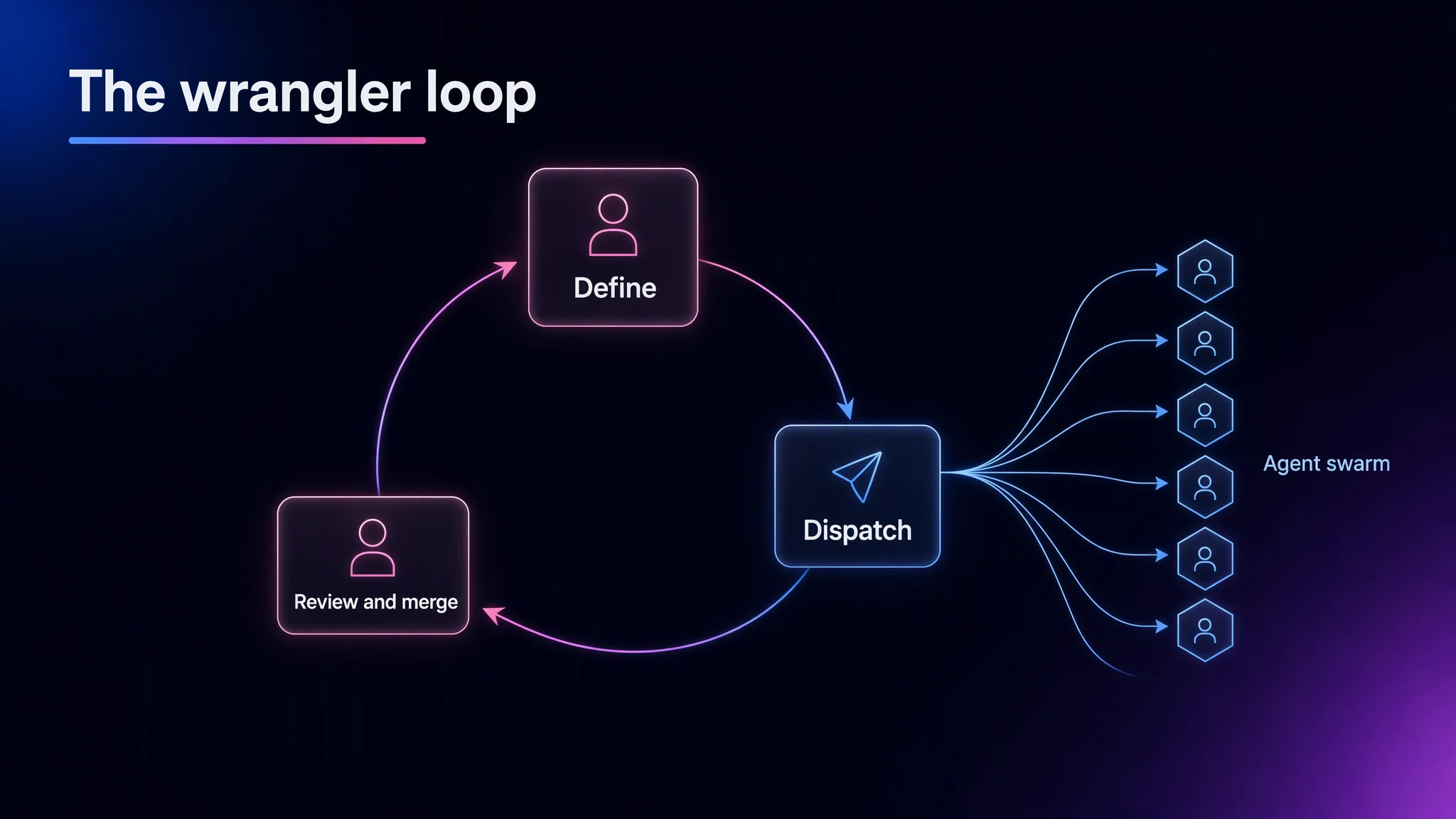
The wrangler loop: define, dispatch, review and merge, with a named human accountable. Source: The AI Delivery Factory, Chapter 14, Figure 14.1.
That is the gap. A firm can hold a perfect trail of what its agents did and still have no one who will stand in a room and answer for it. Equally, a firm with a named owner and no provenance cannot tell a human mistake from a machine mistake a human missed, and those need different fixes. You need both records, and you have to keep them apart on purpose.
Three stories, one blank
Three moments in the book show the blank from different angles. All three are composite scenes.
The agent wearing a person. One engineer ran a coding agent on his laptop, signed in as himself. He reviewed everything it wrote before committing it, and that was true and beside the point. The history now claimed he had typed lines he had not typed, and the agent could reach everything he could, approval rights included. He had broken no rule; the rules predated the question. By the end of the week the agent had its own identity and a line on the register, with him as its named owner.
The agent that belonged to nobody. A document classifier from a hackathon ran nightly under a hurried pipeline account. No access review ever listed it, because access reviews listed people. Two squads each said the other owned it, so it was switched off on a Friday evening. On Monday, a team discovered it had relied on those labels without knowing the classifier existed. An agent without an owner is an unowned dependency, and the people depending on it may not know they are.
The change nobody merged. The firm’s rule — whoever dispatched an agent’s change and merged it is its accountable owner — was a good rule, and it assumed a human merged. When a workflow dispatched the agent for a requester who never saw the change, and an automated gate merged it, the rule had nobody to point at. The owner field filled itself with the only thing it could name: auto-approved (routing gate). An owner field that names a mechanism is an empty field, written so that it does not look empty.
I want to be honest about the third one. The books settle that a mechanism is not an owner, and that a requester who dispatched nothing and merged nothing is not one either. They do not fully settle what an agent’s named owner owns when no engineer merges. The reference proposes an answer — the agent’s owner stays accountable, and gets a feed of every change their agent ships without a reviewer and a stop that works without asking the gate’s owner — but it is labelled as a proposal, because that is what it is.
Three records, not one
Pulling the stories together, a regulated firm running agents has to keep three things findable for every change:
- Provenance. Which agent, under which identity and version, produced this, from which instruction. The factory holds it: workload identity on the commit, the change record, the evidence pipeline.
- The accountable person for the change. A named human who can explain it in a meeting. Never the agent’s identity, never a service account, never a team mailbox.
- The accountable person for the agent. Its owner on the registry, with a deputy, named before it is built, who can suspend it and has actually tested that they can.
There is a fourth thing that sits underneath all three: the written limits the agent works within. In the book, when the supervisor’s evidence query reconstructed the incident, the record could show the limits the agent had worked within on the day. It could not show the limits that had never been written. The agent’s envelope sent changes to matching logic to a person and was silent about tolerances, because nobody had called a tolerance a control. Accountability without a declared boundary is a person standing behind something whose edges nobody drew.
A test you can run this week
Pick any change your firm shipped last week and ask four questions. Which team owns it? Which person signs for it? If an agent wrote it, which named person stands behind that agent? Where is the evidence?
In the composite, most squads could answer the first and the last. The middle two were where authorship had quietly taken accountability with it. My guess is that most firms will find the same shape, and I would rather they found it themselves than had it found for them.
Where this goes in the reference
Accountability holds the model: the two records side by side, four named accountabilities per product (business, technical, operational and control, with control the one most often blank), the dispatcher-and-merger rule and what the reviewer signs for, the seven named seats and the blank test you run against commit history rather than an organisation chart.
Agent lifecycle covers the owner of the agent itself: inventory, naming the wrangler, no owner, no agent, suspension rehearsed before go-live, and the two forms of autonomy creep that move an agent beyond what anyone approved.
Bounded agent covers the boundary the owner stands behind: Mandate, Means, Memory and Monitoring, enforced at the runtime, the gateway and in detection, so that an agent with no registered envelope is either a sandbox experiment or a breach.
Agents carry throughput. People carry accountability. The work is making sure the second is written down before the first arrives.